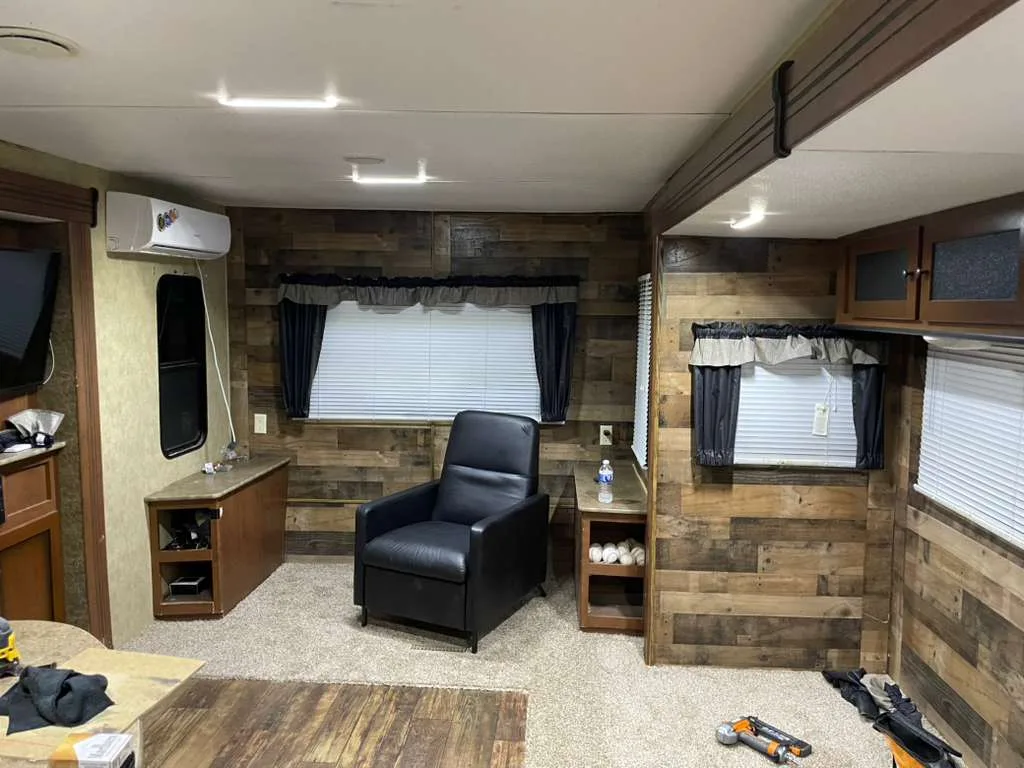
RV Water Damage Repair: How Bad Is It and How Fast to Act
RV water damage is a progression from a failed seal to rotted structure. Learn the stages, triage what you can see, then call 888-759-1438 in Florida.
RV water damage is a progression, not an event. A failed seal wets a cavity, a wet cavity feeds fungi, fungi soften the wood the coach is built from, and softened wood lets the bonded wall or floor come apart. Each stage costs more to reach because more of the coach has to be opened to get at it. The useful question is not what it looks like, but which stage it has reached.
What we handle in this category
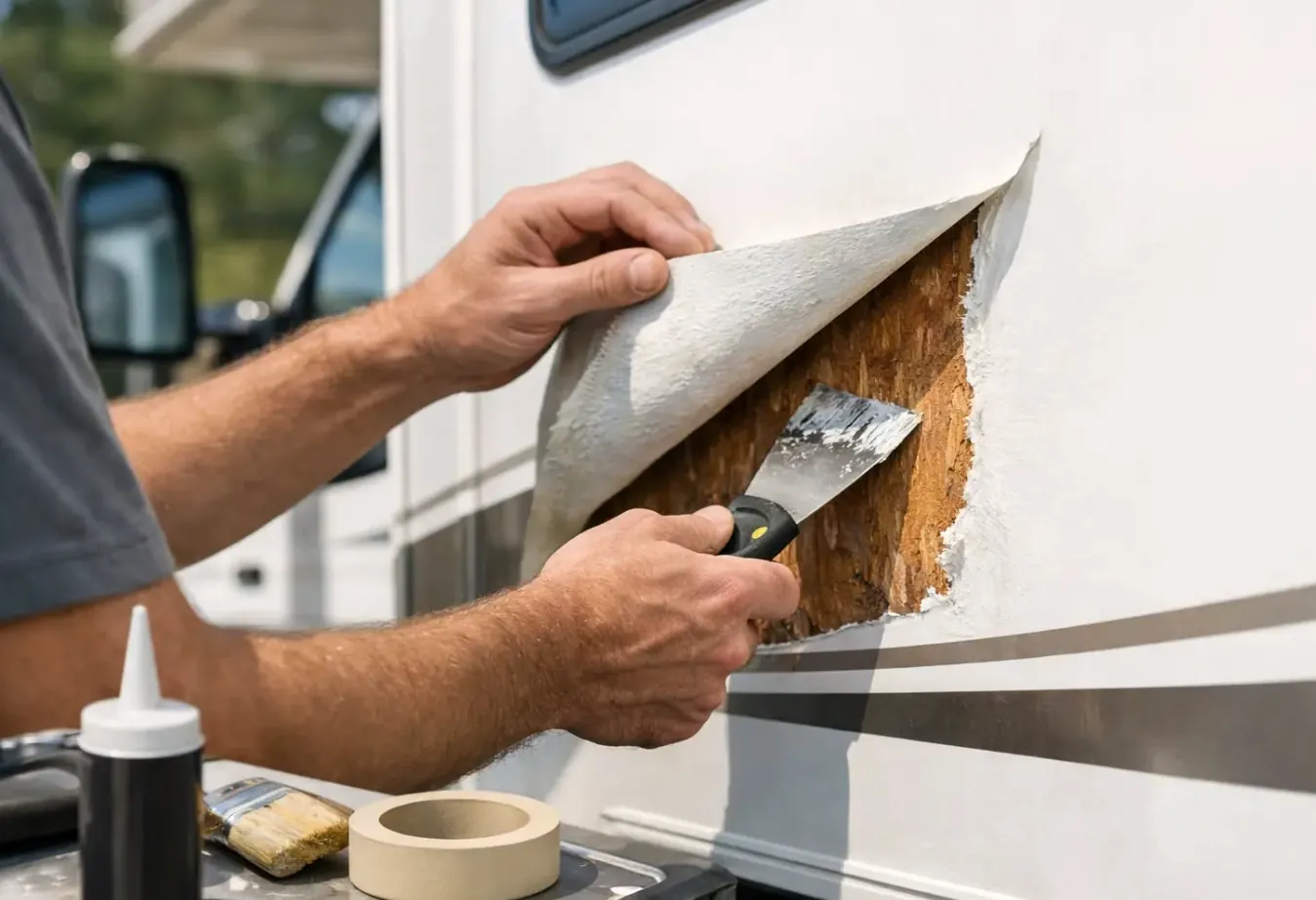
Sidewall delamination repair
See what this involves →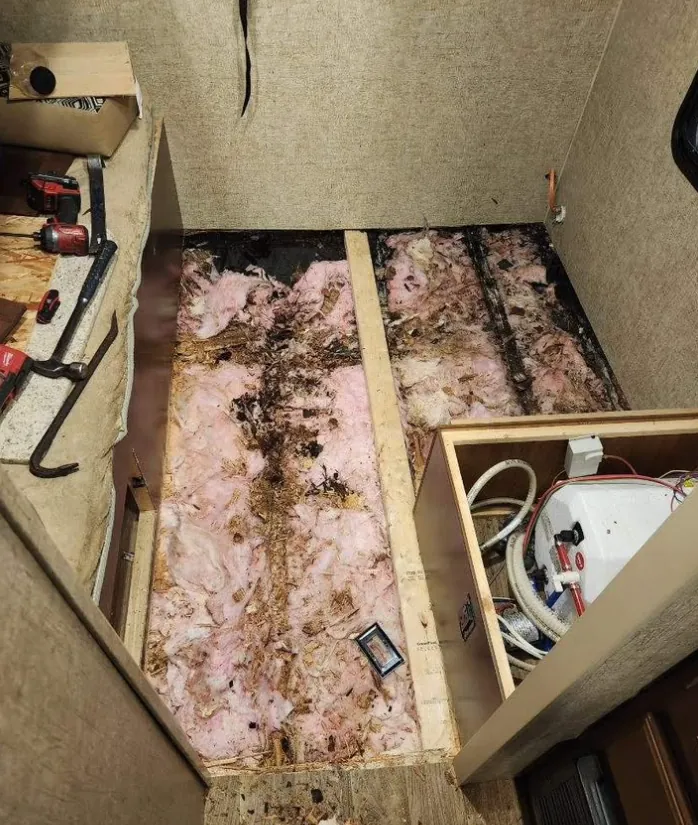
Subfloor replacement
See what this involves →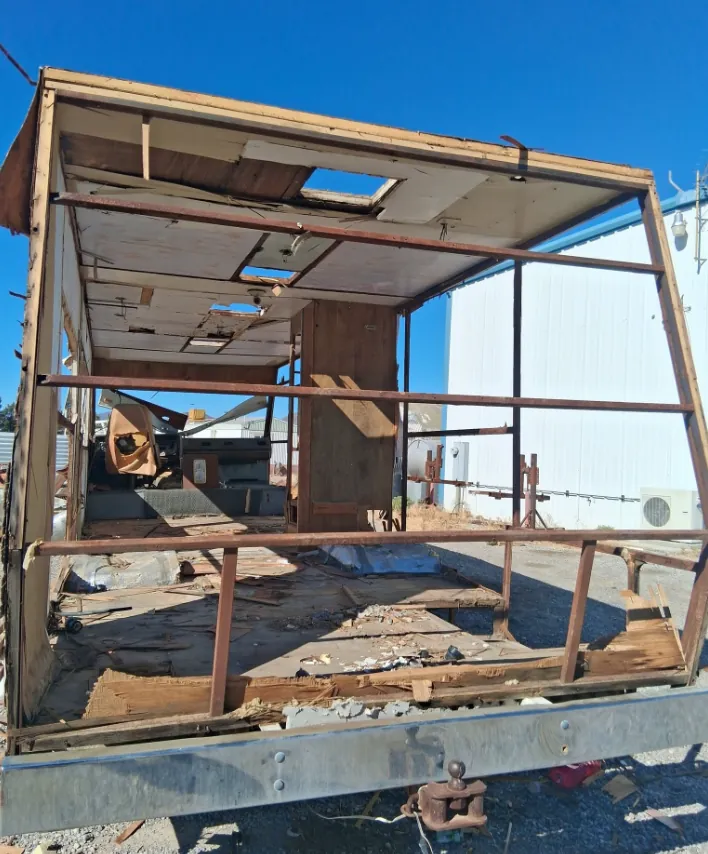
Wall framing and stud rot
See what this involves →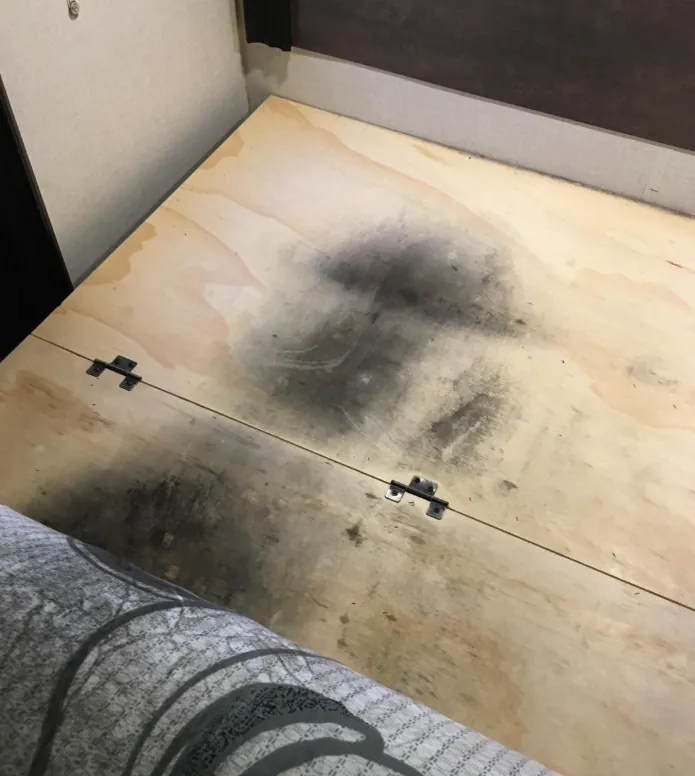
Mold remediation
See what this involves →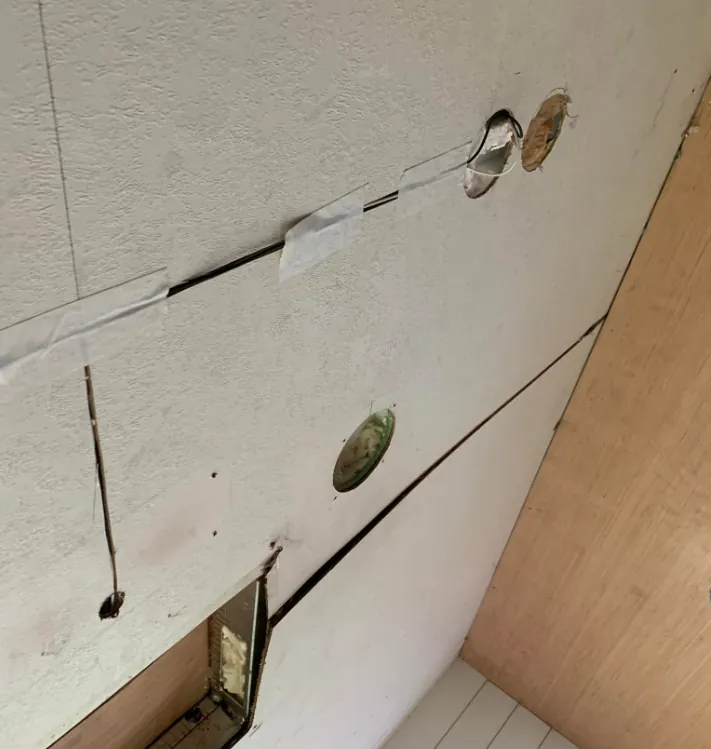
Ceiling panel replacement
See what this involves →The Four Stages RV Water Damage Moves Through
Water damage runs a predictable course, and each stage is defined by how much of the coach has to come apart to reach it. Stage one is an open path: a lap sealant bead gone chalky, butyl behind a window flange gone hard, a screw backed out of a marker light. Nothing is wet yet and the fix is measured in a tube of sealant. Stage two is a wet cavity, where water sits between layers that were never meant to be opened, and only a meter knows it is there. Stage three is fungal, and it has published limits: the Forest Products Laboratory places serious decay above the fiber saturation point, an average of 30 percent moisture content, and holds that wood kept at or under 20 percent will not decay at all. Stage four is mechanical. Softened wood stops holding fasteners and stops holding glue, so the bonded panel it belongs to loses its shape, and one trade becomes three.
Why the Stain Is Never Where the Water Got In
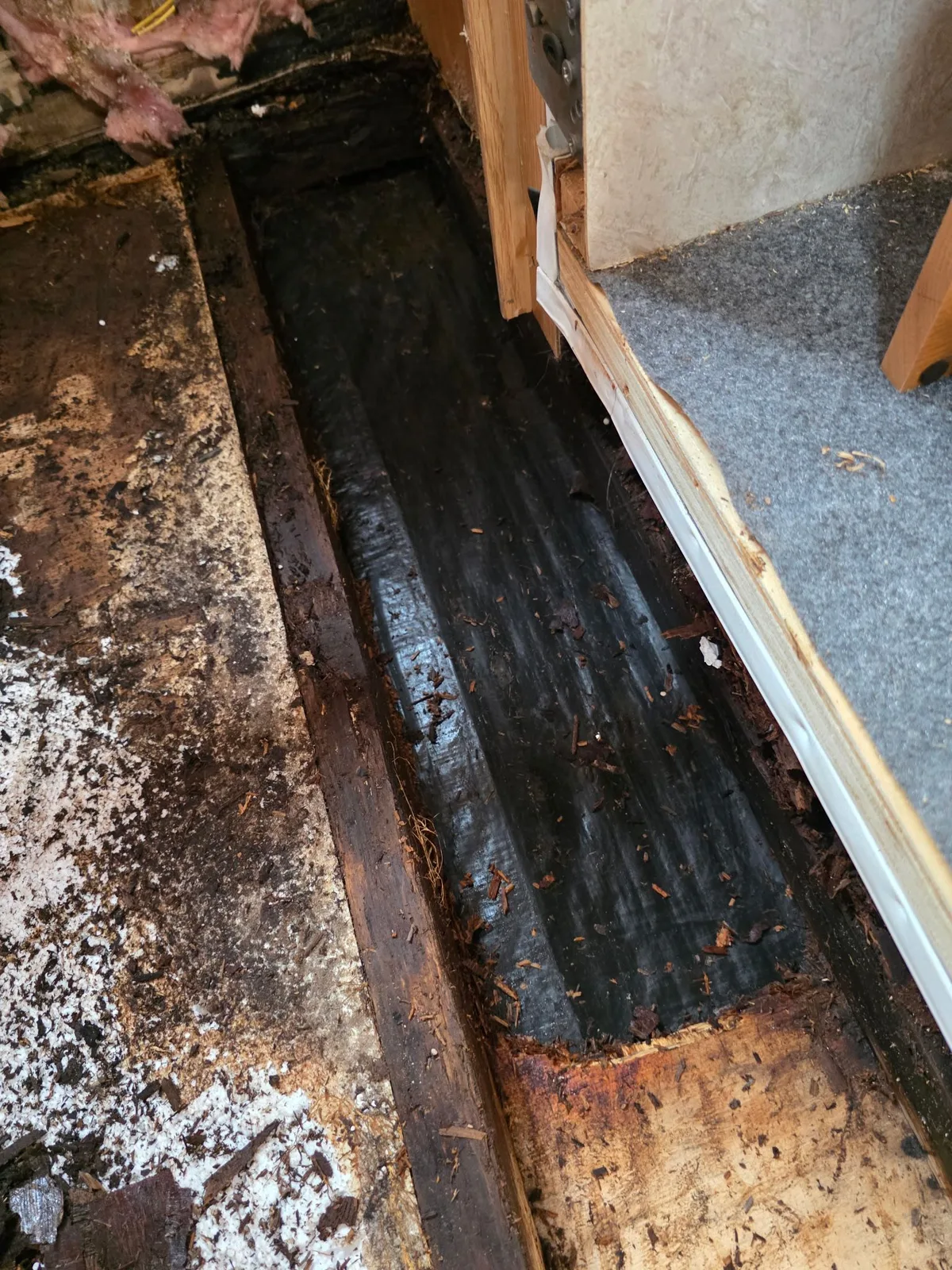
The most expensive assumption an owner makes is that the mark on the ceiling or the ripple in the wall sits under the hole. It does not. A coach is built as continuous framing with bonded skins over it, so water through a roof penetration or a window flange runs along the first member it meets and drops wherever the panel gives it an opening, often several feet away and on the far side of a vent. Resealing whatever sits nearest the stain is how one leak gets paid for twice. That is what an RV moisture and leak survey exists to prevent, and it is why diagnosis has to precede a repair quote rather than follow it. The survey works the coach downward, roof to upper sidewall to openings to belly, reading through finished surfaces rather than cutting them, with every value set against a dry area of that same coach. The deliverable is a boundary and a source, and scope is drawn from those two things.
Triage: Sorting What You Can Actually See
Symptoms sort into six patterns, and each points at a different scope. A brown ring overhead is roof-side water that has already crossed a truss bay, which is ceiling panel replacement territory. A floor that gives underfoot at a slide opening or the entry step is subfloor replacement, while the same sponginess inside the slide room itself is slide floor rot, a separate panel with its own failure path. A wall that ripples or bubbles in reflected light is sidewall delamination, meaning a glue line has released. A musty smell with nothing visible is the most urgent of the six, because it says a cavity is wet and closed. Black or green spotting on a panel face is a mold remediation question before it is a carpentry one. A window or slide that drips during rain is still at the seal stage, which is the only cheap one on the list. A door that must be lifted to latch is framing rather than trim.
Why Florida Water Damage Never Gets a Pause
Elsewhere a wet cavity gets a winter off. Here it does not. The Forest Products Laboratory puts decay fungi at their fastest between roughly 50 and 95 degrees Fahrenheit, essentially stopping only near 35 or above 100, and that is a band a closed Florida wall cavity sits inside on almost every day of the year. The same handbook records that in humid regions such as the Gulf States wood often will not air-dry fast enough to avoid losses from fungi, and publishes a climate index for decay hazard for exactly that reason. The seal side of the problem is measured too: Q-Lab runs the internationally recognized outdoor exposure benchmark in south Florida because it is the only true subtropical region in the continental United States, and reckons one year of Florida sunshine equal to several years of weathering elsewhere. Afternoon storms then test every termination the sun has already chalked, and Atlantic hurricane season holds from June 1 through November 30.
When an RV Is Worth Repairing, and When It Is Not
Some coaches are past economic repair, and saying so plainly is worth more than a quote. The line is not drawn by how bad a stain looks. It is drawn by how many assemblies are involved and whether the structure still does its job. One wet assembly is a repair almost regardless of age: a panel and a resealed vent, a section of deck, a bubble that maps small with dry edges. Two assemblies is a judgment call. Three at once, meaning roof or ceiling plus wall framing plus the deck that wall stands on, is a rebuild, and on an older trailer the labor alone can pass what the unit would sell for. The structural signals are specific: a beltline that bows, a roofline that dips over one bay, a slide that racks in its opening, a door that no longer latches square. When the finding reads that way, the deliverable is a written assessment to weigh against the coach's value.
Sources
Every figure on this page comes from a manufacturer document or a standards body, not from another repair site. Here is where each one comes from.
- USDA Forest Products Laboratory, Wood Handbook, Chapter 14: Biodeterioration of WoodVerified by extracting and reading the PDF text. Verbatim: 'Serious decay occurs only when the moisture content of the wood is above the fiber saturation point (average 30%).' 'Fully air-dried wood usually will have a moisture content not exceeding 20% and should provide a reasonable margin of safety against fungal damage. Thus, wood will not decay if it is kept air dry, and decay already present from prior infection will not progress.' 'By itself, the water vapor in humid air will not wet wood sufficiently to support significant decay, but it will permit development of some mold fungi.' 'decay is relatively slow at temperatures below 10 degrees C (50 degrees F) and above 35 degrees C (95 degrees F). Decay essentially ceases when the temperature drops as low as 2 degrees C (35 degrees F) or rises as high as 38 degrees C (100 degrees F).' 'In humid regions, such as the Gulf States, these products often do not air-dry fast enough to avoid losses from fungi.' 'They increase the absorbency of wood ... Increased porosity also makes wood more wettable, which can lead to subsequent colonization by typical wood-decay fungi.' Figure 14-1 is captioned 'Climate index for decay hazard. Higher numbers indicate greater decay hazard.'
- US EPA, A Brief Guide to Mold, Moisture and Your HomeVerified by reading the page. Verbatim: 'If wet or damp materials or areas are dried 24-48 hours after a leak or spill happens, in most cases mold will not grow.' 'The key to mold control is moisture control.' 'If possible, keep indoor humidity below 60 percent (ideally between 30 and 50 percent) relative humidity.' That is the published basis for the 24 to 48 hour action window used in the first FAQ.
- Q-Lab Weathering Research Service, Florida natural outdoor exposure testingVerified by reading the page. Verbatim: 'Florida is the internationally-recognized benchmark location for outdoor exposure testing.' 'One year of Florida sunshine can equate to several years of weathering elsewhere.' The site is described as located in 'the only true subtropical region in the continental United States', with 'high-intensity sunlight, high year-round temperatures, high annual rainfall, and high humidity', and the synergistic effect of UV, moisture and heat named as what makes south Florida the test location for outdoor durability. That supports the claim that Florida is a measured worst case for sealant and laminate exposure rather than a figure of speech.
- NOAA National Hurricane Center, tropical cyclone climatologyVerified by reading the page. The Atlantic hurricane season runs June 1 to November 30, the 1991-2020 average season produces 14 named storms, 7 hurricanes and 3 major hurricanes, and the peak of the season is September 10 with most activity between mid-August and mid-October. Supports the statement that the storm loading period covers half the calendar year.
Related systems
Where we work
What this usually costs
| Item | Price | What it covers |
|---|---|---|
| Service call | $299 | Includes the trip out to your RV and the first hour on site |
| Work past the first hour | Quoted after diagnosis | We tell you what it will take before we carry on |
| Parts | Quoted per job | Special-order parts may need a deposit before we order them |
| Written estimate | No charge | You approve the estimate before any work starts |
The service call covers the trip out to your RV and the first hour on site. Anything beyond that depends on what we find, and we quote it and get your approval before carrying on.
The price ranges on this page come from our own recent jobs across Florida, not from an industry average. What you pay depends on the rig, the parts it needs and what we find on site, so we give you a written estimate before any work begins and you approve it first.
Frequently asked questions
How fast do I have to act on an RV water leak?
The EPA puts the window at 24 to 48 hours: dry wet or damp materials inside it and in most cases mold will not grow. An RV cavity is the hard version of that test, because the wet layer sits behind a bonded panel where nothing evaporates and no air moves. Past that window the question stops being whether something is growing and becomes how far it has spread, which is a survey rather than a wipe-down.
There is a musty smell but nothing visible. Is that bad?
It is the pattern worth acting on quickest. The Forest Products Laboratory notes that humid air by itself will not wet wood enough to support significant decay, but will permit mold fungi, so a smell with no stain says a closed cavity is holding moisture rather than that a panel got splashed. Those same fungi raise the absorbency of the wood, which makes it wetter the next time water reaches it. Early is the cheapest place to be.
Which water damage repair do I actually need?
That is set by where the water stopped, not by where it shows. Readings that fall away inside the wall point to sidewall delamination. Readings that stay high at the floor line with flex underfoot point to subfloor replacement, or to slide floor rot when they stop at the room's edge. A stain overhead above a dry wall is ceiling panel work. Spotting on a panel face with a wet cavity behind it is a mold scope. A door out of square is framing.
Can RV water damage be repaired without opening the wall or floor?
Diagnosis, yes. Repair, rarely. A survey reads through finished surfaces, so locating the wet zone and its entry point costs no panels. The repair is the opposite, because RV walls and decks are bonded sandwiches rather than fastened layers, so reaching a wet core means separating something a factory glued together. Anyone offering a lasting fix that touches only the visible surface is selling the appearance of a repair rather than the repair.