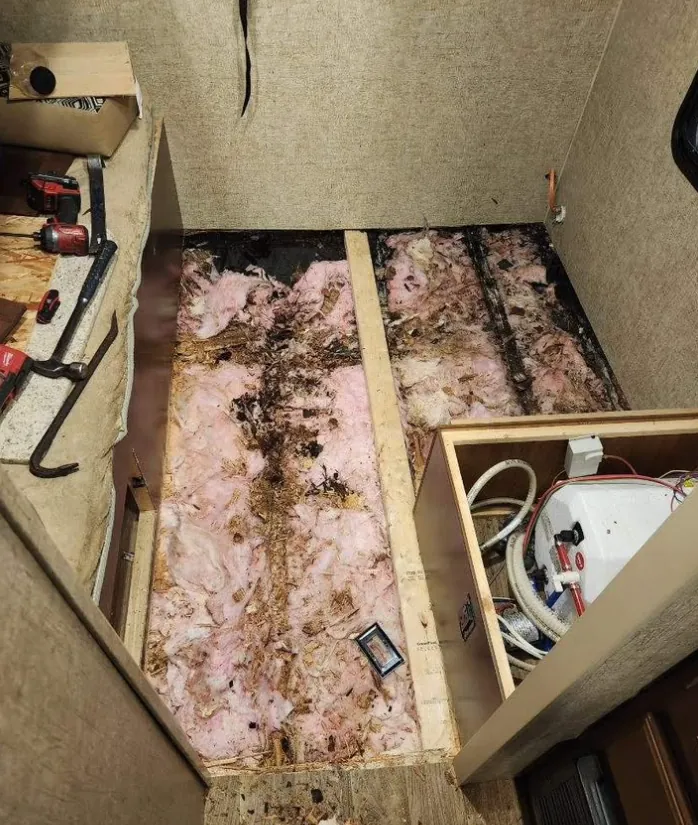
RV Subfloor Replacement - Soft Spots at Slides and Doors
A soft floor at the slide opening or entry door means the plywood deck is rotting. Mobile RV subfloor replacement across Florida. Call 888-759-1438.
An RV subfloor is the structural deck the coach stands on: a bonded sandwich of plywood, foam or tube framing and a thin lauan skin, fastened to the frame rails. Replacing it means cutting the failed section out to sound, dry wood and rebuilding to the original thickness. The finished flooring comes up first, and where the damage runs under a slide opening the slide room usually has to come out too.
What an RV Subfloor Is, and Why It Is Not a House Floor
The subfloor is the structural deck of the coach, a bonded panel rather than a stack of loose layers. A laminated RV floor is typically 5/8 or 3/4 inch plywood on top, a core of block foam with aluminum tube framing let into it, and a 1/8 inch lauan sheet closing the underside, pressed together with adhesive so the panel carries load like a beam. That panel is then fastened to the steel or aluminum frame rails and closed in from below by a coroplast underbelly. Plumbing runs, wiring and holding tanks live in the space between. A house floor spans joists, so any square foot can be cut out and sistered back. A laminated deck gets its stiffness from the glue line between plywood and lauan, so once water breaks that bond the panel loses strength across an area wider than the wet wood itself. This work is section replacement back to sound bonded panel, not a patch.
Why Soft Spots Start at the Slide Opening and the Entry Door
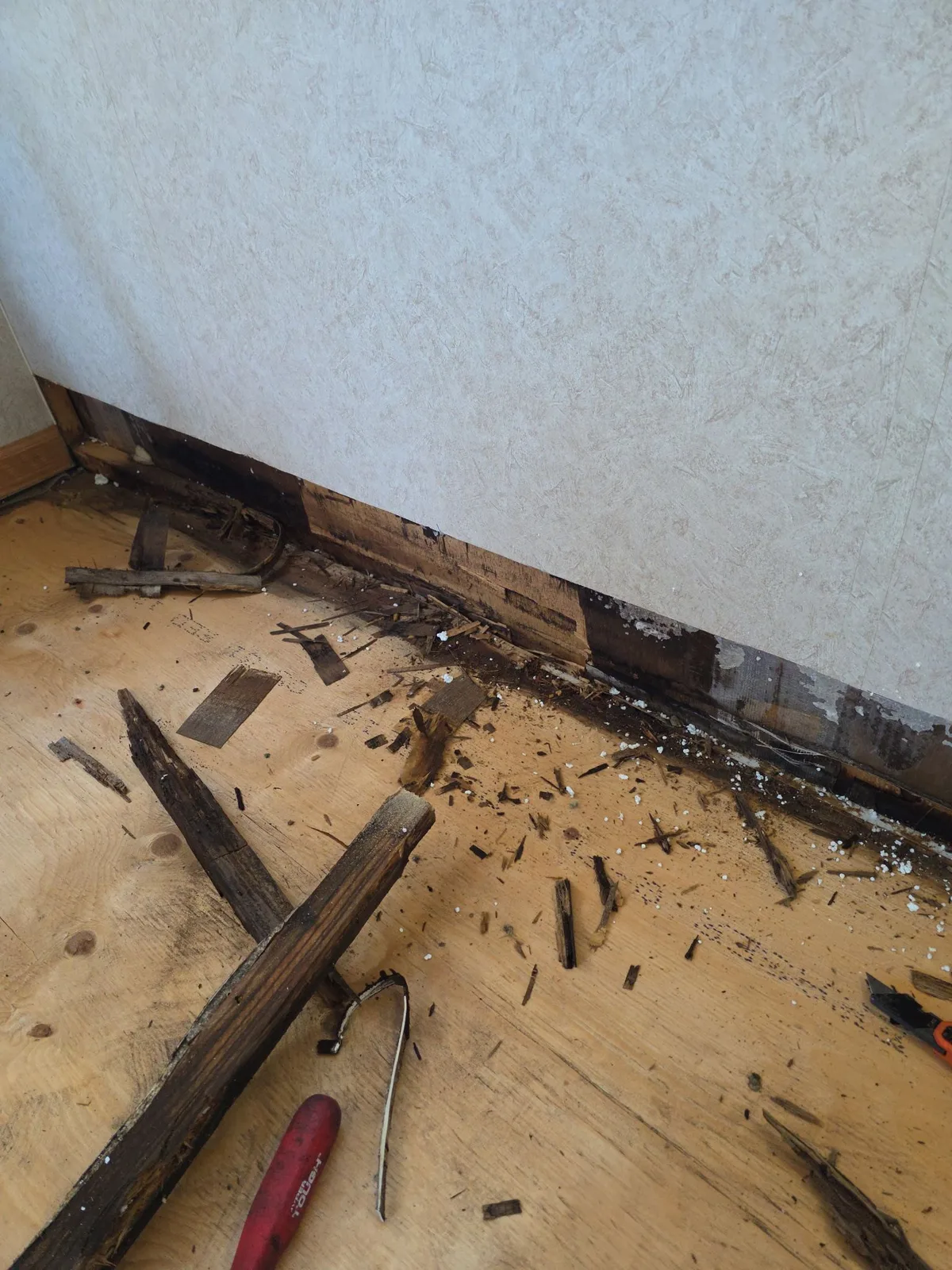
Soft spots are not random, and the two classic locations repeat on almost every coach. The slide opening and the entry door are the largest holes cut through the deck and sidewall, and each cut leaves raw plywood end grain that was never sealed at the factory. End grain wicks. Water reaching a cut edge travels along the plies instead of beading off, which is why a floor usually goes soft in a band running parallel to the slide rail rather than in a circle around a drip. At Florida latitude the pressure on those two openings is ultraviolet. UV hardens the slide wiper and bulb seals and chalks the sealant bead around the door frame long before either looks failed from the ground, and a stiff wiper stops sweeping the roof of the slide room clean. Water then runs down the inside face of the opening onto the exposed edge of the deck. Wind-driven rain does the same at the door threshold.
How Our Technicians Map a Soft Subfloor, In Order
Mapping happens before anyone quotes, and it runs in a fixed sequence. It starts with the symptom as the owner describes it: the floor is walked and loaded along the slide rail, the door threshold and cabinet perimeter, listening for the dull note a delaminated panel returns instead of a sharp one. A probe awl goes through an existing screw hole wherever that note changes. Next the slide is cycled while the wiper contact and the room roof are watched for standing water and a seal that has stopped sweeping. Finding the source before the deck is opened keeps the same repair from happening twice. Then comes moisture, read with a pin meter such as a Delmhorst BD-2100 fitted with a 26-ED/CM hammer electrode, whose Teflon insulated pins contact wood only at their tips and drive 1-1/8 inches into the deck. Last, the coroplast is dropped at the suspect bay so the lauan face can be read from below.
How Far the Rot Goes Versus How Far It Feels Soft
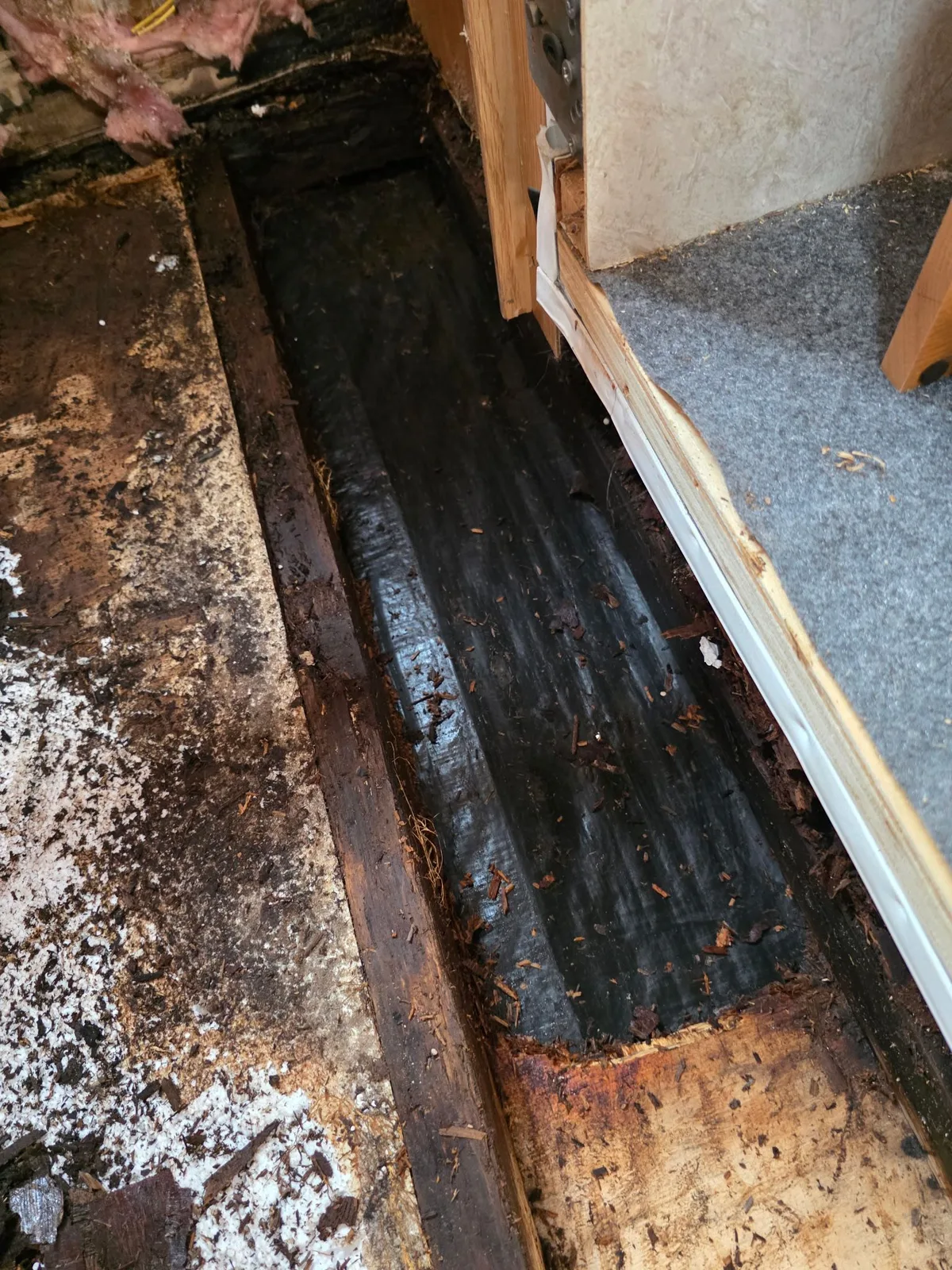
The soft area and the damaged area are never the same size, and the soft area is always the smaller of the two. Wood needs sustained moisture to decay, and the thresholds are published: the Forest Products Laboratory puts serious decay above the fiber saturation point, an average of 30 percent moisture content, and states that wood held at or under 20 percent will not decay and that decay already present stops progressing once it dries. APA gives a matching number for engineered wood panels, with vulnerability beginning past 19 percent. Those figures are what the cut line should follow, not the edge of the mushy patch. A floor only feels soft where the plywood has already lost enough fiber to flex underfoot. The surrounding zone still sitting above 20 percent is firm, quiet and actively rotting. Cut to the edge of the soft area and wet, infected plywood gets glued to the new panel, and the seam fails again within a season or two.
Why a Subfloor Cannot Be Patched From Above
The deck is underneath everything, so an honest scope starts with what comes off it first. The finished floor has to lift before the deck can be cut, which makes the vinyl plank or laminate a separate job with its own line item. Where the rot runs under a slide opening, the room itself usually has to be pulled or supported and hung, because it sits on the exact section of deck being removed and its rails, rollers and drive assembly fasten through or beside it. Lippert publishes separate installation and service documentation for above floor slide-out systems: the room is an aligned assembly, not trim that lifts off. The cutting is done with a plunge saw set to the exact deck thickness so the blade stops above the frame rail and the wiring, plus an oscillating multi-tool for corners the saw cannot reach. Going in from below is no shortcut, because the underbelly, insulation and plumbing are in the way.
What It Costs to Find Out, and What It Becomes If You Wait
Nobody can price a subfloor over the phone, and a fixed number quoted sight unseen is a guess that gets revised the moment the flooring comes up. What can be quoted is the visit. What the mapping finds sets everything after it. A hardened wiper or a failed threshold caught before the deck wets through is a seal job. A panel reading wet but still firm may only need the source fixed and the bay opened and dried rather than cut. Left alone, the same water reaches the wall studs behind the opening and then the sidewall skin, and delamination and framing rot join the invoice. That is the point where the repair can outrun what the coach is worth.
That is why the first thing worth buying here is a survey rather than a repair. Knowing the boundary of the wet area decides whether this is a section of floor or a decision about the coach.
Sources
Every figure on this page comes from a manufacturer document or a standards body, not from another repair site. Here is where each one comes from.
- USDA Forest Products Laboratory, Wood Handbook Chapter 14: Biodeterioration of WoodThe moisture thresholds the cut line is set by: serious decay occurs only above the fiber saturation point, an average of 30 percent moisture content, and wood held at or under 20 percent will not decay while decay already present stops progressing once it dries.
- APA - The Engineered Wood Association, Moisture MitigationThat engineered wood panels such as a plywood deck become vulnerable to decay and structural deterioration once moisture content exceeds 19 percent, with mold growth past 20 percent.
- Delmhorst Instrument Co., 26-ED/CM hammer electrodeThe tool and the measurement: Teflon insulated pins that contact wood only at their uninsulated tips and penetrate 1-1/8 inches, which is how a reading is taken at the lauan glue line rather than at the surface.
- Lippert Customer Care, Power Gear above floor slide-out system documentationThat an above floor slide-out room is a separately documented, separately serviced assembly with its own installation and service manuals, which is why deck work under a slide opening is a slide job as well as a floor job.
Related repairs
- our Wall Stud Rot Repair service
- Rv Mold Remediation in Florida
- how we handle rv ceiling panel replacement
Other systems we service
Where we work
Service category
What this usually costs
| Item | Price | What it covers |
|---|---|---|
| Service call | $299 | Includes the trip out to your RV and the first hour on site |
| Work past the first hour | Quoted after diagnosis | We tell you what it will take before we carry on |
| Parts | Quoted per job | Special-order parts may need a deposit before we order them |
| Written estimate | No charge | You approve the estimate before any work starts |
The service call covers the trip out to your RV and the first hour on site. Anything beyond that depends on what we find, and we quote it and get your approval before carrying on.
The price ranges on this page come from our own recent jobs across Florida, not from an industry average. What you pay depends on the rig, the parts it needs and what we find on site, so we give you a written estimate before any work begins and you approve it first.
Frequently asked questions
Did the subflooring get damaged?
That gets answered with a meter, not by eye. A shallow reading on the top face of the deck can look fine while the same point reads past 30 percent at full pin depth, because the water sits at the glue line between the plywood and the lauan skin. Every test point therefore gets two readings, a shallow one and a full-depth one, and the deep number decides whether the deck is damaged or only damp.
Is it a floor leak?
Usually the floor is where the water lands, not where it starts. Water at the slide opening almost always enters at a hardened wiper or bulb seal above it, and water at the entry door usually enters at the frame sealant or the threshold. The deck is simply the lowest horizontal surface with an exposed cut edge, so it collects whatever the opening lets past. The source gets found before any deck is cut.
Can you help with water leaking into the underbelly?
Yes, and it is worth taking seriously, because water showing in the coroplast means it has already crossed the deck. The underbelly gets dropped at the suspect bay so the lauan face can be read from below for staining, sag and moisture. Water pooling there can also come from a plumbing fitting or a tank connection rather than from the roof, so the source is confirmed before anything structural is quoted.
Can you replace just the soft part of the floor?
Not to the edge of the soft area, no. The cut line is set by moisture readings, so it runs out past the flexing wood to where the deck reads under 20 percent at full pin depth, and it is squared to the frame members underneath so the new section has something to land on. Sectional replacement is normal and correct. Cutting to the mushy edge is what makes a repair fail at the new seam.
Do you have to take the slide out to fix the floor under it?
Usually yes, either removed outright or supported and hung clear. The room rests on or over the same deck section being cut, and its rails, rollers and drive hardware fasten through that area, so the deck cannot be lifted around it. That is the step that turns a floor repair into a multi-day job, and it is why a quote that ignores the slide is not a real quote.
How long does RV subfloor replacement take?
The mapping visit itself is short, usually a couple of hours. Beyond that the honest answer is that the extent is unknowable until the flooring is up and the deck is open, because the wet zone always reaches further than the soft zone. A single section beside a slide opening is a multi-day job once the room has to come out, and a floor gone soft from the door through to the slide runs longer.