RV Wall Stud Rot Repair - Structural Framing, Not the Skin
Rotted or corroded RV wall studs are structural work, not cosmetic. Mobile framing diagnosis and rebuild across Florida. Call 888-759-1438 to book.
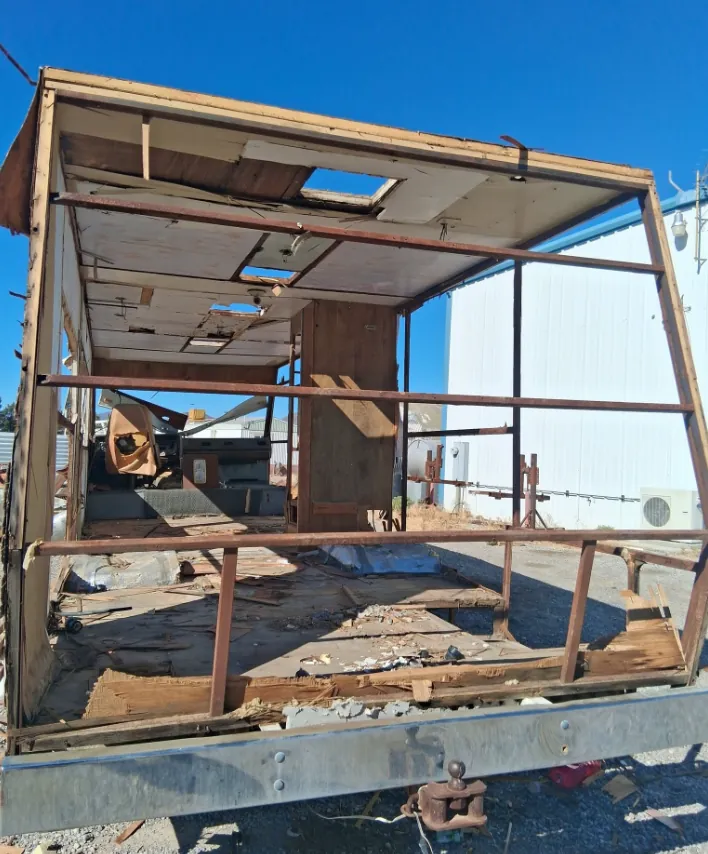
RV wall stud rot repair rebuilds the framing inside the wall rather than the skin over it: the wood or aluminum members that carry roof load and hold the window openings square. The fork is repair or write-off, and one question settles it, which is whether the wall still carries load.
Why a Rotted RV Wall Stud Is Not Swapped Like a House Stud
An RV sidewall is a bonded sandwich, not a framed cavity with sheathing screwed over it. Jayco's StrongholdVBL page gives its own layer stack plainly: a welded aluminum tubing frame, high-density block foam, electro-galvanized steel backer at the anchor points, an interior decorative panel and a one-piece fiberglass exterior, pressed together for a minimum of 16 minutes under 144 tons of pressure. Every layer in that stack carries load through the glue line. The framing is not a skeleton the panels hang from, it is one flange of a composite panel whose other flange is the exterior skin. Take a stud out and the material either side of it loses the member it was bonded to. That is why this repair opens the laminate. There is no route to a rotted member that does not separate the skin, and no way to put a driveway repair back under 144 tons. The rebuild re-anchors mechanically and re-bonds under clamp pressure instead.
Aluminum Framing Versus Wood Framing, and How Each One Fails
Wood-framed walls use slender stapled studs, roughly 1 inch by 1-1/2 inch, and what they lose first is not stiffness but grip. The USDA Forest Products Laboratory Wood Handbook gives fastener withdrawal load as a function of the wood's specific gravity, penetration depth and fastener diameter, and directs that wood which stays continuously damp be designed at two-thirds of the tabulated values. A stud can look whole and still hold nothing. Aluminum tube framing does not rot, so owners assume it is immune. It corrodes instead, and fastest where a steel screw passes through it with salt-laden condensate for an electrolyte. The Aluminum Association is explicit on two counts: steel in contact with aluminum must be coated where the joint sees moisture, and steel fasteners with a minimum tensile strength above 120 ksi, A490 and SAE J429 Grade 8 among them, are not to be used against aluminum at all, because they can crack from hydrogen-assisted stress corrosion. On a coastal Florida coach both mechanisms eat the tube around the hole.
Where RV Wall Studs Rot First: Windows, Roof Joint, Shower
Three locations account for most rotted framing, and each leaves a different signature. Window openings come first, because the flange screws land in the jamb studs and the butyl tape behind the flange is the only barrier between weather and end grain. The roof-to-wall joint is second. Water that gets past the corner molding runs down the inside face of the exterior skin and soaks the top plate plus the upper third of every stud it passes, which is why a stain appears at the ceiling line long before the wall feels soft anywhere. Behind the shower is third, and it is the one nobody looks for, because the water is not coming from outside at all. A weeping shower surround seam or a supply fitting inside the wet wall keeps framing damp around the clock rather than in wetting and drying cycles. Damage there is normally further along than anything visible suggests.
How Our Technicians Check the Framing, In Order
Owners describe this as a system failure rather than a part: a window that fogs and will not stay square, a door that has to be lifted to latch, a soft patch beside the shower. The inspection runs in a fixed order so nothing gets opened that does not need opening. First is the exterior fastener test. Every window flange screw and beltline trim screw takes a light turn from a torque screwdriver, and any screw that spins without drawing up has lost the wood or the aluminum it was threaded into. Second is the interior geometry check: the window opening measured corner to corner both ways, and the entry door reveal compared top and bottom. Third is a pinless moisture meter sweep across the interior panel. Fourth, and only when the first three agree, a 3/8 inch borescope port goes in behind removable trim so the member itself can be seen before a wall is quoted.
Is the Wall Still Carrying Load? The Question That Decides Repair
This is the honest fork, and the size of the stain does not answer it. A sidewall is still doing its job while the roofline over the affected bay stays straight, the window opening measures the same on both diagonals, and the entry door latches without being lifted. When two or more adjacent full-height studs and the header over an opening are gone together, the wall has stopped transferring roof load down to the floor and is hanging on its exterior skin. That announces itself as a bowed beltline, a dip in the roofline, or a slide room that begins racking in its opening. At that point the work is a wall rebuild rather than a stud repair, and on an older coach the estimate can pass what the unit is worth. Saying so plainly is part of the job. A written structural finding is worth more to an owner than a repair that never pencils out.
What It Costs to Find Out, and What It Becomes If You Wait
There is no honest fixed price for a wall nobody has opened yet. What the damage becomes is the part worth understanding. One wet jamb stud at a window is a contained framing repair and a re-bond. Left through a wet season, the same seal takes the header, then the top plate at the roof-to-wall joint, then the bottom rail and the deck the wall sits on. By then the job crosses framing, laminate and flooring at once and the coach is out of service for weeks. The cheap version of this repair is the one bought while the damage still measures in inches.
The cost is driven by how far the water traveled rather than by how much wall comes off, which is why an early moisture survey is the cheapest thing an owner can buy on this page. Finding it at one stud is a day. Finding it at four is a rebuild.
Sources
Every figure on this page comes from a manufacturer document or a standards body, not from another repair site. Here is where each one comes from.
- Jayco - StrongholdVBL aluminum-framed vacuum bond laminationOEM description of the laminated RV sidewall as a bonded layer stack: welded aluminum tubing frame, high-density block foam, electro-galvanized steel anchor backing, interior panel and one-piece fiberglass exterior, bonded a minimum of 16 minutes under 144 tons of pressure.
- The Aluminum Association - Aluminum Structures FAQ (Aluminum Design Manual M.7 and A.4.5)Galvanic corrosion of aluminum in contact with dissimilar metals, and the rule that steel fasteners above 120 ksi tensile strength such as A490 and SAE J429 Grade 8 are not to be used in contact with aluminum.
- USDA Forest Products Laboratory - Wood Handbook, Chapter 8: FasteningsFastener withdrawal load as a function of wood specific gravity, penetration depth and fastener diameter, and the instruction to use two-thirds of tabulated values where wood remains continuously damp.
Related repairs
- Rv Mold Remediation in Florida
- how we handle rv ceiling panel replacement
- Sidewall Delamination Repair repairs
Other systems we service
Where we work
Service category
What this usually costs
| Item | Price | What it covers |
|---|---|---|
| Service call | $299 | Includes the trip out to your RV and the first hour on site |
| Work past the first hour | Quoted after diagnosis | We tell you what it will take before we carry on |
| Parts | Quoted per job | Special-order parts may need a deposit before we order them |
| Written estimate | No charge | You approve the estimate before any work starts |
The service call covers the trip out to your RV and the first hour on site. Anything beyond that depends on what we find, and we quote it and get your approval before carrying on.
The price ranges on this page come from our own recent jobs across Florida, not from an industry average. What you pay depends on the rig, the parts it needs and what we find on site, so we give you a written estimate before any work begins and you approve it first.
Frequently asked questions
What is the leak that rots RV wall studs?
Almost always a seal rather than a crack. The butyl tape behind a window flange, the sealant over the roof-to-wall corner molding, and the seam at a shower surround are the three sources that put water straight onto framing. None of them leak visibly at first, because the water tracks down the inside face of the exterior skin and reaches the interior panel well below where it got in. Finding the seal comes before any framing quote.
Can one rotten stud be replaced without opening the whole wall?
One stud, yes, when the damage is contained and the surrounding bond is still sound. What cannot be avoided is opening the laminate, because the framing is bonded to both panels rather than screwed to them. Access is usually taken through the exterior skin so the interior finish survives, and the new member is re-anchored and re-bonded under clamp pressure. The scope of the repair is set by the bond line, not by the stud count.
How do I tell whether my RV has wood or aluminum wall framing?
Back out one exterior screw at the beltline trim and look at what came up on the threads. Pale fibrous material means wood framing, bright metal swarf means aluminum tube. A rare-earth magnet is the second check: it will find the electro-galvanized steel backer plates that laminated walls use at anchor points, but it will not stick to the aluminum tube itself. Brochures and the VIN plate rarely state framing type.
Is an RV with rotted wall studs safe to tow?
That depends on whether the wall is still carrying load. A localized wet stud beside a window is a repair, not a road hazard. A bowed beltline, a dip in the roofline over one bay, or a door that must be lifted to latch means the wall has stopped transferring load, and the coach should then be moved as short a distance as possible. Highway speed loads a sidewall far harder than standing in a site does.
When is a rotted RV wall not worth repairing?
When the framing failure has reached the roof-to-wall joint and the floor at the same time. That is a rebuild of three assemblies rather than a wall repair, and the labor alone can exceed the value of an older coach. Our technicians write up what was found and what a rebuild would involve, so the number can be weighed against the unit's value before anything gets opened up.