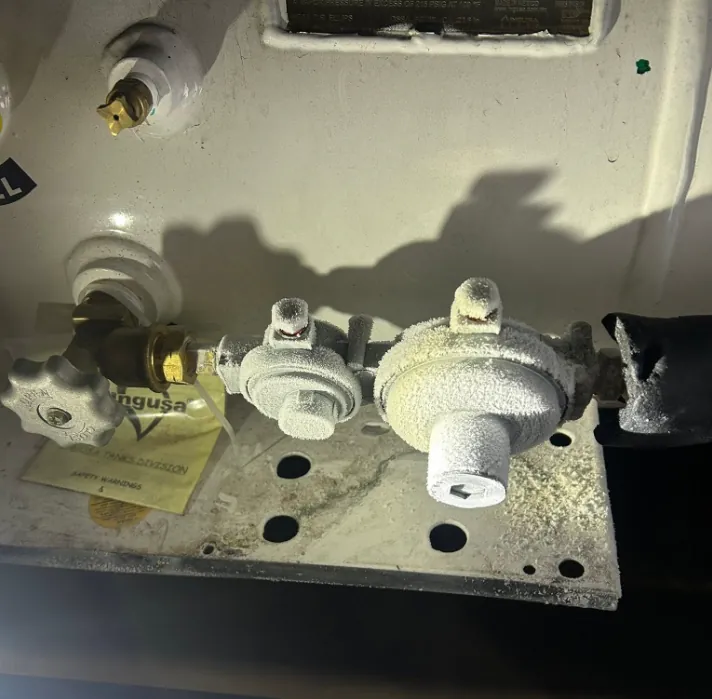
RV Propane Tank Valve and OPD Replacement Across Florida
Tank will not fill or the OPD has stuck? Mobile RV propane tank valve and OPD service plus requalification date checks, statewide. Call 888-759-1438.
Leave a sticking OPD and the tank first stops taking a full fill, then stops taking any fill, and the furnace, water heater and absorption fridge go out together. The OPD is the float inside a propane cylinder's service valve that halts filling near 80 percent, identified by its three lobe handwheel and Type 1 ACME outlet. Refusals also come from an expired requalification date or an obsolete POL only valve.
Why a Tank That Looks Fine Gets Turned Away at the Filling Station
A refusal has three ordinary causes, and only one of them means the cylinder is finished. The first is an overfill prevention device whose float has stuck, so the pump either cuts off at a quarter full or the attendant never gets a seal at the outlet. The second is a requalification date on the collar that has run out. 49 CFR 180.205 states that no cylinder may be filled and offered for transportation unless it has been successfully requalified and marked. The third is an obsolete valve. A bottle still wearing a plain round or five point star handwheel and a POL only outlet has no OPD at all, and most attendants will not touch it. None of the three repairs itself. What it becomes is a coach with no heat, no hot water and a warm fridge on the same weekend, and the food spoils long before the propane gets sorted.
DOT Cylinders and ASME Motorhome Tanks Are Not Governed the Same Way
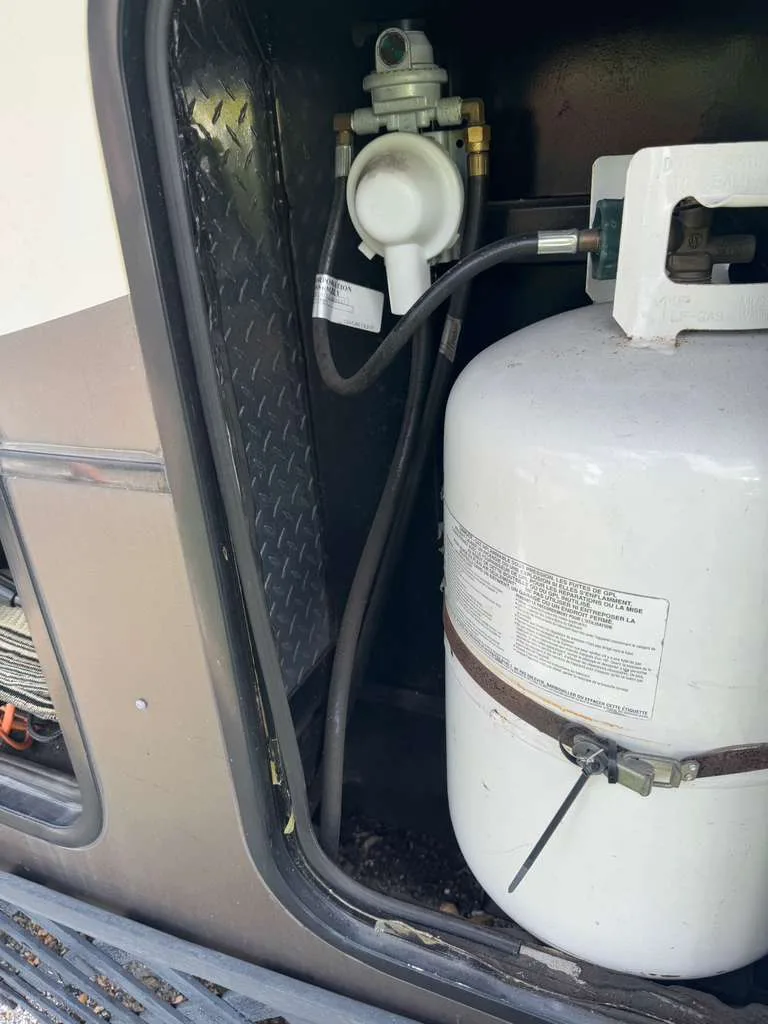
This is the most confused point on the subject, and the split runs by rig type. A travel trailer or fifth wheel carries removable DOT cylinders, typically a pair of 20 or 30 pound bottles stamped 4BA240, in a rack on the A frame. A Class A, B or C motorhome carries an ASME tank bolted to the chassis and filled where it sits. The federal requalification rule is 49 CFR 180.205, and it applies to each cylinder bearing a DOT, CRC, BTC or CTC specification marking. An ASME tank carries an ASME Boiler and Pressure Vessel Code stamp instead, so no federal requalification interval attaches to it and it has no expiry date. What governs it in service is state law, administered here by the Florida Department of Agriculture and Consumer Services under Rule 5J-20.002. The tank does not expire. Its valve, gauge and relief still fail, and on a motorhome they are the parts that strand you.
Reading the Collar: the Date, the RIN and the Letter Beside It
Every requalification is stamped into the collar or shoulder of a cylinder, never the sidewall. 49 CFR 180.213 fixes the format: the month, the four character requalifier identification number set in a square pattern, the year, and then a symbol saying which test was performed. That last symbol is the part almost nobody reads, and it decides how long the stamp is good for. A blank symbol is the volumetric expansion test, which under 180.209(e) buys 12 years on a coated cylinder in propane service. The letter E is the five year external visual inspection under 180.209(g), and the letter S means a proof pressure test, which has to repeat every 10 years once that first 12 year period expires. So two bottles stamped in the same month can fall due five years apart. Read the letter before assuming a decade is left on the tank.
Inside the Valve: the Float, the Dip Tube and the Type 1 Outlet
The overfill prevention device is a float on an arm inside the service valve body. As liquid rises past roughly 80 percent of container volume the float lifts and closes a check, and the filler stops taking gas. Cavagna's Type 1 ACME cylinder valve with OPD, outlet family CGA 791, is built for DOT cylinders up to 40 pounds of propane, or 96 pounds water capacity. Cavagna catalogs the same valve as parts 82.9.890.8017, 80.B.890.8002 and 80.B.890.8001, differing in dip tube length at 4.0, 4.7 and 6.4 inches, because the tube is matched to the cylinder it screws into. The outlet matters as much as the internals. Type 1 is a right hand ACME nut that tightens by hand, while POL, the CGA 510 connection, is a left hand internal thread that needs a wrench, and it is what Manchester Tank fits to its 50, 60 and 100 pound cylinders.
What Gets Checked, In What Order, and What Each Finding Costs
Almost nobody calls about a valve. The call is that the tank will not fill, that the fridge quit running on gas, or that the station said the bottle was out of date. Our technicians start at the collar, reading the DOT specification, the manufacture date, the stamped tare weight and the requalification date with its method letter. 49 CFR 180.209(c) requires requalification once a 4 series cylinder has lost 5 percent or more of its official tare weight. On a 20 pound bottle stamped TW 18 that threshold is under a pound of rust. The valve comes last: handwheel type, outlet thread, stem seal, relief cap, and whether the fixed liquid level gauge bleeds where it should. Our service call covers the trip out and the first hour on site at the rate in the pricing table on this page; anything past that first hour is quoted and approved before we carry on.
Salt Air, Year Round Propane Use and the Hurricane Season Refusal
Coastal rigs lose their valves long before they lose their tanks. Salt aerosol settles inside the collar, sits against the 3/4 inch NGT thread where the valve screws into the bung, and creeps under the paint at the collar welds. That is exactly the condition 49 CFR 180.209(c) treats as grounds for requalification before a refill. Year round propane use hides the clock. A bottle that never sits idle through a northern winter gets swapped often enough that nobody looks at the date until an attendant finally does. That attendant is usually busy when it happens. The week a storm gets named, refill lines stretch and staff get strict, so an out of date collar stamp is refused at the worst possible moment. Apex does not do tire work or chassis work, so a rusted frame crossmember found under an ASME tank gets documented and referred out rather than repaired here.
Sources
Every figure on this page comes from a manufacturer document or a standards body, not from another repair site. Here is where each one comes from.
- 49 CFR 180.209, Requirements for requalification of specification cylinders (GPO, official CFR)Verified by reading the PDF: Table 1 gives DOT 4B, 4BA, 4BW and 4B-240ET a requalification period of 5, 7, 10 or 12 years; paragraph (e) allows 12 year volumetric expansion testing instead of 5 years for a coated cylinder in non-corrosive service, with a proof pressure alternative repeating every 10 years after the initial 12 year period; paragraph (g) sets external visual inspection at five year intervals; paragraph (c) requires requalification once a 4 series cylinder shows corrosion or has lost 5 percent or more of its official tare weight.
- 49 CFR 180.213, Requalification markings (GPO, official CFR)Verified by reading the PDF: the marking is month, the four character RIN in a square pattern, year, then a symbol; paragraph (f)(4) makes the letter S the proof pressure test and paragraph (f)(5) makes the letter E the 5 year external visual inspection under 180.209(g). It also confirms markings go on the upper end of the cylinder and that marking the sidewall is prohibited.
- 49 CFR 180.205, General requirements for requalification of specification cylinders (GPO, official CFR)Verified by reading the PDF: requalification applies to each cylinder bearing a DOT, CRC, BTC or CTC specification marking, which is the basis for ASME tanks falling outside it; no cylinder may be filled and offered for transportation in commerce unless successfully requalified and marked; and a cylinder filled before its requalification came due may remain in service until it is emptied.
- Manchester Tank, Portable DOT Steel LP Gas Cylinders catalog 49500Verified by reading the PDF: 5 to 30 pound cylinders are built to specification 4BA240 and 40 pound and larger to 4BW240; cylinders from 5 to 40 pounds are equipped with an Overfill Prevention Device while the 50, 60 and 100 pound sizes ship with POL vapor valves; and the stamped tare weights behind the 5 percent corrosion calculation, including 18 pounds on a 20 pound bottle and 25 pounds on a 30 pound bottle.
- Cavagna Group North America propane products catalogVerified by reading the PDF: the Type 1 ACME cylinder valve with OPD (CGA 791) is intended for DOT cylinders up to 40 pounds LPG capacity, or 96 pounds water capacity, and carries a tri-lobular one piece forged handwheel, captive fixed liquid level gauge and 375 PSIG relief; part numbers 82.9.890.8017, 80.B.890.8002 and 80.B.890.8001 with 4.0, 4.7 and 6.4 inch dip tubes; and the separate ASME multi-service valve 67.0.490.1075 with a female POL CGA 510 service connection.
- Florida Administrative Code Rule 5J-20.002, Standards of National Fire Protection Association Adopted (Florida Department of State)Verified by reading the page: Rule 5J-20.002 is titled Standards of National Fire Protection Association Adopted and sits under the Department of Agriculture and Consumer Services, Division of Consumer Services, in the Liquefied Petroleum Gas Inspection chapter, which is how NFPA standards become Florida law and why an ASME motorhome tank is governed by state rule rather than by a federal requalification interval.
Related repairs
Other systems we service
Where we work
Service category
What this usually costs
| Item | Price | What it covers |
|---|---|---|
| Service call | $299 | Includes the trip out to your RV and the first hour on site |
| Work past the first hour | Quoted after diagnosis | We tell you what it will take before we carry on |
| Parts | Quoted per job | Special-order parts may need a deposit before we order them |
| Written estimate | No charge | You approve the estimate before any work starts |
The service call covers the trip out to your RV and the first hour on site. Anything beyond that depends on what we find, and we quote it and get your approval before carrying on.
The price ranges on this page come from our own recent jobs across Florida, not from an industry average. What you pay depends on the rig, the parts it needs and what we find on site, so we give you a written estimate before any work begins and you approve it first.
Frequently asked questions
Why will the propane station not fill my RV tank?
Three causes cover most refusals. The OPD float has stuck, so the pump shuts off early or the attendant cannot get a seal. The requalification date stamped on the collar has run out, and 49 CFR 180.205 makes refilling unlawful rather than merely risky. Or the valve is an obsolete POL only type with no OPD inside, which most attendants refuse on sight regardless of the tank's condition.
Do motorhome ASME propane tanks expire?
No. The federal requalification rule, 49 CFR 180.205, applies it to cylinders bearing a DOT, CRC, BTC or CTC marking. An ASME tank on a Class A, B or C motorhome carries an ASME Boiler and Pressure Vessel Code stamp instead, so no federal interval attaches to it. State law, Florida Administrative Code Rule 5J-20.002, governs it in service. Its valve and gauge still wear out, and a leaking relief or a dead gauge on a chassis tank is the failure that actually takes the coach out of use.
How do I read the requalification date on a propane cylinder?
Look at the collar, never the sidewall. 49 CFR 180.213 sets the layout: month, then the four character requalifier identification number in a square, then the year, then a method symbol. A blank symbol means a 12 year volumetric expansion test, the letter E means a five year external visual inspection, and the letter S means a proof pressure test repeating every 10 years after that first 12 year period.
Can I still use a propane tank that is past its requalification date?
Using it and refilling it are two different questions. 49 CFR 180.205 says a cylinder filled before its requalification came due may remain in service until it is emptied, so the propane already inside is legal to burn. What you cannot do is have it refilled. Once it runs dry the bottle has to be requalified and restamped by a holder of a requalifier identification number, or replaced outright.
What is the triangular handle on my propane tank valve?
It is the quickest visual marker of an OPD valve. Cavagna's Type 1 ACME valve with overfill prevention uses a one piece forged aluminum tri-lobular handwheel, paired with a CGA 791 Type 1 outlet that tightens by hand instead of the wrenched left hand POL thread. A round or five point star handwheel over a POL only outlet is the older pattern, with no overfill device inside it.
What does RV propane tank valve and OPD service cost in Florida?
Our service call covers the trip out and the first hour on site at the rate in the pricing table on this page; anything past that first hour is quoted and approved before we carry on. Parts vary with the valve family and the cylinder size, and a fixed price is never quoted on a tank nobody has seen yet, because the collar stamp often changes the answer entirely.