Two-Stage LP Regulator Replacement for RVs Across Florida
A worn two-stage LP regulator will not hold 11 inches of water column. Mobile propane regulator replacement anywhere in Florida. Call 888-759-1438.
A two-stage LP regulator is the die-cast body bolted between your propane bottles and the coach, and its job is to take cylinder pressure that can swing anywhere from 25 to 250 PSIG down to a steady 11 inches of water column. It does that in two steps, dropping to an intermediate 10 psi in the first stage before the second stage sets final appliance pressure.
What a Two-Stage LP Regulator Actually Is
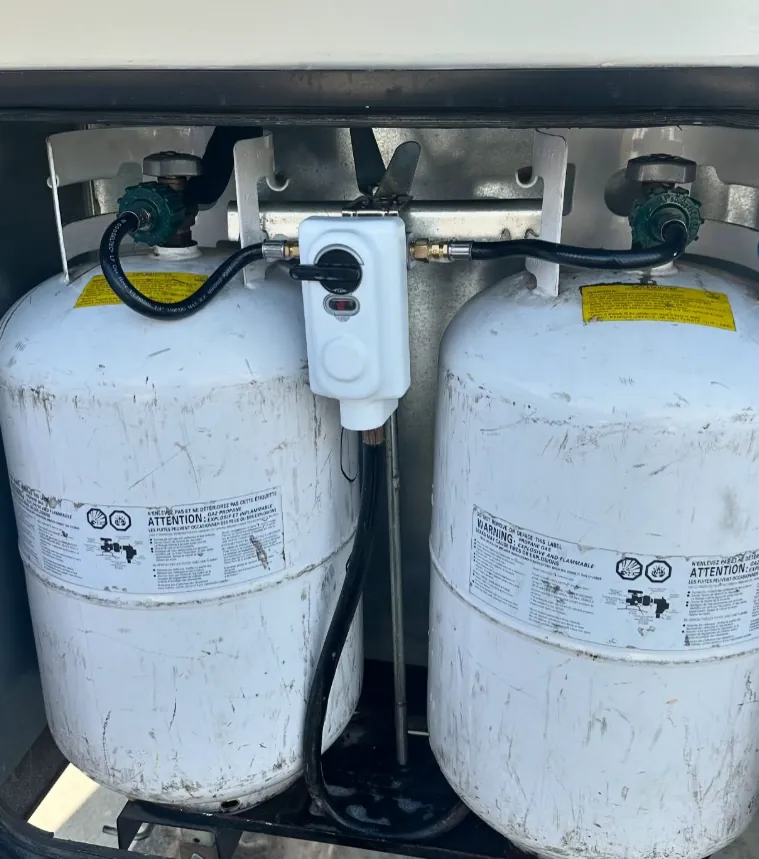
A two-stage LP regulator is one die-cast zinc body containing two independent pressure-reducing stages, mounted on a bracket inside the propane compartment. Cavagna builds the RV versions as combinations such as the Type 524AC automatic changeover paired with a Type 988 LP second stage, and the Marshall Excelsior MEGR-253 is the equivalent that a great many coaches leave the factory wearing. Inside each stage sits a rubber diaphragm, a calibrated spring and a valve seat. Gas pushes the diaphragm one way, the spring pushes back, and the seat opens exactly far enough to hold the outlet where the spring says it belongs. None of it is electronic, so there is no error code to read and no self-test to run. The assembly carries a UL 144 listing and is built to what NFPA 1192 requires of recreational vehicles. It also wears a plastic vented cover, which is neither decoration nor optional equipment.
Why Two Stages: Tank Pressure Moves and Appliance Pressure Cannot
Propane sits in the bottle as a liquid under its own vapor pressure, and that pressure tracks temperature rather than how full the cylinder is. A bottle baking on a sunny apron near Ocala can push well past 170 PSIG, while the same bottle on a cold Panhandle morning may deliver less than 30. Cavagna rates its RV regulators for a supplying pressure of 25 to 250 PSIG for precisely that reason. Your furnace, range, water heater and refrigerator care about none of it. Their orifices are drilled for 11 inches of water column, which is about four tenths of a single psi, and they burn badly at anything else. One stage cannot bridge that gap cleanly. The first stage does the coarse work and cuts cylinder pressure to an intermediate 10 psi, then the second stage takes that already-steady input down to the 11 inches every appliance in the coach was designed around.
The Automatic Changeover and the Indicator Most Owners Never Read
An automatic changeover regulator carries two inlets, one per bottle, plus a handwheel that selects which cylinder is currently the service side. When the service bottle runs down, the changeover moves supply across to the reserve bottle by itself, so the furnace and the fridge never notice. The small window on top is where the useful information lives. It shows green while the service cylinder is still feeding and flips to red the instant supply has crossed to the reserve. Cavagna designs that indicator to be legible from above through the opening in the tank cover lid, so nobody has to lift the cover to check. Here is the part that catches people out. Red does not mean both bottles are empty, it means one of them is, and after a refill you have to rotate the handwheel toward the full side to reset the sequence. Owners who never learn that will eventually run both cylinders dry and blame the hardware.
The Vent Faces Downward, and a Blocked Vent Is Genuinely Dangerous
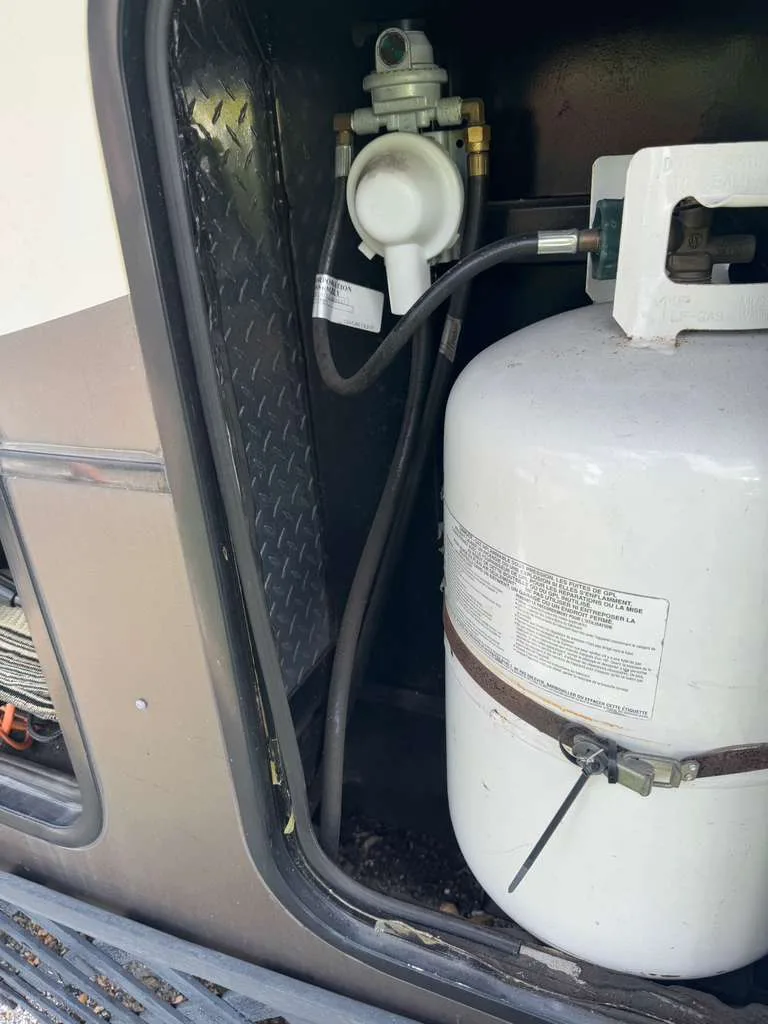
Every regulator has a vent opening on the underside of its cover. The diaphragm has to breathe against atmospheric pressure to hold its setting, and if the internal relief ever lifts during an overpressure event, the vent is the path that gas is supposed to take to the outdoors. Cavagna's installation instructions carry a blunt warning that the unit must be fitted with the vent hole pointing downwards to allow water to exit, and they cite NFPA 1192 for it. A vent aimed upward or sideways collects rain, and water standing inside the cover rusts the spring and attacks the diaphragm from the wrong side. A vent packed solid is worse than a wet one. The diaphragm can no longer track atmospheric change, lock-up wanders, and a relief event has nowhere to discharge except into the compartment. The vented cover belongs over it, and it must never be bagged, taped or sealed airtight.
Regulators Are a Wear Item, Not a Lifetime Part
Nothing inside a regulator is permanent, and treating it as permanent is the most common reason a coach with perfectly good appliances still burns badly. The diaphragm is rubber that stiffens through years of heat cycling, the spring takes a permanent set, and the seat disc grooves where it has been closing against the same orifice since the rig was new. There is no rebuild kit and no adjustment that restores a tired diaphragm. The adjusting screw under the cap can nudge outlet pressure a little, and chasing a low reading with it on a worn unit only hides the fault while usually leaving lock-up pressure somewhere it should not be. Age and environment set the replacement point, not mileage. A unit on a coach parked outdoors year-round near the coast will not go the distance of the same part kept in a dry barn, because salt air eats the vent screen and pits the zinc body long before the rubber gives up.
Small Weak Flames, One Appliance at a Time, and a Fridge That Will Not Stay Lit
Almost nobody calls and says the regulator failed. They describe a flame gone small and lazy where a crisp cone used to sit, a burner that will not prove, or a furnace that runs and runs without warming the coach. Low supply pressure does not make a flame yellow. The orifice jet draws primary air into the burner venturi, so less gas means proportionally less air and the mixture holds while the flame shrinks. Suburban says the same for the ST-42 and ST-60: low propane gas pressure trips flame out protection and shuts the gas off. Yellow belongs to the air side downstream, a fouled burner tube or a blocked intake screen. The regulator signature is appliances that work singly but not together. Cavagna's own RV load example adds a 30,000 BTU furnace, a 29,000 BTU range, a 12,000 BTU water heater, a 1,500 BTU refrigerator and a 10,000 BTU outside grill drawing at once. A fridge that lights, runs a while and drops out is usually supply pressure, not a control board.
What We Check First, What Each Finding Costs, and What It Becomes If You Wait
Order matters, because the cheapest causes sit on the outside. Our technicians begin at the vent and cover looking for salt crust, mud dauber packing and webbing, then move to the pigtail hoses and their flare seats, then to the changeover indicator and handwheel position, and only then put a gauge on the low-pressure port. A blocked vent or a webbed orifice is usually clearing work that fits inside the first hour. A failed regulator is a part in the region of $45 to $110 for a common two-stage changeover unit, plus a pair of pigtails at roughly $18 to $40 each. Soot is the visual warning that combustion has gone incomplete, and Suburban tells owners to shut the appliance down the moment any appears. The furnace and water heater burn in chambers vented to the exterior rather than into the living space, so a sooting burner does not by itself put carbon monoxide in the coach. It gets inside when that barrier fails: a covered or corroded vent, a split flue, a breached heat exchanger.
Sources
Every figure on this page comes from a manufacturer document or a standards body, not from another repair site. Here is where each one comes from.
- Cavagna Group North America, Propane Regulators, Valves and Equipment catalog (2025 edition)The recreational vehicle section states the two-stage design, the 10 psi intermediate pressure, the 11 inch water column outlet, the 25 to 250 PSIG supplying range, UL 144 compliance, the Type 524AC and Type 924N changeover units with their full and empty indicator, the warning that the vent hole must point downwards to allow water to exit, and the instruction to fit a new pigtail with every replaced regulator.
- Cavagna Group, Propane Regulators: how they workManufacturer explanation of integral two-stage and automatic changeover regulator types, the typical 11 inch water column second stage outlet, and the function of the vent built into the regulator cover as the path the unit breathes and relieves through.
- Lekov, Sturges and Wong-Parodi, Impacts of Imported Liquefied Natural Gas on Residential Appliance Components, Lawrence Berkeley National Laboratory for the U.S. Department of Energy, December 2009The burner mechanism: in conventional appliance burners the pressurized gas flows through the orifice of a nozzle into a venturi where the primary air is pulled in. The orifice is defined as the opening whereby the flow of gas is limited, and the venturi as the tube that draws in air to be mixed with the gas. The report also places incomplete combustion, evidenced through flame lifting or yellow tipping, on the primary air side, with too little primary air giving a rich mixture.
- Suburban (Airxcel) ST-42 and ST-60 On Demand Water Heater User's Manual, PN 206212-1Flame Out Protection, which shuts the gas supply off should the flame be extinguished inadvertently due to low propane gas pressure or burner malfunction. The manufacturer stated consequence of low supply pressure is flame loss, not a yellow flame.
- Suburban (Airxcel) Gas Furnace Operation Guide, REV 22046Soot is formed whenever combustion is incomplete and is the visual warning to shut the furnace down immediately, that furnace venting must be free of obstructions and routed to the exterior of the RV, that the vent must never be covered, and that the flow of combustion air must not be restricted.
- Missouri Department of Conservation, Field Guide: Mud DaubersMud daubers are solitary wasps that build their nests out of mud on sheltered structures, adults drink nectar from flowers, and they pack paralyzed spiders into the nest cells as provisions for their young. The attractants described are the nest cavity and the prey, with no reference to gas or odorant.
- NFPA 1192, Standard on Recreational Vehicles - Technical Committee public input responses carrying the draft standard textVerified by reading the PDF: NFPA 1192 requires low pressure propane piping systems to have at least two stages of pressure regulation to reduce container pressure to appliance utilization pressure, and requires a two stage regulator system or an integral two stage regulator to be listed to the requirements of UL 144, with the gauge pressure to the second stage limited to 10.0 psi or less as specified in UL 144. This is the standards body source behind the UL 144 listing and the 10 psi interstage pressure that Cavagna's catalog attributes to NFPA 1192.
Related repairs
Other systems we service
Where we work
Service category
What this usually costs
| Item | Price | What it covers |
|---|---|---|
| Service call | $299 | Includes the trip out to your RV and the first hour on site |
| Work past the first hour | Quoted after diagnosis | We tell you what it will take before we carry on |
| Parts | Quoted per job | Special-order parts may need a deposit before we order them |
| Written estimate | No charge | You approve the estimate before any work starts |
The service call covers the trip out to your RV and the first hour on site. Anything beyond that depends on what we find, and we quote it and get your approval before carrying on.
The price ranges on this page come from our own recent jobs across Florida, not from an industry average. What you pay depends on the rig, the parts it needs and what we find on site, so we give you a written estimate before any work begins and you approve it first.
Frequently asked questions
Can you help with a propane regulator and an awning issue on the same visit?
Yes, and combining them saves you a second service call. The regulator work is a bench-style job in the propane compartment while awning work happens on the sidewall, so one technician can carry both in a single visit. Tell us both problems when you book so the right regulator and the right awning parts ride out on the truck together rather than turning into a return trip.
How long does a two-stage regulator replacement actually take?
Budget forty five to seventy five minutes once the fault is confirmed. Both bottle valves get closed, the old unit comes off its bracket, the replacement goes on with a 7/8 inch flare nut wrench, both pigtails are renewed, and then the joints are checked with leak detection fluid before pressure is verified. Corroded flare nuts or a rusted bracket can stretch that, which is why the diagnosis comes first.
My changeover indicator is red but both bottles are full. What is wrong?
Usually nothing is broken. The indicator reports which inlet is feeding, not how much gas is in either cylinder, and it stays red after a refill until you rotate the handwheel toward the full bottle. If it still shows red with the handwheel correctly set and both valves open, suspect a blocked vent, a collapsed pigtail or a first-stage diaphragm that is no longer sensing properly.
Can I adjust my regulator instead of replacing it?
There is an adjusting screw under the cap, but on a worn unit turning it is a trap. It can push outlet pressure back toward 11 inches of water column while doing nothing about the stiffened diaphragm or grooved seat causing the drop, and it often leaves lock-up pressure too high. Adjustment is a calibration step during a diagnosis, never a repair for a regulator that has aged out.
Do spiders really cause propane problems on stored RVs in Florida?
They do, though not for the reason the story usually gives. Mud daubers are solitary wasps hunting a sheltered tube of about the right bore, which they fill with mud cells and stock with paralyzed spiders for the larvae, as the Missouri Department of Conservation describes. The regulator vent, the vent tube and the burner tubes on the furnace and water heater are that cavity. Nothing is drawing them to the odorant, and those passages hold air rather than propane unless something is already leaking. Humid summer storage gives them months of quiet, and the result reads exactly like a failing regulator.