RV Backup and Security Camera Installation, Mobile Florida
Mobile RV backup and security camera installation across Florida. Sealed brackets, prep-wire testing, no-lag wiring. Call 888-759-1438 for a technician.
A camera bracket screwed to a rear cap and sealed badly does not leak where you can see it. Water wicks into the laminate and surfaces two years later as a soft, delaminated sidewall. RV camera work is really two separate jobs: a backup or observation camera, which is a driving-safety device that has to be lag-free at highway speed, and a surveillance camera, which has to hold power and a network connection while the coach sits unattended.
Backup camera or surveillance camera: two jobs owners keep merging
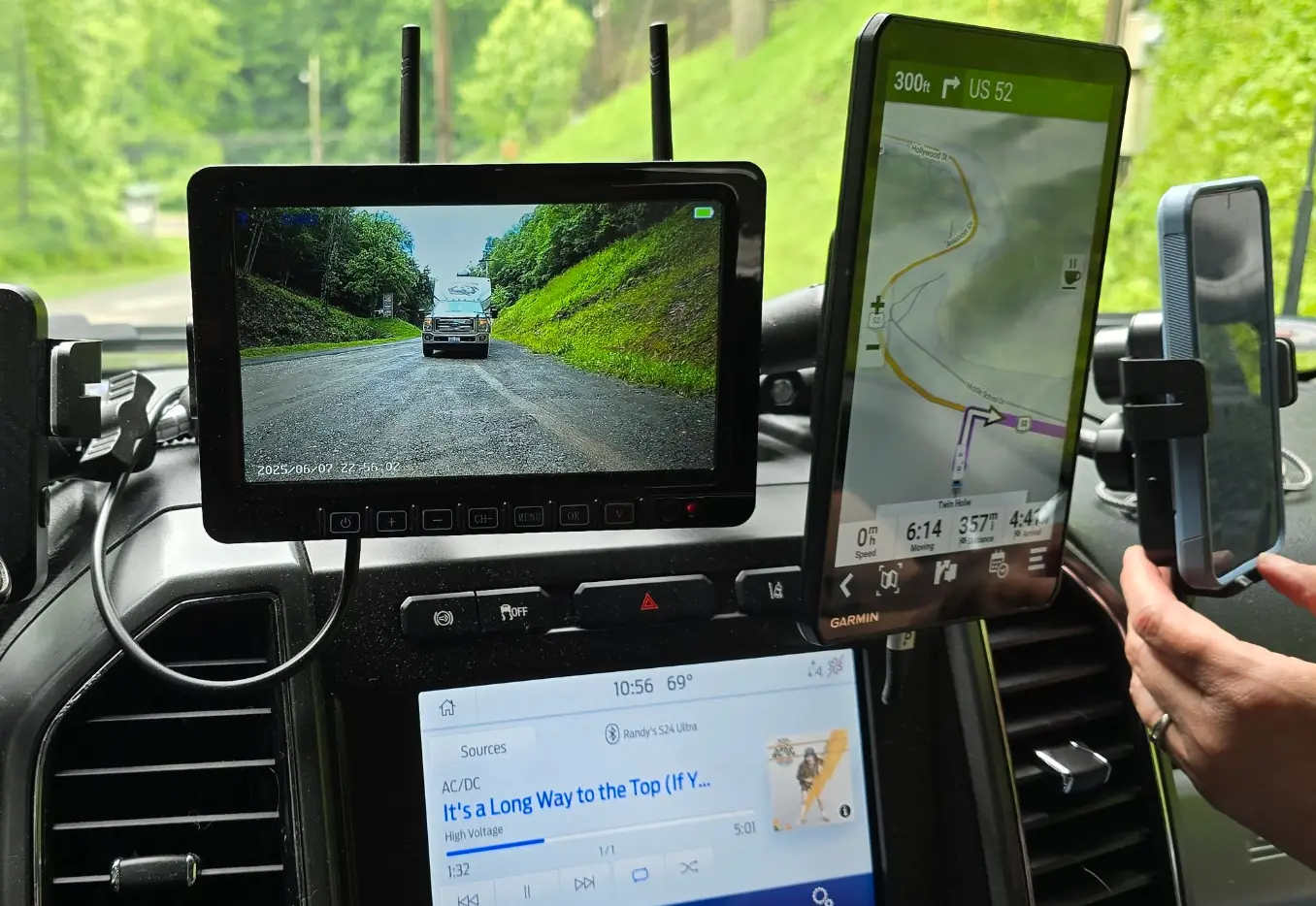
A backup or observation camera is a driving-safety device. It mounts on the rear cap, feeds a monitor at the dash, and has one hard requirement: the picture on screen must match the world outside right now, at road speed. A surveillance camera is a parked-security device. It has to keep 12V power and a network path alive while the coach sits unattended for weeks, which is the harder half of the job. Owners ask for a camera, mean one of these two things, then buy a kit built for the other. A doorbell-style wifi camera buffering half a second is fine watching a porch. Put that same delay behind a 38-foot coach reversing into a site and it is roughly a car length of stale video. Purpose-built systems such as the Furrion Vision S+ sharkfin and the ASA Electronics Voyager range exist because the driving job carries requirements a home camera never has to meet.
Every camera is a new penetration, and the bracket is what leaks

A camera bracket is not an accessory. It is three or four screw holes drilled through a fiberglass rear cap or a laminated roof, plus a wire pass-through, in a wall built to be sealed. Done correctly the base gets butyl tape behind it so the surface sealant is a second line rather than the only one, stainless number 8 pan-head screws landed in structure instead of thin skin, and a bead worked over the heads. Sealant choice is not cosmetic. Dicor 501LS self-leveling lap sealant is formulated for horizontal surfaces and will slump if it is run down a vertical rear cap; the non-sag 551LS is the vertical-wall product. Both skin over in about five minutes and are waterproof in roughly four hours, but neither reaches full cure for thirty days. Water past a bracket rarely drips. It wicks into the luan and foam core, and the bill arrives later as delamination, which is structural work rather than a camera job.
Power and network: the prep wire, and the storage lot problem
Many coaches built in the last decade already carry a camera prep at the rear, commonly a capped 12V pigtail tucked behind the rear badge or a brake-light housing. Voyager sells the WVSXP43 specifically as a wireless camera system for prewire prep, and warns it only mates to a Voyager pre-wired vehicle, which is why finding that pigtail and identifying it can turn a wiring job into a mounting job. The prep is not one standard circuit. Depending on the builder it is fed from constant 12V, from an ignition-switched source, or off the reverse-lamp circuit, so a digital multimeter goes on that plug before anything is ordered. A constant feed reads near 12.6 volts DC at rest and 13.6 volts with the charger active. A surveillance camera in a storage lot is a different problem entirely. There is no shore power, no wifi, and no router to join, so the honest options are a cellular camera on its own data plan or a battery and solar unit whose runtime collapses in summer heat.
Distorted, black, or dropping out: the check order and what it costs

The symptom arrives as a picture problem, and one caller in our own recorded calls put it exactly this way: can you repair a distorted RV backup camera. Distortion, rolling bands and color smear point at the signal path, not the lens, so the order matters. Monitor first on a known source, then voltage at the camera, then the connector, then the run itself. The most common cause is corrosion inside the rear connector shell, where a bracket seal has been breached and the pins have gone green. On a wireless system, a picture that breaks up in a crowded campground row is usually 2.4 GHz congestion, not a failing camera. Cost follows the same order: the service call covers the trip out and the first hour on site at the rate shown in the pricing table on this page, and anything past that hour is quoted after the diagnosis and approved first. Left alone, an intermittent camera becomes a dead one, and the moisture that killed the connector is already in the wall.
Florida load: roof heat, driving rain at the bracket, and surge
Heat and ultraviolet are the slow failures here. A dark camera housing on a roof or rear cap bakes all summer, the gasket hardens, and the polycarbonate lens cover hazes, which quietly degrades infrared night performance long before the daytime image looks wrong. Driving rain is the fast one. An IP65 rating covers water jets, but rain hitting a bracket at road speed arrives at an angle and pressure the seal was never designed around, and it finds the pass-through hole rather than the camera body. Then there is surge. Vaisala's lightning network puts Florida first in the country at 305 lightning events per square mile, and a wired camera run is 25 to 35 feet of conductor threaded from the rear cap to the dash. That run wants its own inline fuse at the source, marine-grade heat-shrink butt splices rather than crimp caps, and shore power unplugged when a storm is coming through the lot.
Sources
Every figure on this page comes from a manufacturer document or a standards body, not from another repair site. Here is where each one comes from.
- Furrion - Vision S+ RV backup camera systemsFurrion's own spec for the Vision S+: 2.4 GHz wireless signal rated for a stable connection up to 100 feet while driving, IP65 waterproofing, infrared night vision with IR cut filters, and the sharkfin rear camera format.
- ASA Electronics - Voyager WVSXP43 wireless camera system for prewire prep (product literature)Manufacturer confirmation that factory camera-prep wiring is a real and common RV feature: ASA's own literature titles the WVSXP43 a wireless camera system for prewire prep, tells the owner to look for the prep plate on the back of the RV, and states the system is only compatible with Voyager pre-wired vehicles. It also gives the 12VDC camera and a monitor that holds signal up to 60 feet.
- Dicor - Self-Leveling Lap Sealant (501LS)That 501LS is the self-leveling product for horizontal surfaces, is compatible with EPDM, TPO and PVC and adheres to fiberglass and aluminum, and its cure schedule: skins in 5 minutes, waterproof in 4 hours, 100 percent cure at 30 days.
- Dicor - Non-Leveling Lap Sealant (551LS)That the 551 series is the non-sag product specified for vertical surfaces, which is why a camera bracket on a vertical rear cap must not be sealed with the self-leveling 501LS.
- Vaisala Xweather Annual Lightning Report 2025That Florida leads all US states in lightning density at 305 lightning events per square mile, supporting the surge-exposure warning on any long wired camera run in a Florida coach.
Related repairs
Other systems we service
Where we work
Service category
What this usually costs
| Item | Price | What it covers |
|---|---|---|
| Service call | $299 | Includes the trip out to your RV and the first hour on site |
| Work past the first hour | Quoted after diagnosis | We tell you what it will take before we carry on |
| Parts | Quoted per job | Special-order parts may need a deposit before we order them |
| Written estimate | No charge | You approve the estimate before any work starts |
The service call covers the trip out to your RV and the first hour on site. Anything beyond that depends on what we find, and we quote it and get your approval before carrying on.
The price ranges on this page come from our own recent jobs across Florida, not from an industry average. What you pay depends on the rig, the parts it needs and what we find on site, so we give you a written estimate before any work begins and you approve it first.
Frequently asked questions
Can you repair a distorted RV backup camera?
Usually yes, and usually without replacing the camera. Distortion, rolling bands or color smear almost always trace to the signal path rather than the optics. The check order is monitor, then voltage at the camera, then the connector, then the cable run. Corroded pins in the rear connector shell are the most common single cause, and that repair is a clean, splice and reseal job rather than a new system.
Will a wireless backup camera work at highway speed?
A purpose-built RV system will. Furrion rates the Vision S+ for a stable 2.4 GHz link up to about 100 feet while driving, which covers the length of any coach. A general-purpose wifi camera is the wrong tool, because it buffers to smooth the picture and that buffering is exactly what you cannot have while reversing. Wired analog or wired digital removes the question entirely.
My RV already has a camera prep. Can you just plug a camera in?
Sometimes, and it is the first thing worth checking. Many coaches carry a capped 12V pigtail behind the rear badge, and a camera sold for prewire prep will mate to it. What decides the job is what that wire is fed from: constant power, ignition-switched, or the reverse lamps. A meter reading at the plug with the key off answers it in two minutes.
Can a security camera watch my RV in a storage lot with no wifi?
Only with cellular. Battery and solar cameras still need a network to reach your phone, and a storage lot has no router to join, so the realistic option is a camera with its own SIM and data plan. Be honest about the trade: Florida summer heat cuts battery runtime hard, and a shaded or dusty panel will not keep up with the recharge.
How much does RV camera installation cost?
Our service call covers the trip out and the first hour on site at the rate in the pricing table on this page; anything past that first hour is quoted and approved before we carry on. Parts sit on top. A camera that lands on an existing prep wire is a short job; a fresh run from rear cap to dash, sealed properly, is the longer one. We quote after seeing the coach.
Can you mount a camera without drilling a new hole?
Often yes. Existing hardware is the best anchor available: a rear badge, a brake-light housing, a ladder stile or an existing prep pass-through all give a mounting point and sometimes a wire route that already exists. Where a new penetration is unavoidable it gets butyl tape behind the base and the correct sealant on top, non-sag 551LS on vertical walls and self-leveling 501LS on horizontal.