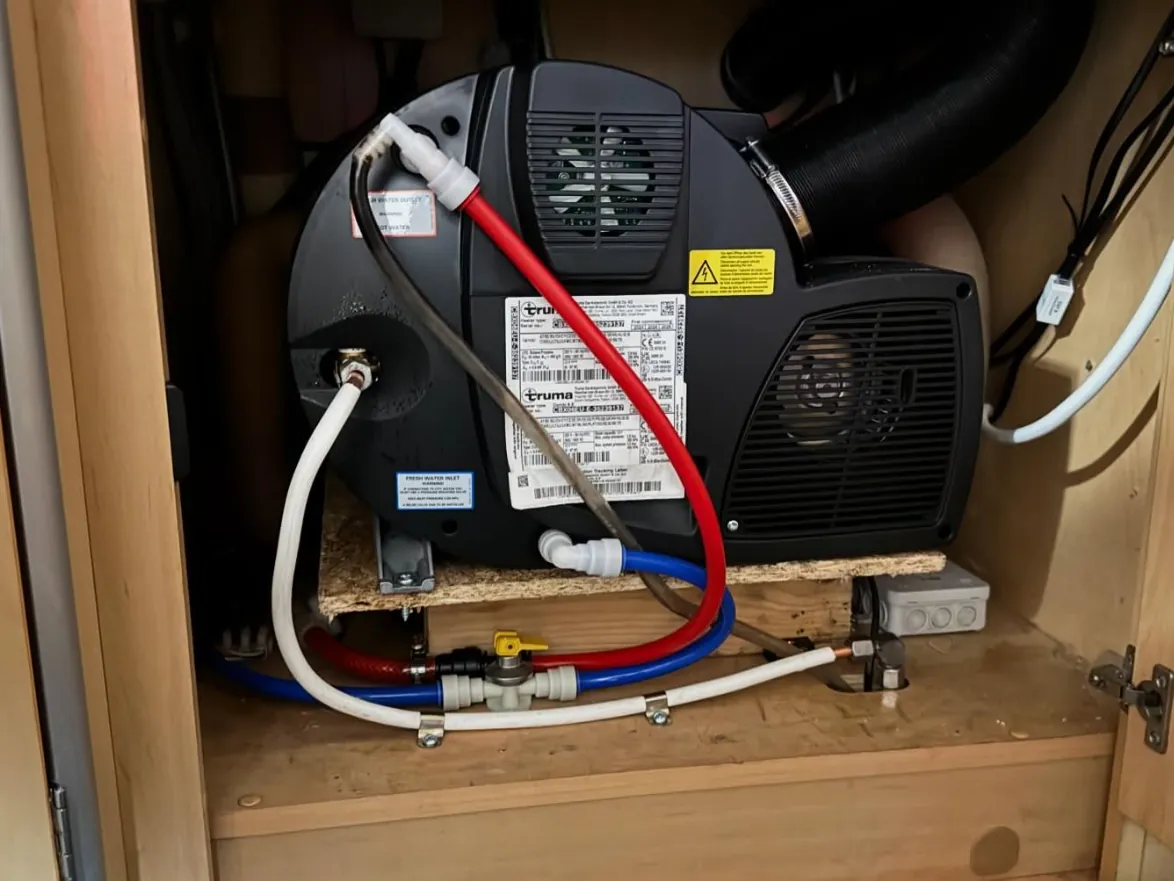
Truma Aventa Repair and Service: Mobile RV Techs in Florida
Truma Aventa eco, eco plus and comfort service across Florida. Model-specific diagnosis, real parts lead times, honest repair advice. Call 888-759-1438.
The Truma Aventa is a German rooftop air conditioner sold into a US market built around Dometic and Coleman-Mach, and nearly every service difference follows from that. It runs on Truma's own wireless remote or CP plus panel rather than a standard RV wall thermostat, and the eco and comfort models do not even share a refrigerant. Apex diagnoses and repairs Aventa units statewide in Florida at 888-759-1438.
The Aventa Runs, Air Moves, and the Coach Never Gets Cold
Owners describe this failure at the system level rather than as a broken part. The rooftop unit powers up, the fan turns, and the interior temperature simply will not come down. The first question our technicians ask is not what failed but which Aventa it is, and on a Truma that single answer reshapes the entire visit before a panel comes off. Order matters more here than on an American unit. Our technicians confirm supply voltage at the coach under load first, because an Aventa comfort pulls 12 A on high speed and a tired pedestal or a long extension cord will starve it into a no-cooling complaint the air conditioner did not cause. Next comes the air distributor filter and the return air path, then the evaporator face for ice. Only after those clear does the shroud come off and the sealed refrigeration circuit come into question.
Aventa eco, eco plus and comfort Are Three Different Machines
Truma sells more than one Aventa for North America and they are not interchangeable. The Aventa eco is rated 13,500 BTU/h, weighs 80 lbs, draws 1,260 W and uses R32 refrigerant. The Aventa comfort is rated 15,000 BTU/h, weighs 86 lbs, draws 1,440 W and uses R410A. The Aventa eco plus adds reverse cycle heating at 13,500 BTU/h on a 1,080 W heating draw, and it is the only Aventa where a heat pump conversation applies at all. Truma also lists factory soft start versions of each, separated on the spec sheet by start-up current: 59 A RMS on a standard eco against 30 A with soft start fitted, and 70 A against 34 A on the comfort pair. Getting the variant right is not pedantry. A shop tooled for R410A has neither the recovery equipment nor the charge data for an R32 machine, so refrigerant alone can decide whether a local shop can touch it.
There Is No RV Thermostat on the Wall to Replace
On a typical American rooftop unit the wall thermostat is a serviceable part and a routine failure point. On an Aventa it is frequently not there at all. Truma states that an Aventa installed aftermarket is controlled by the included Aventa wireless remote control, and that only when an RV manufacturer fits the unit at the factory may it also run from the Truma CP plus control panel or be integrated into a third-party system at that manufacturer's discretion. That reroutes the diagnosis completely. A dead-to-the-touch Aventa in a retrofit coach points at the remote, its batteries and its pairing long before it points at anything electrical on the roof. In an original-equipment coach the same symptom points at the CP plus panel and the Truma Interconnect bus tying heating, cooling and water together. It also rules out a repair owners ask for by name, since there is no thermostat circuit for a generic wall control to land on.
The 14 by 14 Opening Fits. The 28 Inches Behind It Often Does Not
The Aventa uses the standard 14 inch by 14 inch roof cutout, so the hole itself is rarely what blocks a retrofit. What blocks it is everything around the hole. Truma specifies 3 inches of rooftop clearance forward of the cutout, 28 inches behind it and 9 inches to each side, plus 4 inches front, 10 inches back and 4 inches each side at the interior ceiling opening. The 28 inches at the rear is the number that ends jobs during the survey. Truma lists the rooftop casing itself at 44.2 inches wide, 31.4 inches deep and 10.2 inches high, so a roof vent, a solar panel or a second air conditioner sitting inside that window means the unit will not sit down and seal. Weight is the other pre-check. At 80 lbs for an eco and 86 lbs for a comfort, the framing around a cutout that already carried one air conditioner for a decade gets inspected before anything is lifted.
Parts Lead Time Is the Florida Pressure, Not the Heat
Heat is not what makes an Aventa failure painful in Florida. Waiting is. A Coleman-Mach run capacitor or a Dometic control board sits on a shelf within a day of almost any Florida town, and an Aventa part usually does not, so a coach with a failed unit in July is unusable while a box moves. The offsetting fact surprises most owners. Truma North America runs only two company service locations on the continent, its Elkhart, Indiana headquarters and a service center in Lakeland, Florida with mobile service in the state, while every other pin on the map is a trained dealer or partner that Truma states it does not own or control. That combination is why the honest answer on lead time is a range rather than a date. Our technicians read the exact variant off the rating plate first, because an eco part and a comfort part move through different channels, and a wrong variant is a second wait stacked on the first.
When to Repair an Aventa and When a Common American Unit Wins
Here is the call most competitor pages avoid. Repair the Aventa when the fault sits outside the sealed system: the wireless remote, the CP plus panel, the air distributor, a fan, a blocked condensate path, a roof gasket, or anything still covered by Truma's warranty. Those parts are orderable and the visit is ordinary. Think hard when the compressor or the sealed circuit fails on an out-of-warranty unit. A common American 13,500 or 15,000 BTU rooftop drops into that same 14 by 14 opening and any technician in the state can service it tomorrow. If the coach is a Class B chosen for the low profile, the 62 dBA low-speed noise figure and the dehumidification mode, the Aventa is worth the wait. If it is a travel trailer that simply needs to be cold, it usually is not. Leaving it is the worst option, because a sealed Florida coach without cooling holds humidity that raises mildew on soft goods and cabinetry.
Sources
Every figure on this page comes from a manufacturer document or a standards body, not from another repair site. Here is where each one comes from.
- Truma - Aventa eco product and technical detailsAventa eco rated 13,500 BTU/h, 80 lbs, 1,260 W, R32 refrigerant, 59 A RMS start-up current, 62 dBA low-speed noise, 14 by 14 inch roof cutout with 3 in front and 28 in rear rooftop clearance, and control by the included Aventa wireless remote when installed aftermarket
- Truma - Aventa comfort product and technical detailsAventa comfort rated 15,000 BTU/h, 86 lbs, 1,440 W, R410A refrigerant, 70 A RMS start-up current, 12 A high-speed current draw, and the statement that a factory-fitted Aventa may additionally run from the Truma CP plus control panel
- Truma - Aventa eco plus product and technical detailsAventa eco plus is the reverse cycle heat pump variant, rated 13,500 BTU/h cooling and 13,500 BTU/h heating on a 1,080 W heating power consumption
- Truma - Aventa comfort + soft start technical detailsFactory soft start variants exist and are separated from the standard models by start-up current, 34 A RMS on the comfort + soft start against 70 A RMS on the standard comfort
- Truma - Truma Service Centers, North AmericaTruma operates brick-and-mortar service centers in Elkhart, Indiana and Lakeland, Florida, with mobile service available in Florida
- Truma - Dealer and service center searchTruma states that Sales Partner, Service Center and Mobile Service Center locations on its map are trained but not owned or operated by Truma, and that it does not control their pricing or availability
Related repairs
Other systems we service
Where we work
Service category
What this usually costs
| Item | Price | What it covers |
|---|---|---|
| Service call | $299 | Includes the trip out to your RV and the first hour on site |
| Work past the first hour | Quoted after diagnosis | We tell you what it will take before we carry on |
| Parts | Quoted per job | Special-order parts may need a deposit before we order them |
| Written estimate | No charge | You approve the estimate before any work starts |
The service call covers the trip out to your RV and the first hour on site. Anything beyond that depends on what we find, and we quote it and get your approval before carrying on.
The price ranges on this page come from our own recent jobs across Florida, not from an industry average. What you pay depends on the rig, the parts it needs and what we find on site, so we give you a written estimate before any work begins and you approve it first.
Frequently asked questions
Where is my rooftop air conditioner leaking?
Water inside the coach under an Aventa is almost always condensate that never reached the roof, not a refrigerant leak. The usual paths are a blocked drain route in the pan, a mounting gasket that has taken a set under the 80 to 86 lb casing, or an iced evaporator that thawed at once. Our technicians check gasket compression and the pan first, since two of those three are inexpensive.
How do I tell whether I have an Aventa eco or an Aventa comfort?
The rating plate is the fastest answer, and the numbers are unmistakable. An Aventa eco is 13,500 BTU/h, 80 lbs and charged with R32. An Aventa comfort is 15,000 BTU/h, 86 lbs and charged with R410A. An eco plus reads 13,500 BTU/h for both cooling and heating. Photograph the plate before you call, because the refrigerant alone determines which shops and which parts can serve the unit.
Can I control a Truma Aventa with a regular RV thermostat?
No. Truma states that an aftermarket Aventa is controlled by its included wireless remote, and that factory-fitted units may additionally use the Truma CP plus control panel or a manufacturer's own integration. There is no standard RV thermostat circuit on the unit for a generic wall control to connect to. If a remote is lost or unpaired, the fix is a Truma control part, not a substitute thermostat from a parts counter.
How long does an Aventa part take to reach Florida?
It depends entirely on the part and where it ships from, and anyone quoting you a fixed number has not checked. What we do is confirm the exact variant and part on the first visit, get a lead time from the supply channel before you commit, and tell you what the coach is unusable for in the meantime. Truma has a Lakeland service center and Florida mobile service, which shortens some of these considerably.
Is swapping an Aventa for a Dometic or Coleman-Mach worth it?
Sometimes, and the roof makes it easy either way, because the Aventa shares the standard 14 by 14 opening. You give up the low profile, the quiet operation and the dehumidification mode. You gain a unit any technician in Florida can diagnose and parts available same week. On an out-of-warranty sealed-system failure that trade usually favors the American unit; on a control or airflow fault it never does.