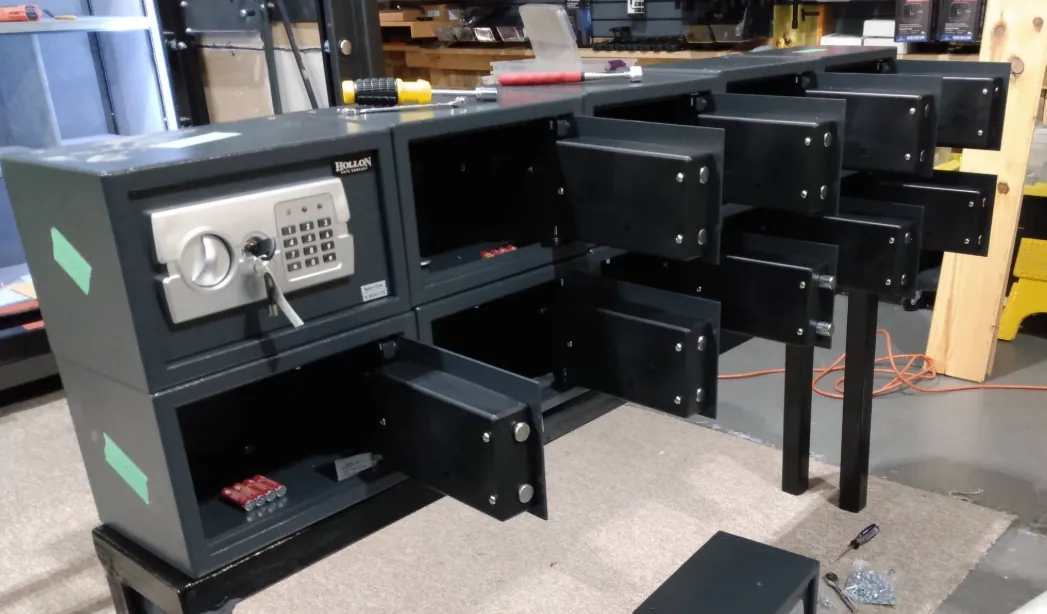
RV Safe Installation - Mounting and Anchoring in a Coach
Mobile RV safe installation across Florida. We find real structure, through-bolt to a steel backing plate, and check under the floor first. Call 888-759-1438.
An RV safe is a mounting job first and a box second. A SnapSafe Lock Box XL weighs six pounds empty, so what it protects is only as secure as whatever it is fastened to. RV walls are thin laminate over foam, and RV floors are sandwich panels sitting straight above a storage bay.
Why an RV safe is a mounting problem, not a box purchase
A safe is two things at once: a container that resists attack, and an attachment that stops the container leaving the building. In a house the second half is trivial, because a slab or a joisted floor takes a wedge anchor and the job is finished. In a coach the attachment is the entire job. The SnapSafe Lock Box XL is a 16 gauge steel housing measuring seven by ten by two inches and weighing six pounds, and it ships with a four foot, 1500 pound rated steel cable precisely because the maker knows an unsecured box is luggage. Accept that and the shopping question changes shape. You stop asking how thick the door is and start asking what in this coach can take a through-bolt, because a thief in a storage row has long minutes alone with the rig. The anchor point is the real security rating.
What you can actually anchor to inside a coach
An RV sidewall is a laminate sandwich: a thin fiberglass or aluminum skin, a block foam core, and a luan inner face, with framing set on rough centers rather than a predictable sixteen inch grid. A lag screw driven into that grabs foam and pulls straight out under a pry bar, and a hollow-wall toggle is worse, because it loads the luan skin in tension. The fasteners that hold are the ones that pass all the way through a panel and land on steel on the far side. The workable anchor points in most coaches are the base cabinet floor above a storage bay, the vertical stile at a cabinet corner, and the plywood platform under a dinette bench. Our technicians through-bolt with quarter-inch hardware, a fender washer and a steel backing plate on the hidden face, or set threaded inserts where only one side is reachable. Load spread over square inches, not over a screw thread, defeats a pry bar.
Drilling through an RV floor: what is underneath it
An RV floor is not a floor in the residential sense. It is a sandwich panel, commonly luan over a foam or lumber core over a second skin, and directly below it can be a storage bay, an underbelly membrane, or open air over the road. Running through that void, in no standard order, are twelve volt wiring harnesses, fresh and gray tank plumbing, tank heat pads, and in many coaches a copper or plated LP supply line feeding the range and water heater. A bit that finds an LP line does not announce itself. It opens a slow leak inside a sealed cavity. So the sequence is fixed: open the bay below, put an inspection borescope or a work light on the underside, mark the hole from below rather than from above, and confirm clearance before the drill runs. Where nothing clears, the safe moves. Sliding a safe eighteen inches costs nothing; a punctured LP line costs a leak test and a line repair.
Fire ratings on RV safes, and what those numbers measure

Fire ratings are the part of safe marketing that most deserves unpicking, because the numbers printed on two safes sitting on the same shelf rarely come out of the same test. Hollon lists fire-rated models tested to the Japanese Industrial Standard at 1700 degrees and the Korean Industrial Standard at up to 1850 degrees, which are separate national protocols with separate pass criteria. The SnapSafe lock boxes carry a 2300 degree fire rating, a furnace temperature with no duration attached to it at all. Separately again, the Underwriters Laboratories Residential Security Container rating that gun safes commonly bear is a burglary rating, not a fire one, and owners routinely read the two as a single grade. None of these tests was run in a coach. A house fire is fought around a standing structure, while an RV is a small, fuel-rich box that can burn down to its steel, often in a storage row where nobody sees smoke for an hour.
From wanting a safe to a mounted safe: check order, cost, and delay
The question almost never arrives as a mounting question. It arrives as I bought a safe and I do not know where it can go, or the one the previous owner fitted rattles and the cabinet floor under it is sagging. The check order is the same either way. First the load path: what sits under the chosen spot, and whether that cabinet or bench platform carries the loaded weight without deflection. Second the underside: bay access, wiring, plumbing and LP routing at the exact hole positions. Third balance, because a heavy safe in a slide-out room or far outboard changes how the coach rides. A sagging platform caught early is a plywood doubler and an hour. Left alone it becomes a torn cabinet base and a safe that has already pulled its fasteners. Our service call covers the trip out and the first hour on site at the rate in the pricing table on this page; anything past that first hour is quoted and approved before we carry on.
Sources
Every figure on this page comes from a manufacturer document or a standards body, not from another repair site. Here is where each one comes from.
- SnapSafe Lock Box XL product specificationsThe 16 gauge steel housing, seven by ten by two inch size, six pound weight, four foot 1500 pound rated security cable, key and combination lock item numbers, and the California Department of Justice approval for firearms storage.
- Hollon Safe - safe and lock ratingsThat fire-rated safes are tested to the Japanese Industrial Standard at 1700 degrees and the Korean Industrial Standard at up to 1850 degrees, and that the Underwriters Laboratories Residential Security Container rating gun safes carry is a burglary rating rather than a fire rating.
- Console Vault in-vehicle safesThat vehicle-specific safes are built from 12-gauge steel and engineered to fit an existing console without cutting or drilling, which is the model-specific alternative to drilling into structure.
- Florida Statutes 790.174 Safe storage of firearms requiredThe Florida statutory language about keeping a firearm in a securely locked box or container, cited as the primary source rather than paraphrased as legal advice.
- Eva-Dry E-333 renewable mini dehumidifierCoverage rated to 333 cubic feet, color-changing moisture beads as the indicator, and a recharge of roughly ten to twelve hours plugged in.
Related repairs
Other systems we service
Where we work
Service category
What this usually costs
| Item | Price | What it covers |
|---|---|---|
| Service call | $299 | Includes the trip out to your RV and the first hour on site |
| Work past the first hour | Quoted after diagnosis | We tell you what it will take before we carry on |
| Parts | Quoted per job | Special-order parts may need a deposit before we order them |
| Written estimate | No charge | You approve the estimate before any work starts |
The service call covers the trip out to your RV and the first hour on site. Anything beyond that depends on what we find, and we quote it and get your approval before carrying on.
The price ranges on this page come from our own recent jobs across Florida, not from an industry average. What you pay depends on the rig, the parts it needs and what we find on site, so we give you a written estimate before any work begins and you approve it first.
Frequently asked questions
Can you bolt a safe to an RV floor?
Sometimes, and only once the underside has been checked. An RV floor is a sandwich panel, not a joisted subfloor, so a bolt has to pass through it and clamp a steel backing plate rather than thread into the panel. Below that panel there may be a storage bay, tank plumbing, a wiring harness or an LP supply line. Our technicians open the bay, sight the position from below, and mark the hole from the underside.
How much weight can a base cabinet or dinette bench really take?
Less than most owners assume, and coach builders rarely publish a figure for a cabinet floor. The workable answer is to judge the platform itself: plywood thickness, how it is supported at its edges, and whether it deflects underfoot. A loaded one hundred pound safe on an unsupported half-inch panel will sag long before it tears out. Adding a plywood doubler and a support cleat beneath the platform is inexpensive and usually happens in the same visit as the mount.
Does a residential fire rating mean anything in an RV?
Less than the number suggests, and the numbers are not comparable to one another. Hollon lists fire-rated safes tested to Japanese and Korean industrial standards at 1700 and up to 1850 degrees, while SnapSafe prints a 2300 degree rating with no duration attached, and the Underwriters Laboratories Residential Security Container rating that gun safes carry is a burglary rating rather than a fire one. None of it models a coach. Keep original titles and passports off the RV.
How do I keep humidity out of a closed safe in Florida?
A sealed steel box in a humid coach traps moist air, and trapped moist air is what pits firearms and cockles the paperwork you would grab for a hurricane evacuation. A renewable desiccant sized to the interior is the simplest fix. The Eva-Dry E-333 is rated for enclosed spaces up to 333 cubic feet, uses color-changing beads as its indicator, and recharges by plugging in for roughly ten to twelve hours. Check the bead color before every trip.
What about storing a firearm in the RV?
Apex installs hardware and does not give legal advice, including on transport. Florida Statutes 790.174, titled safe storage of firearms required, is the provision owners are commonly pointed toward, and it speaks in terms of a securely locked box or container. Some products state an approval directly: the SnapSafe Lock Box XL is listed as approved by the California Department of Justice for firearms storage. Take your own situation to a Florida attorney.
What does a safe install cost and how long does it take?
A cable anchor inside a base cabinet is usually one short visit. A through-bolted mount needing bay access, a backing plate and a doubler takes longer. We do not quote a fixed figure sight unseen.