RV Keyless Entry Handle Installation - Mobile Service Florida
Mobile RV keyless entry handle install anywhere in Florida. RVLock and Bauer fitment, fob pairing, keypad codes, deadbolt alignment. Call 888-759-1438.
A keyless entry handle replaces your factory RV door handle with a coded keypad and a paired fob, so the door opens on a number instead of a key. Owners upgrade because factory RV locks are cut from a small pool of key codes, so the same key often fits more than one rig.
Why the same key opens half the campground
The call usually starts the same way. An owner tries a baggage key on a friend's rig two sites over, it opens, and they want to know what is wrong with their RV. Nothing is wrong with it, and that is the uncomfortable part. Compartment locks across most of the industry are keyed from a tiny set of codes, and one of them, stamped CH751, is close to universal on baggage doors. Entry door locks are better but not by much, because manufacturers have historically drawn entry keys from a limited pool as well. Lippert's own keyless entry doors use Southco latches, and Lippert documents that key as carrying a three-digit code stamped on it. We state this plainly because it is the honest reason to change your own locks, and not a reason to be suspicious of the people parked next to you. Nobody needs a skill to hold a key that happens to match yours. They only need to own an RV.
What a keyless entry handle is, and what it is not
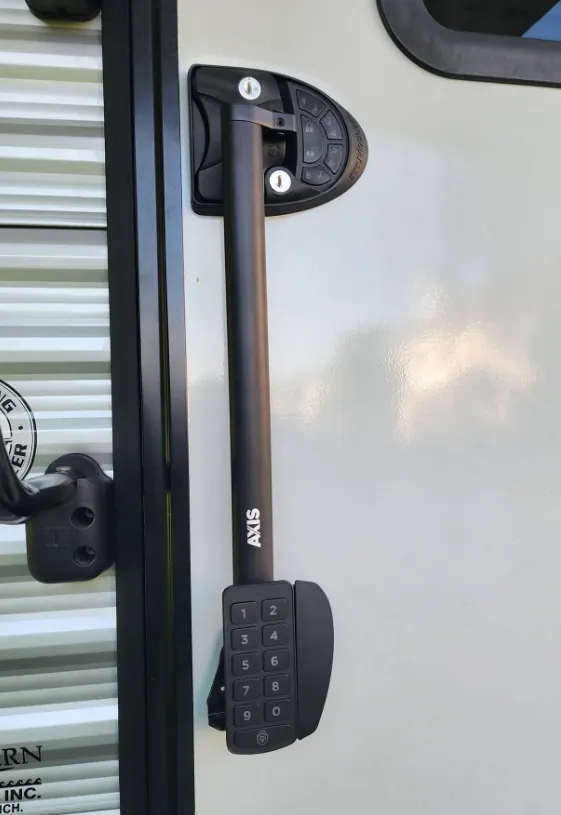
A keyless entry handle is a direct replacement for the factory RV entry handle. The outside half carries a numeric keypad and a motorized deadbolt, the inside half carries the battery pack and the control board, and a fob on your keyring does the same job from across the site. RVLock and Bauer both build units that drop into the standard cutout. What it buys you is control over who can open the door. You issue a code, you change a code, and a lost key stops mattering because there is no shared key code left in the system. That is real security value and it is the reason we install these. What it is not is a safe. The handle mounts in a thin aluminum door skin next to a window, so treat it as a strong deterrent and a genuine convenience, not as protection for valuables you would not leave in a parked car.
Will an RVLock or Bauer handle fit your door?
Fitment comes down to three measurements, and our technicians take all three before any parts come out of the van. The first is door thickness, which on most Florida coaches lands between one and a quarter and one and three quarter inches, measured with digital calipers at the handle itself rather than at the door edge. The second is the cutout. The common RV entry cutout runs about three and one eighth inches by six and three eighths inches, and a handle built for that opening drops straight in. Doors measuring taller or narrower need a trim adapter plate, or a careful enlargement with a step drill and a fine tooth jigsaw blade. The third is deadbolt height above the handle, because the frame strike has to line up with the new bolt. If those numbers do not agree, we tell you before you buy hardware rather than after.
What our technicians check before the old handle comes off
The order matters, because the most common reason a new keyless handle fails in month two is something worth catching in month zero. First we check door sag and closure, since a door that needs a shove to latch will stall a motorized deadbolt that has no square shoulder to push against. Hinge and alignment correction usually falls inside the first labor hour. Second we probe the frame around the handle and the deadbolt for soft spots, because a water damaged door stile will not hold the through bolts under load. That finding moves the job onto our moisture and leak survey work rather than a straight handle swap. Third we confirm the existing latch mechanism actually functions, since a keyless handle does not repair a worn latch. That is separate work, and it lives on our entry door latch repair page.
The install: sealing, deadbolt alignment and fob pairing
With fitment confirmed, the swap itself is straightforward. The old handle comes out, the cutout gets cleaned, and a fresh bead of butyl putty tape goes behind the new exterior escutcheon, because a keypad that leaks is a keypad that corrodes. Through bolts get snugged by hand and never driven with an impact driver, since overtightening bows the exterior plate and binds the deadbolt. Deadbolt alignment is where most owner installs go wrong. We cycle the bolt into the frame strike and look for free travel on both sides of it, then file or shim the strike until the motor throws the bolt without loading up against the frame. Pairing comes last. Fobs are learned to the interior control board in a set sequence, then we program a master code and a separate guest code and hand you both, written down.
Florida failure modes: salt air, UV and five idle months
Snowbird use patterns are what actually kill these handles here, not daily use. A rig that sits from April to October on a coastal lot near Clearwater or Naples has salt laden humidity working into the keypad membrane and the battery contacts, and the first symptom is a keypad where two or three digits stop responding while the fob still works fine. Alkaline AA cells left in the handle over a long idle season are the other half of the problem. They leak, they corrode the contacts, and the repair becomes a control board replacement instead of a battery change. Lithium AA cells and a light film of dielectric grease on the contacts prevent nearly all of that. UV is the slow one. Florida sun hazes the printed keypad overlay and hardens the rubber fob buttons, so park with the entry door out of afternoon sun where the site allows it.
Costs, timing, and what putting it off turns into
Our service call covers the trip out and the first hour on site at the rate in the pricing table on this page; anything past that first hour is quoted and approved before we carry on. The handles themselves typically retail somewhere between one hundred fifty and three hundred dollars depending on model and finish. A clean swap into a matching cutout is usually a sixty to ninety minute job. A door needing cutout enlargement, hinge correction or an adapter plate runs closer to two hours on site. Left alone, the failure path is predictable. A weak battery pack becomes a stalled deadbolt, a stalled deadbolt gets forced by hand, and forcing it bends the bolt and chews the frame strike, which turns a battery change into door frame repair. Change the batteries on a schedule, not on a warning beep you may not hear.
Sources
Every figure on this page comes from a manufacturer document or a standards body, not from another repair site. Here is where each one comes from.
- RVLock - manufacturer support and fitment resourcesManufacturer fitment data for RVLock keyless entry handles, including door thickness range, standard cutout dimensions and the fob pairing procedure.
- Bauer Products - RV lock and keyless entry product lineThat Bauer builds keyless entry handles designed to drop into the standard RV entry door cutout, and the alternative fitment path when an RVLock does not suit the door.
- Lippert TI-126: Keyless Entry Door System - Key Fob (CCD-0002020)That Lippert's own keyless entry doors are built on Southco latches, that the Southco key code is a three-digit code stamped on the key, and that the same code can be read off the latch plate behind the inside handle - the factory hardware a keyless handle replaces.
Related repairs
Other systems we service
Where we work
Service category
What this usually costs
| Item | Price | What it covers |
|---|---|---|
| Service call | $299 | Includes the trip out to your RV and the first hour on site |
| Work past the first hour | Quoted after diagnosis | We tell you what it will take before we carry on |
| Parts | Quoted per job | Special-order parts may need a deposit before we order them |
| Written estimate | No charge | You approve the estimate before any work starts |
The service call covers the trip out to your RV and the first hour on site. Anything beyond that depends on what we find, and we quote it and get your approval before carrying on.
The price ranges on this page come from our own recent jobs across Florida, not from an industry average. What you pay depends on the rig, the parts it needs and what we find on site, so we give you a written estimate before any work begins and you approve it first.
Frequently asked questions
Do you handle emergency roadside service if we get locked out?
Yes. We run mobile service across Florida and lockouts are one of the calls we take. Once you are back inside, a keyless handle is the usual permanent fix, because a code cannot be locked inside the rig the way a key can. Our service call is a typical one hundred twenty five to two hundred fifty dollar range, most commonly one hundred forty, with the first hour of diagnostics usually included.
Is it true one key opens most RV storage compartments?
For baggage compartments, largely yes. The CH751 code is close to an industry standard across manufacturers, so a very large share of RV compartment doors share it. Entry doors draw from a somewhat bigger pool of codes, but still a limited one. That is the honest argument for changing your own locks. Compartment rekeying is separate work covered on its own page.
How long does the install take?
About sixty to ninety minutes when the new handle matches your existing cutout and the door closes squarely on its own. Budget closer to two hours if the cutout needs enlarging with a step drill and jigsaw, if the door has sagged and needs hinge correction first, or if the deadbolt strike has to be relocated in the frame.
What batteries do these use and how long do they last?
Most of the handles we install run on AA cells in the interior half, with a small coin cell in the fob. A fresh set should read right around six volts, and we start seeing the deadbolt motor stall intermittently below roughly five point two volts. In Florida we recommend lithium AA cells, especially if the rig sits through a summer, because alkalines leak and corrode the contacts.
Will a keyless handle stop someone breaking into my RV?
It is a strong deterrent, not a safe. It removes the shared key code problem, it lets you change access instantly, and it means no key is hidden under the entry step. It is still mounted in a thin door skin beside a window, so treat valuables accordingly and ask our technicians about hitch and compartment security for the rest of the coach.
Can you keep my old key working as a backup?
Most keyless handles include a mechanical key override, and we hand you those keys, but they carry new codes rather than your old ones. That is the entire point of the upgrade. If you want every lock on the coach running on one new key, tell our technicians up front and we will plan the compartment work into the same visit.