RV Water System Blowout: Air Pressure Limits and Sequence
Blowing out RV water lines? The safe ceiling is 30 psi, set by the pump and not the pipe. Mobile blowout and line draining in Florida. Call 888-759-1438.
A water system blowout clears an RV's fresh water plumbing by pushing regulated compressed air in through the city water inlet until every fixture runs dry. The safe ceiling is 30 psi, and the weakest part in the loop sets it rather than the pipe. Pentair rates the SHURflo Revolution 4008 pump at 30 PSI maximum inlet pressure, and Truma tells AquaGo owners not to use high-pressure air on that unit at all.
What the Blow-Out Plug at the City Water Inlet Does
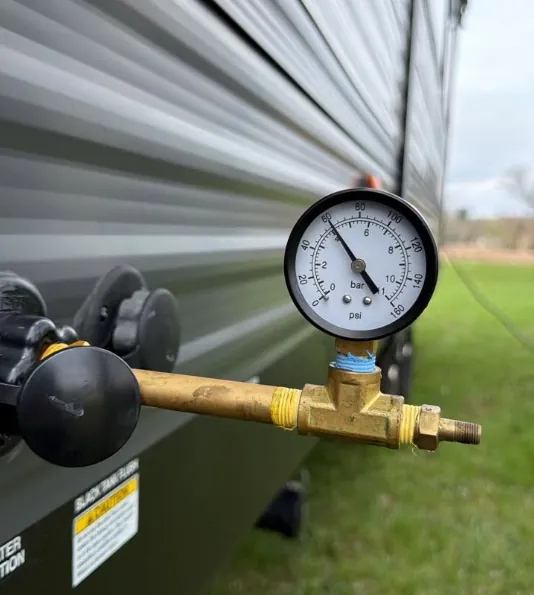
A blow-out plug is a short adapter with a Schrader air valve on one end and a male garden hose thread on the other, and it threads into the coach's city water inlet in place of the water hose. Air entering there follows the exact path municipal water takes: past the inlet's one-way check valve, into the cold manifold, out along the PEX runs to every fixture, and finally out of whichever tap is open. That is the entire mechanism, and it is why the inlet is the only correct entry point for air. Feeding the compressor into the gravity fill or the pump outlet drives air backwards through parts built to pass flow one way, and the check valve inside a SHURflo pump head will simply refuse it. The hardware list is short: a compressor with a working regulator and gauge, a quarter inch quick-connect coupler, and the plug. Everything that goes wrong on this job is pressure and order, not parts.
The Maximum Air Pressure an RV Water System Tolerates
The limit is a component rating, not a rule of thumb, and it belongs to whichever part in the loop gives up first. Pentair's technical data sheet for the SHURflo Revolution 4008 lists inlet pressure as 30 PSI maximum, with the pressure switch shutting off at 55 psi and restarting at 40 psi. Suburban sits far above that: the relief valve on its Nautilus tankless heater is built to open at 145 PSI or 210 degrees, and cross-linked polyethylene tubing is rated well beyond anything a regulator will pass, so neither the pipe nor the tank is the limiting part. Truma goes the other way and states plainly that it does not recommend high-pressure air when winterizing the AquaGo. Manufacturers genuinely disagree here, and when they disagree the lowest published figure has to win, because the weakest component decides what the system tolerates. Set the regulator to 30 psi and the whole argument goes away.
Why a 120 psi Shop Compressor Costs You a Fitting
A compressor tank sitting at 120 or 150 psi is not a setting, it is storage, and the regulator is the only thing standing between that stored pressure and a half inch PEX crimp. Hook a bare hose to a blow-out plug and the first thing that yields is usually a fitting the coach builder put somewhere unreachable, behind a shower surround or above a slide floor. The second is a toilet water valve, because a pedal-operated valve on a Thetford Aqua-Magic or a Dometic bowl seals against water pressure and its diaphragm was never asked to hold dry air at four times the system's working range. A pump pressure switch can be knocked out of calibration the same way. None of those parts are expensive on their own. The cost is that a weeping crimp behind a wall does not announce itself until the panel below it is soft, which is why the regulator is not optional equipment on this job.
What Owners Describe, and the Order Our Technicians Check It
The call almost always arrives in spring, phrased as water on the floor the first time the pump is switched on, or a hiss behind a wall that stops when the pump cuts out. The check order starts at the cheapest end: pressurize to 30 psi with the pump off and listen, then isolate the hot side at the water heater bypass valves to see whether the leak follows hot or cold. Next comes the toilet valve and the shower mixer, then the low point drains, then the pump head itself, because a switch that will not cut off mimics a leak convincingly. Left through a summer, a seeping fitting stops being a plumbing repair and becomes a floor.
Do the test before the trip rather than after the first cold night. A system that holds pressure overnight on a gauge has told you more than a season of hoping.
The Sequence: Bypass the Heater, Then Low Side to High Side
Order matters more than technique. Drain the fresh tank and open both low point drains first, then close the heater off at its bypass valves and drain the tank separately by pulling the anode rod with a 1-1/16 inch socket, which is the method Suburban publishes in its own operation guide. A six gallon tank will not empty through a half inch line on air, and blowing through it only pushes hot side water back into the cold manifold. With the pump switched off, set the regulator to 30 psi and open one fixture at a time, starting with the one furthest from the inlet and working back: cold then hot at each, then the toilet, the outside shower, the ice maker line and any washer inlet. Run the whole circuit a second time, because water that clung to a horizontal run releases on the second pass and the first pass alone leaves it there.
The Florida Case: Biofilm Before Storage, and the Panhandle Freeze
For most Florida coaches the point of a blowout has nothing to do with ice. A snowbird rig parked from April to November holds warm standing water in dead legs the whole time, and warm wet plumbing is where biofilm establishes itself and where the rotten egg smell owners report in November comes from. Dry lines grow nothing, which is why emptying the system beats leaving it full even in Fort Myers. Freeze is a real second reason north of the peninsula: Tallahassee, Pensacola and the western panhandle drop below freezing every winter, the January 2025 Gulf Coast snowstorm put measurable snow on the ground there, and hard freezes reach inland as far south as the Gainesville and Ocala corridor. Owners heading north in March meet the same problem in Georgia and the Carolinas before they arrive.
Sources
Every figure on this page comes from a manufacturer document or a standards body, not from another repair site. Here is where each one comes from.
- Pentair SHURflo Revolution 4008 product technical data sheetInlet pressure 30 PSI maximum, shut-off 55 PSI, restart 40 PSI - the pump rating that sets the blowout ceiling
- Truma AquaGo winterizing guidanceTruma states it does not recommend high-pressure air or antifreeze solutions when winterizing the AquaGo
- Truma AquaGo Comfort technical detailsAquaGo water operating pressure of 65 psi
- Suburban tank water heaters operation guideBypass the heater and drain it by removing the anode rod with a 1-1/16 socket rather than blowing air through the tank
- Suburban Nautilus tankless water heater operation guideRelief valve opens at 210 degrees or 145 PSI, showing the heater is not the pressure-limiting component
Related repairs
- our Rv Antifreeze Fill service
- Rv De Winterization Sanitize in Florida
- how we handle rv long term storage prep
Other systems we service
Where we work
Service category
What this usually costs
| Item | Price | What it covers |
|---|---|---|
| Service call | $299 | Includes the trip out to your RV and the first hour on site |
| Work past the first hour | Quoted after diagnosis | We tell you what it will take before we carry on |
| Parts | Quoted per job | Special-order parts may need a deposit before we order them |
| Written estimate | No charge | You approve the estimate before any work starts |
The service call covers the trip out to your RV and the first hour on site. Anything beyond that depends on what we find, and we quote it and get your approval before carrying on.
The price ranges on this page come from our own recent jobs across Florida, not from an industry average. What you pay depends on the rig, the parts it needs and what we find on site, so we give you a written estimate before any work begins and you approve it first.
Frequently asked questions
What is the maximum air pressure for blowing out RV water lines?
Thirty psi. That figure is not a convention, it is the lowest published component rating in the loop: Pentair's data sheet for the SHURflo Revolution 4008 gives inlet pressure as 30 PSI maximum. Pipe and heater tanks tolerate far more, so quoting their ratings is misleading. The weakest part decides, and on almost every coach built in the last twenty years that part is the fresh water pump.
Can I use my shop compressor if it only goes down to 120 psi?
Not directly. Tank pressure is storage, and what reaches the coach is whatever the regulator passes, so the compressor rating is irrelevant as long as an adjustable regulator and a working gauge sit between the tank and the blow-out plug. A compressor with no regulator, or with a gauge that reads tank pressure rather than line pressure, is the setup that splits a crimp fitting behind a wall.
Do I have to bypass the water heater before blowing out the lines?
Yes, and you also have to drain it separately. Suburban's operation guide has owners close the heater off at its bypass kit and empty the tank by removing the anode rod with a 1-1/16 inch socket. Air will not move six gallons out through a half inch line, so a heater left in circuit stays full and quietly feeds water back into the cold side as soon as the air stops.
Can you blow out a Truma AquaGo the same way?
No, and we will not do it. Truma's own winterizing guidance says it does not recommend high-pressure air or antifreeze solutions on the AquaGo, and directs owners to the unit's drain sequence instead. The AquaGo is a heat exchanger rather than a tank, with a water operating pressure of 65 psi and internal passages that do not empty the way a straight PEX run does. Manufacturer procedure wins over habit.
If I blow the lines out, do I still need RV antifreeze?
For anything that holds water by design, yes. Air cannot clear a P-trap under the galley, lavatory or shower, and it will not empty the toilet bowl seal or the charge sitting behind the flush valve. The usual right answer is both methods: blow the supply lines dry, then pour non-toxic antifreeze into each trap and the bowl. That is a separate job from filling the whole system.
Does an RV that never leaves Florida really need a blowout?
Usually yes, for water quality rather than freeze protection. A system sitting full and warm through a Florida summer is an ideal place for biofilm, and that is what the sulfur smell after storage generally is. Freeze matters too north of the peninsula, where the panhandle and north Florida see hard freezes every winter and an unprepared coach can split a line overnight.