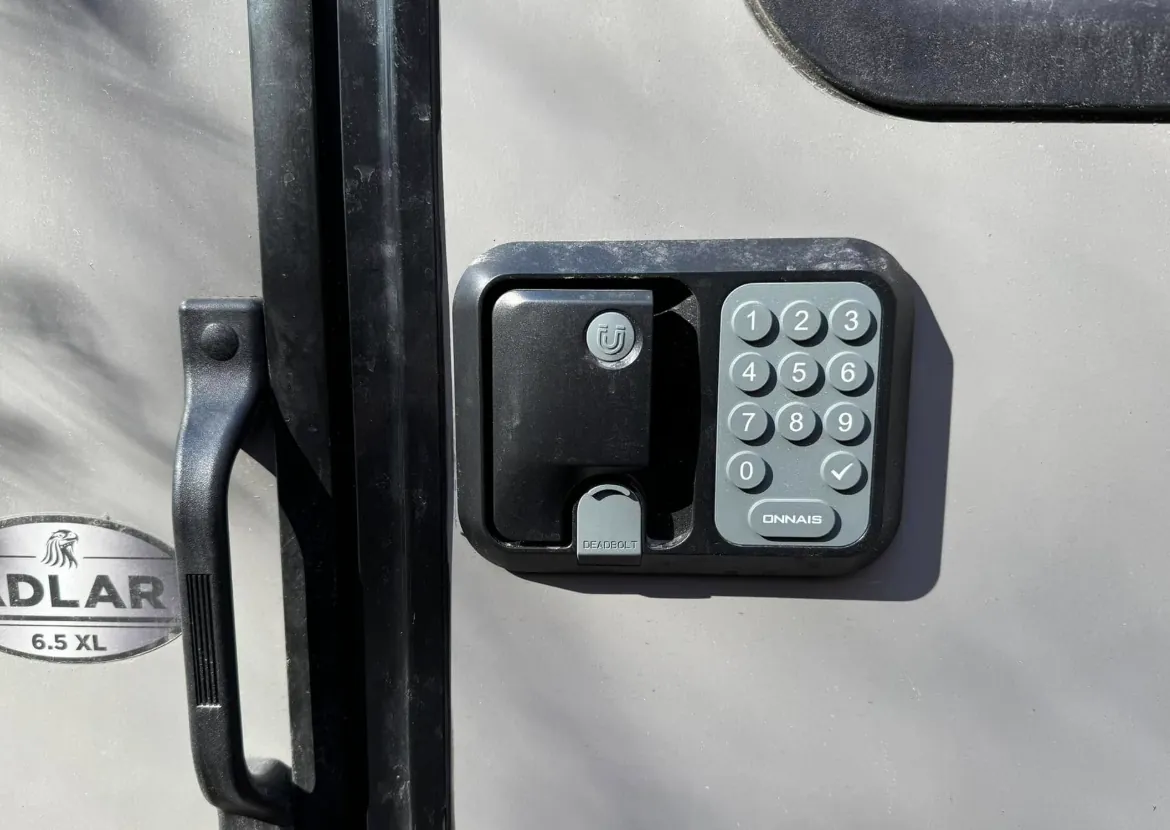
RV Entry Door Latch and Strike Repair - Mobile Service FL
RV entry door that will not latch, or pops open on the road? Mobile latch, strike plate and handle repair anywhere in Florida. Call 888-759-1438.
An RV entry door latch is the spring-loaded bolt behind the outside paddle handle, and it holds the door shut by dropping into a strike plate screwed to the door frame. A separate deadbolt above it locks but carries no road load. When the two stop meeting, the cause is usually not the latch itself.
What the latch, the strike and the handle each do
Three separate pieces of hardware hold an RV entry door shut, and they fail independently of one another. The paddle handle on the outside withdraws a spring-loaded latch bolt from a strike plate screwed into the door frame, and that latch is the only thing holding the door closed while the coach is moving. Above the handle sits a deadbolt, thrown by the key outside or a thumbturn inside, which drops a square bolt into a second pocket in the same frame. It is a lock rather than a latch, and it carries none of the road load. The third piece is the strike plate, a stamped plate mortised into a frame often no thicker than the sidewall laminate behind it. Lippert, Fastec Industrial under its FIC brand, and Southco supply most factory-fitted assemblies, and Lippert's service library splits entry door troubleshooting between the Fastec and Southco designs on separate technical sheets.
The symptom owners describe, and why it is a safety problem

Owners describe this failure the same way almost every time. The door needs a shove, or a lift on the handle, or a hip against it, and then one day it swings open on the interstate. That second half is why this is not a maintenance annoyance. A door that only latches on the second try is being held by a bolt sitting part way onto its strike ramp, and the load that finishes the job is a crosswind, a passing semi or a bridge expansion joint. Once it opens at speed the wind takes it fully open, which tears hinge screws out of the door stile and can put a swinging panel into the lane beside you. The test is simple and worth doing before the next trip. Pull the door shut with one finger on the handle and no lift at all. If it does not seat on the first pull, the latch is not fully engaging.
Four reasons the latch stops meeting the strike
Four things push a latch out of line with its strike, and they get checked in this order because each one changes the measurement for the next. The first is door sag. An entry door is heavy, its hinges thread into a thin aluminum stile, and once those screw holes elongate the whole leaf drops so the latch bolt arrives below its pocket. Second is a strike plate that has worked loose. The frame behind it is laminated wall rather than solid timber, so short screws driven into foam spin free after a few thousand slams, and the fix is a backing plate or riv-nuts instead of a longer screw. Third is the bulb weatherseal. Sustained heat and humidity take the spring out of the rubber, it stops pushing the door back onto the latch evenly, and the closed gap changes. Fourth is frame flex on an older coach sitting on a crowned site, which racks the opening enough to move the strike.
Why adjusting the strike only works on a square door
Repositioning the strike plate is the repair almost every owner tries first, and it is the correct repair only when the door itself is still square. Lippert builds entry doors with deliberate positive camber, and measures it with a straightedge against the inside of the frame: the gap at the center of the door belongs between an eighth and a quarter of an inch, and a door whose latch edge meets the frame before its corners has negative camber. That matters because an under-cambered or negative door no longer presses its latch bolt toward the strike at the same height along the whole leaf. Move the strike on a door in that condition and you buy a few weeks, then the door seals on one corner only and starts letting water past the seal. So the sequence runs backwards from instinct. Measure camber, correct camber, adjust the strike last. Lippert documents one method using shop supplies and another using its camber adjustment tool, part 2023002404, which must not be used on G Series glass panel doors.
Deadbolt, paddle latch and screen door latch are three jobs
The paddle latch, the deadbolt and the screen door latch are separate mechanisms, and telling them apart is most of the diagnosis. Fastec sells its FIC travel trailer lock both with a deadbolt and without one, and the dual-cylinder versions run the handle and the deadbolt on separate cores, which is the plainest evidence that the two are independent. The reading that separates them takes about ten seconds. If the key throws the deadbolt smoothly into its pocket but the paddle will not hold the door, the door and frame are still close to square and the latch assembly itself is worn. If the deadbolt also binds or misses, the door has moved and no latch work will fix that. The screen door latch is its own small repair. Bauer's replacement lever for Lippert screen doors, part 402-602-000, is glass-filled nylon and lists at about twenty one dollars.
What each finding costs, and what it turns into if left
Pricing follows the same structure as the rest of our mobile work. Our service call covers the trip out and the first hour on site at the rate in the pricing table on this page; anything past that first hour is quoted and approved before we carry on. Hinge screw repair and a strike reposition normally finish inside that first hour. Camber correction plus a full latch assembly adds parts and roughly another hour on site. Florida rigs give this failure no rest, because there is no winter lay-up here and the door keeps cycling twelve months a year while a northern coach sits covered for five of them. Left alone the path is predictable. A partly engaged latch wears a groove in its own ramp, the deadbolt gets pressed into service as the primary latch until that pocket elongates too, and a seal that never compresses evenly begins tracking water into the frame corner.
Sources
Every figure on this page comes from a manufacturer document or a standards body, not from another repair site. Here is where each one comes from.
- Lippert Customer Care Center - RV entry doorsThat Lippert splits entry door latch troubleshooting between the Fastec and Southco latch designs (TI-099, TI-117) and publishes separate camber adjustment procedures for the door itself (TI-156 using shop supplies, TI-453 using the camber tool).
- Lippert TI-453: Adjusting RV Entry Door Camber Using Camber Adjustment Tool (CCD-0007331)The published camber specification - with a straight edge held against the inside of the door frame, correct positive camber is a gap of 1/8 inch to 1/4 inch measured at the center of the door, under 1/8 inch calls for camber to be added and over 1/4 inch for it to be reduced - the definition of negative camber as the latch area of the door contacting the frame first, and the manufacturer warning that tool 2023002404 must not be used on G Series glass panel doors.
- NHTSA recall 13E039 - Fastec Industrial (FIC) RV entry door locks, models 43610, 40610 and 44610That the deadbolt is a separate mechanism from the latch, and that on FIC locks built between January 2006 and April 2013 the key could be withdrawn in a position that jammed that deadbolt - a failure of the lock alone, with the latch unaffected.
- Bauer Products RV screen door latch 402-602-000That the screen door latch is a separate serviceable part from the entry door latch, its part number, its glass-filled nylon UV resistant construction, and its approximate retail price.
Related repairs
- our Compartment Lock Rekey service
- Hitch Coupler Lock Install in Florida
- how we handle rv security camera install
Other systems we service
Where we work
Service category
What this usually costs
| Item | Price | What it covers |
|---|---|---|
| Service call | $299 | Includes the trip out to your RV and the first hour on site |
| Work past the first hour | Quoted after diagnosis | We tell you what it will take before we carry on |
| Parts | Quoted per job | Special-order parts may need a deposit before we order them |
| Written estimate | No charge | You approve the estimate before any work starts |
The service call covers the trip out to your RV and the first hour on site. Anything beyond that depends on what we find, and we quote it and get your approval before carrying on.
The price ranges on this page come from our own recent jobs across Florida, not from an industry average. What you pay depends on the rig, the parts it needs and what we find on site, so we give you a written estimate before any work begins and you approve it first.
Frequently asked questions
Why does my RV door only latch if I lift the handle?
Lifting takes the weight off the hinges and raises the latch bolt back to the height of its strike pocket. That means the door has sagged, usually because the hinge screws have elongated their holes in the aluminum door stile. The latch itself is often fine. Correct the hinges and the camber first, because a strike moved to suit a sagging door has to be moved again as the sag continues.
Can I just move the strike plate over?
Sometimes, and it is the right fix when the door still closes square and the strike has simply loosened. Check camber with a straightedge against the inside of the frame first. If the gap at the center of the door is under an eighth of an inch, or the latch edge meets the frame first, the door is under-cambered or negative and moving the strike is a patch. Check what the screws bite into as well, because laminated sidewall needs a backing plate rather than longer screws.
Is a door that pops open while driving actually dangerous?
Yes, and that is why this gets treated as urgent rather than cosmetic. At speed the wind catches the leading edge and throws the door fully open, which tears hinge screws out of the stile, dents the sidewall the door slams against, and puts a swinging panel into the next lane. It also removes the only barrier between a moving vehicle and an open doorway.
The deadbolt locks fine but the handle will not hold the door. Which part failed?
That combination points at the latch assembly rather than the door. The deadbolt and the paddle latch engage separate pockets in the frame and, on FIC style locks, separate cylinders, so a deadbolt that throws cleanly shows the door and frame are still close to aligned. The paddle mechanism, its spring or its ramp is worn, and the assembly gets replaced rather than adjusted.
Why did the door start missing in summer when it latched fine all winter?
The bulb weatherseal is the usual answer. Sustained heat and humidity take the spring out of the rubber and it takes a permanent set, so it stops pushing the door back against the latch with the same force and the closed gap changes by a couple of millimeters. That is enough to move a marginal latch from just catching to not catching, so seal condition gets checked before anything is unbolted.
How long does entry door latch repair take and what does it cost?
Our service call covers the trip out and the first hour on site at the rate in the pricing table on this page; anything past that first hour is quoted and approved before we carry on. Most of these are single visit repairs. A strike reposition with hinge screw repair generally fits inside the first hour. Camber correction plus a new latch assembly runs closer to two hours plus parts.