RV Hitch and Coupler Lock Installation - Mobile Florida
Coupler locks, king pin locks and hitch pin locks fitted at your site anywhere in Florida. Which one you actually need, and what it stops. Call 888-759-1438.
Before a lock is ordered, three things get checked in order: the coupler style and ball size stamped on the casting, the condition of that coupler, and what is holding the weight when the rig sits unhitched. Those three answers decide whether the right part is a coupler lock, a fifth wheel king pin lock, or a receiver pin lock. Buying before measuring is the single most common mistake owners make here.
Coupler lock, king pin lock, or hitch pin lock?
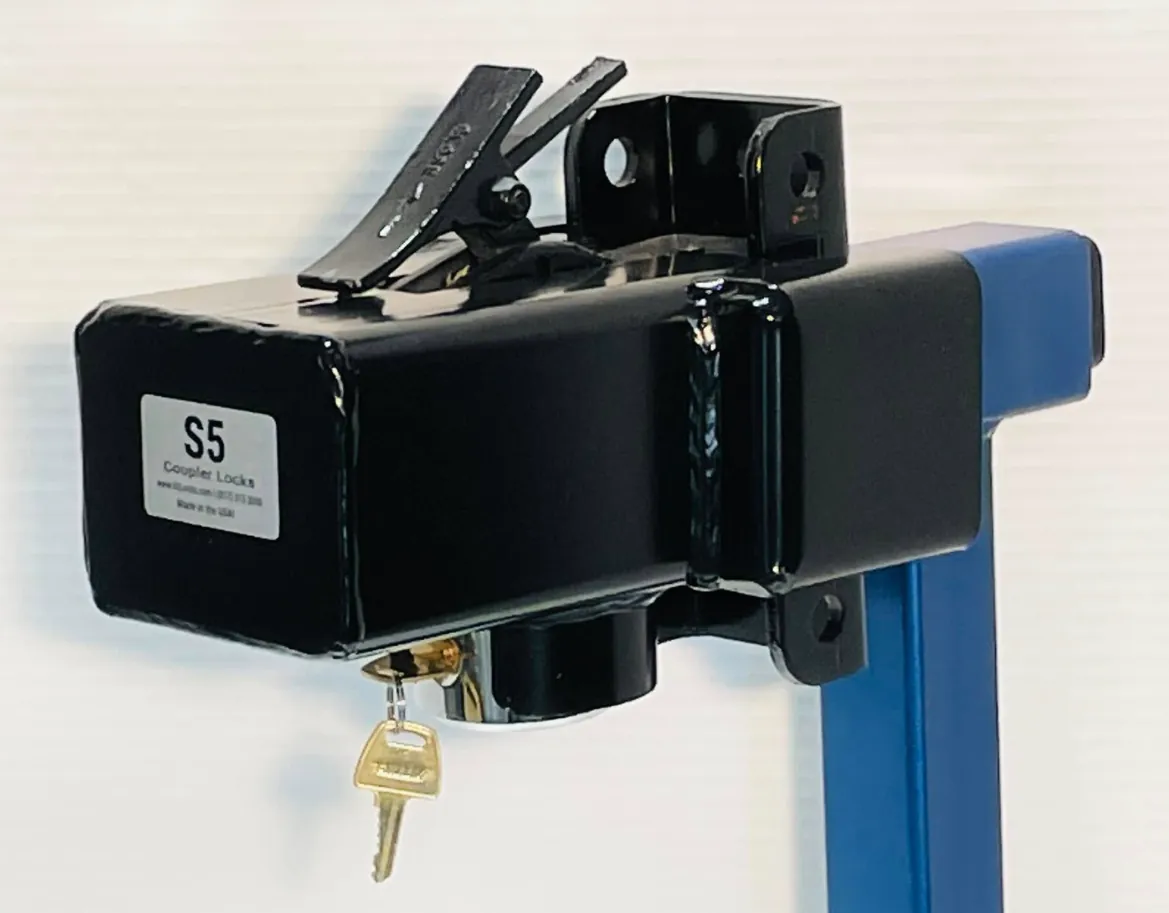
Three different products get called a hitch lock, and they secure three different things. A coupler lock fills or clamps the ball socket on a bumper pull trailer so the throat cannot drop onto a stranger's ball. A king pin lock, such as the Blaylock TL-70 King Pin Coupler Lock, encases the king pin on a fifth wheel so no truck's jaw can close on it. A hitch pin lock, like the BOLT 5/8 inch receiver lock, only stops a drawbar or ball mount sliding out of the receiver tube, which protects an accessory rather than the trailer. An owner who buys a receiver pin lock and leaves a travel trailer parked overnight has locked the ball mount into the truck and left the trailer towable by anyone carrying a matching ball. The question that settles it is simple: what is bearing the weight while the rig is parked?
Measure the coupler before anything is ordered

Coupler sizes are not interchangeable, and one builder ships several. Lippert's own towing component list covers a 2 inch Pacific Rim A-frame coupler rated 5,000 pounds, part 191964, alongside a 2-5/16 inch 14,000 pound 50 degree coupler, part 135430, and an undermount Pacific Rim unit, part 351718. Blaylock American Metal does not sell one lock for all of that: the TL-38 suits a 1-7/8 inch lip, the TL-36 a 2 inch straight lip, the TL-34 a 2-5/16 inch lip, while the TL-22 and TL-23 exist purely because a Bulldog style casting is a different shape at the same ball size. A universal lock such as the Master Lock 389DAT spans 1-7/8, 2 and 2-5/16 inch couplers, which by definition means slack on the smaller ones. A tape measure across the socket and the size stamped in the casting settle it in two minutes.
What a security rating actually certifies
A rating is a bench test result, not a promise. Under the ANSI/BHMA A156 series, grades run 1, 2 and 3 with grade 1 highest, and the Builders Hardware Manufacturers Association describes those grades as progressive levels of performance benchmarks defined inside each applicable standard, covering cycle, operational, strength, security and finish requirements. That is a laboratory sequence with defined tools and defined durations. It says nothing about a dark storage row and unlimited time. Master Lock states a high security level for the 389DAT and describes it as suited to moderate-risk environments, and puts the whole lock at 1.93 pounds. A rating also only ever covers the lock. It certifies nothing about the coupler casting the lock clamps onto, which is the part a thief will look at second. Match the lock to the coupler you actually have, not to the trailer class.
Salt air, seized cylinders and the wrong lubricant

A coupler lock lives outdoors, low to the ground, taking road spray and coastal air on a component whose working parts are small springs and wafers. On the coast that cylinder drags, then binds, then stops turning, and a seized lock on your own trailer is its own emergency because the rig cannot move until it is cut off. The lubricant choice is where most of the damage is done. Master Lock's service guidance says to lubricate with Master Lock Lubricant 2300D and to never use dry graphite or a silicone lubricant, which are the two products most commonly grabbed off a shelf for a sticky lock. Cylinder design matters too. BOLT locks permanently learn the first key inserted and cannot be reset, so a corroded BOLT cylinder with a worn key is a cutting job, not a rekey.
A worn or damaged coupler is a different job
One of the questions that comes in on our own recorded lines is whether someone can check that a coupler is okay after it popped off. That is an honest question and it is not a lock job. Lippert's aftermarket A-frame coupler manual, document CCD-0001314 for part 135430, lists a welder and welding protective equipment under resources required, and the procedure opens by cutting the existing welds to free the coupler from the A-frame with the trailer supported. Replacing a coupler is fabrication on the towing structure. Apex does not do chassis work, so a spread throat, an elongated latch hole, a cracked weld or a latch that will not hold a 2-5/16 inch ball gets reported and referred out to a trailer or welding shop. A lock fitted over a worn coupler hides the wear rather than fixing it.
Check order, cost of each finding, and what waiting turns into
The order rarely changes. Ball size and casting style first, then coupler condition, then the lock already on hand if there is one, then the cylinder and how the owner stores the rig. Our service call covers the trip out and the first hour on site at the rate in the pricing table on this page; anything past that first hour is quoted and approved before we carry on. A straightforward coupler lock or king pin lock fitting normally finishes inside that first hour. A wrong size lock already bought means a refit and a correct part. A dragging cylinder means flushing and lubricating, or replacing the lock if the wafers are gone. Left alone, the two outcomes are a trailer that stays towable by anyone with a ball, or a lock that seizes shut and strands the rig where it is parked.
Sources
Every figure on this page comes from a manufacturer document or a standards body, not from another repair site. Here is where each one comes from.
- Lippert - A-Frame and Pac Rim Couplers component listCoupler part numbers and sizes from one builder: 135430 is a 2-5/16 inch 14,000 pound 50 degree coupler, 191964 is a 2 inch Pacific Rim A-frame coupler at 5,000 pounds, 351718 is a Pacific Rim undermount coupler.
- Lippert - A-Frame Coupler Installation and Owner's Manual, CCD-0001314Replacing an A-frame coupler requires a welder and welding PPE under resources required, and begins by cutting the existing welds with the trailer supported, which is why coupler replacement is referred out rather than performed as an accessory job.
- Blaylock American Metal - coupler lock rangeLock model is tied to coupler geometry, not just ball size: TL-38 for 1-7/8 inch lip couplers, TL-36 for 2 inch straight lip, TL-34 for 2-5/16 inch lip, TL-22 and TL-23 for Bulldog style, TL-50 for gooseneck and TL-70 for king pin.
- BOLT Lock - 5/8 inch receiver lockA receiver pin lock is sized by hitch class, with the 5/8 inch pin fitting Class 3, 4 and 5 hitches and the 1/2 inch pin fitting Class 1 and 2, and it secures only the ball mount in the receiver tube.
- Master Lock - 389DAT universal trailer coupler lockUniversal fit across 1-7/8, 2 and 2-5/16 inch couplers, a manufacturer stated high security level described as suited to moderate-risk environments, and a 1.93 pound product weight.
- Master Lock - product maintenance and service guidanceLubricate with Master Lock Lubricant 2300D and never use dry graphite or a silicone lubricant on a lock that has become hard to turn.
Related repairs
Other systems we service
Where we work
Service category
What this usually costs
| Item | Price | What it covers |
|---|---|---|
| Service call | $299 | Includes the trip out to your RV and the first hour on site |
| Work past the first hour | Quoted after diagnosis | We tell you what it will take before we carry on |
| Parts | Quoted per job | Special-order parts may need a deposit before we order them |
| Written estimate | No charge | You approve the estimate before any work starts |
The service call covers the trip out to your RV and the first hour on site. Anything beyond that depends on what we find, and we quote it and get your approval before carrying on.
The price ranges on this page come from our own recent jobs across Florida, not from an industry average. What you pay depends on the rig, the parts it needs and what we find on site, so we give you a written estimate before any work begins and you approve it first.
Frequently asked questions
Will a universal coupler lock fit my trailer?
Usually, but universal means it spans a range rather than matching one size. The Master Lock 389DAT covers 1-7/8, 2 and 2-5/16 inch couplers, so on the two smaller sizes it sits with slack. Slack is what lets a lock be levered or worked off, and it lets the lock body knock against the casting while towing. A size specific lock is a better fit on a trailer that lives outdoors.
My fifth wheel is hitched to the truck. Do I still need a king pin lock?
While it is hitched and the jaws are closed, the king pin lock has nothing to do, and it physically will not fit around an engaged pin. The king pin lock is for the time the trailer sits on its landing gear without the truck under it. That is also when a fifth wheel is easiest to take, because a thief only needs a hitch of the right height and a working set of jaws.
Does a hitch pin lock stop someone taking my trailer?
No. A receiver pin lock, such as the BOLT 1/2 inch unit for Class 1 and 2 hitches or the 5/8 inch unit for Class 3, 4 and 5 hitches, only keeps the ball mount from sliding out of the square receiver tube on the tow vehicle. It protects the drawbar. A trailer parked on its own needs a coupler lock or a king pin lock instead.
Can you check if our RV coupler is okay after it popped off?
We can look at it and tell you what we see, including whether the throat looks spread, whether the latch still captures the ball and whether any weld looks cracked. What follows is where the line sits. Replacing or repairing a coupler is welding work on the towing structure, which is not a service Apex offers, so that finding gets referred to a trailer or welding shop rather than handled on site.
What should I use to lubricate a coupler lock in Florida?
Follow the lock maker rather than a general habit. Master Lock's service guidance is to use Master Lock Lubricant 2300D and to never use dry graphite or a silicone lubricant, which is the opposite of what many owners assume. Work the key several times after lubricating, and do it before a rig goes into storage instead of after, because a cylinder that has already bound needs flushing first.
How much does fitting a coupler lock cost, and how long does it take?
Measuring the coupler, fitting a correctly sized lock and lubricating the cylinder is normally one short visit. The service call covers the trip out and the first hour on site, and a straightforward coupler lock or king pin lock fitting finishes inside it. A price is only firm once the coupler has been measured, because a lock bought before measuring means a second part and a refit, and a cylinder that has already seized has to be flushed or replaced rather than simply fitted.