RV Slide Out Seal and Wiper Replacement - Mobile Florida
Mobile RV slide out seal and wiper replacement across Florida. Hardened bulb, wiper and D-seals leak and rot slide floors. Call 888-759-1438.
Nearly every rotted slide floor our technicians open started as a seal job that somebody deferred. Slide-out seals are the bulb, wiper and D-seal profiles that keep water out of the wall opening whether the room is extended or retracted, and they harden and quit sealing long before they look bad from the ground. Apex RV Repair replaces them on site anywhere in Florida.
Bulb, Wiper and D-Seal: Three Profiles Doing Three Different Jobs
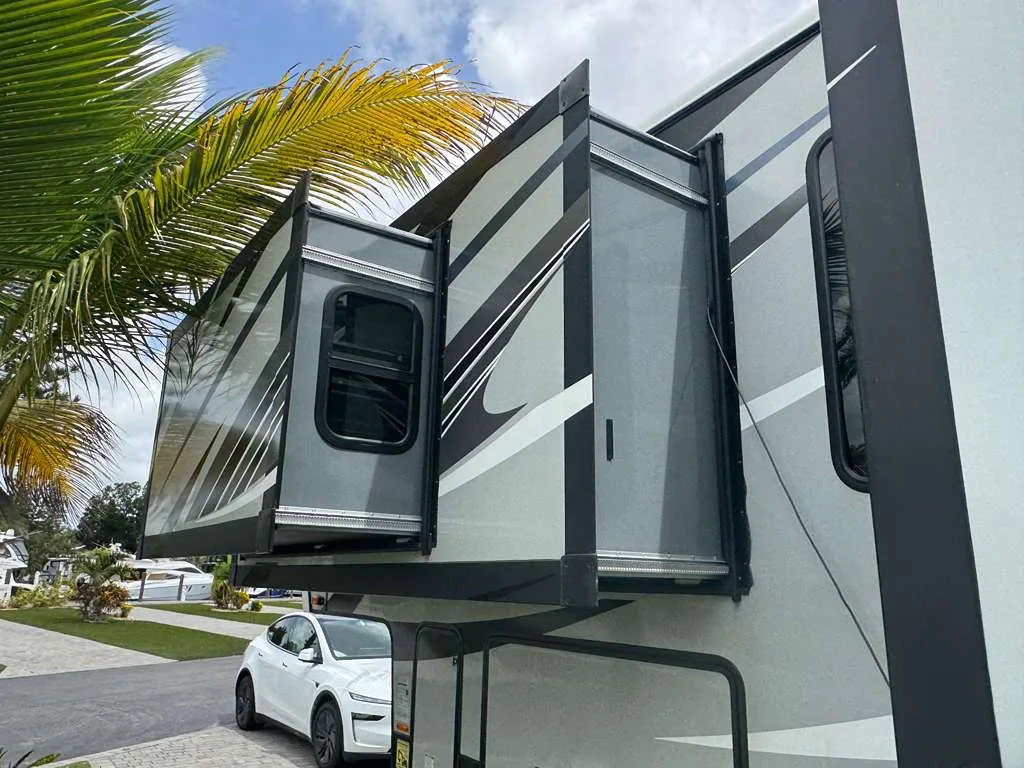
An RV slide-out opening is sealed by several different rubber profiles, and owners tend to call all of them the seal. The bulb seal is a hollow tube on a flat mounting base that compresses against the sidewall when the room is run out, and while you are parked it is the only thing holding rain out of the opening. The wiper seal, also sold as a sweep, is a stiffer blade that rides on the painted skin of the slide box and scrapes water, grit and pine needles off the room as it travels. Across the top sits the D-seal, named for its cross-section, which throws water outward onto the topper instead of letting it track down inside the wall cavity. Most rooms carry an inner and an outer set so the box is sealed both in and out. Our technicians identify each profile by base width and bulb height before ordering, because Clean Seal, AP Products and Steele Rubber cut different shapes.
The Dollar Bill Test: How We Find a Leaking Seal Before It Shows Inside
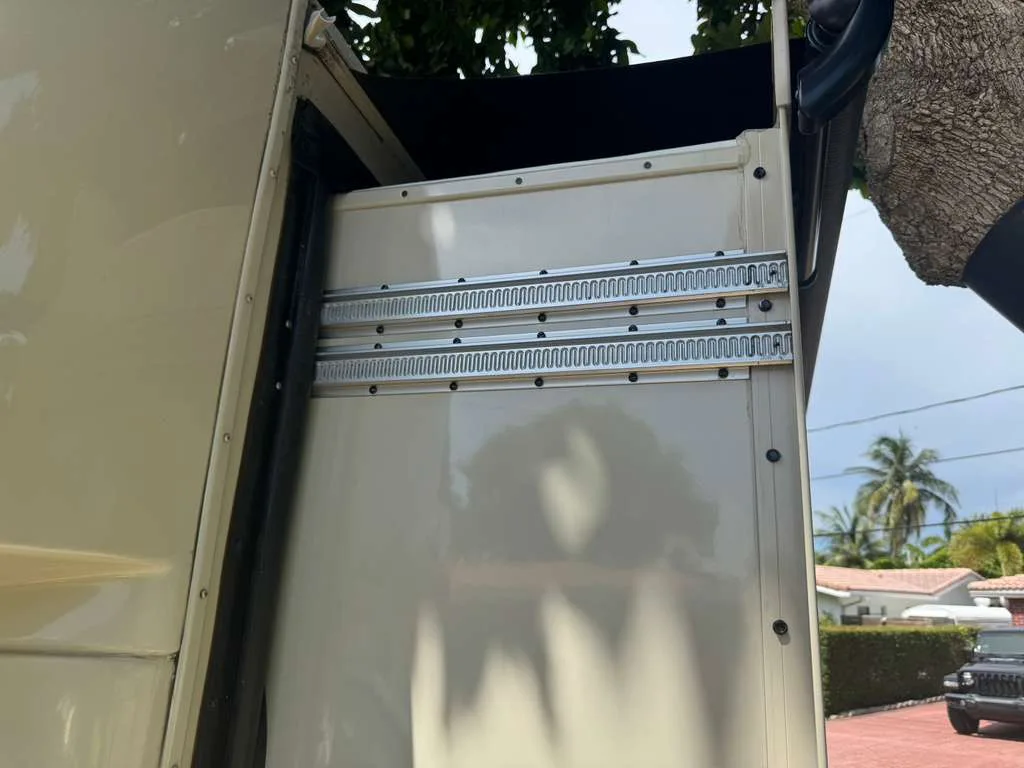
A seal that still looks black and intact can be passing water all day, so we test it instead of eyeballing it. With the room run out, our technicians close a dollar bill or a strip of paper into the seal and pull it back out: light drag means the bulb is still compressing there, and a strip that slides free means that section has taken a set and is no longer making contact. We repeat that every 12 to 18 inches around the full perimeter, because seals fail in sections rather than all at once, usually along the top run and the weather-side vertical first. Then we go inside, lift the slide floor edge trim, and read the subfloor with a pinless moisture meter. Wood at or above 20 percent moisture content supports decay fungi, so a reading in the mid-teens is still a seal job while a reading in the twenties has already become a floor conversation.
Why Florida Hardens Slide Seals Years Ahead of Northern Coaches
EPDM is used for slide seals because it shrugs off ozone and sunlight far better than natural rubber, but resistance is not immunity. A coach parked here takes heavy year-round UV plus a daily heat cycle on the sunny flank, and both slowly drive the plasticizers out of the rubber. What you feel afterward is a seal gone hard and chalky that no longer springs back when you press a thumbnail into it. The second Florida problem is storage. Coaches here sit retracted for months at a stretch with the inner seals held fully squashed, and an elastomer compressed while hot takes a permanent compression set - it holds the flattened shape rather than returning to a round bulb. That is why our technicians pull hard, flat-spotted seals off five-year-old Florida units and find softer, livelier ones on ten-year-old coaches that came down from the north.
Petroleum Destroys EPDM: What to Actually Lubricate Slide Seals With
The wrong bottle will kill a seal faster than the sun does. EPDM has poor resistance to petroleum oils, so WD-40, petroleum jelly, mineral oil and most general-purpose spray lubricants soak in, swell the rubber and leave a soft gummy seal with no memory left - it smears against the slide box instead of wiping it clean. Our technicians see the result most often as a wiper blade gone limp and folded over on itself, which then holds water against the sidewall rather than shedding it. Use a dry silicone spray or a purpose-made rubber conditioner instead. Both 303 Aerospace Protectant and Thetford Premium RV Slide-Out Rubber Seal Conditioner are safe on EPDM and worth applying three or four times a year in this climate. Wash the seal with plain water first, because conditioner rubbed over trapped grit turns the seal into sandpaper against your paint.
What a Mobile Seal Replacement Runs, and What Deferring It Costs
Seal and wiper replacement is a driveway or storage-lot job, not a shop job. Our technicians run the room out, strip the old profile and its retainer trim, clean the flange back to bare aluminum with a plastic trim tool and a 50/50 isopropyl alcohol wipe, then set the new seal straight the first time because the adhesive gives you no second attempt. One or two runs on a single room is usually an hour or two of labor. Our service call covers the trip out and the first hour on site, and the current rate is in the pricing table on this page. Anything past that first hour is quoted after diagnosis and approved before we carry on. What makes this worth doing early is the alternative: a leaking bottom wiper wicks water into the slide floor edge, and a soft leading edge is a subfloor rebuild costing many times the seal.
Sources
Every figure on this page comes from a manufacturer document or a standards body, not from another repair site. Here is where each one comes from.
- Lippert QR-073 - Flush Floor Slide-Out Seal GuideThat slide-out openings use several distinct seal profiles identified by shape and dimension, backing the point in 'Bulb, Wiper and D-Seal' that a profile is matched by base width and bulb height rather than ordered by description.
- Timco Rubber - EPDM material properties and resistance tableThe published EPDM property table rates weather and sunlight aging resistance as excellent while rating oil and solvent resistance as poor, supporting both the reason EPDM is used for slide seals and the warning in 'Petroleum Destroys EPDM' that petroleum lubricants swell and ruin the rubber.
- Thetford - Rubber Seal Conditioner product support pageThe manufacturer states the conditioner restores elasticity and prevents fading, cracking and deterioration, supporting the FAQ answer that conditioning a seal which still rebounds buys real service life.
- Gold Eagle - 303 Aerospace Protectant product pageThat 303 Aerospace Protectant is a non-petroleum UV protectant made for rubber and vinyl, backing the recommendation to use it rather than a general-purpose spray lubricant on slide seals.
Related repairs
Other systems we service
Where we work
Service category
What this usually costs
| Item | Price | What it covers |
|---|---|---|
| Service call | $299 | Includes the trip out to your RV and the first hour on site |
| Work past the first hour | Quoted after diagnosis | We tell you what it will take before we carry on |
| Parts | Quoted per job | Special-order parts may need a deposit before we order them |
| Written estimate | No charge | You approve the estimate before any work starts |
The service call covers the trip out to your RV and the first hour on site. Anything beyond that depends on what we find, and we quote it and get your approval before carrying on.
The price ranges on this page come from our own recent jobs across Florida, not from an industry average. What you pay depends on the rig, the parts it needs and what we find on site, so we give you a written estimate before any work begins and you approve it first.
Frequently asked questions
Do you do mobile reseal service on slide-outs, or does it have to go to a shop?
We do it on site. Slide seal and wiper replacement needs the room run out, a power source and clear access down both sides, all of which you have in a driveway, campground site or storage lot. Our technicians carry common bulb, wiper and D-seal profiles plus retainer trim, adhesive remover and surface prep. Only a room already showing floor rot or a failed mechanism usually needs to move somewhere else.
How do I know if my slide seals are actually leaking?
Run the room out and close a dollar bill into the seal every 12 to 18 inches. If the bill pulls free with no drag, that section is not sealing. Inside, look for staining or a dark line where the slide floor meets the main floor, and press the leading edge with your heel for softness. Chalky rubber that will not spring back under a thumbnail is finished regardless of what the bill test says.
Do you know what kind of seals my slide needs before you come out?
Not from a phone call alone, and anyone who says otherwise is guessing. Seal profiles vary by manufacturer and model year in base width, bulb height and whether they are adhesive-backed or barbed into a retainer channel. Our technicians measure the existing profile on site, photograph the corner joints, then match against Clean Seal, AP Products or Steele Rubber stock. Photos of the top and bottom runs texted ahead help us load the right rolls.
What does slide seal and wiper replacement usually cost?
It varies with how many runs need doing and how big the room is, so we quote after seeing it. A single wiper run on one room is often an hour or two plus seal material. A full four-side reseal on a large living room slide takes longer.
Can I just condition the seals instead of replacing them?
If the rubber still compresses and rebounds, yes. Conditioning with 303 Aerospace Protectant or a dedicated slide-out seal conditioner three or four times a year keeps plasticizers in the rubber and buys real years in Florida. Once a seal has taken a compression set and stays flat, no product brings it back, and conditioner on dead rubber only makes it shiny. The dollar bill test is what settles which of the two you have.
My slide floor feels soft near the outside edge. Is that the seals?
Usually it starts there. The bottom wiper is what keeps runoff out of the slide floor edge, and once it stops wiping, water wicks into the plywood or lauan decking and stays there. Our technicians read that edge with a pinless moisture meter before pricing anything, because new seals over wet, softened decking simply hide the damage. Above 20 percent moisture content you are looking at floor repair alongside the new seals.