Fiberglass RV Roof Repair: Crazing, Chalk, Delamination
Fiberglass RV roof repair in Florida: gelcoat crazing vs structural cracks, oxidation and delamination. Mobile inspection statewide. Call 888-759-1438.
Repair or replace on a fiberglass RV roof turns on one question: did the damage stop at the gelcoat, or reach the laminate under it? A crack you can catch with a fingernail, or an area that thuds when tapped, means the panel itself has failed, and the job becomes days rather than hours.
Repair, Refinish or Replace: The Fork That Sets the Bill
A fiberglass roof gives you three possible outcomes, and the inspection exists to tell them apart. A refinish is cosmetic work on a sound panel: cut, polish and protect, with no structural repair at all. A laminate repair rebuilds a damaged area of glass and resin, then refinishes the gelcoat over it. A panel section replacement means cutting out and rebonding part of the roof, and it is the only honest answer once the panel has released from the structure beneath it. What moves a coach from the first outcome to the third is rarely the defect you can see. It is how long water has had access through that defect. Cost follows that escalation rather than the size of the defect you can see, and no fiberglass roof gets a fixed quote before someone has been on it.
A Fiberglass Roof Is a Laminate, Not a Membrane

EPDM and TPO roofs are membranes: a sheet glued down over decking, which is why those roofs get replaced rather than repaired once the sheet releases. A fiberglass roof is a structural panel. Filon Flexroof is chopped fiberglass roving in a modified polyester resin under a gelcoat face, published at 0.040 inch nominal thickness in the smooth G4SR grade and Barcol hardness 37 by ASTM D2583. It ships as one piece and bends around the radius where the roof meets the sidewall, at a published minimum bend radius of two inches, so no seam runs along the edge of the coach. That single difference drives every decision on this page. You cannot patch a laminate the way you patch a sheet. You rebuild it in layers, then refinish the surface over the repair.
Gelcoat Crazing or a Structural Crack: How to Tell
Gelcoat is the pigmented surface layer, not the strength of the roof. Crazing is a web of fine lines confined to that layer, and the gelcoat maker Scott Bader attributes cracking and crazing to excessive gelcoat thickness, rapid temperature change and uneven curing rather than to impact. A structural crack goes through the glass underneath. Three checks separate them. A fingernail dragged across crazing does not catch, and it catches in a crack. Crazing sits as a field or fans out from a stressed corner, while a crack runs a line and often has a slight step across it. Wet the area: a crack darkens and stays dark as water wicks into the laminate. The Filon data sheet gives 0.3 percent water absorption in 24 hours by ASTM D570, and that figure describes sealed gelcoat only. Once the surface is open, it stops describing your roof at all.
Why a Fiberglass Roof Is Walkable, and Why That Matters
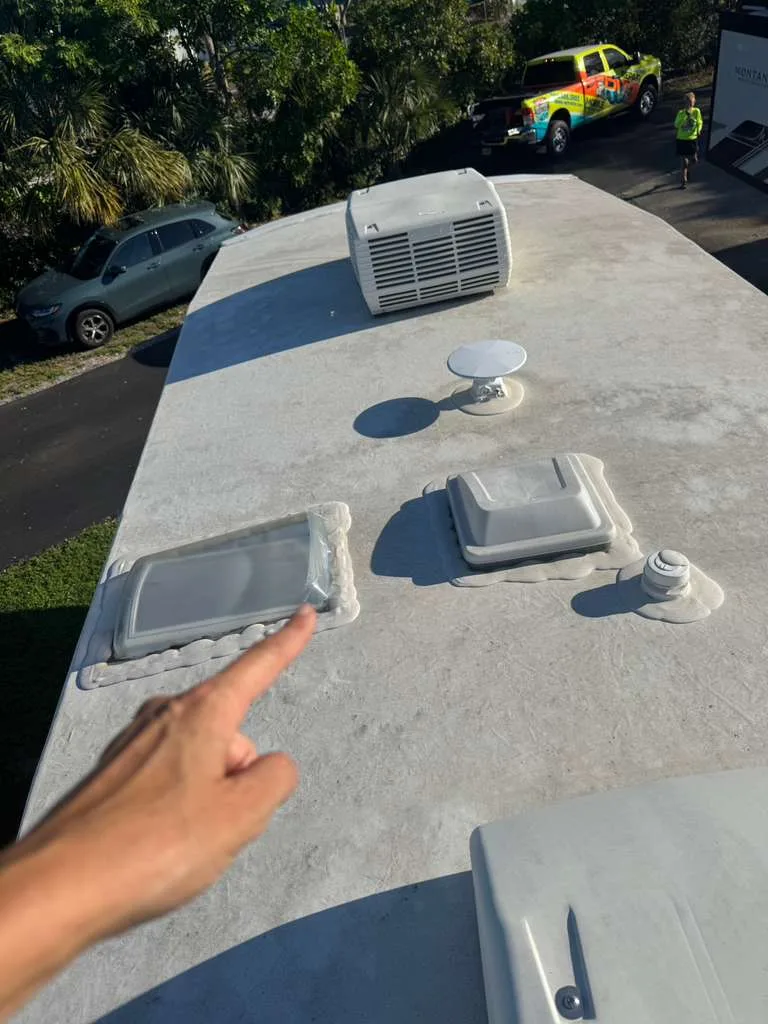
Because the panel carries load rather than merely covering the coach, most fiberglass roofs are rated to walk on, where a thin membrane over lightweight decking often is not. For an owner that is worth more than convenience. The roof can be inspected properly during a normal service call, sealant at every penetration can be pressed and checked by hand, and most repairs happen on top of the coach instead of through the ceiling. Two cautions apply. Stay over the trusses, near the centerline and alongside roof-mounted equipment, rather than out at unsupported edges. Oxidized gelcoat is slick when damp or dusty, noticeably more so than rubber. Anywhere the roof feels soft, springy or drum-like underfoot is a finding to report, not a spot to step around. Vent fan openings, skylight domes and the air conditioner gasket each have their own service page here; this page is about the panel itself.
Oxidation and Chalking Under Florida UV, and What Restores It
Gelcoat protects the laminate by filtering ultraviolet light, and it is consumed doing that job. The American Composites Manufacturers Association lists chalking among common gel coat failures and notes that gel coats do not have the exterior durability of automotive grade paints, while weathered coatings can be restored by buffing and polishing. Chalking is that eroded surface: a white powder that transfers to your hand and streaks down the sidewalls after rain. At this latitude the exposure runs year round instead of for a season, so a roof that left the factory glossy can go flat and porous in a few seasons. Restoration is abrasive, not additive. A rotary polisher with a wool cutting pad and a heavy oxidation compound, followed by a finishing polish and a sealant, brings gloss back by cutting down to fresh gelcoat. The limit is real: thin or crazed gelcoat can be cut through, and the right call there is to stop.
Delamination Is the Failure That Ends a Fiberglass Roof
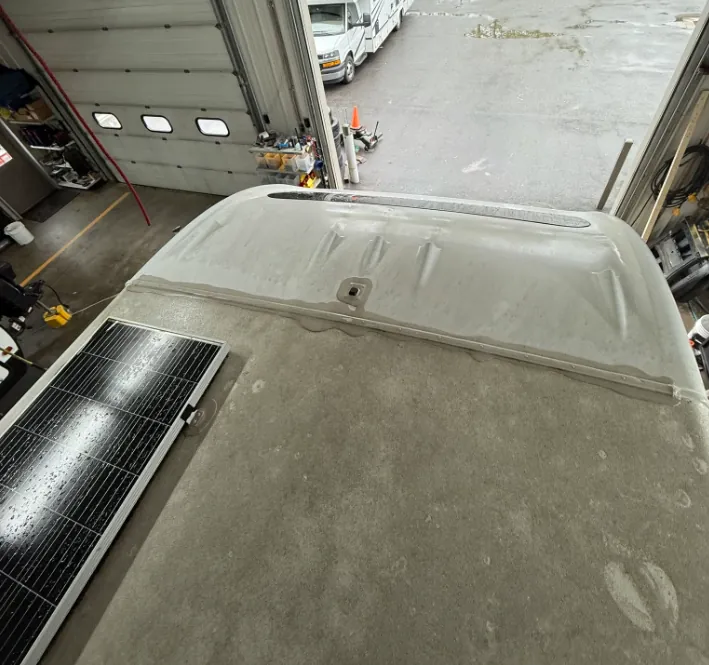
Delamination on a roof is the panel losing its bond to what sits under it, usually a foam core and the tops of the trusses. Water causes it almost every time, entering at a penetration or a failed seam and traveling sideways between layers where nothing dries it out. Heat then works the joint apart. Filon publishes a coefficient of linear thermal expansion of 0.000017 inch per inch per degree Fahrenheit by ASTM D696, so a 32 foot roof changes roughly half an inch in length across an 80 degree surface swing, which a white roof here sees between dawn and mid afternoon. A wet bond line cycled that way does not recover. Find it by looking along the roof at a low angle in reflected light, where a released area shows as a ripple in an otherwise straight reflection, then confirm by sounding: bonded panel rings, released panel thuds.
What Our Technicians Check, In What Order, and What It Costs
The call usually arrives as a worry rather than a symptom: someone asks whether we can do a roof and seal assessment, or just needs somebody to look at the roof. The order is fixed, because the expensive findings hide behind the visible ones. Inside first, along ceiling panel seams, the top edges of overhead cabinets and the corners of every roof opening, since a stain in there means water already crossed the core. Then the surface: a chalk swipe by hand, a crazing map noting whether lines radiate from fasteners, and sounding across the field and around each penetration. Sealant condition gets recorded and belongs to the reseal service. Moisture readings come last, taken where the first three steps pointed. Crazing alone is a few hours of finishing labor. A through crack adds laminate rebuild. Left open, it wets the core, and the job moves from the roof to the ceiling and framing.
Sources
Every figure on this page comes from a manufacturer document or a standards body, not from another repair site. Here is where each one comes from.
- VALTO Engineered Materials - Filon Flexroof Smooth (G4SR) technical data sheetFiberglass RV roof panel construction as chopped fiberglass roving in modified polyester resin with a gel-coat finish, 0.040 inch nominal thickness, 2 inch minimum bend radius, Barcol hardness 37 (ASTM D2583), water absorption 0.3 percent in 24 hours (ASTM D570), and coefficient of linear thermal expansion 0.000017 in/in/degF (ASTM D696).
- VALTO Engineered Materials - RV roof panelsFilon Flexroof is engineered as a flexible one-piece RV roof panel that bends around the roof-to-sidewall radius, producing a seamless roof with no seam at the edge of the coach.
- Scott Bader - common gelcoat faultsCracking and crazing in gelcoat are attributed to excessive gelcoat thickness, rapid temperature change and uneven curing, and are surface-layer defects distinct from laminate failure.
- American Composites Manufacturers Association - gel coat basicsGel coat provides UV protection and water resistance to an FRP composite, chalking is a listed gel coat failure mode, gel coats lack the exterior durability of automotive grade paints, and weathered gel coat can be restored by buffing and polishing.
- Dicor - Fiberglass RV Roof Coating (RP-FRC-1)Dicor's fiberglass roof coating is for fiberglass and previously coated roofs and states it is not recommended for EPDM rubber or TPO roofing, showing RV roof coatings are substrate specific.
- Dicor - Signature Extended Life RV Roof CoatingThe Signature coating is for EPDM and TPO membranes, requires primer RP-CRP-Q on EPDM or RP-TPR-Q on TPO, and covers about 125 square feet per gallon per coat.
Related repairs
- Rv Roof Reseal Lap Sealant in Florida
- how we handle maxxair fan replacement
- Rv Skylight Dome Replacement repairs
Other systems we service
Where we work
Service category
What this usually costs
| Item | Price | What it covers |
|---|---|---|
| Service call | $299 | Includes the trip out to your RV and the first hour on site |
| Work past the first hour | Quoted after diagnosis | We tell you what it will take before we carry on |
| Parts | Quoted per job | Special-order parts may need a deposit before we order them |
| Written estimate | No charge | You approve the estimate before any work starts |
The service call covers the trip out to your RV and the first hour on site. Anything beyond that depends on what we find, and we quote it and get your approval before carrying on.
The price ranges on this page come from our own recent jobs across Florida, not from an industry average. What you pay depends on the rig, the parts it needs and what we find on site, so we give you a written estimate before any work begins and you approve it first.
Frequently asked questions
Can you inspect the roof and tell me about an actual repair?
Yes, and that is the normal first visit. The inspection covers the interior ceiling line, the whole roof surface, sounding for released areas, and sealant condition at every penetration. It ends with which of three outcomes applies: refinish, laminate repair, or panel section replacement, and what each one involves on your coach.
Can I use RV roof coating on a fiberglass roof?
Only a coating made for fiberglass. Dicor sells its Signature Extended Life coating for EPDM and TPO membranes, and it needs a membrane specific primer first, RP-CRP-Q for EPDM or RP-TPR-Q for TPO, at about 125 square feet per gallon per coat. The separate fiberglass product, RP-FRC-1, is labeled for fiberglass and previously coated roofs and states plainly that it is not recommended for EPDM rubber or TPO roofing. They are not interchangeable in either direction.
Does crazing on the gelcoat mean my roof is leaking?
Not on its own. Crazing is confined to the gelcoat and stays cosmetic for years on plenty of coaches. It does open the surface to water, and once water is into the laminate the panel stops behaving the way it was specified to. Crazing that radiates out from a fastener, a corner or the edge of a roof opening deserves attention sooner, because that pattern points to stress rather than to surface age.
Can I walk on my fiberglass RV roof to check the seals?
Usually yes, because the panel is structural, and that is one of the practical advantages it has over a membrane roof. Stay over the trusses and near the centerline, wear shoes with grip since oxidized gelcoat is slippery when damp, and treat any soft or hollow feeling area as something to report rather than to test further. If the roof flexes underfoot, come down and have it looked at.
Will buffing fix a chalky fiberglass roof for good?
It restores it without making it permanent. Buffing removes the oxidized layer and exposes fresh gelcoat, which then begins weathering again under the same sun. A wax or sealant applied afterward slows that down. How often it has to be redone depends on covered storage and daily exposure, and there is a hard ceiling: gelcoat is a finite layer, so it can only be cut back so many times before refinishing stops being an option.