HWH Hydraulic Leveling System Service and Repair in Florida
HWH hydraulic leveling service for Florida motorhomes. Pump, reservoir, solenoid manifold and shuttle valve diagnosis by mobile techs. Call 888-759-1438.
An HWH hydraulic leveling system is built around one power unit: a 12 volt pump motor, a fluid reservoir, a square pump housing between them, and a solenoid valve manifold on top. Hoses run from that manifold out to four hydraulic cylinders. HWH calls the group the pump-motor-tank assembly, and most leveling faults on an HWH coach trace back to that assembly rather than to the jacks themselves.
The HWH power unit: pump, reservoir and valve manifold
An HWH leveling system is one assembly rather than a set of separate boxes. A 12 volt pump motor bolts to a square pump housing, the fluid reservoir bolts to the other side of that housing, and the solenoid valve manifold sits on top of it. HWH calls the group the pump-motor-tank assembly, and the breather cap used to check fluid is on top of it. On most coaches the leveling cylinders are single-acting: hydraulic pressure pushes them down and internal springs pull them back up, so a jack that will not retract is rarely a pressure problem. HWH builds pivoting and straight-acting cylinders rated from 6,000 pounds to 24,000 pounds each, and the pump motor comes in 3 inch, 3.7 inch and 4.5 inch diameters depending on how much jack it has to feed. Which motor is fitted also changes the battery cable gauge and the fuse size behind it.
How to tell which HWH system your coach has

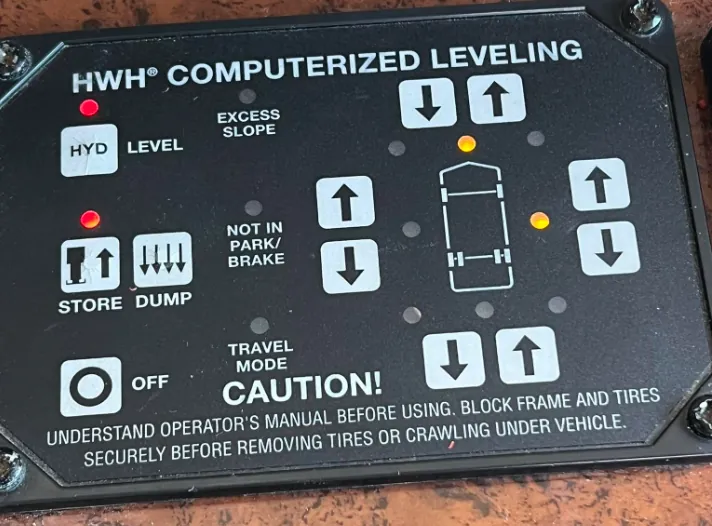
HWH names its leveling systems by series, and the series tells you the control type and roughly the era. The 100 and 110 series are lever-controlled hydraulic systems. The 200, 210 and 225 series are joystick-controlled. The 300, 305, 310 and 325 series are touch panel controlled and ran from 1995 to 2004. The 400 series used paddle switches between 1985 and 1992. The 500, 510, 600, 610, 625, 625S and 680 series are computer-controlled with a touch panel, and the 700, 725 and 2000 series carry that line forward. On 305, 325, 625, 625S and 2000 systems the control box and the level sensing unit are normally part of the power unit itself, sitting with the hydraulic pump and the solenoid valve manifold. That one detail decides where a technician starts looking, and it is the first thing worth establishing on the phone.
Air, hydraulic and air/hydraulic coaches are different jobs
HWH sells leveling in three plumbing variants, and several of its series exist in all three. A hydraulic system lifts the coach on cylinders. An air system levels the coach on its own suspension bags. An air/hydraulic system does both, and on an air suspension coach an air dump kit with electrically controlled solenoid valves has to be present or the hydraulic side cannot level correctly. The operating rules differ too. HWH advises against dumping the suspension before an automatic level cycle, because the system works better starting from ride height. Air leveling also has a sleep mode that holds the coach level after the cycle ends, which is fine while parked and is not recommended during storage. Treating an air or air/hydraulic coach as though it were a plain hydraulic one produces a long list of replaced parts that were never the fault.
Why Lippert habits misdiagnose an HWH system
The most common misdiagnosis on an HWH coach comes from a technician applying a Lippert routine to it. HWH touch panel and joystick systems are BI-AXIS, meaning they operate two jacks at a time and will not run one jack alone. Only the 100 and 110 lever systems drive a single jack. The familiar habit of isolating one corner to prove a jack or a valve therefore fails outright, and the fault gets pinned on whatever moved last. The hardware differs as well. HWH manifolds carry 2.25 inch large diameter and 1.50 inch small diameter solenoid valves, and every valve built since roughly 1993 has a manual release. Lippert Level-Up control boards, BAL electric leveling, jack cylinder resealing and sensing unit adjustment are all real jobs, each covered on its own page. None of those procedures transfer to an HWH power unit.
The symptoms owners describe and the order we check them
Callers describe this at system level, not part level. Two of the most frequent are whether a leveling leg can be repaired at all, and a hydraulic slide out that will not open, which on many coaches shares the same pump. Check order matters. First the enabling circuit: ignition in accessory, park brake set, and the not in park or brake light behaving correctly, because the pump is designed not to run while that light is on. Then listen for the pump. Then fluid, with every jack, slide out and step fully retracted and the level within one inch of the top of the tank. Then the ground: a multimeter across the pump housing ground stud finds the voltage drop that imitates a dead pump. Only after those four does a valve, the shuttle valve or a cylinder come apart.
What each finding turns into, and where it stops being a repair
Scope on an HWH coach is decided by how far into the power unit the fault sits. A low reservoir, a corroded ground stud or a valve release seized open is all bay level work on parts already carried, and it finishes inside the hour the service call covers. A shuttle valve or a solenoid valve is deeper: the manifold comes apart, fluid is lost and replaced, and the system is cycled and rechecked afterward. A cylinder is the finding that turns one visit into two, because the jack has to come off the coach and the seal kit is ordered against that cylinder rather than against the coach. Left alone the escalation is predictable. Low fluid lets air into the lines, air causes cavitation, and cavitation is what wears a pump out. A cylinder seeping past its seal stops holding, then creeps down under way, which is exactly what the warning buzzer exists to catch. Anything past that first hour is quoted after the diagnosis and approved before work continues.
Routine service versus waiting for the failure
HWH publishes a maintenance schedule that almost nobody follows: check the hydraulic system twice a year, in spring before the travel season and again before storage, and cycle the jacks and rooms through a full extend and retract once a month while the coach sits. Clean around the breather cap before opening it, check the level with everything retracted, and never mix fluid types. HWH Specialty Hydraulic System Oil is part HWH22867, HWH47370 is the low temperature version, and Dexron or a good multipurpose transmission fluid is an accepted substitute. On a coach that lives near salt water in Clearwater, the corrosion side outranks the fluid side. Every ground in the system, pump motor, solenoid valves and control box alike, runs through that pump housing and its ground stud, and HWH specifies sealing those connections with a red air dry enamel such as RANVAR B6-665.
Sources
Every figure on this page comes from a manufacturer document or a standards body, not from another repair site. Here is where each one comes from.
- HWH Corporation - Leveling and Stabilizing System Identification and Nomenclature (ML17785_01_NOM_PR_LESY)HWH's own series designations and eras (1XX lever, 2XX joystick, 3XX touch panel 1995-2004, 4XX paddle 1985-1992, 5XX/6XX/7XX/2000 computer control), the air, hydraulic and air/hydraulic variants, and the control box and level sensing unit naming.
- HWH Corporation - Frequently Asked QuestionsFluid level within one inch of the top of the tank with all jacks, slide-outs and steps retracted; breather cap on the pump-motor-tank assembly; BI-AXIS systems operating two jacks at a time; single-acting spring-retract cylinders; 2.25 inch and 1.50 inch solenoid valves; T-handle five turns counterclockwise, center two valves then outer two; shuttle valve part RAP7964; a jack needing to be pried up requiring cylinder repair rather than springs.
- HWH Corporation - Oil for HWH Hydraulic SystemsHWH Specialty Hydraulic System Oil part number HWH22867 and the low temperature HWH47370 part number.
- HWH Corporation - ML44818 Component Selection and Installation Manual (Motorized Vehicles)All system grounding, pump motor, solenoid valves and control box, running through the pump housing and its ground stud; corrosion sealing with Red Air Dry Enamel RANVAR B6-665; 3 inch, 3.7 inch and 4.5 inch pump motors with matching cable and fuse sizing; the not in park or brake circuit preventing the pump from running; the reservoir filled to within 1 inch of the top.
- HWH Online Technical School - Basic Information for Performing Hydraulic System Maintenance (ML57000-012-CH3)Twice-yearly system checks in spring and before storage; monthly extend and retract cycling during storage; cleaning around the breather cap and not mixing fluid types; cylinder capacities from 6,000 to 24,000 pounds; low fluid allowing air in and causing cavitation; the pump manifold assembly needing protection from the elements.
Related repairs
- our Bal Electric Leveling Repair service
- Leveling Jack Cylinder Reseal in Florida
- how we handle leveling sensor calibration
Other systems we service
Where we work
Service category
What this usually costs
| Item | Price | What it covers |
|---|---|---|
| Service call | $299 | Includes the trip out to your RV and the first hour on site |
| Work past the first hour | Quoted after diagnosis | We tell you what it will take before we carry on |
| Parts | Quoted per job | Special-order parts may need a deposit before we order them |
| Written estimate | No charge | You approve the estimate before any work starts |
The service call covers the trip out to your RV and the first hour on site. Anything beyond that depends on what we find, and we quote it and get your approval before carrying on.
The price ranges on this page come from our own recent jobs across Florida, not from an industry average. What you pay depends on the rig, the parts it needs and what we find on site, so we give you a written estimate before any work begins and you approve it first.
Frequently asked questions
Can you repair an RV leveling leg?
Yes, although on an HWH coach the leg is often not where the fault is. The first job is deciding whether the cylinder itself is failing or whether a solenoid valve, the shuttle valve, the fluid level or a corroded ground is stopping it from moving. HWH is direct about one case: a jack that has to be pried up will not be cured by new springs, and that cylinder needs repair. Cylinder resealing is covered on its own page.
My HWH jacks will not retract even after I opened the manual valve releases. What now?
If some jacks retract and others do not, the fault sits in one valve or one cylinder. If none of them move once all four releases are open, HWH points at the shuttle valve, part RAP7964, and warns that the malfunction will repeat until it is replaced. The published sequence is to open the center two valves first and then the outer two, turning a T-handle counterclockwise about five full turns as the internal spring loads up.
What hydraulic fluid does an HWH leveling system take?
HWH Specialty Hydraulic System Oil, part HWH22867, is the recommended fluid, and HWH47370 is the low temperature version. If neither is on hand, HWH accepts Dexron or a good multipurpose automatic transmission fluid. Never put hydraulic jack oil, brake fluid or power steering fluid into an HWH system, because all three attack the seals, and never mix fluid types in the same reservoir.
How many quarts does an HWH leveling reservoir hold?
HWH does not publish a reservoir capacity, and the quart figures traded around owner forums do not come from HWH. The actual specification is a level rather than a volume: with every jack, slide out and step fully retracted, the fluid should sit within one inch of the top of the tank. How much it takes to reach that line depends on hose length and routing, which vary coach to coach.
What does it cost to diagnose an HWH leveling problem?
Our service call covers the trip out and the first hour on site at the rate in the pricing table on this page; anything past that first hour is quoted and approved before we carry on. Coverage runs across central Florida, from Plant City and Oviedo out to the Clearwater coast.
Do you work on hydraulic slide outs that run off the same HWH pump?
Yes. On many HWH coaches the room extensions are fed by the same pump-motor-tank assembly through a separate room extension manifold, so a slide out that will not move and jacks that will not move can share one root cause. The harder part is working out which pair of solenoid valves serves which room. HWH permits opening all the slide out valves during a manual retract, then closing them and confirming every room is fully in.