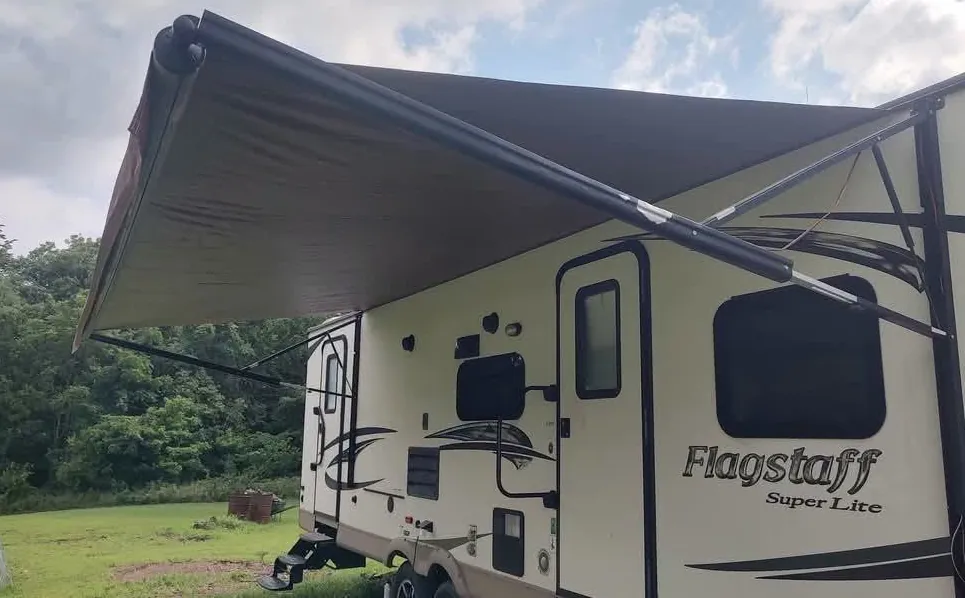
RV Awning Fabric Replacement: Vinyl or Acrylic in Florida
Torn, mildewed or brittle RV awning fabric? Vinyl versus acrylic, correct measuring, and what a fabric swap really costs in Florida. Call 888-759-1438.
Replacing the fabric costs far less than replacing a whole awning, and one question decides which you need: are the support arms, roller tube and sidewall rail still straight and moving freely? If they are, this is a fabric job, and the real choice is vinyl or acrylic. If an arm is bent or a casting is cracked, new fabric alone will not fix it.
Torn, Chalky or Streaked: What the Fabric Is Telling You
Awning fabric fails in four recognizable ways, and the way it failed tells you what to order. Pinholes and splits along the fold lines mean vinyl has gone brittle, which happens as UV drives plasticizer out of the PVC coating and the polyester scrim underneath loses its flexible shell. Black streaks and speckling that will not scrub off are mildew growing in the dirt film on a panel that was rolled up wet and left that way. A seam that has opened in a straight line is thread rot, or a heat-welded seam that aged faster than the panel around it. Fabric that sags into a belly in the middle has stretched, which is why one afternoon thunderstorm dumps water past the lead rail and down the side of the coach instead of off the edge. All four are fabric replacements, provided the support arm assemblies still fold along a straight path.
Vinyl or Acrylic: The Trade Almost Nobody Explains Honestly
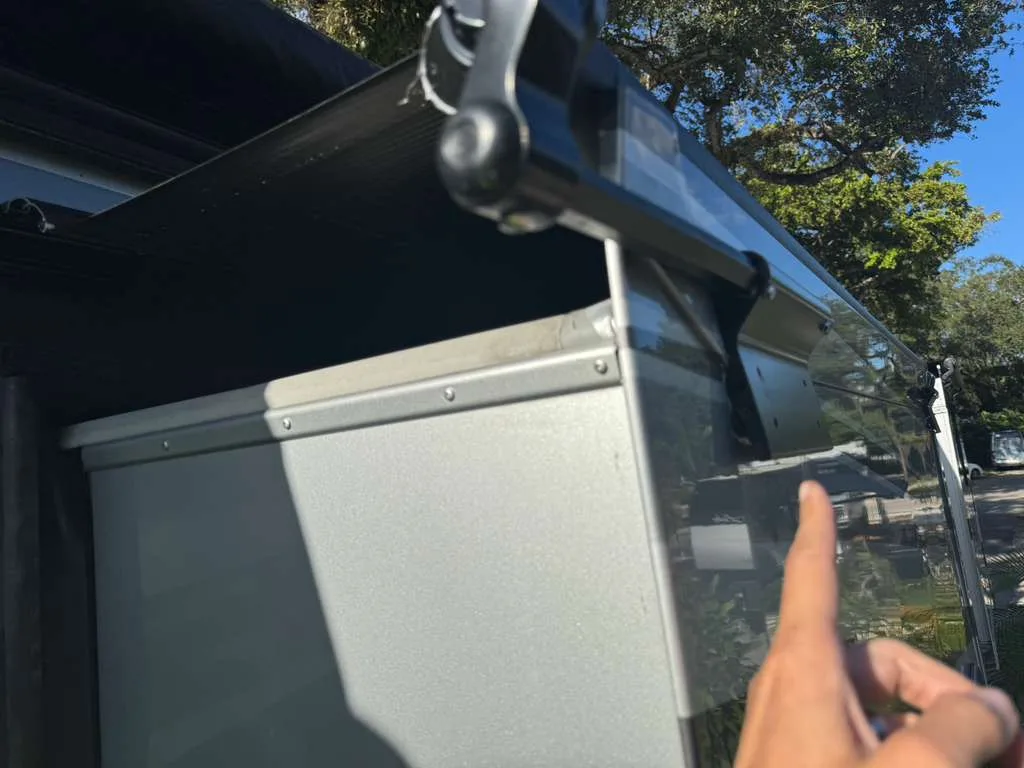
Vinyl awning fabric is a woven polyester scrim coated in PVC, so it behaves as a waterproof membrane and its panels are joined with heat-welded seams. Acrylic awning fabric, the kind Glen Raven sells as Sunbrella, is woven from solution-dyed acrylic yarn with pigment locked into the fiber rather than printed on the surface. That is why acrylic holds color and shrugs off UV degradation far longer than a coated vinyl, and why it dominates permanent shade structures. The catch is water, and Sunbrella's own fabricator guidance is blunt about it: you cannot have a fabric that is breathable and waterproof, and no fabric is entirely waterproof. A woven acrylic breathes, sheds a light shower on a surface finish, then wets through in a hard rain once that finish has worn. So vinyl keeps you dry overhead but mildews and stiffens, while acrylic stays supple and colorfast but is shade first and shelter second.
Measure the Arms, Not the Old Fabric
Replacement fabric is sized by the distance between the support arm assemblies, not by the length of the panel you are pulling off. Lippert's quick reference for Solera awnings is specific: close the awning, mark the horizontal center of each support arm assembly, and measure center to center, so a reading of ten feet means ten-foot fabric. Then comes the part that catches almost everyone. The fabric that arrives measures about ten inches shorter than the size on the label, so ten-foot fabric is roughly nine feet two inches of actual material. Measure the old panel and you will order a size short, and a size is a full foot, because replacement fabric is sold in one-foot increments from ten to twenty-one feet. Reading a number stamped on an arm, or measuring the awning rail on the sidewall, sets the same trap and costs a week waiting on an exchange.
What Gets Checked, and In What Order
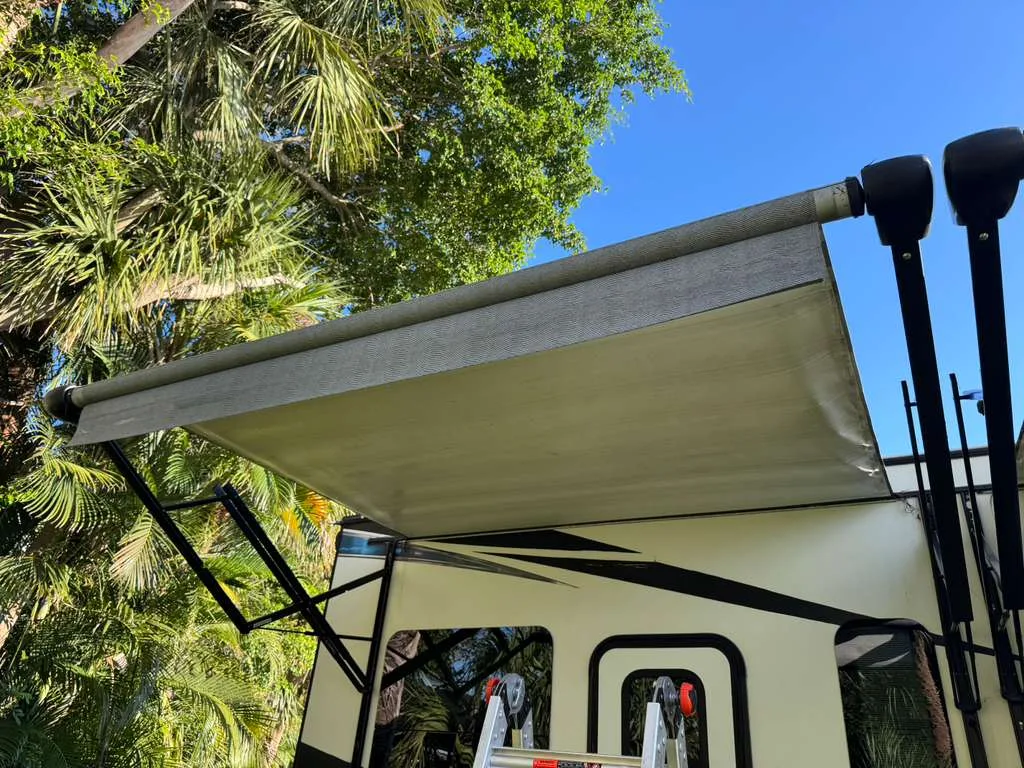
Most of these calls open the same way: the awning is torn, or the owner asks whether we replace awnings on RVs at all. The first step is running the awning out and back, under power or by hand, because travel that binds means fabric is not the whole story. Second come the arms, checked for a straight lead rail, free pivots and uncracked castings. Third is the roller tube, inspected for bow and for whether the torsion assembly still holds tension. Fourth is the sidewall awning rail, where the poly cord channel gets checked for cracks and the sealant above it for gaps. Only then is the fabric itself graded.
Grading the fabric last is deliberate. Replacing a panel on a rail that is cracked or an arm that has lost tension puts new material on a mechanism that will damage it, and the owner pays for the same fabric twice within a season.
The Roller Tube Spring Is Why This Is Not a Two-Friends Job
Every patio awning stores energy in a torsion spring inside or beside the roller tube, and that energy does not go away when the fabric is cut off. On a manual unit the spring is what pulls the roll closed; on a powered Solera or Carefree of Colorado awning a 12-volt motor lives in the tube, and the assembly still has to be de-tensioned before an end cap comes apart. The order that keeps people safe is boring: pull the awning fuse, capture the roller tube with two ratchet straps and vise grips so it cannot spin, then remove the end cap screws and walk the tension down deliberately. Skip the capture step and a released tube spins hard enough to break a wrist or throw a ladder. It is also why fabric work pairs badly with a manual-to-electric conversion attempted on the same visit.
Weatherguard Wrap, Valance and Honest Lifespan at This Latitude
The weatherguard, sometimes called the wrap, is the extra flap of fabric that covers the roll when the awning is closed, and the valance is the short skirt hanging from the lead rail. Both are consumables, and a torn wrap means the rolled panel bakes and wets in turn instead of being shielded. Expect any fabric here to age fast: Homestead, Florida is the internationally recognized benchmark site for outdoor weathering, chosen because high-intensity sunlight, heat, rainfall and humidity break materials down faster than almost anywhere else. Dark fabrics absorb more UV than whites and pastels and give up first. Left alone, a torn panel flogs in wind until it bends an arm, which turns a fabric job into a storm rebuild, and water tracking past a cracked awning rail gets behind the sidewall skin where delamination starts.
Sources
Every figure on this page comes from a manufacturer document or a standards body, not from another repair site. Here is where each one comes from.
- Lippert QR-113: Measuring Solera Awning for Correct Fabric ReplacementThat fabric is sized center to center between the support arm assemblies, that the fabric received measures ten inches shorter than the size ordered, and that replacement sizes run in one-foot increments from ten to twenty-one feet.
- Lippert TI-166: Awning Fabric Replacement (CCD-0002066)That awning fabric replacement is a one to three person job, that the roll tube's spring tension has to be released deliberately at the drive head, and at the idler head on awnings longer than six feet, before an end cap is removed, and that the fabric is held by a polycord seated in the roll tube channel and in the sidewall awning rail.
- Sunbrella and Glen Raven - How to Choose the Right Marine Fabric (white paper)That solution-dyed acrylic is breathable and extra-resistant to UV degradation while coated vinyl is less breathable and more waterproof, that no fabric is entirely waterproof, and that dark colors absorb more UV than whites and pastels.
- Q-Lab - Florida natural outdoor weathering exposure testingThat South Florida is the internationally recognized benchmark location for outdoor weathering, with high-intensity sunlight, high year-round temperatures, high rainfall and high humidity, and that the site is used for mildew and mold resistance testing.
Related repairs
- Manual Electric Awning Conversion in Florida
- how we handle awning storm damage rebuild
- Window Door Awning Repair repairs
Other systems we service
Where we work
Service category
What this usually costs
| Item | Price | What it covers |
|---|---|---|
| Service call | $299 | Includes the trip out to your RV and the first hour on site |
| Work past the first hour | Quoted after diagnosis | We tell you what it will take before we carry on |
| Parts | Quoted per job | Special-order parts may need a deposit before we order them |
| Written estimate | No charge | You approve the estimate before any work starts |
The service call covers the trip out to your RV and the first hour on site. Anything beyond that depends on what we find, and we quote it and get your approval before carrying on.
The price ranges on this page come from our own recent jobs across Florida, not from an industry average. What you pay depends on the rig, the parts it needs and what we find on site, so we give you a written estimate before any work begins and you approve it first.
Frequently asked questions
Do you guys replace awnings on RVs?
Yes, and the first question is whether you need the whole awning or only the fabric. If the support arms fold straight, the roller tube is not bowed and the sidewall rail is intact, fabric replacement is the cheaper fix and the rest of the awning is fine. Bent arms, cracked castings or a damaged rail push the job toward a full assembly, which is a different quote.
Can you get and install an awning part?
Yes. Fabric, weatherguard wrap, valance, end caps, poly cord and lead rails are all orderable, and fabric in particular has to be ordered to the measured size rather than picked off a shelf. Because replacement fabric only comes in one-foot increments from ten to twenty-one feet, the measurement is taken before anything is ordered, never after.
What brand awning is it, and does the brand change the fabric job?
It changes the measurement rule and the hardware, not the fabric decision. Lippert Solera, Carefree of Colorado and Dometic each use their own arm geometry, end caps and roller tube ends, so the teardown differs. The vinyl-or-acrylic choice and the sizing method stay the same regardless, and photos of an arm and an end cap will usually identify the brand before the visit.
Should I choose vinyl or acrylic fabric in Florida?
Choose vinyl if you want to sit under it during a downpour and are willing to accept mildew and eventual brittleness. Choose solution-dyed acrylic if shade, color retention and UV life matter more than staying dry in heavy rain, since a woven acrylic breathes and its water repellency is a surface finish that wears off. No fabric does both jobs at once.
What does RV awning fabric replacement cost?
Our service call covers the trip out and the first hour on site at the rate in the pricing table on this page; anything past that first hour is quoted and approved before we carry on. A straightforward patio fabric swap is usually a one to three hour job once the correct size is on hand.
Can I replace the awning fabric myself?
Sliding the panel out is not the hard part; the torsion spring is. The roller tube stores enough energy to injure someone if an end cap is opened before the tube is captured and the tension walked down, and a second pair of hands is needed simply to feed the poly cord through the rail without kinking it. Owners who try it get caught by the sizing rule first.