BAL Electric Leveling System Repair: Screw Jacks, Motors
Mobile BAL electric leveling repair across Florida: stripped gearboxes, bound lead screws, jack timeout and low voltage faults. Call 888-759-1438.
A BAL electric leveling system is a set of screw jacks. Each leg carries a 12 volt motor, a reduction gearbox and an acme lead screw, and there is no pump, no hose and no fluid anywhere in it. Failures are therefore mechanical and electrical: a stripped gearbox, a bound screw, a corroded thread, or voltage sagging at the control.
A BAL Leveling System Is a Screw Jack, Not a Hydraulic One
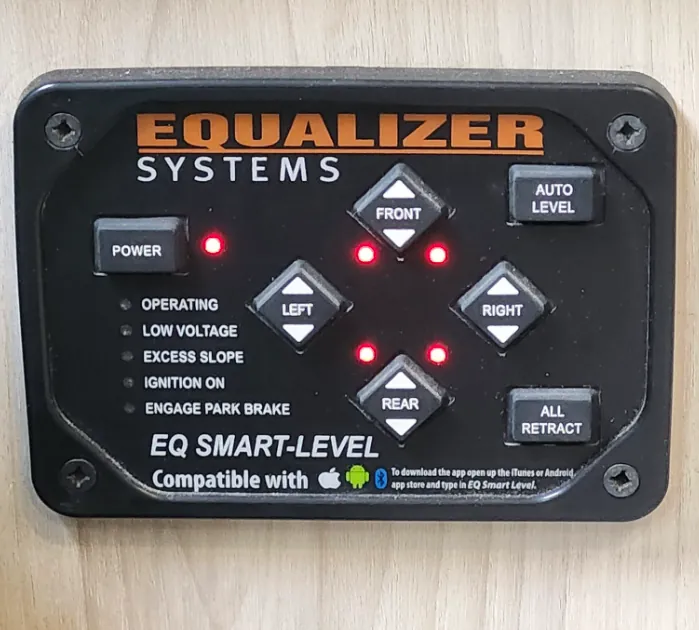
BAL electric leveling lifts on threaded steel rather than fluid. Every leg holds an acme lead screw turned by a 12 volt motor and gearbox assembly, and as that screw rotates a trunnion nut travels along the thread and drives the leg out. Nothing in the system holds pressure, so there is no reservoir to top up, no manifold to test and no bleeding procedure. That one difference sends most owners down the wrong path, because the advice they find was written for hydraulic leveling such as HWH or Lippert Level-Up. Three questions replace the fluid checks: is the leg receiving battery voltage, is the gearbox actually turning its output, and is the screw free to rotate in the nut. Norco Industries builds the travel trailer, fifth wheel and motorhome versions on the same layout, with a touch screen control, a level sensor in the coach and one motor per leg.
The Motor Hums But the Leg Never Moves
Noise with no motion is the signature screw jack failure, and it narrows to three causes. The reduction gearbox has stripped, so the motor spins freely and the output shaft does not follow. The coupler between motor and threaded drive rod has rounded off, which on the powered C jack is part 20300030, the D to square coupler. Or the screw has seized in its nut and the motor is stalling against a load it cannot break loose. A hydraulic jack cannot fail in any of these ways, since a pump running with no movement points at a valve or a leak instead. Sequence matters: listen at each leg individually, then read voltage at the motor leads while someone holds the switch. Battery voltage present at the motor with the leg standing still condemns the drive train, not the control head.
Reading BAL Fault Messages on the Touch Screen
The BAL control names its own faults in words, and each string points somewhere different. LOW VOLTAGE means the control is seeing less than the 10.2 volts BAL requires, which is a battery, a terminal or a wire gauge problem rather than a jack problem. HIGH VOLTAGE means it sees more than 16 volts and is protecting itself from a converter or charger fault. EXCESS ANGLE DETECTED and MANUAL ADJUST ANGLE LIMIT both say the site is steeper than the geometry allows. OUT OF STROKE means a leg has run to the end of its thread. JACK TIMEOUT means movement was commanded and never sensed, which is how a stripped gearbox usually announces itself. FEATURE DISABLED is the misleading one: nothing is broken, the zero point has simply never been set, and the system refuses to run auto functions until it is.
Where the Manual Override Actually Is
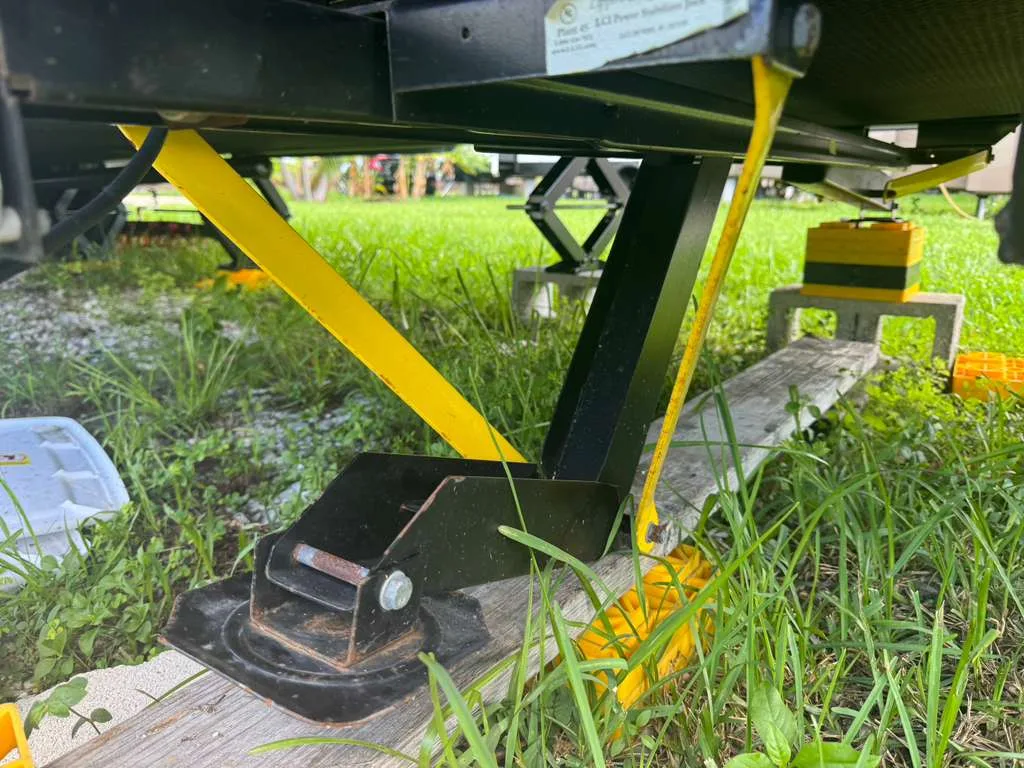
Every BAL leg can be wound by hand, and the access point is easy to walk past. At the bottom center of each jack leg motor sits a round rubber plug; pull it and a 5/16 inch override hex is underneath. BAL's user manual has the technician turn that hex with a drill and a 5/16 inch drive socket to run the jack in either direction. A travel trailer tongue jack carries a second override, behind the plug to the right of the touch screen, which takes a 3/8 inch square drive. One exception matters: on the powered C type stabilizing jack, model 21100005, Norco prints a warning against using a cordless drill on the override because the gearbox will not survive it. Knowing which plug hides which drive size decides whether a stuck coach can be towed home tonight.
Leveling Jacks Stabilize, They Do Not Lift
A leveling jack is built to carry weight, not to pick a coach up, and BAL states the limit twice in the same manual: never raise the wheels completely clear of the ground, and never use the leveling system as a lift for changing a tire or for working underneath. The reason is structural. A screw jack pushing into a frame outrigger that was designed to be supported rather than jacked will bend the outrigger, rack the body and pull an entry door out of square. Norco goes further on the powered C jack and tells owners to ask the RV manufacturer about sub frame strength before mounting one at all. Bent BAL legs are rarely worn out legs. They were asked to lift, or they were extended into a depression and then loaded sideways as the coach settled.
Sand, Shell and Salt Air on an Exposed Lead Screw
Two BAL failures belong to this state in particular. The first is what the foot pad is standing on: shell driveways, sugar sand lots and soft grass sites around Vero Beach or Apopka let a pad sink while the control keeps commanding extension, so the leg reaches the end of its thread and reports OUT OF STROKE with the coach still leaning. Load distribution pads under every foot are the answer, and the manual asks for them on any soft surface. The second is corrosion, and it is genuinely worse here than on a hydraulic jack. A cylinder keeps its working surface sealed inside a barrel, while a screw jack leaves its thread hanging in the weather, so coastal salt air lands directly on the lead screw. Grease through the plastic plug twice a year, and keep a pressure washer away from it.
How We Diagnose It On Site and What Each Finding Costs
The order is set by what can be proved cheapest. Voltage at the control and again at each motor comes first, because a sagging reading explains most fault strings before any part is condemned. The leg is next: rotation at the 5/16 inch override hex separates a bound screw from a dead drive in about a minute. The stored level position is third, since a coach that parks itself crooked on flat ground is storing a bad reference, not breaking a jack. Our service call covers the trip out and the first hour on site at the rate in the pricing table on this page; anything past that first hour is quoted and approved before we carry on. Apex does not replace tires and does not take on chassis work, so a bent frame outrigger is reported and referred out. Left running, a dragging leg becomes a bent leg, then torn underbelly and floor.
Sources
Every figure on this page comes from a manufacturer document or a standards body, not from another repair site. Here is where each one comes from.
- BAL Electric Leveling System User Manual 20300509 (Norco Industries)The 10.2 volt and 16 volt control thresholds, the fault strings LOW VOLTAGE, EXCESS ANGLE DETECTED, MANUAL ADJUST ANGLE LIMIT, OUT OF STROKE, JACK TIMEOUT and FEATURE DISABLED, the 5/16 inch override hex under the rubber plug, the 3/8 inch square tongue jack drive, the load distribution pad and greasing instructions, and the warning never to lift the wheels off the ground or use the system as a lift.
- BAL 5th Wheel Electric Leveling System User Manual 20300513That the fifth wheel version runs the same control logic and override procedure with landing gear mode in place of tongue jack mode, and carries the identical warnings against lifting the wheels clear of the ground.
- BAL GDS.LEV.004 Rev A - Programming the Level PositionThe hidden programming screen behind the voltage readout, access codes 9588 and 3759, running the rear legs down first, and pressing SET to store the level position.
- BAL Powered C Type Stabilizing Jack manual, model 21100005The D to square coupler part 20300030, motor gearbox assembly 231000, 15 amp resetting breaker 20300031, 10 AWG minimum wiring, the warning against overriding with a cordless drill, and the Norco sub frame strength caution.
- BAL GDS.IDCJ.001 Rev B - Identifying a C Jack by stamped numberIdentifying jack size from the six digit number stamped on the link and arm, including link 855132 and arm 855130 for the 25 inch jack, and foot pad part 23100.
Related repairs
- Leveling Jack Cylinder Reseal in Florida
- how we handle leveling sensor calibration
- Fifth Wheel Landing Gear Repair repairs
Other systems we service
Where we work
Service category
What this usually costs
| Item | Price | What it covers |
|---|---|---|
| Service call | $299 | Includes the trip out to your RV and the first hour on site |
| Work past the first hour | Quoted after diagnosis | We tell you what it will take before we carry on |
| Parts | Quoted per job | Special-order parts may need a deposit before we order them |
| Written estimate | No charge | You approve the estimate before any work starts |
The service call covers the trip out to your RV and the first hour on site. Anything beyond that depends on what we find, and we quote it and get your approval before carrying on.
The price ranges on this page come from our own recent jobs across Florida, not from an industry average. What you pay depends on the rig, the parts it needs and what we find on site, so we give you a written estimate before any work begins and you approve it first.
Frequently asked questions
Can you repair a BAL leveling leg, or does the whole jack get replaced?
It depends on which half failed. Motors, gearboxes, couplers, switches and the 15 amp resetting breakers are serviceable items and get changed on site. A lead screw that is pitted through its thread, or a leg bent from being loaded sideways, is replaced rather than repaired, because a damaged thread will chew the next nut it drives. Our technicians decide that at the leg, after the override test shows whether the screw still turns freely.
The screen says LOW VOLTAGE but my battery reads fine. What is wrong?
BAL needs 10.2 volts held at the control while the jacks are actually moving, and a battery measured at rest tells you almost nothing about that. Undersized or corroded wire, a loose ground or a tired battery all read normal until a motor pulls current, then the control drops below its threshold and stops. The reading that matters is taken at the control with a leg running, not at the battery terminals in the morning.
How do I raise the jacks if the control panel is dead?
Use the manual override. Pull the round rubber plug from the bottom center of each jack leg motor to expose a 5/16 inch hex, then turn it with a drill and a 5/16 inch drive socket until that leg is retracted. On a travel trailer the tongue jack has its own override behind the plug beside the touch screen, taking a 3/8 inch square drive. Powered C type stabilizers are the exception and should not be driven with a cordless drill.
How much do you charge to diagnose an electrical leveling problem?
We do not quote a fixed repair price for a leveling system nobody has looked at yet, because a coupler and a stripped gearbox look identical from the driver seat. The order of work is voltage at the control with a leg running, then rotation at the override hex under the rubber plug, then the stored level position. That sequence separates a wiring fault from a dead drive train in minutes. The service call covers the trip out and the first hour on site, and anything past it is quoted after diagnosis and approved before work continues.
Why does my BAL system level the trailer crooked on flat ground?
The stored level position is wrong, so the system is reproducing a bad reference faithfully every time. BAL's own guide has a technician enter the programming screen, level the coach by hand with the rear legs down and a bubble level on the floor, then press SET to teach the control what level means. A system that has never been taught will instead show FEATURE DISABLED and refuse the auto functions.