RV Converter Charger Repair and Replacement Across Florida
Batteries keep dying? Our technicians test and replace Progressive Dynamics, WFCO and Iota RV converters anywhere in Florida. Call 888-759-1438.
An RV converter is the deck-mounted module in your power center that turns 120-volt shore power into 12-volt DC, running your lights and pumps while charging the house battery bank. Progressive Dynamics, WFCO and Iota build most of them. When one fails or stays stuck at float voltage, the bank never reaches full charge and the owner blames the batteries.
What an RV converter is and where yours is mounted
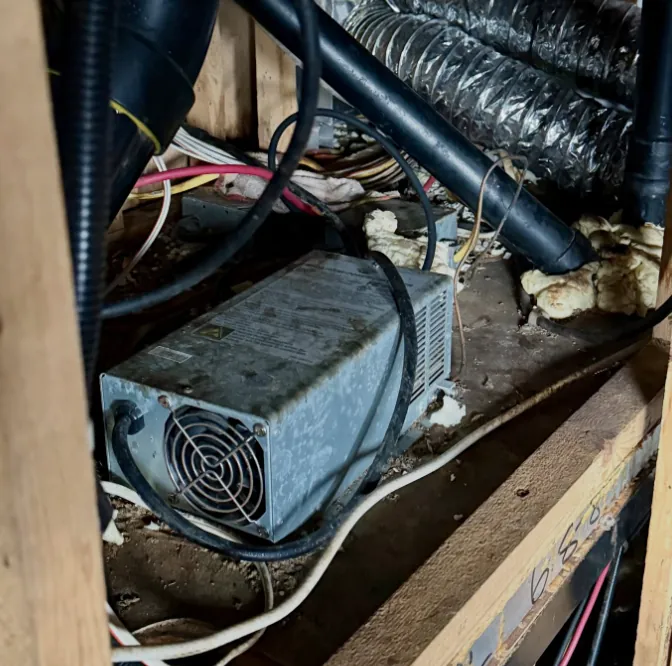
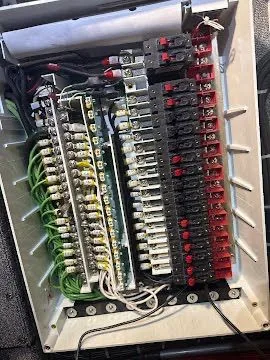
Your converter is a deck-mounted module inside the power distribution center, the same panel that carries your 120-volt breakers and your 12-volt blade fuses. In most coaches that is a Progressive Dynamics Inteli-Power PD4000 series section such as a PD4045, a WFCO WF-8900 series unit like the WF-8955 or WF-8965, or a standalone Iota DLS-45 or DLS-55 bolted into a nearby bay. All of them do the same job. Each one takes 120 volts AC in, puts out up to 14.4 volts DC, and feeds both the 12-volt fuse panel and the house battery bank at the same time. Where it sits matters here. These panels are usually mounted behind an exterior compartment door or against an outside wall under a dinette, and at Florida latitude the UV load breaks down the self-leveling sealant and the vinyl gaskets around those openings. Once those seals chalk and split, humid air and rainwater reach the board, the cooling fan bearings and the DC output studs.
Why "my batteries keep dying" usually means the converter
A working converter charges in stages. Progressive Dynamics publishes the four modes its Charge Wizard runs: boost at 14.4 volts to bring a discharged bank up quickly, normal at 13.6 volts to safely complete the charge, storage at 13.2 volts to maintain a battery that is already full, and an equalization step that returns to 14.4 volts for 15 minutes every 21 hours to slow stratification and plate sulfation. When the stage logic fails, the unit sits in that storage step and never leaves. It is enough to hold a charged battery but nowhere near enough to refill a discharged one, so the bank walks down week after week while the monitor panel still shows a comfortable 13.2 volts. Owners then buy a new set of batteries, which discharge, sulfate and lose permanent capacity on the same undercharging converter. That loop is the most expensive misdiagnosis on this system, and it is why we test the charger before anyone condemns a battery.
Could it be an inverter or converter problem?
That is one of the most common questions we get on the phone, and the two devices do opposite jobs. A converter takes 120-volt AC and makes 12-volt DC to run house loads and charge the bank. An inverter takes 12-volt DC from the bank and makes 120-volt AC for the outlets, so outlets that work on shore power and quit the moment you unplug point at the inverter, while a bank that will not hold a charge while you are plugged in points at the converter. Callers also ask why an inverter charger is not getting a red signal. On combination units and on a Charge Wizard remote pendant, that indicator reports the charging section, so a dark LED far more often means the unit has lost its 120-volt input, tripped the breaker feeding it, or blown a DC output fuse than that the board is dead. Our technicians confirm live AC at the input terminals first, then read the DC side before condemning anything.
How our technicians diagnose a converter, in order
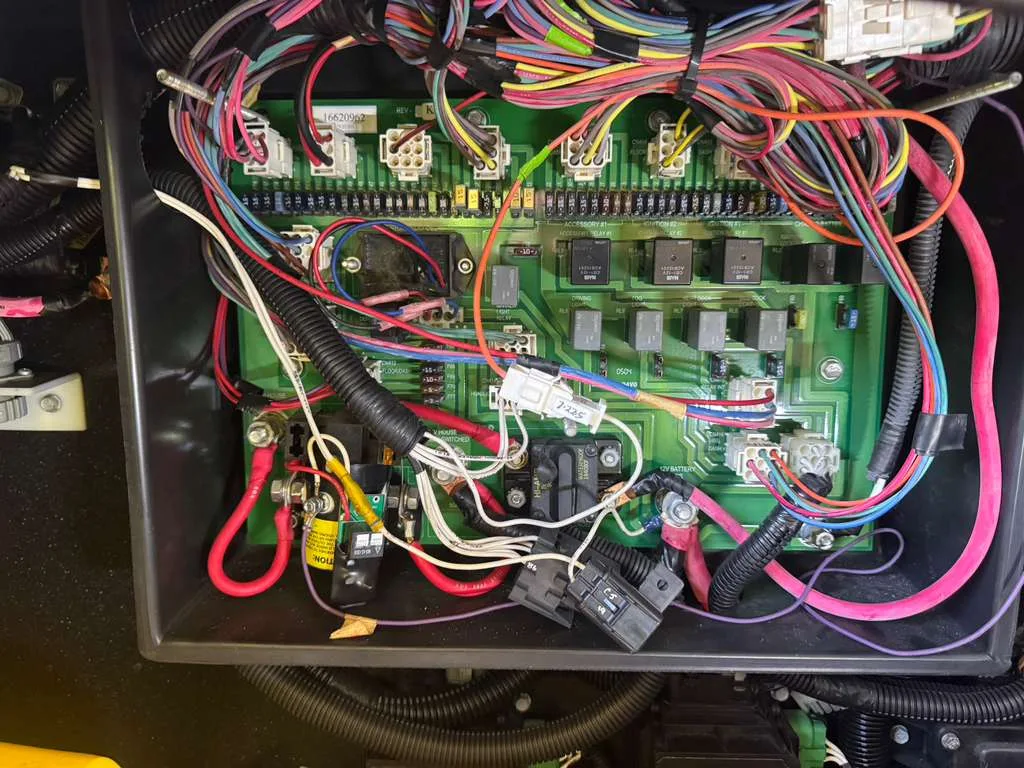
The sequence matters, because voltage on its own will lie to you. We confirm 120 volts AC at the converter input and check the breaker feeding it. Then we put a Fluke 117 across the converter DC output studs with the coach on shore power and immediately move the same meter to the battery posts. More than 0.3 volts of difference between those two readings under load means resistance in the charge wire, the ground bond or a corroded 30-amp ATC blade fuse, not a failed converter. Current comes next, and it is the reading that settles the argument. A Klein CL800 clamp meter around the DC output lead shows what the unit is actually delivering. A 55-amp converter feeding a bank at half charge should be pushing well over 30 amps in bulk, and 3 amps means the stage logic never left float. Only after that do we load test the batteries and check specific gravity on flooded cells.
What the repair costs and what it becomes if you leave it
Converter sections themselves generally land in the $180 to $400 range depending on amperage and brand, and a like-for-like swap in an accessible power center is usually 60 to 90 minutes of work once we are at the panel. Waiting is what makes it expensive. A chronically undercharged flooded or AGM bank sulfates and loses capacity permanently, so a single converter visit turns into a converter visit plus a full battery bank, and a weak 12-volt system also drags on the slide motors and leveling jacks. Chemistry decides the replacement part as well. If the bank is LiFePO4, the new section has to carry a lithium profile, because a lead-acid converter parked at 13.2 volts will never bring lithium cells up to full, and no amount of extra shore power time changes that.
Sources
Every figure on this page comes from a manufacturer document or a standards body, not from another repair site. Here is where each one comes from.
- IOTA DLS power converter and battery charger product guideThat converter charging is staged rather than a single voltage: the IQ4 module plugs into the DLS dual voltage jack and drives bulk, absorption and float phases with published per-phase voltages, plus a periodic maintenance cycle aimed at dissolving sulfate layers on stored batteries. The guide also lists chemistry-specific IQ4 modules including a LiFePO version, which supports the answer that an Iota DLS with the correct IQ module is a common lithium-capable swap.
- Battle Born Batteries, charging LiFePO4 batteriesThe lithium answer on this page. Battle Born specifies a bulk and absorption voltage of 14.4 V, calls for chargers in the 14.2 to 14.6 V bulk and absorb range, and states that float charging is not necessary and that any float stage should sit under 13.6 V. That is exactly why a converter running a lead-acid profile parked near 13.2 to 13.6 V leaves a LiFePO4 bank short of full.
- Klein Tools CL800 auto-ranging TRMS digital clamp meterThat the CL800 named in the diagnostic sequence is an auto-ranging true RMS clamp meter rated for AC and DC current, which is what makes it possible to read the converter's real DC charge current around the output lead without breaking into the circuit. This is the measurement the page argues settles the battery-versus-charger question.
- Progressive Dynamics - Charge Wizard operating modesThe four staged output voltages this page quotes for a lead-acid RV converter: Boost mode 14.4 volts, Normal mode 13.6 volts, Storage mode 13.2 volts, and an Equalization step at 14.4 volts every 21 hours for 15 minutes to prevent stratification and sulfation.
Related repairs
- our Victron Inverter Install service
- Rv Solar Install Florida in Florida
- how we handle rv shore power inlet repair
Other systems we service
Where we work
Service category
What this usually costs
| Item | Price | What it covers |
|---|---|---|
| Service call | $299 | Includes the trip out to your RV and the first hour on site |
| Work past the first hour | Quoted after diagnosis | We tell you what it will take before we carry on |
| Parts | Quoted per job | Special-order parts may need a deposit before we order them |
| Written estimate | No charge | You approve the estimate before any work starts |
The service call covers the trip out to your RV and the first hour on site. Anything beyond that depends on what we find, and we quote it and get your approval before carrying on.
The price ranges on this page come from our own recent jobs across Florida, not from an industry average. What you pay depends on the rig, the parts it needs and what we find on site, so we give you a written estimate before any work begins and you approve it first.
Frequently asked questions
Do you do AC/DC converter replacement?
Yes. Our technicians replace deck-mount converter sections in Progressive Dynamics and WFCO power centers and standalone Iota DLS units anywhere in Florida. We test the existing unit first: AC input, DC output voltage at the studs, and real charge current with a clamp meter. If the converter is charging correctly, replacing it will not fix a bank that keeps dying, and we would rather find that out before you pay for the part.
Could it be an inverter or converter problem?
Both can look like nothing works, so the test is which power source is present when the fault shows up. If your 12-volt lights and water pump fade while you are plugged into shore power, the converter is the suspect. If your 120-volt outlets and microwave quit only after you unplug, the inverter or its transfer relay is. Our technicians measure both sides at the panel instead of guessing, because the two faults share almost every symptom an owner can see from inside the coach.
Why is my inverter charger not getting a red signal?
On most inverter chargers, and on a Progressive Dynamics Charge Wizard pendant, that indicator reports the charging section rather than the whole unit. A dark LED usually means no 120-volt AC is reaching the input, the feeding breaker has tripped, or a DC output fuse has opened, commonly one of a pair of 30-amp ATC blades. We check all three, plus the pendant plug itself, before anyone discusses replacing the board, since a lost input is far cheaper to fix than a charger section.
I installed new batteries and they died too. What happened?
The charger sets the ceiling, not the battery. A section stuck at 13.2 volts will hold a full battery but cannot refill a discharged one, so every bank you install slowly drains, sulfates and loses capacity. A clamp meter on the DC output exposes that in seconds, while a voltmeter reading at the posts looks completely normal. It is why owners often buy two sets of batteries in one year, and why our technicians clamp the charge lead before quoting anything.
Will my existing converter charge lithium batteries?
Usually not properly. Battle Born calls for 14.2 to 14.6 volts through bulk and absorption on a LiFePO4 bank, while a lead-acid section falls back to 13.6 volts the moment it leaves boost and leaves the bank well short of full. Progressive Dynamics, WFCO and Iota all build lithium-profile units, and an Iota DLS with the correct IQ module is a common swap. Our technicians confirm the chemistry of your bank before ordering any replacement section.
How long does a converter replacement take, and do I need to bring the RV somewhere?
We come to you. A like-for-like converter section swap in an accessible power center is typically 60 to 90 minutes of work once we reach the panel, though a unit buried under a dinette, behind a refrigerator or above a wheel well can add an hour of access time. Our technicians stock the common amperage sizes in Progressive Dynamics, WFCO and Iota, so most of these finish on the first visit rather than turning into a second trip charge.