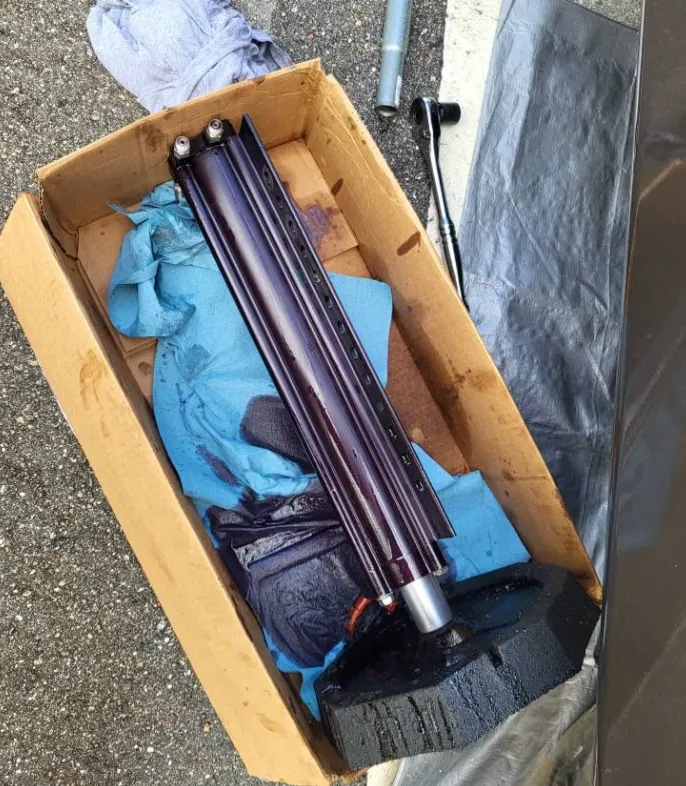
Hydraulic Leveling Jack Cylinder Reseal and Leak-Down Fix
Leveling jacks creeping down or bleeding off overnight? Mobile jack cylinder reseal, rod inspection and valve leak diagnosis in Florida. Call 888-759-1438.
The first thing our technicians look at on a jack that creeps down is the chrome rod. A cylinder that has lost its rod seal leaves automatic transmission fluid on the rod, the collar or the foot pad. A solenoid valve that no longer holds drops the coach with the rod bone dry.
Why a Leveling Jack Creeps Down Overnight
A hydraulic leveling jack holds a coach on a trapped column of fluid, not on a mechanical lock. Fluid enters the top of the cylinder to push the rod out, and a cartridge valve at the manifold keeps that fluid from running back to the reservoir once the pump stops. Nothing else keeps the rig at height while you sleep. So the complaint arrives in the same shape every time: level at bedtime, one corner low by morning, and the touchpad still showing the jacks as deployed. Sometimes one leg, sometimes the pair on the weather side of a coastal storage lot. That one symptom has two separate causes and the touchpad cannot tell them apart. Either fluid escapes past the rod seal inside the leg, or it bleeds back through a valve that will not seat. One repair is a seal kit and a teardown, the other is a part small enough to hold in a hand. Everything below separates the two before anyone spends money.
Wet Rod or Dry Rod: Leaking Cylinder Versus Leaking Valve
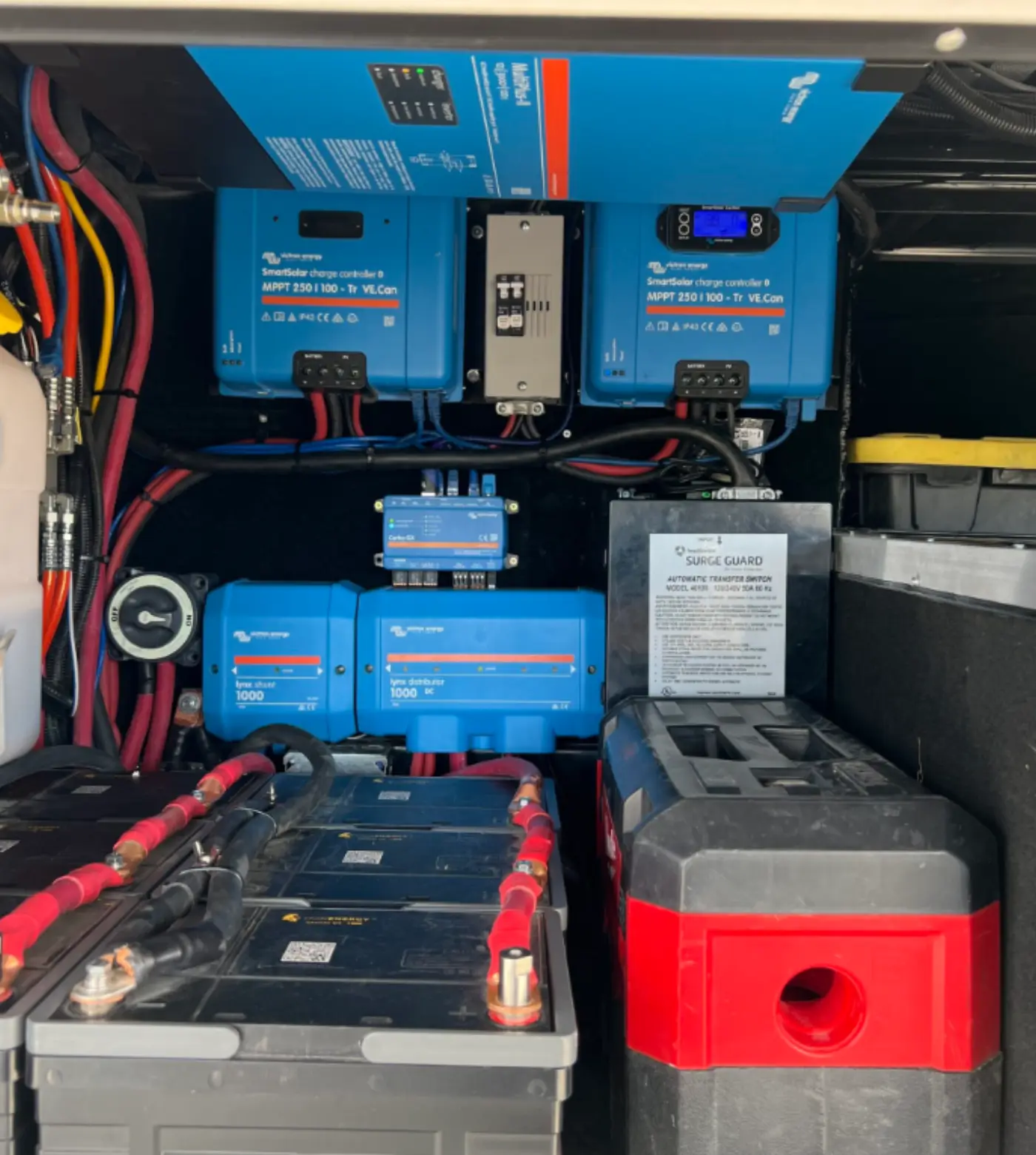
Start with a flashlight and a clean rag rather than a parts catalog. Lippert's TI-043 sheet maps every place a leveling cylinder can lose fluid and splits them into external points you can see, meaning the top of the collar, the rod seal and the static seal where the rod guide threads into the barrel, and internal points you cannot, meaning the piston head and the bottom shaft seal. An external failure paints the chrome with a wet film that runs down onto the foot pad and marks the pavement underneath. If the chrome is dry and the reservoir level still drops, the leak is internal or the valve is at fault. TI-050 is the procedure that settles it. Retract the leg fully, remove the extend hose from the top of the jack, then press retract again. Fluid from that port means the piston seal is bypassing internally. No fluid means the cylinder is sound and the valve becomes the suspect.
Rod Pitting, Salt Air and the Reseal or Replace Decision
A seal kit is inexpensive, so the surface it seals against is what actually decides the job. The rod seal rides on polished chrome, and once salt has broken through that plating the pits underneath work like a file on every stroke. Lippert is blunt about this in the Power Gear seal replacement manual: pull the rod out to its stop, and if it is not free of dings, dents, corrosion or scratches, discard the leg instead of resealing it. Coastal rigs are where that call gets made, because a coach parked in sight of the water collects chloride on any rod left extended for a week. The maintenance schedule in the same manual reflects it, calling for silicone lubricant on exposed jack rods every three months in normal service but every four to six weeks in a salty environment. A leg resealed onto pitted chrome weeps again within a season, so the rod gets inspected before anything is quoted.
Soft Ground, Correct Fluid and What Kills a Fresh Seal
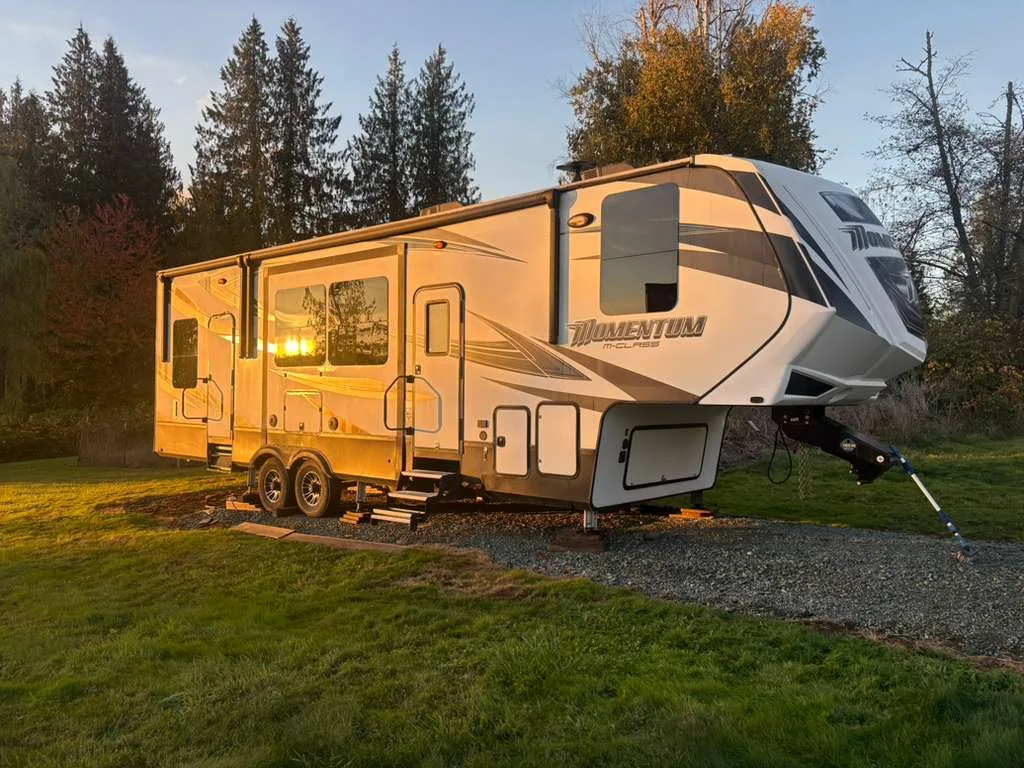
Two things ruin new seals far faster than age does. The first is deploying onto soft ground. The manual says to park on a reasonably solid surface and to put load distribution pads under each jack on extremely soft surfaces, because a foot pad that sinks unevenly stops loading the rod straight down and starts loading it sideways. Side load presses the rod hard against the rod guide and wear ring, which is what wipes a fresh seal and scores the bore. Grass, damp shell and August asphalt all count as soft, and so does a driveway edge that lets one pad hang off the concrete. The second killer is the wrong fluid. These systems take Dexron III or Mercon V class A automatic transmission fluid, or a blend of the two, and the seal compounds are matched to it. Check the reservoir only with every jack fully retracted, filling to about a quarter inch from the top and never more than half an inch down.
The On-Site Reseal, What It Costs and What It Becomes Ignored
Our technicians follow the same order on every call: rod inspection, then the TI-050 bypass test, then valve and coil continuity, then reservoir level and fluid condition. Our service call covers the trip out and the first hour on site at the rate in the pricing table on this page; anything past that first hour is quoted and approved before we carry on. A valve fault is the cheaper ending, since a HYDAC cartridge valve and its coil are modest parts. The reseal is the longer job, because the coach must be supported, the leg unpinned and dropped, and the rod guide driven in with a drift punch so the retaining ring can be pried out, which is vise and spanner wrench work rather than roadside work. Left alone, a bleeding leg stops being only a leg problem. It settles one corner onto a slide seal or a door frame, and it empties the reservoir until the pump draws air.
Sources
Every figure on this page comes from a manufacturer document or a standards body, not from another repair site. Here is where each one comes from.
- Lippert TI-043 - Hydraulic Leveling Cylinder Possible Leakage Location (CCD-0001899)The split between external leak points visible on the jack (top of collar, rod seal, static seal at the rod guide and barrel) and internal points (piston head, bottom shaft seal), plus Lippert's note that ATF is visible on the jack, foot pad or ground when the leak is external.
- Lippert TI-050 - Hydraulic Cylinder Test (CCD-0001910)The bypass test that separates a leaking cylinder from a leaking valve: retract the jack fully, remove the extend hose from the top of the leg, press retract again, and treat fluid from the port as an internally bypassing piston seal and no fluid as a sound cylinder.
- Lippert Power Gear Hydraulic Jack Seal Replacement Service Manual 82-L0352 (CCD-0002478)The reseal procedure and parts at the rod guide, the instruction to discard the leg if the rod is not free of dings, corrosion or scratches, the Dexron III or Mercon V class A ATF specification and reservoir fill level, the load distribution pad guidance for soft ground, and the maintenance interval of silicone lubricant on exposed rods every three months, shortened to every four to six weeks in a salty environment.
- Lippert TI-022 - Valve Comparison and Operation (CCD-0001879)That the holding function belongs to a HYDAC cartridge valve with a replaceable coil, carrying Lippert part numbers 123353 and 138417 with coil 176954, which is why a valve fault is a different and cheaper repair than a cylinder reseal.
Related repairs
- how we handle leveling sensor calibration
- Fifth Wheel Landing Gear Repair repairs
- Lippert Level Up Board
Other systems we service
Where we work
Service category
What this usually costs
| Item | Price | What it covers |
|---|---|---|
| Service call | $299 | Includes the trip out to your RV and the first hour on site |
| Work past the first hour | Quoted after diagnosis | We tell you what it will take before we carry on |
| Parts | Quoted per job | Special-order parts may need a deposit before we order them |
| Written estimate | No charge | You approve the estimate before any work starts |
The service call covers the trip out to your RV and the first hour on site. Anything beyond that depends on what we find, and we quote it and get your approval before carrying on.
The price ranges on this page come from our own recent jobs across Florida, not from an industry average. What you pay depends on the rig, the parts it needs and what we find on site, so we give you a written estimate before any work begins and you approve it first.
Frequently asked questions
Can you repair an RV leveling leg?
Yes, in most cases. A leg leaking at the rod seal, the collar or the static seal at the rod guide is a candidate for a seal kit, and a leg that holds fluid but drops anyway is usually a valve or coil rather than the leg at all. The exception is a rod with corrosion or scoring in the chrome, which Lippert says to replace rather than reseal, because a fresh seal will not survive on a damaged surface. That inspection is the first thing done on arrival.
Do you do mobile jacks repair?
Yes. Diagnosis, valve and coil replacement, hose and fitting work, fluid service and rod inspection all happen where the coach sits, in a driveway, storage lot or campground. A full cylinder reseal needs the coach supported and the leg unpinned, and part of the teardown is bench work with a vise and spanner wrench, so we confirm the diagnosis on site first, then schedule the reseal with the right kit on hand. The service call covers the trip out to your RV and the first hour on site, and anything beyond that is quoted after diagnosis and approved before work continues.
Do you do mobile reseal service?
Yes, on hydraulic leveling legs. A reseal replaces the rod seal, wiper, wear ring, back-up washer and O-ring at the rod guide, and it only makes sense once the chrome has been inspected and passed. We run the TI-050 bypass test first, because a jack that bleeds down through a valve gets no benefit at all from new seals and the money is better spent on the cartridge valve and its coil. Roof and skylight resealing is a separate service from this one.
Why do my jacks drift down when there is no fluid on the ground?
A dry rod with a falling reservoir points away from an external leak. Either the piston seal inside the cylinder is bypassing, moving fluid from one side of the piston to the other without it ever leaving the leg, or a cartridge valve is not seating and lets the trapped column drain back to the reservoir. The bypass test tells those apart in minutes and prevents buying a seal kit for what is really a valve problem. Topping off the reservoir hides it for a week.
What fluid does a hydraulic leveling system take?
Lippert specifies class A automatic transmission fluid meeting Dexron III or Mercon V, or a blend of the two. Do not substitute motor oil, brake fluid or power steering fluid, since the seal compounds are matched to ATF. Check the level with every jack fully retracted, fill to roughly a quarter inch below the top of the reservoir, and change the fluid if it looks milky or pink rather than clear red. Lippert also asks for a full fluid change every five years even when it looks clean.