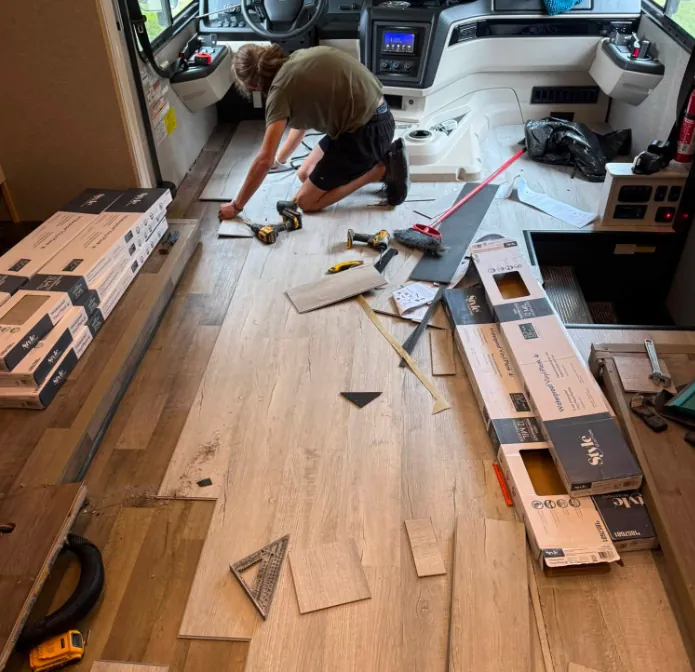
RV Flooring Replacement - Vinyl Plank Over a Sound Deck
Spongy spots or lifting seams? We check the deck first, then lay loose-lay or click-lock vinyl plank. Mobile RV flooring across Florida. Call 888-759-1438.
Owners usually call and say the floor feels spongy in front of the slide, or that a seam near the entry door has started to lift. RV flooring replacement covers the finished surface you walk on - vinyl plank, laminate, carpet or tile - and it is a different job from replacing the plywood deck underneath. Our technicians confirm that deck is dry and solid before any new flooring goes down.
Finished Floor or Subfloor: Which Job Are You Actually Buying?
Two different repairs share the word floor, and the difference decides the whole quote. The finished floor is the wear surface you see and walk on: vinyl plank, laminate, sheet vinyl, carpet or ceramic tile. The subfloor is the structural deck underneath it, usually plywood or OSB bonded into the frame, and replacing that is a separate scope with its own page. Callers ask for one and almost always need the other checked first. Luxury vinyl plank has no structural strength of its own, so a dished, spongy area under your heel is not telling you anything about the vinyl. It is reporting the condition of the deck below it. Our technicians therefore treat the deck as the gate on every flooring job. New plank laid over a wet or delaminated deck telegraphs every soft spot within a season, and the coach has to be emptied and stripped a second time.
Did the Subfloor Get Damaged? How Our Technicians Check, In Order

The check starts with feet, not tools. Our technicians heel-load the floor on a grid, working the edges and seams first, because a delaminated plywood deck flexes at its perimeter long before the middle gives. Next comes a pinless moisture meter at the places water actually enters: the slide-out floor lip, the toilet flange, the entry step, the base of the refrigerator vent and every slide corner. Plywood reading near 12 percent is dry and normal. Anything at 16 percent or higher is wet, and that reading gets traced upward until we find what is feeding it. Afternoon thunderstorms are the usual culprit, because wind-driven rain hits a slide-out topper and bulb seal sideways in a way a calm-day hose test never reproduces. Last, we lift a floor register or a run of shoe molding and probe an exposed deck edge with an awl. Sound plywood resists the point. Wet luan shreds under it.
What Each Finding Costs, and What It Becomes If You Leave It
Our service call covers the trip out and the first hour on site, and the current rate is in the pricing table on this page. Anything past that first hour is quoted after diagnosis and approved before we carry on, because we will not price a coach we have not stood inside. A dry, solid deck means the job is flooring only, and the cost is mostly demolition, appliance removal and material. A damp but structurally sound deck adds drying time and a sealant repair at the source before anything is laid. A delaminated deck moves the work into deck replacement, and the flooring becomes the last step rather than the whole project. Leaving it does not hold still. Water tracks along the deck seam to the wall base, swells cabinet toe kicks, backs fasteners out of the slide-out floor lip and turns a one-room flooring job into flooring plus deck plus lower wall.
Why RV Flooring Is Not House Flooring: Weight, Flex and Movement
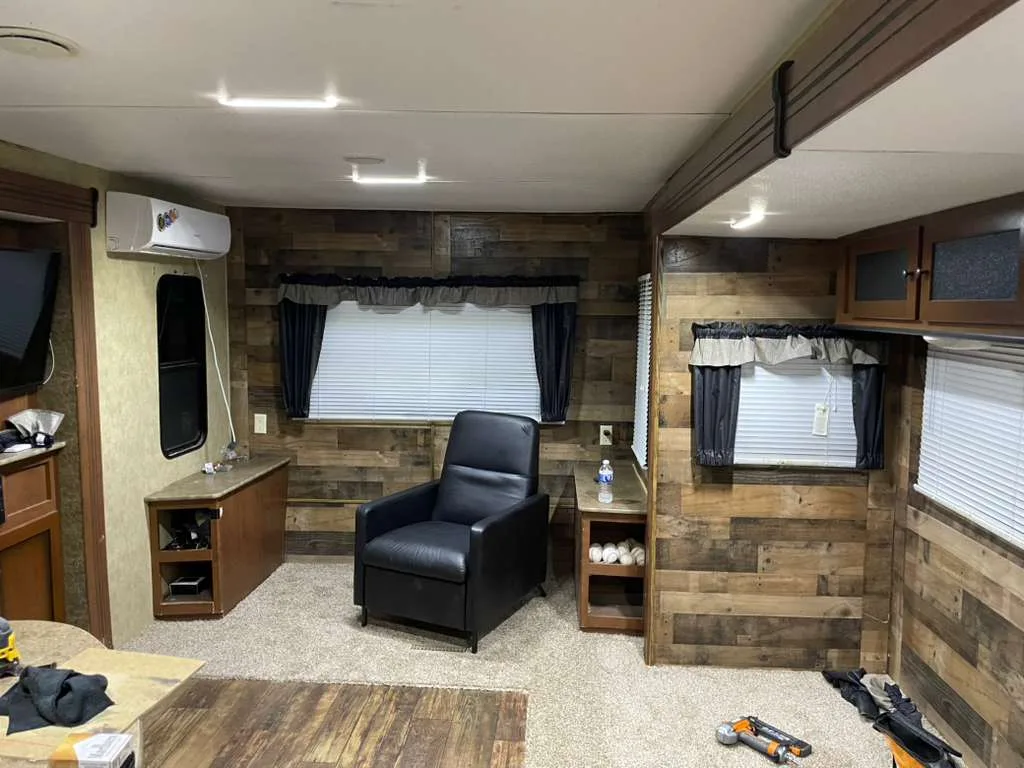
A house floor sits on a slab or on joists that never move. A coach floor rides a chassis that twists over every driveway apron and expansion joint, so anything rigid and brittle bonded across it will crack, and grout lines crack first. Weight is the second constraint, and it is the one owners never budget for. A 5mm rigid-core plank runs roughly two pounds per square foot, while ceramic tile over thinset and cement backer board runs closer to four or five. Across a 200 square foot living space that is a difference of 400 to 600 pounds, charged against a cargo carrying capacity that on many travel trailers is under 1,500 pounds. That number is printed on the yellow CCC sticker in your coach, and flooring spends it permanently. Movement is the third constraint. The slide-out room floor travels relative to the main floor, so the two are never one continuous surface.
Loose-Lay and Click-Lock Vinyl Plank vs Glue-Down and Tile
Loose-lay vinyl plank is the easiest material to live with in an RV. The planks are heavy and dimensionally stable with a friction backing, so they hold position with perimeter tape alone, and you can pull three of them to reach a leak or a wiring run. Click-lock SPC rigid core plank is the other floating option, and it usually arrives 5mm thick with a 12 to 20 mil wear layer. It floats as one field, absorbs chassis flex instead of fighting it, and needs a quarter inch expansion gap at every wall, hidden under shoe molding or cove base. Glue-down plank and peel-and-stick are where Florida bites. A closed-up coach in summer runs interior surface temperatures far above the outside air, and pressure-sensitive adhesive softens, creeps and telegraphs every seam. Humidity swings move the material as well, which is exactly what a floating floor is built to tolerate.
Slide-Out Rooms, Trim and Appliances: The Part Nobody Quotes
The slide-out is where most flooring quotes go wrong. On a Lippert or Schwintek room, the bulb seal and wiper seal sweep across the main floor as the room travels, so any added height at the opening drags on that seal or shaves it. Our technicians match the original stack height or set a low-profile reducer strip back out of the seal path, and the slide room gets its own field terminated so no plank edge feeds under the seal. Trim is not decoration here. Shoe molding, cove base and screwed transition strips have to hold the perimeter down without pinning a floating floor in place. Appliances decide the schedule. The toilet lifts and gets a new closet flange seal at the new floor height, dinette and theater seat bases unbolt through the deck, and a Dometic refrigerator is either pulled or cut around. An oscillating multi-tool undercuts door casings so plank slides beneath them rather than being scribed.
Sources
Every figure on this page comes from a manufacturer document or a standards body, not from another repair site. Here is where each one comes from.
- Lippert Components - Slide-Out Systems support libraryLippert's own support index lists the In-Wall (Schwintek), SlimRack, Above Floor and Through Frame slide-out systems as distinct products with their own documentation, which is why the finished floor height at a slide opening has to be matched to the specific room mechanism and its seal rather than treated generically.
- RV Industry Association - Association and ANSI Adopted StandardsRV construction is governed by the RV Industry Association's ANSI adopted standards rather than residential building code, which is the underlying reason the page treats RV flooring as a separate discipline from house flooring with its own weight, flex and movement constraints.
- Dometic - RV and van refrigeratorsDometic's RV refrigerator range is the built-in cabinet mounted type referenced in the appliance removal section, confirming these are fitted units that either come out or get cut around when a finished floor is replaced, rather than free standing appliances that simply roll aside.
Related repairs
Other systems we service
Where we work
Service category
What this usually costs
| Item | Price | What it covers |
|---|---|---|
| Service call | $299 | Includes the trip out to your RV and the first hour on site |
| Work past the first hour | Quoted after diagnosis | We tell you what it will take before we carry on |
| Parts | Quoted per job | Special-order parts may need a deposit before we order them |
| Written estimate | No charge | You approve the estimate before any work starts |
The service call covers the trip out to your RV and the first hour on site. Anything beyond that depends on what we find, and we quote it and get your approval before carrying on.
The price ranges on this page come from our own recent jobs across Florida, not from an industry average. What you pay depends on the rig, the parts it needs and what we find on site, so we give you a written estimate before any work begins and you approve it first.
Frequently asked questions
Did the subflooring get damaged?
That is the first thing our technicians answer, before pricing any flooring. We heel-load the floor on a grid, take pinless moisture meter readings at the slide lip, toilet flange, entry step and refrigerator vent, then probe an exposed deck edge with an awl under lifted shoe molding. Plywood near 12 percent is dry. At 16 percent or above the deck is wet, and new flooring waits until the source is fixed and the deck dries.
Can you just lay new vinyl over the old flooring?
Sometimes, and it is often the wrong call. Laying over old sheet vinyl or laminate adds height that fights the slide-out bulb seal and the entry door swing, and it hides the deck at exactly the moment you want to see it. Old carpet always comes out, because the tack strip and staples telegraph through plank. If the existing floor is flat, bonded and dry, a direct overlay can work with a low-profile reducer at the slide.
What does RV flooring replacement usually cost?
Our service call covers the trip out and the first hour on site at the rate in the pricing table on this page; anything past that first hour is quoted and approved before we carry on. Total cost depends on square footage, how many appliances have to come out and whether the slide room is included. We will not quote a fixed price on a coach we have not seen in person.
Can I put ceramic tile in my RV?
You can, and we do install it, but understand the trade. Tile over thinset and backer board runs roughly four to five pounds per square foot against about two for rigid-core plank, so a 200 square foot floor can add 400 to 600 pounds to a cargo capacity often under 1,500 pounds. Tile is also brittle across a flexing chassis, so grout lines crack first. In a stationary park model it makes far more sense than in a towable.
Do the furniture and appliances have to come out?
Most of it, yes, and that is the labor nobody expects. The toilet lifts and gets a fresh closet flange seal at the new floor height, dinette bases and theater seats unbolt through the deck, and a refrigerator or washer and dryer is pulled or the plank is cut around it. Slides get run in and out during the job so the room floor and the main floor both finish correctly at the seal.
How long will my RV be out of use?
A single room of loose-lay or click-lock plank over a deck we have already confirmed is dry is usually a same-day or next-day job. A full coach with the slide rooms, appliance removal and trim replacement runs longer. If the moisture meter finds a wet deck, add drying time plus the sealant repair at the source, because laying plank over damp plywood means doing the entire job twice.