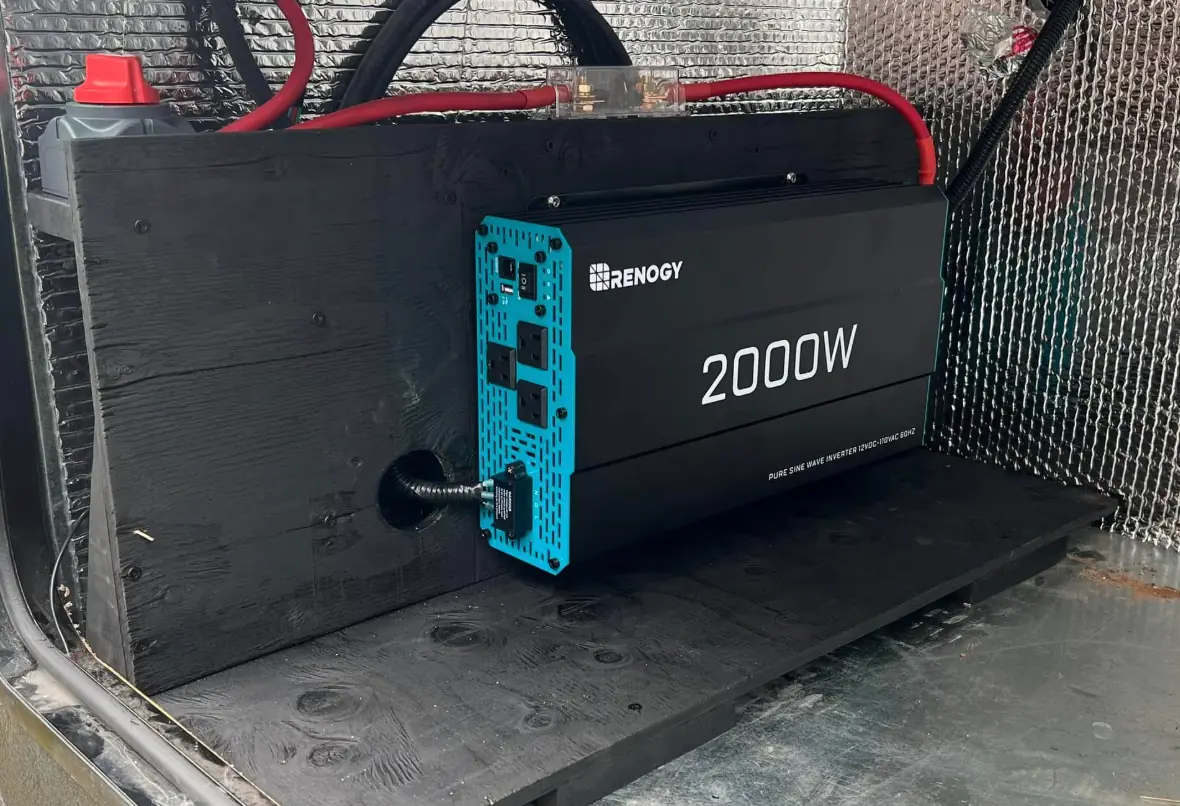
RV Inverter Install and Automatic Transfer Switch Wiring
Victron and Xantrex RV inverter plus automatic transfer switch installation in Florida. Load sizing, DC cable, fusing, placement. Call 888-759-1438.
The first fork in an RV inverter install is not the brand. It is whether you buy an inverter alone or an inverter/charger, because the second one takes over your shore power path and brings a transfer switch, a sub-panel decision and a neutral bond you did not have before.
Inverter only or inverter/charger, and what the second one changes
An inverter turns 12 volt DC into 120 volt AC and does nothing else. An inverter/charger puts a battery charger and an automatic transfer switch inside the same case, so shore power no longer runs straight to your distribution panel. It runs into the unit and back out, and the unit decides which source feeds the load. That one change rewires the coach. A Victron MultiPlus 12/3000/120 switches up to 50 amps of AC depending on model, while a Xantrex Freedom XC 2000, part number 817-2080, carries a 30 amp transfer relay. The MultiPlus also adds a ground relay that bonds the AC output neutral to the vehicle frame while inverting, then opens that bond before the input safety relay closes on shore power. Buy a plain inverter and you still need a separate automatic transfer switch, an enclosure for it, and a charging source you probably already own. Most coaches land cheaper and simpler on the combined unit.
Sizing to the load you actually run, not the number on the box

Owners ask whether we can upgrade an RV inverter from 2000 to 3000 watt, and the answer starts with a load list rather than a catalog. Continuous rating and surge rating are two different specifications. The Freedom XC 2000 delivers 2000 watts continuous at 40 C and 4000 watts of surge for five seconds, and the surge figure is what actually starts a microwave magnetron or a compressor. Add up only what you will genuinely run at the same time. A household microwave pulls 1200 to 1500 watts, a drip coffee maker 900 to 1200, a 12 volt compressor refrigerator far less. If the honest total sits under 1800 watts, a 3000 watt unit buys headroom you pay for twice. The hidden cost is DC current. A 2000 watt inverter pulls about 192 amps of DC at 12 volts at 87.5 percent full load efficiency, and a 3000 watt unit lands nearer 285 amps. Cable, fuse and battery bank all scale with that number.
DC cable gauge and length, where the install is won or lost
On the DC side of an inverter the current is enormous and the voltage is tiny, so a fraction of an ohm decides the outcome. Victron's Wiring Unlimited sets the ceiling at a 2.5 percent voltage drop, which on a 12 volt system is 0.3 volts total across the positive and negative conductors together. The book's own worked example is blunt. A 2400 watt inverter on a 12 volt battery through two 1.5 meter 16 mm2 cables draws 200 amps and drops 0.32 volts in each cable, so it sees 11.36 volts rather than 12. That 0.64 volts throws away five percent of the energy as heat and pushes battery current up to 210 amps to compensate. Victron's table for the MultiPlus 12/3000/120 asks for two 50 mm2 cables on each positive and negative terminal at runs under five meters, and two 70 mm2 cables from five to ten meters. Battery cables must never sit in closed conduit, terminals take 12 Nm, and every extra lug adds resistance.
Fusing at the battery is a requirement, and amps are not the only rating
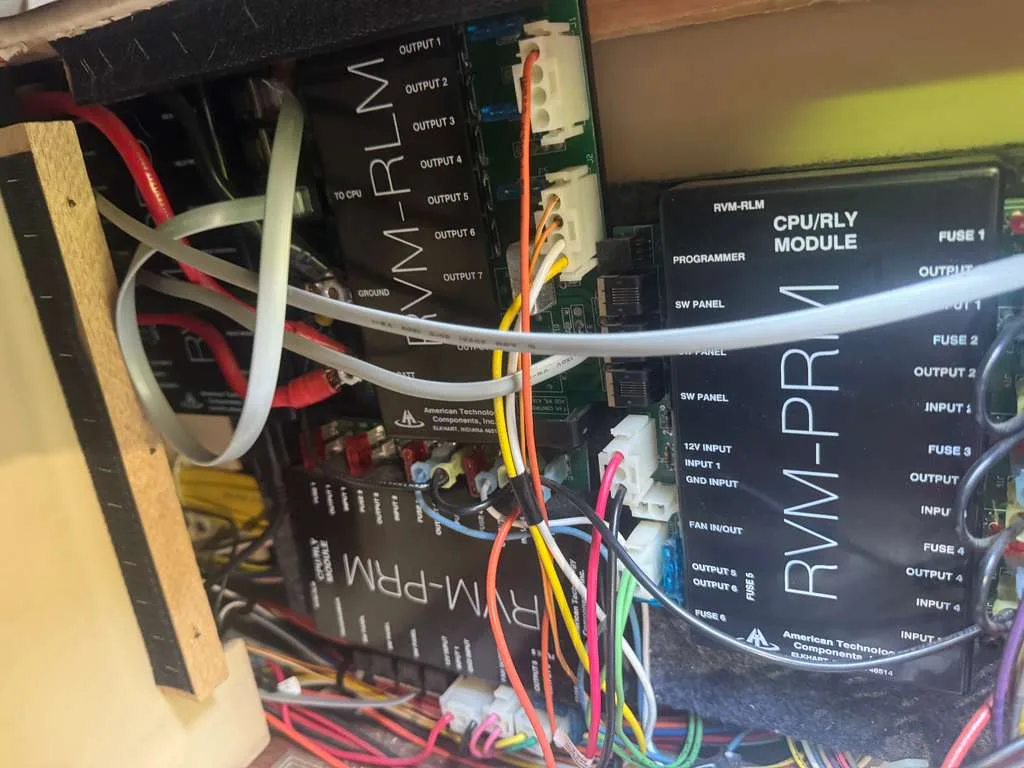
Every device connected to a battery gets its own fuse in the positive conductor, sized to the lower of the equipment rating and the cable rating. Victron specifies a 400 amp DC fuse for the MultiPlus 12/3000/120 and a 300 amp fuse for the 24 volt version of the same unit. Slow blow is the correct speed, because an inverter's input capacitors pull a large, brief inrush at switch on. The specification almost nobody checks is interrupt capacity, meaning the fault current a fuse can break without rupturing. A LiFePO4 bank can deliver a prospective short circuit current far above a lead acid bank of the same size, and at least one fuse in the DC line has to be rated to interrupt it. The numbers separate fast. A Class T fuse interrupts 200 kA, a Blue Sea ANL 6000 amps, an MRBF terminal fuse 2000 amps, and a 58 volt MEGA fuse only 1000 amps.
Where the inverter can physically live in a Florida coach
Placement is a specification, not a convenience. The MultiPlus manual asks for at least 10 cm of clear space on every side for cooling, prefers vertical mounting for airflow, and forbids mounting the unit directly above the batteries, where vented gas and acid vapor reach the electronics. It also states plainly what excessive ambient temperature does: reduced service life, reduced charging current, reduced peak capacity, and eventually a thermal shutdown with the temperature LED lit. The Freedom XC family is specified to derate its output above 104 F and to stop at 140 F, and a closed pass through bay here sits well above outside air on a still afternoon. The cable adds to it. At the 2.5 percent drop Victron allows, every kilowatt moving down the DC run dumps about 25 watts of heat into the same bay, so the enclosure has to shed inverter heat and cable heat together. A louvered door or a small extraction fan is cheap insurance.
Sub-panel or outlet level, and what actually runs when shore power drops
There are two ways to distribute inverter output. Outlet level wiring feeds two or three dedicated receptacles straight from the inverter, so the entertainment center and one kitchen outlet stay alive and nothing else does. Sub-panel wiring moves selected breakers into a second panel fed by the inverter, so those circuits change over on their own with nobody plugging anything in. The transfer relay rating decides which one is even possible. A 30 amp relay cannot carry the whole panel of a 50 amp coach, so on a Freedom XC the sub-panel is the only correct answer and the main panel is not. What you leave out matters as much. The roof air conditioner and the converter/charger stay on the shore side, because feeding the converter from the inverter charges the battery from itself. The MultiPlus provides a second AC output for exactly those loads, dropping them on battery and reconnecting them two minutes after shore power returns.
What we check on an install that misbehaves, and in what order
The complaint is behavioral rather than electrical: the microwave trips the inverter, the unit runs a while then quits, or there is a hot smell in the bay. Our technicians work it in a fixed order. First, AC input voltage at the terminals, because the unit rejects anything outside roughly 94 to 143 volts and drops back to inverting. Second, DC volts at the battery posts and again at the inverter DC terminals with the inverter loaded hard, since the difference between those two readings is the voltage drop. Third, the same meter switched to AC across the DC terminals to read ripple, then an infrared thermometer on every lug, fuse and busbar. Left alone, this ends in melted insulation and a genuine fire risk.
None of that requires dismantling the install. It is a meter, a clamp and a thermometer, and it is the difference between finding a loose lug on a Tuesday and finding it after it has melted.
Sources
Every figure on this page comes from a manufacturer document or a standards body, not from another repair site. Here is where each one comes from.
- Victron Energy, MultiPlus 12/3000/120 and 24/3000/70 120V installation manualBattery cable cross section table of two 50 mm2 cables per terminal under five meters, recommended 400 A DC fuse, 12 Nm terminal torque, 10 cm cooling clearance, the instruction never to mount above the batteries, 50 A maximum transfer current and the ground relay bonding sequence.
- Victron Energy, Wiring UnlimitedThe 2.5 percent voltage drop target of 0.3 volts on a 12 volt system, the 200 amp worked example on 16 mm2 cable, the ripple pre-alarm level of 1.50 V RMS with shutdown after twenty minutes, and the fuse interrupt ratings for Class T, ANL, MRBF and MEGA fuses.
- Xantrex, Freedom XC inverter charger specificationsContinuous output of 2000 watts at 40 C, a 4000 watt five second surge, 192 amps DC at full load, 87.5 percent full load efficiency, the 30 A transfer relay rating and output derating above 104 F.
Related repairs
- Rv Solar Install Florida in Florida
- how we handle rv shore power inlet repair
- Rv 12V Parasitic Draw repairs
Other systems we service
Where we work
Service category
What this usually costs
| Item | Price | What it covers |
|---|---|---|
| Service call | $299 | Includes the trip out to your RV and the first hour on site |
| Work past the first hour | Quoted after diagnosis | We tell you what it will take before we carry on |
| Parts | Quoted per job | Special-order parts may need a deposit before we order them |
| Written estimate | No charge | You approve the estimate before any work starts |
The service call covers the trip out to your RV and the first hour on site. Anything beyond that depends on what we find, and we quote it and get your approval before carrying on.
The price ranges on this page come from our own recent jobs across Florida, not from an industry average. What you pay depends on the rig, the parts it needs and what we find on site, so we give you a written estimate before any work begins and you approve it first.
Frequently asked questions
Can you upgrade my RV inverter from 2000 to 3000 watt?
Usually yes, but the inverter is the cheapest part of that change. A 3000 watt unit at 12 volts pulls close to 285 amps DC at full load against 192 amps for a 2000 watt Freedom XC, so the battery cable, the main fuse and often the bank itself have to grow with it. Victron recommends 400 to 1200 amp hours behind a MultiPlus 12/3000/120. We quote the wiring, not just the box.
Do I need to upgrade my RV batteries for a larger inverter?
Often, yes. Victron lists a recommended battery capacity of 400 to 1200 amp hours for the 12 volt 3000 VA MultiPlus, because a bank that is too small carries enough internal resistance to sag hard under load. That sag shows up as ripple voltage, and the inverter shuts itself down rather than cook its own capacitors. A large inverter on a small bank performs worse than a smaller inverter on a healthy one.
My inverter is smoking. What should I do?
Kill it at both ends. Switch the inverter off, unplug shore power, then pull the main DC fuse or open the battery isolator so the unit is dead on the DC side too. Do not restart it to see whether it repeats. Smoke on an inverter install traces most often to a loose or badly crimped DC lug, an undersized cable, or a fuse holder heating up, and all three get worse every time it is energized.
Why is my inverter charger not showing a charging light?
Check the mode switch first. In charger only mode the charger runs and the inverter does not, and in the on position the unit only charges once it accepts the incoming AC. A MultiPlus rejects shore voltage outside roughly 94 to 143 volts, falls back to inverter operation, and no bulk, absorption or float LED lights at all. A pedestal sagging under load looks identical to a dead charger from inside the coach.
What is the cheapest way to diagnose a battery or inverter issue?
One visit that measures both, instead of replacing parts in sequence. The meter work is the same either way: resting and loaded voltage at the battery posts, voltage again at the inverter DC terminals while the inverter is loaded hard so the drop between them is visible, and AC ripple read across those same terminals. Those three readings separate a tired bank from an undersized cable run from a failing inverter. Buying a battery bank first is the expensive way to ask the same question.
Does an inverter install need its own transfer switch?
Only if you buy an inverter without one. Every inverter/charger has an automatic transfer switch built in, rated at 30 amps on a Freedom XC and up to 50 amps on larger MultiPlus models. A plain inverter has no way to disconnect shore power, so it needs a separate automatic transfer switch in its own enclosure plus the wiring to route shore power through it. That hardware usually erases the price difference.