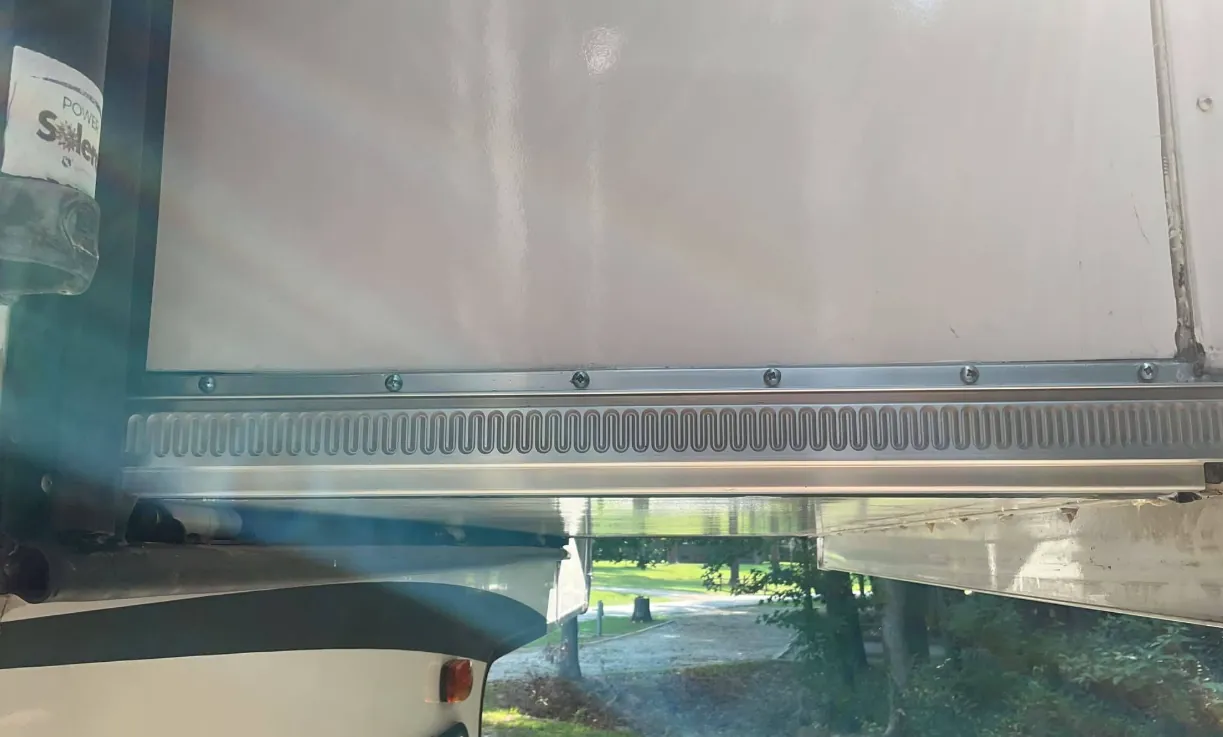
Hydraulic Slide Out Repair - Pump, Cylinder and Hose Fix
Through-frame hydraulic slide stuck, drifting or leaking? Mobile pump, cylinder, hose and manifold repair anywhere in Florida. Call 888-759-1438.
A through-frame hydraulic slide-out moves the room on two cylinders mounted across the chassis rails, fed by a 12 volt Lippert hydraulic power unit that pushes automatic transmission fluid through a valve manifold. Because those valves hold the fluid trapped, hydraulic slides fail quietly rather than loudly: creeping in overnight, stalling short of the seal, or drifting out of square. Apex RV Repair diagnoses and repairs these systems on site anywhere in Florida.
What a Through-Frame Hydraulic Slide Actually Does
A through-frame hydraulic slide moves the room on two long cylinders mounted crosswise beneath the floor, carried inside the chassis rails rather than hidden in the sidewall. A 12 volt hydraulic power unit sits in a bay or under the entry steps, drawing fluid from a small reservoir and pushing it through steel line and rubber hose to a valve manifold. The manifold routes that pressure to the extend port or the retract port of each cylinder, and the rod pushes or pulls a crossmember tied into the slide frame. Nothing about the room's position is electronically tracked. There is no gearbox, no timing motor and no synchronization controller deciding how far each side has traveled. The room stays square because both cylinders see the same fluid at the same moment, and it stays put because the valves keep that fluid trapped in the cylinder. Once that is clear, every hydraulic symptom becomes a question about pressure, volume, or a valve that will not seat.
The Pump Assembly, Reservoir and Fluid Specification
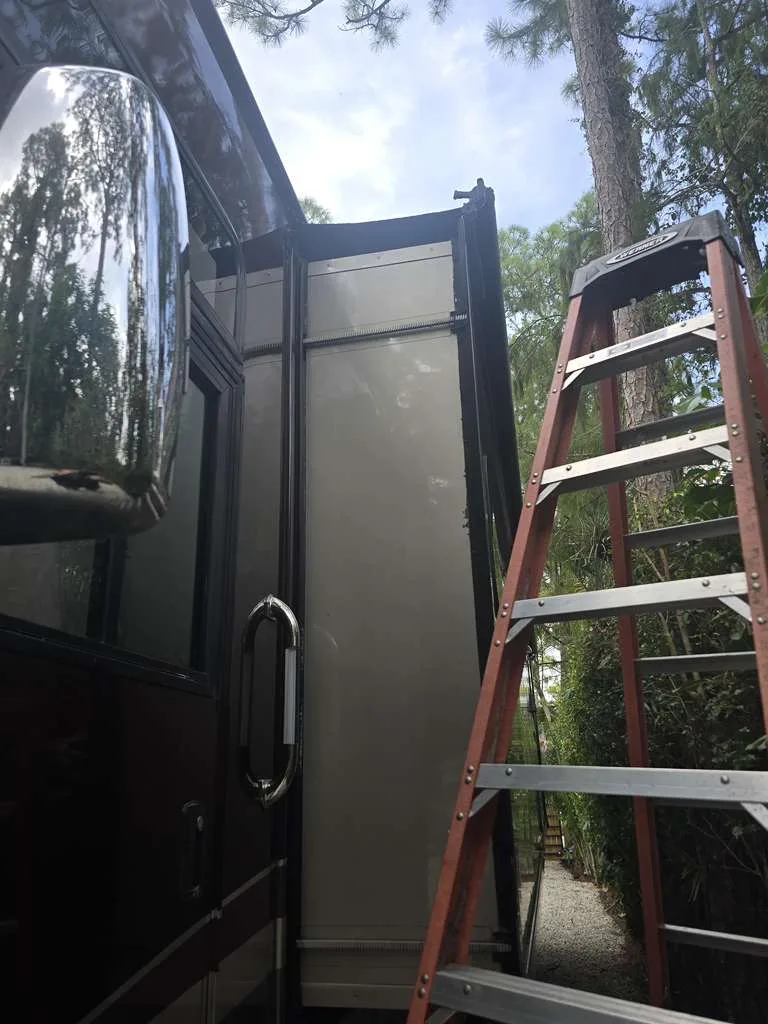
The Lippert hydraulic power unit is a motor, a gear pump, a reservoir and a manifold stacked into one assembly, and it is worth confirming first because it is the loudest and most accessible part of the system. Lippert specifies Type A automatic transmission fluid, Dexron III or Mercon equivalent, and the reservoir holds only a couple of quarts - which means a slow weep that would be invisible on an engine can starve this pump within a single season. Fluid gets checked with every slide retracted and every jack up, never with a room extended, or the unit is overfilled and pushes fluid past the cap on the next retract. A pump that whines, surges, and walks the room out in short bursts is usually low or aerated fluid rather than a failing motor. A pump that clicks but never spins is almost always the motor solenoid, a corroded ground strap, or a battery sagging under 11.5 volts at load rather than the pump itself.
Cylinders, Rod Seals and Hoses in Florida Sun
The cylinder is a chrome rod running through a gland nut, sealed by a rod seal on the inside and a wiper seal on the outside. The wiper's entire job is to scrape road film off the rod before it re-enters the barrel, and once it hardens it stops scraping and starts abrading. Ultraviolet exposure at Florida's latitude is what hardens it, along with the sealant packed around the frame rail penetrations. The same sun bakes the hose jacket, and the crack almost never appears mid-run where an owner would look for it - it shows at the crimp collar where the hose leaves the shaded rail and turns into open sunlight. A rod that has gone hazy or pitted will chew through a fresh seal within months, so the rod gets inspected with the room extended before any seal kit is quoted. Hose ends are 37 degree JIC swivels, and a weeping fitting is often an over-torqued flare rather than a failed hose.
Solenoid Valves, the Manifold and Why a Room Creeps In
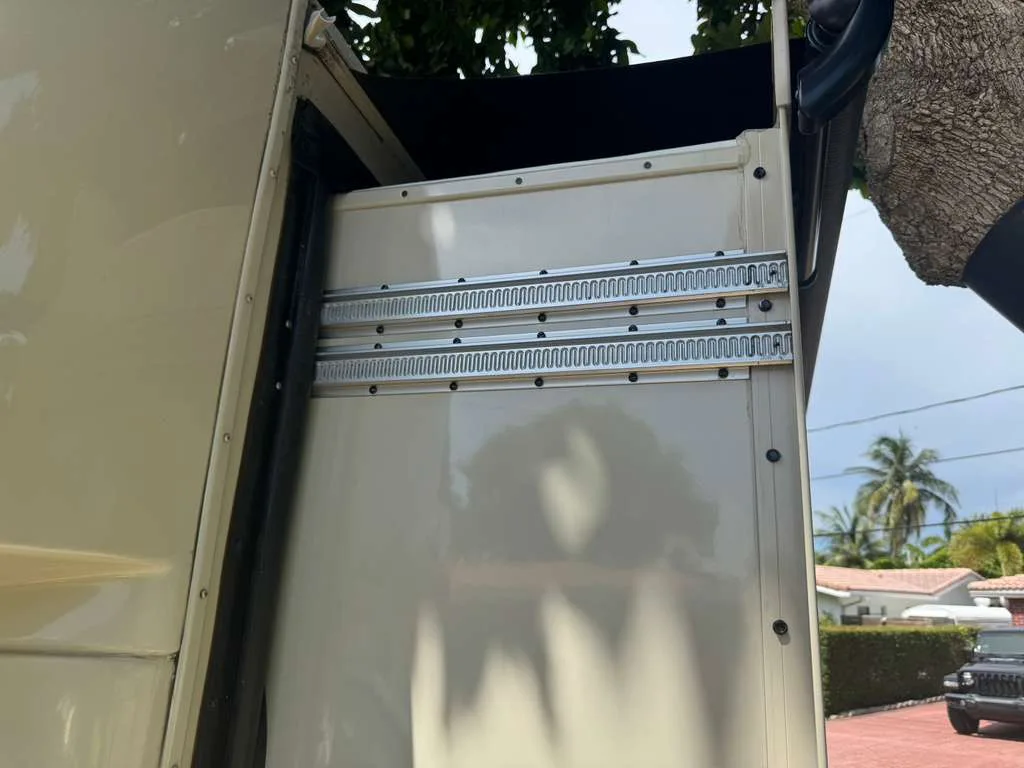
Each function on the manifold is controlled by a cartridge solenoid valve: a screw-in cartridge with a 12 volt coil slipped over its stem and held by a nut. Energize the coil, the poppet lifts and fluid passes. De-energize it and a spring is supposed to seat that poppet hard enough to trap the column of fluid inside the cylinder for weeks at a time. This is where hydraulic failure separates itself from electric slide failure. An electric room fails loudly and visibly, with chatter or one side lagging behind the other. A hydraulic room fails quietly: it creeps in an inch overnight, or it stalls two inches short of full extension while the seal never quite touches the wall. Coils are the easy half, since a coil either reads resistance and warms up or it does not. The cartridge underneath is the part that actually wears, and grit circulating in old fluid is what scores the seat it depends on.
How We Diagnose and Repair Hydraulic Slides On Site
Diagnosis starts electrically because that half is faster to rule out. A meter goes on the pump solenoid output to confirm the battery holds above roughly 11.5 volts while the motor is under load, then a clamp-on DC ammeter goes around the pump lead to prove the motor is drawing current rather than buzzing. Only then do we tee a 0 to 5,000 psi gauge into the pressure port and stall the room gently against its stops, watching whether the pump builds pressure and then holds it or bleeds it straight back to tank. From there the list is short: fluid level and condition, coil continuity at each cartridge, then a rod and fitting inspection with the room out. Nearly all of it happens where the coach sits, in a driveway, storage lot or campsite anywhere in Florida. A power unit swap typically runs two to three hours, and a cylinder reseal three to five, since the room must be supported and the cylinder unpinned.
Sources
Every figure on this page comes from a manufacturer document or a standards body, not from another repair site. Here is where each one comes from.
- Lippert Customer Care Center - Power Gear Through Frame Slideout SystemThat the through-frame hydraulic slide is a Lippert-supported architecture with cylinders carried inside the chassis rails, as described in 'What a Through-Frame Hydraulic Slide Actually Does'.
- Lippert FAQ - How do I purge my hydraulic pump unitThat aerated fluid in the power unit is a recognized Lippert condition with its own purge procedure, backing the claim that a pump which whines, surges and walks the room out in short bursts is usually low or aerated fluid rather than a failing motor.
- Lippert FAQ - How can I test my hydraulic cylinderThat Lippert publishes a defined cylinder test procedure, supporting the on-site diagnostic sequence in 'How We Diagnose and Repair Hydraulic Slides On Site'.
- Lippert TI-048 - Manual Override for Motorized Standard Leveling Systems Prior to 2008 (CCD-0001907)The FAQ answer on getting a room in with a dead pump. Lippert's sheet locates a hex head receptacle at the end of each valve as that valve's manual override, opened by turning it clockwise with a 5/32 inch hex wrench, identifies the slide-out valve as the one with two black hoses at the port, and then has the motor itself overridden with a hand drill and a 1/4 inch hex bit, clockwise to extend and counterclockwise to retract. It also carries Lippert's own caution that manual override is for retract mode only and that the slide-out and the jacks must never be overridden at the same time.
Related repairs
- our Lippert Cable Slide Repair service
- Rack Pinion Slide Repair in Florida
- how we handle slide seal wiper replacement
Other systems we service
Where we work
Service category
What this usually costs
| Item | Price | What it covers |
|---|---|---|
| Service call | $299 | Includes the trip out to your RV and the first hour on site |
| Work past the first hour | Quoted after diagnosis | We tell you what it will take before we carry on |
| Parts | Quoted per job | Special-order parts may need a deposit before we order them |
| Written estimate | No charge | You approve the estimate before any work starts |
The service call covers the trip out to your RV and the first hour on site. Anything beyond that depends on what we find, and we quote it and get your approval before carrying on.
The price ranges on this page come from our own recent jobs across Florida, not from an industry average. What you pay depends on the rig, the parts it needs and what we find on site, so we give you a written estimate before any work begins and you approve it first.
Frequently asked questions
Why does my hydraulic slide creep in by itself overnight?
Almost always a cartridge solenoid valve in the manifold that no longer seats, letting fluid bleed from the extend side back to the reservoir. A leaking hose or cylinder leaves visible fluid on the frame rail or the ground. An unseated poppet leaves the rail dry and simply drops the reservoir level instead, which is why owners often top off the fluid and find the creep unchanged the following week.
What fluid does a Lippert hydraulic slide-out pump take?
Lippert specifies Type A automatic transmission fluid, Dexron III or Mercon equivalent, for its hydraulic power units. Do not substitute motor oil, brake fluid or power steering fluid, since the seal compounds in the pump and cylinders are matched to ATF. Check the level with every slide retracted and every leveling jack up, then fill to the mark rather than to the top of the reservoir, since an overfilled unit will push fluid past the cap the first time a room retracts.
Can I get the room in if the hydraulic pump is dead?
Usually yes. Most Lippert power units put a hex head manual override at the end of each valve, opened clockwise with a 5/32 inch hex wrench, and the motor itself takes a hand drill with a 1/4 inch hex bit. Lippert's own instruction is to use the override for retract only, and never on the slide-out and the jacks at the same time. It is a get-home measure, not a repair - once the room is in and the overrides are closed, the underlying pump, coil or valve fault still needs to be found.
How does hydraulic slide failure differ from electric slide failure?
Electric rooms fail with noise and visible mistiming, because motors, gearboxes and controllers are trying to keep two sides synchronized. Hydraulic rooms have no synchronization to lose, so they fail quietly through pressure and volume: slow travel, a stall short of the seal, drift back in, or a room that will not hold position. That difference is why a hydraulic complaint gets a pressure gauge rather than a controller reset.
What does hydraulic slide-out repair usually cost?
Parts vary widely by coach, but a complete replacement hydraulic power unit is commonly a several hundred dollar part, a solenoid coil is typically well under a hundred, and a cylinder seal kit is modest by comparison. Labor is usually the larger line, since a reseal means supporting the room and unpinning the cylinder. We quote the diagnosis and the repair separately, so you see the parts and the hours and approve the work before anything comes apart.