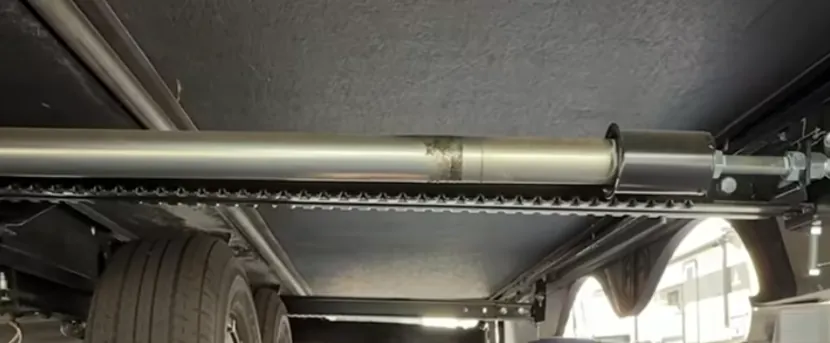
Rack and Pinion Slide-Out Repair - Mobile RV Gear Rack Fix
Rack and pinion RV slide-out repair across Florida: slipped gear racks, worn pinions, stripped gearboxes and manual override help. Call 888-759-1438.
The first three checks on a rack and pinion slide-out are battery voltage under load, the quality of the ground connection, and whether the motor turns while the room stays put. Those three answers separate a power fault from a stripped gear before anything is taken apart. Both sides of this system are tied to one cross shaft, so a room running crooked is a mechanical problem, never an electronic sync problem.
How a Rack and Pinion Slide-Out Keeps Both Sides in Step
A rack and pinion slide-out moves the room on toothed gear racks fixed to the slide arms or hat channels, with a pinion gear meshed into each rack. Lippert's Above Floor Slide-out System, sold for years under the Power Gear name, turns both pinions from one bi-directional 12V DC motor through a single cross shaft, and the motor gearbox carries a built-in automatic clutch. That shaft is the entire design idea. Because both pinions ride on the same piece of steel, the two sides stay synchronized mechanically instead of being matched by a controller comparing motor timing, which is how a Schwintek in-wall slide holds step. There is no timing to relearn here and no electronic resync to run. So when one side of a rack and pinion room leads the other, something physical has moved: a gear rack has slipped on its channel, a gear key has sheared, or a rail is bent.
The Readings We Take Before Anyone Touches the Gears
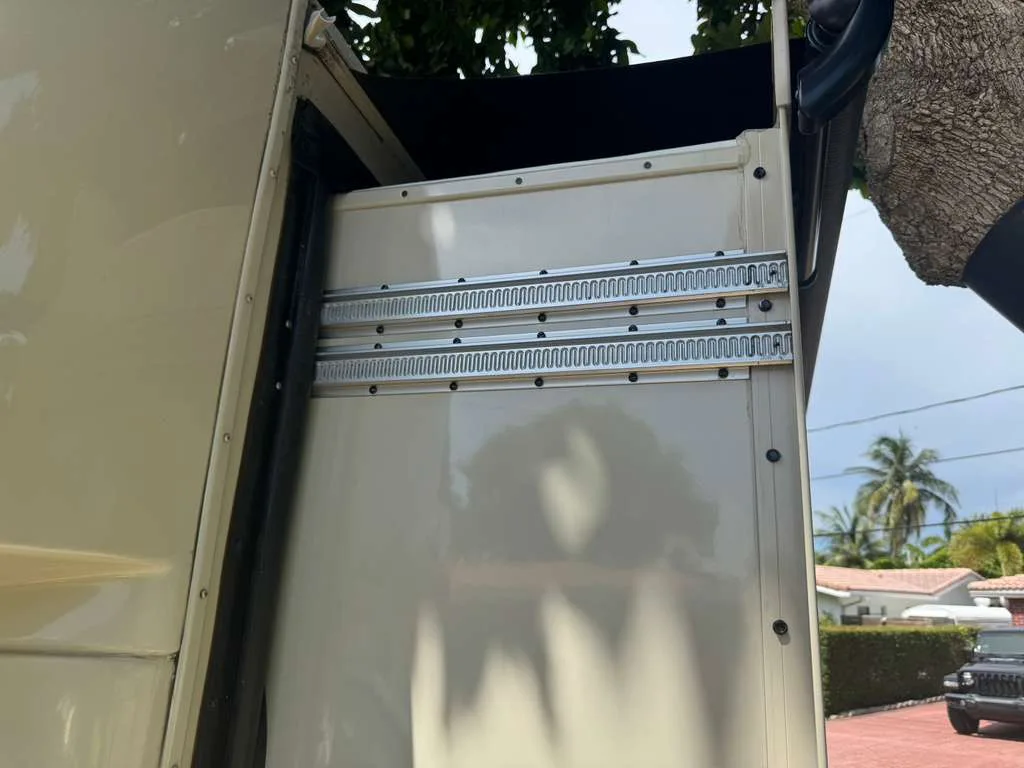
Slide-out faults get blamed on the motor far more often than the motor earns. The first reading is battery voltage taken under load, because Lippert's Above Floor manual is explicit that a battery has to be loaded to read honestly and that the meter must show 12.5 to 13.7 volts for a full charge. Next is 12V DC across the wall switch terminals on a feed that has to be 10 gauge minimum, with yellow as extend, green as retract, red as power and black as ground. Ground is the reading that pays. Lippert attributes over 90 percent of unit electrical faults to bad ground connections, and a corroded ground under a Florida coach will move a room slowly, stall it halfway, or imitate a binding rail perfectly. A clamp meter on the motor lead through a full stroke finishes the picture: current climbing steadily across travel is drag, while a spike at one point is an obstruction.
Slipped Rack, Worn Pinion and Bent Rail: What Loses Sync
Three mechanical faults account for most lost synchronization, and each one sounds different. A slipped gear rack, where the toothed rail shifts on its channel or its fasteners loosen, lets one side gain or lose a tooth per cycle, so the room walks progressively further out of line every time it is run. A worn pinion or a chewed inner rail produces chatter under load, and Lippert's troubleshooting chart is blunt about that symptom: teeth broken or worn on the gear drive, or on the inner rail, means the gear drive assembly gets replaced rather than dressed. The third is a bent or tweaked rail, usually from a room driven against an obstruction or against a missing stop block. One separate signature is worth memorizing. If the motor runs cheerfully and the room does not move at all, the cause is normally a sheared gear key or a broken gear on the drive shaft, not a dying motor.
Out of Square or Failing Drive? They Present Identically
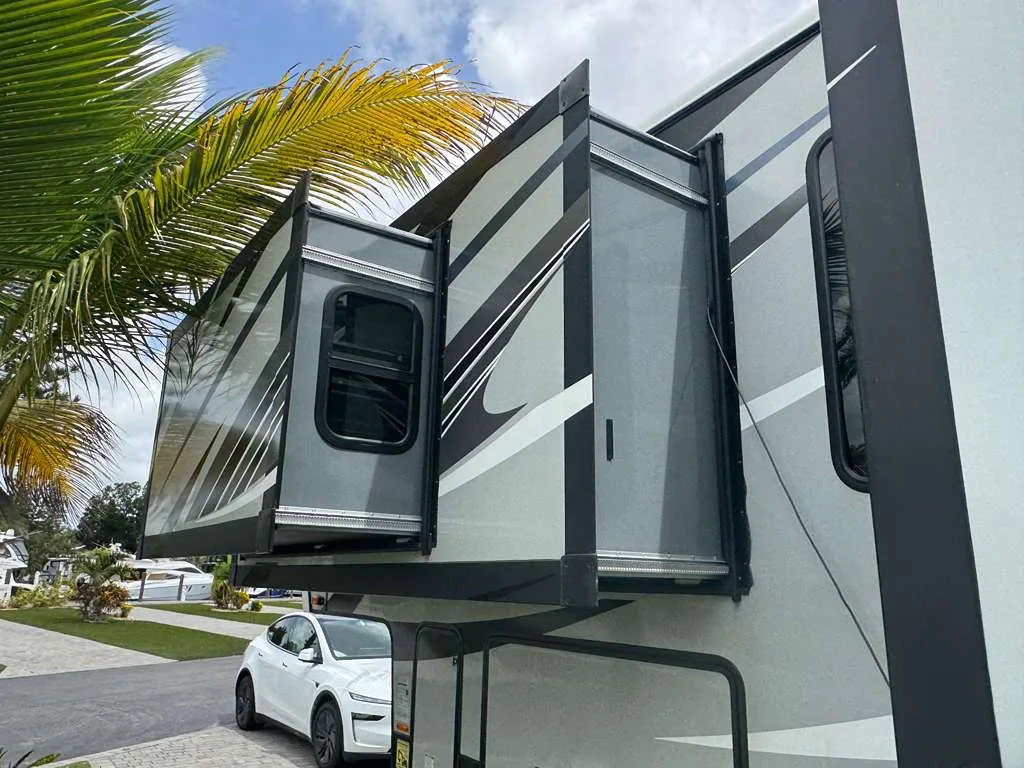
An owner cannot tell these two apart from the switch, and neither can a technician without measuring. Our technicians take the gap between the room flange and the sidewall at all four corners, then compare the two diagonals. A room that is out of square shows an even taper, wide at one corner and tight at the diagonal opposite, and it reads the same on every cycle. A failing drive is inconsistent instead, worsening as the stroke goes on or changing between runs. That distinction decides the repair, because out of square is corrected at the two carriage bolts on the interior mounting plate for height and then at the clamp-on stop blocks, set with a hex key so the seal is made at both ends of travel. A failing drive is not adjustable. A room left out of square will not compress its top wiper, and one Florida afternoon thunderstorm pushes water over the slide face into the floor.
Why Forcing a Binding Room Turns a Small Repair Into a Big One
Every Above Floor rack and pinion system has a manual override, and the day the room is stuck is the wrong day to go looking for it. It is a hex head crank extension at the back of the motor gearbox, turned with a 5/8 inch wrench or a socket and ratchet: clockwise extends the room, counterclockwise retracts it. Lippert is specific about the order. Switch the 12V DC battery disconnect off and disconnect one motor lead first, because back-feeding current through the motor damages it. The same manual carries the warning that matters most here: keep cranking once the room has reached full travel and the gears strip, and a stripped gear means the entire gearbox is replaced, not a tooth repaired. Holding the wall switch against a room that has already stopped does the same damage electrically. A binding room is a diagnostic result, not an invitation to push harder.
Lubrication, On-Site Repair and Why Grease Makes It Worse
Lubrication is where well-meant maintenance does real damage. Lippert's Above Floor manual states that no grease or lubrication is necessary, that lubricant may in some situations be detrimental, and that the system was static tested past 2,500 continuous cycles without noticeable wear to rotating or sliding parts. If the mechanism squeaks, a light lubricant on the drive shaft and roller areas is permitted with the excess wiped off, and grease is ruled out outright. Grease on a toothed gear rack collects sand and road grit and then grinds the teeth it was meant to protect, which is the mechanism behind that instruction. Most faults close in one visit. The mechanical side of this system comes apart where the coach sits, so the room gets supported on stands, the gear drive is unbolted from the cross shaft, and the stop blocks and travel are reset before the wall switch is handed back to the owner.
Sources
Every figure on this page comes from a manufacturer document or a standards body, not from another repair site. Here is where each one comes from.
- Lippert Above Floor Slide-out OEM Installation Manual (CCD-0001597)That the Above Floor system is a rack and pinion design driven by a bi-directional electric motor through one drive shaft with a built-in automatic clutch; the 12.5 to 13.7 volt battery check, 10 gauge minimum wiring and wire color code; the troubleshooting chart entries for chatter from worn gear drive or inner rail teeth and for a broken gear key; the manual override procedure using a hex head crank extension and 5/8 inch wrench with the battery disconnect off; the warning that cranking past full travel strips the gears and requires whole-gearbox replacement; the stop block and room adjustment procedure; and the maintenance statement that no grease or lubrication is necessary, that the system was static tested past 2,500 continuous cycles, and that grease must not be used.
- Lippert Customer Care Center - Power Gear Above Floor Slide-OutsThat Lippert publishes the service documentation for this system under the Power Gear Above Floor name, including motor troubleshooting and replacement, cross shaft replacement, stop adjustment, manual override and slide-out fault code references.
- BAL RV Products (Norco Industries) - Accu-SlideThat the Accu-Slide is a BAL frame-within-a-frame system driven by stainless steel cables rated above 2,000 pounds tensile strength, not a geared rack and pinion drive, which is the identification point owners and some competitor pages get wrong.
Related repairs
Other systems we service
Where we work
Service category
What this usually costs
| Item | Price | What it covers |
|---|---|---|
| Service call | $299 | Includes the trip out to your RV and the first hour on site |
| Work past the first hour | Quoted after diagnosis | We tell you what it will take before we carry on |
| Parts | Quoted per job | Special-order parts may need a deposit before we order them |
| Written estimate | No charge | You approve the estimate before any work starts |
The service call covers the trip out to your RV and the first hour on site. Anything beyond that depends on what we find, and we quote it and get your approval before carrying on.
The price ranges on this page come from our own recent jobs across Florida, not from an industry average. What you pay depends on the rig, the parts it needs and what we find on site, so we give you a written estimate before any work begins and you approve it first.
Frequently asked questions
Does my RV slide have an override?
On an Above Floor rack and pinion system, yes. The override is a hex head crank extension at the back of the motor gearbox, turned with a 5/8 inch wrench: clockwise to extend, counterclockwise to retract. Switch the 12V DC battery disconnect off and disconnect one motor lead before turning it. Find and photograph yours now, because Schwintek, cable and hydraulic slides put their overrides in completely different places.
How do I manually force my RV slide in and out?
The honest answer is that you should crank it, not force it. Turn the override smoothly and stop the moment resistance climbs or the room reaches the end of its travel. Lippert's manual warns that continuing to rotate the override at full travel strips the gears, and a stripped gear means the whole gearbox is replaced. If the room binds partway, something mechanical is in the way and cranking harder will find the weakest gear tooth.
Do you know what kind of slide it is?
We identify it from the mechanism, not the brochure. A rack and pinion slide shows a toothed steel rail with a pinion meshed into it and a cross shaft tying both sides together. Cable systems show drums and pulleys instead. BAL's Accu-Slide is often grouped with geared systems but is actually a cable design built as a frame within a frame, using stainless steel cables rated above 2,000 pounds tensile, so it is a different repair entirely.
Why aren't my slide outs coming out?
Work the list in order. Start at the battery under load, and if it will not hold 12.5 to 13.7 volts, check the ground and the fuse, then confirm 12V DC reaches the wall switch. Clear any obstruction and verify the transit bars are off. If the motor runs and the room still does not move, the fault is mechanical, normally a sheared gear key or a broken gear on the drive shaft rather than the motor itself.
Can you replace motorhome slide-out tracks?
Yes. Lippert treats the mechanical portions of the Above Floor system as replaceable parts, so a chewed inner rail, a worn gear rack or a failed gear drive assembly can be changed on site. The motor is the exception: it has no serviceable parts inside, and opening it voids the warranty, so a failed motor or gearbox is replaced as a unit. Slide seals and slide floor rot are separate repairs.