RV Toilet Flange Seal Repair - Leaks at the Toilet Base
Sewer smell at the toilet base means the floor flange seal is leaking into the deck. Mobile RV toilet flange repair across Florida. Call 888-759-1438.
An RV toilet seals in two places and they fail differently. The floor flange seal is a nitrile rubber and foam gasket squeezed between the toilet base and a 3 inch floor flange, and when it leaks, waste water goes into the plywood deck rather than onto it. The flush ball seal sits inside the bowl and only holds standing water. A sewer smell over a dry floor almost always means the lower seal.
The Two Seals People Confuse, and Only One Wets the Floor
Every gravity flush RV toilet carries two seals with similar names and completely different jobs. The flush ball seal, called a blade seal on Thetford units and listed as part 31708 for the Aqua-Magic VI, rings the ball valve inside the bowl and does one thing: hold standing water above the tank. When it fails the bowl empties overnight and tank gas rises through the open ball, but the floor stays dry. The floor flange seal, Thetford part 33239, is the lower gasket. It is compressed between the underside of the toilet base and the top face of the closet flange, and it is the only thing between the waste line and the plywood deck the toilet is bolted to. Dometic builds the same part from nitrile rubber and foam on its 300, 310 and 320 series. A bowl that will not hold water is an annoyance. A flange seal that will not hold is a floor repair.
Why an RV Toilet Has No Wax Ring
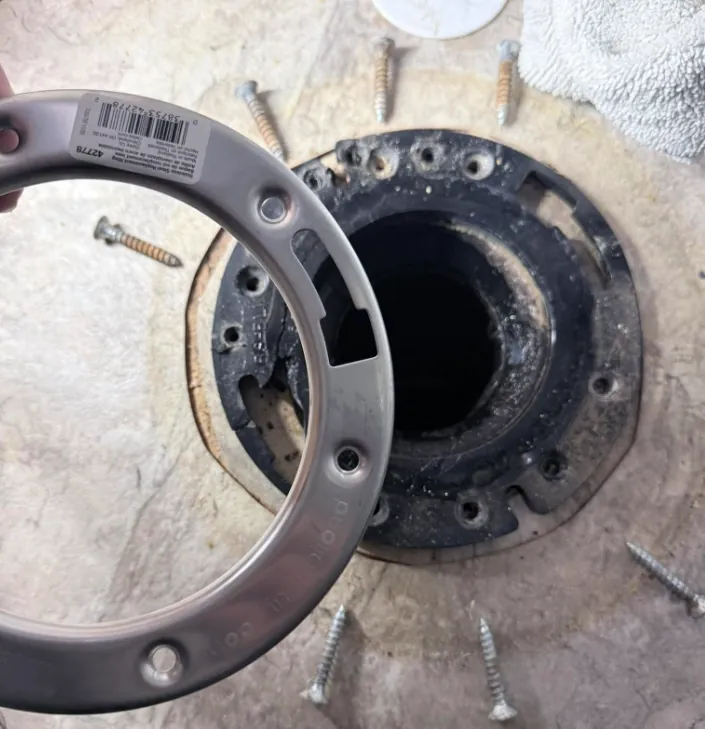
A house toilet sits on a wax ring that crushes into place under the weight of the china and never comes back apart the same way. A coach cannot use one. The floor deck is thin and the whole body flexes and twists as it travels, so a wax ring shears and reseats itself off-center after a few hundred miles of road input. Thetford and Dometic both specify a formed elastomer gasket instead, a nitrile or foam ring that is elastic rather than plastic and returns to shape after each flex cycle. Dometic calls for a floor flange with a 3 inch inside diameter, between 1/4 and 7/16 inch thick, fastened to the deck with a minimum of four screws and preferably eight. That flange is usually ABS or PVC. Nothing in the arrangement depends on crushed wax, which is why a hardware store wax ring is the wrong part for this job.
How We Trace a Toilet Leak, In Order
Order matters, because three unrelated failures put water in the same spot. First comes a flush cycle with the base wiped dry and a paper towel run around the foot: water that appears only while the pedal is down points at the vacuum breaker or the water valve, and Thetford's own answer for a leak behind the toilet is a failed vacuum breaker rather than a gasket. Second, the bowl gets grabbed and rocked. Any movement at all means the gasket is no longer under even compression. Third, the toilet comes off, which is two nuts and a 1/2 inch ratchet, and the flange itself is inspected for cracked ears, stripped screws and a slot the bolt has pulled through. Fourth, the deck around the opening is metered with a pin moisture meter before anything goes back down. Only after those four does a new gasket make any sense.
Closet Bolts, Torque, and the Toilet That Rocks
Two closet bolts hold the unit down, T-bolts that drop into slots in the flange, and they are among the most over-tightened fasteners in the coach. Dometic publishes an actual figure: 30 to 40 inch-pounds, alternating side to side so the base is not distorted, followed by DO NOT OVERTIGHTEN in capitals. Thetford words the same instruction as tighten until the toilet is stable, and no further. Past that point a plastic flange gives way before the bolt does. An ear cracks or a slot tears out, the bolt then has nothing left to pull against, the gasket loses compression on that side, and the toilet starts to rock. Rocking is what finishes the seal off. Every time weight shifts onto the bowl the gasket is crushed on one edge and lifted on the other, and a gasket lifted even for a second during a flush lets waste past.
Why the Smell Arrives Long Before the Water
A flange seal rarely lets go all at once. It loses compression on one side first, so the gap only matters during the second or two of a flush when the ball is open and the line is briefly wet. Almost nothing escapes as liquid. What escapes is tank gas, continuously, through a gap about the width of a business card. The plywood underneath wicks the small amount of moisture it does pass and holds it, and a lauan faced deck gives that moisture nowhere to evaporate to. So the honest sequence is odor for months, then a soft spot at the base, then visible water last. Florida coaches run all year with no winter lay-up, so the gasket never gets a dormant season and the deck never gets a dry one. A bathroom that smells faintly of tank right after the black tank was dumped and treated is a flange complaint, not a tank complaint.
What Each Finding Costs, and Where It Ends If Ignored
Where the job actually lands is decided once the toilet is off and the flange is visible. A gasket swap onto a sound flange is the cheap end. A cracked flange means the old one comes out and a replacement closet flange goes in, and Thetford lists both a male thread version, 02620, and a female thread version, 02621, so that adds labor more than part cost. A wet deck changes the category entirely: saturated plywood around the opening moves the work to subfloor replacement, and if it stayed wet long enough, to mold remediation. Nothing else on the coach turns a stocked gasket into a floor job this quietly.
Book it the week you notice movement in the bowl or a smell that returns after cleaning. Both are early signs, both are cheap at that stage, and both are the same repair once the floor under the flange has gone soft.
Sources
Every figure on this page comes from a manufacturer document or a standards body, not from another repair site. Here is where each one comes from.
- Thetford Permanent RV Toilet Owner's Manual, form 42088 Rev. F (Aqua-Magic VI, Style II, Style Plus, Bravura, Residence)Closet flange seal fits to the toilet lip side down; tighten flange nuts until the toilet is stable and do not overtighten; a leak between closet flange and toilet is diagnosed by checking nut tightness, then flange height, which Thetford spacers adjust to 7/16 inch above the floor, then replacing the flange seal.
- Dometic Model 310 Gravity-Flush Toilet installation and operation manualFloor flange spec of 3 in./76 mm ID and 1/4 to 7/16 in. thickness, secured with a minimum of four screws; floor seal material of nitrile rubber and foam; T-bolt nuts torqued to 30-40 inch-pounds with DO NOT OVERTIGHTEN and alternating sides; and the 20 minute normal trickle versus 30 minute failed water valve threshold on 310, 320 and 321 units.
- Thetford Aqua-Magic VI spare part listPart numbers cited on this page: closet flange seal 33239, blade seal 31708, bolt cap 31713, water module 31705, closet flange male thread 02620 and female thread 02621.
- Thetford support: what is causing the leak behind my toiletThat a leak appearing behind the toilet is attributed by Thetford to a failed vacuum breaker, which is why a flush-only leak is separated from a flange seal leak in the diagnostic order.
Related repairs
- our Rv Water Heater Tank Anode service
- Truma Aquago Service in Florida
- how we handle rv water pump replacement
Other systems we service
Where we work
Service category
What this usually costs
| Item | Price | What it covers |
|---|---|---|
| Service call | $299 | Includes the trip out to your RV and the first hour on site |
| Work past the first hour | Quoted after diagnosis | We tell you what it will take before we carry on |
| Parts | Quoted per job | Special-order parts may need a deposit before we order them |
| Written estimate | No charge | You approve the estimate before any work starts |
The service call covers the trip out to your RV and the first hour on site. Anything beyond that depends on what we find, and we quote it and get your approval before carrying on.
The price ranges on this page come from our own recent jobs across Florida, not from an industry average. What you pay depends on the rig, the parts it needs and what we find on site, so we give you a written estimate before any work begins and you approve it first.
Frequently asked questions
What could be causing the toilet to fill?
A bowl that fills or trickles on its own is the water side of the toilet, not the flange seal. Dometic notes that on 310, 320 and 321 units water may keep trickling into the bowl for up to 20 minutes after a flush by design, and that a trickle continuing past 30 minutes means the water valve needs replacing. On Thetford units the water module is the equivalent part. Neither one puts water under the base.
What is a ballpark estimate?
No useful ballpark exists before the toilet comes off, because the two outcomes are nowhere near each other. A flange seal on a sound flange is a stocked part and a short job. A cracked flange means the old one comes out and a Thetford replacement goes in, and a deck wet long enough moves the work to subfloor replacement instead. The service call covers the trip out and the first hour on site, and you get the finding and the number before anything is replaced.
Do you service vacuum seal flush systems?
Yes. A vacuum flush toilet still sits on the same closet flange, the same two bolts and the same floor gasket, so the leak path under the base is identical to a gravity unit. What differs is everything above the floor. The vacuum generator, the holding tank line and the bellows are their own diagnostic, and a system that will not hold vacuum is usually failing in the pump assembly rather than at the floor flange.
Why does an RV toilet not use a wax ring like a house toilet?
Because wax deforms permanently and a coach does not hold still. Road input twists the floor, and a sheared wax ring reseats itself off-center instead of springing back. Thetford and Dometic both specify a resilient gasket in its place: a closet flange seal, Thetford part 33239, or a nitrile rubber and foam floor seal on the Dometic 310. A hardware store wax ring fitted to an RV toilet works right up until the first long drive.
Why did my toilet leak again after a new seal was fitted?
Usually flange height. Thetford specifies the top of the closet flange sitting 7/16 inch above the finished floor and sells spacers to reach it, and Dometic specifies a flange 1/4 to 7/16 inch thick. If new flooring went in and raised the floor around a flange that stayed where it was, the gasket has almost nothing left to compress against and a fresh seal fails exactly like the old one. Height gets measured before the new gasket goes on.