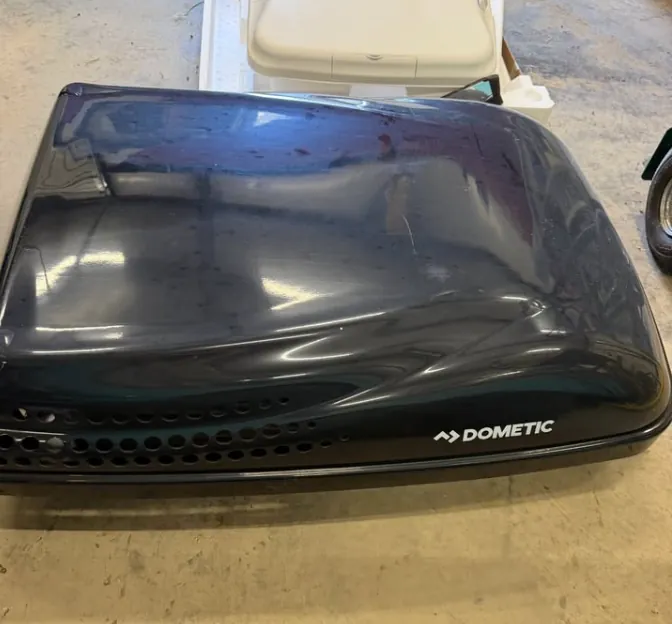
Dometic Penguin II AC Repair: Mobile Service in Florida
Penguin II running but not cooling, icing up or dripping? Our technicians diagnose and repair Dometic rooftop AC on site statewide. Call 888-759-1438.
Owners rarely call and say the compressor is failing. They say the rooftop unit runs all day and the coach still will not get cold. On a Dometic Penguin II that symptom points to one of five things: a weak dual run capacitor, a worn fan motor, blocked condenser or evaporator coils, a failed control board, or a sealed system that has lost its charge. We diagnose all five on site, anywhere in Florida.
The Rooftop Unit Runs But The Coach Never Gets Cold
A Dometic Penguin II that runs without cooling is almost never a dead unit. It is still moving air while something in the refrigeration or airflow chain has quit, and the fan keeps turning because the fan and the compressor are fed by separate legs inside the same electrical box. The number that settles the argument is delta-T. Our technicians put a probe in the return air grille on the ceiling assembly and a second at the nearest supply register, and a healthy Penguin II should pull 15F to 20F out of the air passing through it. A unit showing a 4F drop is not cooling, whatever the thermostat says. If the supply air is genuinely cold and the coach still never catches up, that is a different problem: a 13,500 or 15,000 BTU unit fighting bad ceiling seals, a crushed duct run, or one rooftop covering too long a coach. Those complaints sound identical on the phone, so we measure before quoting.
What Our Technicians Check On A Penguin II, And In What Order
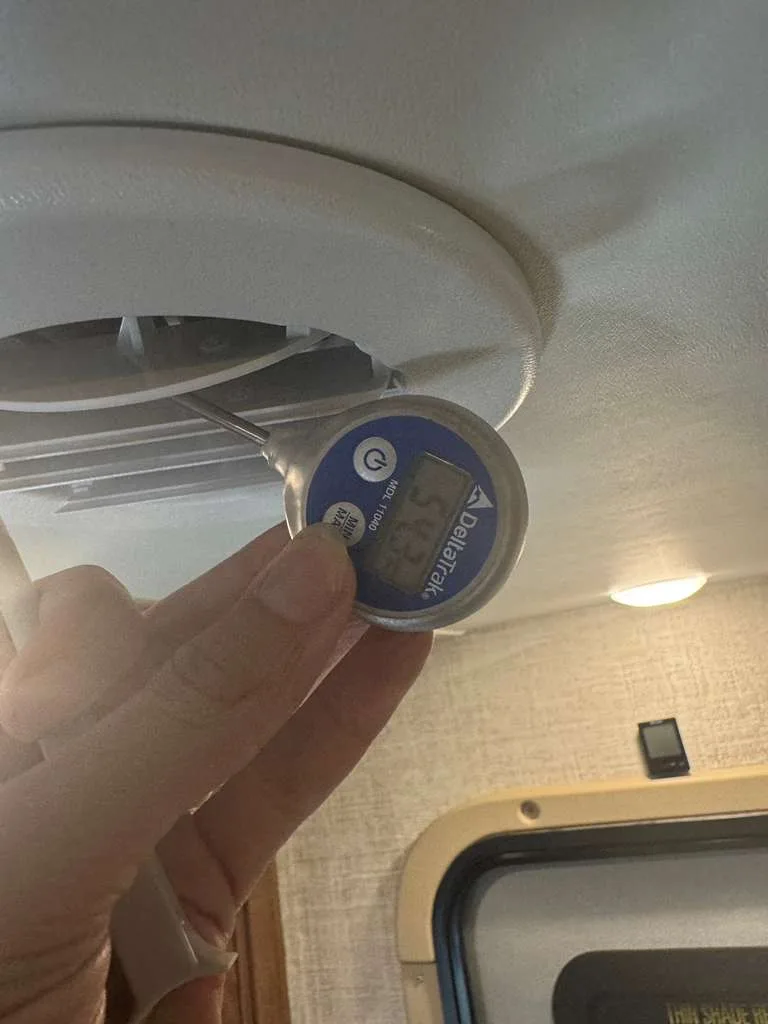
Order matters, because the cheap failures imitate the expensive ones. Before the shroud comes off we read incoming voltage at the unit under load, since a Penguin II starting on a sagging pedestal or a long undersized cord can trip on locked rotor current while every part inside it is healthy. We want at least 108 volts holding through startup. Then the shroud lifts off its perimeter screws and we go straight to the condenser coil and base pan. Coils here load up with pollen, road film and insect debris, and a fin comb with coil cleaner often restores real capacity inside an hour. These units never get a winter lay-up in Florida, so that coil packs year round, not seasonally. Electrical comes last. We discharge and read the dual run capacitor with a capacitance meter, clamp the compressor and fan legs with a clamp meter, then the control board and thermostat wiring. Reading the capacitor before condemning a motor saves owners the most money.
What Each Finding Costs, And What It Becomes If You Leave It
We will not quote a fixed price on a unit nobody has opened, because that complaint covers everything from a capacitor to a whole new unit. The capacitor is the cheapest finding and the most expensive one to ignore. A Penguin II dual run capacitor carries both the compressor and the fan winding, and we replace anything more than ten percent under its printed microfarad rating even if the unit still starts. A compressor asked to start on a weak capacitor pulls locked rotor current repeatedly until the windings cook. A rumbling fan motor is the same story on a longer fuse. The condenser blade and blower wheel ride one shaft, so failing bearings starve the compressor of airflow until it trips on high pressure and stops restarting.
Act in cost order: capacitor and fuse findings are cheap and quick, while a bearing that has begun to howl is telling you the compressor is next.
Frozen Coils And Water Dripping Into The Coach
Ice on the evaporator coil is an airflow problem far more often than a refrigerant one. A clogged return filter, a blower wheel caked with dust, or a flattened foam gasket letting return air short circuit back to the coil each cut airflow enough for the coil to sit below freezing and ice over. Then it melts. The pan under the evaporator drains to the roof through weep paths molded into the base, and once ice bridges those paths the condensate takes the only route left, down through the ceiling assembly and around the air distribution box. Owners reasonably call that a leaking air conditioner, though often the roof is not. When it truly is, the culprit is usually the mounting gasket, the foam ring squeezed between the unit and the 14 by 14 inch roof opening, flattened with age. Dometic specifies those hold down bolts at 40 to 50 inch pounds, and we set them with an inch pound torque wrench, not by feel.
Penguin II Versus Coleman-Mach, And Why The Model Matters
Plenty of callers have no idea which brand is bolted to their roof, which is fine, we identify it on site. It matters anyway, because the two families are not interchangeable above the roof line. Both sit over the same 14 by 14 inch vent opening, so the hole is never what stops a swap. The Penguin II is the low profile member of the pair, sitting about 9.5 inches above the roof under a single molded shroud, which is why it shows up on coaches with clearance concerns. Coleman-Mach units are taller, laid out differently inside, and their capacitors, fan motors and control boards do not cross over to a Dometic. Controls are where a mismatch really bites. A ducted Penguin II answers to the Dometic Comfort Control Center thermostat family talking to the unit's own control board, and a Coleman ceiling assembly will not communicate with it. On a replacement the thermostat and ceiling assembly decide the job, not the BTU number.
Sources
Every figure on this page comes from a manufacturer document or a standards body, not from another repair site. Here is where each one comes from.
- Dometic - Rooftop RV Air Conditioners (manufacturer product category)That the Penguin II family is a low profile rooftop unit sold in 13,500 and 15,000 BTU capacities for ducted or non-ducted application, as stated in the section comparing a 13,500 or 15,000 BTU unit against the coach it is asked to cool.
- Dometic - RV Air Conditioners overviewThat Penguin II is a current Dometic rooftop line with its own ceiling assembly and control pairings, supporting the claim that a replacement is decided by the thermostat and ceiling assembly rather than by the BTU number.
- Dometic - Air Distribution BoxesThat a non-ducted Penguin II depends on a Dometic air distribution box in the ceiling assembly, which is the component named as the path condensate takes into the coach when the base pan weep paths ice over.
- Dometic Support - manuals, spare parts and product documentationThat model and serial identification, manuals and spare parts for a Penguin II are sourced from Dometic, supporting the FAQ answer that the model and serial label is what the technician confirms once the shroud is off.
Related repairs
Other systems we service
Where we work
Service category
What this usually costs
| Item | Price | What it covers |
|---|---|---|
| Service call | $299 | Includes the trip out to your RV and the first hour on site |
| Work past the first hour | Quoted after diagnosis | We tell you what it will take before we carry on |
| Parts | Quoted per job | Special-order parts may need a deposit before we order them |
| Written estimate | No charge | You approve the estimate before any work starts |
The service call covers the trip out to your RV and the first hour on site. Anything beyond that depends on what we find, and we quote it and get your approval before carrying on.
The price ranges on this page come from our own recent jobs across Florida, not from an industry average. What you pay depends on the rig, the parts it needs and what we find on site, so we give you a written estimate before any work begins and you approve it first.
Frequently asked questions
Is it the rooftop air conditioner or the engine?
Those are two separate systems and we treat them separately. Dash air in a motorhome runs off the engine's belt driven compressor and only cools while the engine is running. The rooftop Penguin II runs on 120V shore power or the generator and cools the living space. If the coach is comfortable going down the road but hot once you are parked and plugged in, the rooftop unit is the one at fault, and that is the one we service.
Do you know the model of the rooftop AC?
Most owners do not, and you do not need to before booking. The model and serial label sits on the unit's base pan underneath the shroud, so it is invisible from the ground and from inside the coach. A photo of the ceiling assembly and the thermostat usually narrows it to a Penguin II, a Brisk Air II or a Coleman-Mach, and our technician confirms the exact model once the shroud is off.
Where is the rooftop air conditioner leaking?
It comes from two very different places. Water showing up at the ceiling assembly while the unit is running is normally condensate that could not drain, caused by a frozen evaporator coil or blocked weep paths in the base pan, and it stops once the airflow fault is corrected. Water arriving after rain with the unit switched off points at the mounting gasket over the 14 by 14 inch roof opening, which means lifting the unit and re-gasketing it.
Do you repair Dometic RTX 2000 12-volt air conditioners?
Yes, and it follows a different diagnostic path than a Penguin II. The RTX range is a DC rooftop unit fed by the battery bank instead of shore power, with a variable speed compressor and its own control electronics. So we start at battery bank health and DC voltage measured at the unit under load. Undersized or corroded DC cable is a common cause of complaints that look exactly like a failed air conditioner.
Can you just recharge the refrigerant in my Penguin II?
No, and neither can anyone else in the field. The Penguin II refrigeration circuit is brazed closed at the factory with no Schrader service ports, so there is nothing to attach gauges to and no way to add charge on a roof. If the sealed system has lost refrigerant the honest answer is replacing the unit rather than recharging it, and any offer to top it up describes a job the hardware does not physically allow.
What does it cost to have someone come out and do Dometic AC service?
Our service call covers the trip out and the first hour on site at the rate in the pricing table on this page; anything past that first hour is quoted and approved before we carry on. You get the finding and the number before any repair starts, and we do not quote a fixed price on a unit nobody has opened yet.