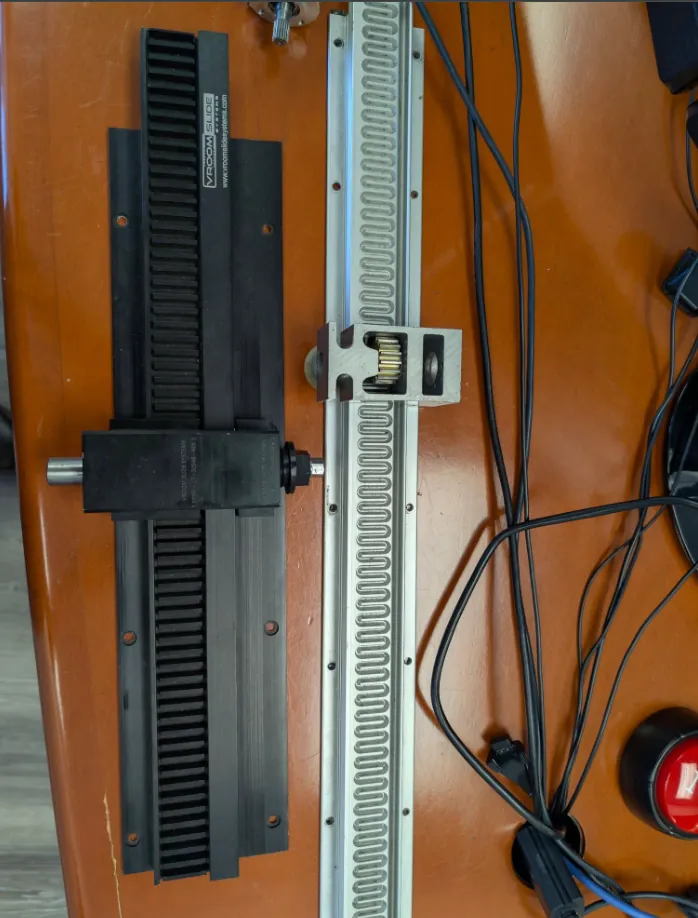
Lippert Cable Slide-Out Repair - Snapped & Stretched Cables
Stretched or snapped Lippert slide cables leave a room out of square. Mobile cable, pulley and tension repair anywhere in Florida. Call 888-759-1438.
A Lippert cable slide-out moves the room with four steel cables wound on drums, routed over corner pulleys and tensioned at threaded studs. Because tension is what keeps both sides synchronized, a stretched or snapped cable shows up as a room that leads on one corner, not as a dead motor. Repair means replacing the cable set and resetting tension, not replacing the slide system.
Repair or Replace: What the Cable Slide Decision Actually Turns On
The fork on a Lippert cable slide-out is narrower than most owners expect. A full cable set plus labor usually lands in the same band as a single replacement drive motor, so the decision is almost never about which part costs less. What decides it is whether the room is still square and whether the cable drums, the cross shaft and the four corner pulleys are still true.
Cables are consumable. Drums, pulley brackets and the steel of the room are not, and once a parted cable has let one corner drop and rack the box, you are pricing structural work rather than a cable job. Parts for a four-cable set typically sit in the low hundreds, with a drive motor in a similar range, though those are general figures and coach size, slide length and access all move them.
The honest test is simple. If the room still meets its seal square, repair wins.
How the Lippert Cable Slide-Out Actually Moves the Room
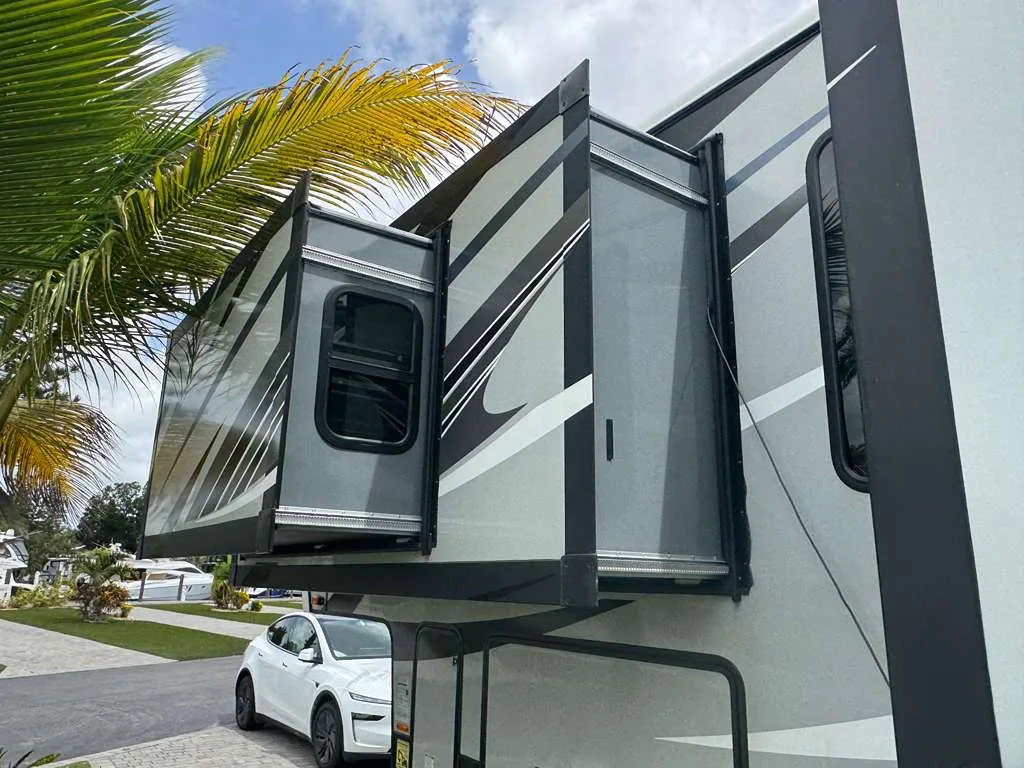
A Lippert cable slide does not push the room with a ram or climb it on a rail. A 12V DC drive motor and its gearbox turn a cross shaft beneath the floor, and that shaft carries a cable drum at each side of the room. Four cables come off those drums on a typical room, an extend cable and a retract cable per side, and each one turns through a pulley at the corner of the slide box before terminating on a threaded stud.
Those studs carry the tension adjustment nuts and their jam nuts. Tension on this system is not a comfort setting, it is the synchronization itself. The two sides stay level only because both cables pull the same amount at the same instant, so anything that lengthens one path, whether stretch, a slipped drum wrap or a cable riding a pulley flange, appears immediately as a room that leads on one corner.
Cable Stretch: The Slow Failure That Throws the Room Out of Square
Stretch is a slow failure and it rarely announces itself. Steel cable elongates under repeated load, and on a room cycled a few times a week it does so unevenly, because the extend and retract cables never see identical duty. The first sign is usually cosmetic.
The room comes out and the top seal gaps at one corner while the opposite corner still touches, or the fascia scuffs the wall trim on the way in. Owners commonly read that as a seal problem and buy a new bulb seal, which changes nothing, because the room is no longer sitting where the seal was designed to meet it. Left alone, the loose side lets the room rack far enough that the drum begins to overwrap.
An overwrapped cable crosses itself, wears a flat spot and eventually parts. Caught at the seal-gap stage this is a tension adjustment. Caught later it is a full cable set.
A Snapped Cable Presents Nothing Like a Dead Motor
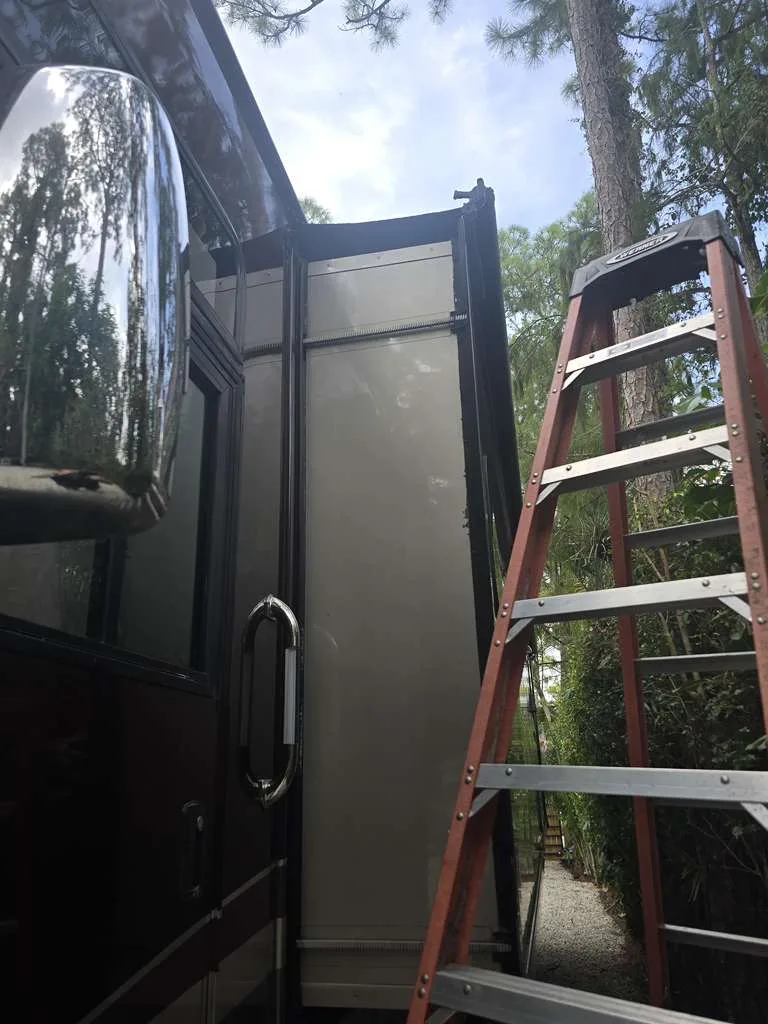
Telling cable failure apart from drive failure takes about ninety seconds at the switch. When a cable parts, the motor still runs. You hear the gearbox spin up, one side of the room moves and the other stays put, and the box visibly twists in its opening before something binds and the motor labors.
A failed drive motor gives you the opposite: a click or nothing at all, no drum rotation on either side, and both corners equally frozen. A hydraulic room fails differently again, with a pump that whines against load and fluid where fluid should not be.
The tell unique to cable systems is asymmetry. If one corner moved and one did not, the drive side is doing its job and the fault is downstream of the drum, which narrows it to a cable, a pulley, or the threaded stud the cable anchors to at that corner.
The Diagnostic Sequence We Run Before Touching an Adjustment Nut
Order matters here, because adjusting a nut before ruling out electrical drag just buries the real fault. The first reading is taken at the motor, not at the switch. A clamp meter on the positive feed shows whether the motor is working or fighting, but the more useful number is voltage measured at the motor terminals under load.
More than roughly half a volt below what the battery reads means you are chasing a harness or ground fault, not a cable. Next the room comes out on the manual override, using a three-quarter inch socket on the override shaft with a cordless drill on its lowest speed, because turning it slowly tells you exactly where resistance begins.
Only then do the four corner pulleys get inspected, and that inspection is as much tactile as visual. A gloved hand run along each cable finds broken strands long before an eye picks them out.
Pests, Humid Storage and Why Florida Cable Slides Fail Early
Storage in Florida does something to cable slides that dry-climate coaches never see. The drums, the cross shaft and the lower pulleys sit in an open cavity beneath the slide floor, and through a humid summer that cavity is dark, sheltered and warm, which is exactly what roof rats, palmetto bugs and mud daubers are looking for. Nesting material packs into the pulley grooves.
A cable that can no longer seat in its groove rides up onto the pulley flange instead, and a flange cuts strands far faster than a groove wears them. Rodents compound it by chewing the slide harness, producing an intermittent motor fault that looks electrical because it is.
The practical result is that a coach stored six months can come out with a cable already half cut, and the owner learns about it the first time the room is cycled. Inspect the pulleys before that first extension.
Setting Tension, Squaring the Room and What the Job Takes On Site
Setting tension is methodical rather than clever. The jam nut backs off the adjustment nut first to give the stud room to move, then the adjustment nut goes in small increments, roughly half a turn at a time, with the room run fully out and back between changes so you can see what each adjustment did. Both corners on a side get equal treatment or you simply trade one gap for another.
Once the room seals square and the fascia clears the trim, every jam nut is retightened against its bracket, because a jam nut left loose undoes the entire job within a dozen cycles. On site, a straightforward re-tension on an accessible room is usually about an hour. A full four-cable replacement, with the room supported and each drum unwrapped and rewound in the correct direction, more typically runs three to five hours.
Sources
Every figure on this page comes from a manufacturer document or a standards body, not from another repair site. Here is where each one comes from.
- Lippert Customer Care Center - F.A.S.T. Track Slide-Out, listed OBSOLETEThe info-gain claim that Lippert's cable-driven slide line, F.A.S.T. Track, is carried as obsolete in Lippert's own support catalog, so these rooms are serviced from individual parts rather than swapped as a system.
- Lippert service video - F.A.S.T. Track Slide-Out Cable ReplacementThat cable replacement is a defined Lippert procedure involving unwrapping and rewinding the drums, supporting the labor estimate and the replace-as-a-set recommendation in 'Setting Tension, Squaring the Room'.
- Lippert FAQ - My slide-out is stuck out, how can I manually retract itThe FAQ answer that a Lippert drive motor carries a manual override shaft that can walk a room in when a cable has parted.
- Lippert FAQ - How do I know what slide-out motor I haveThat Lippert slide-out drive motors are identified by specific part numbers before ordering, supporting the repair-or-replace comparison between a full cable set and a single replacement drive motor.
Related repairs
- Rack Pinion Slide Repair in Florida
- how we handle slide seal wiper replacement
- Slide Floor Rot Repair repairs
Other systems we service
Where we work
Service category
What this usually costs
| Item | Price | What it covers |
|---|---|---|
| Service call | $299 | Includes the trip out to your RV and the first hour on site |
| Work past the first hour | Quoted after diagnosis | We tell you what it will take before we carry on |
| Parts | Quoted per job | Special-order parts may need a deposit before we order them |
| Written estimate | No charge | You approve the estimate before any work starts |
The service call covers the trip out to your RV and the first hour on site. Anything beyond that depends on what we find, and we quote it and get your approval before carrying on.
The price ranges on this page come from our own recent jobs across Florida, not from an industry average. What you pay depends on the rig, the parts it needs and what we find on site, so we give you a written estimate before any work begins and you approve it first.
Frequently asked questions
Can I replace just the one cable that snapped?
You can, but it is a poor trade. The other three cables share the same age, the same cycle count and the same stretch, so a single replacement leaves you a mismatched set that needs retensioning again as the old cables catch up. Most of the labor is access and rewinding the drums, so doing all four costs far less than doing the job twice. Replace as a set.
How long does a Lippert cable slide-out repair take?
A tension adjustment on an accessible room is usually about an hour, assuming the cables themselves are sound. A full four-cable replacement more typically runs three to five hours, because the room has to be supported, the underbelly opened, and each drum unwrapped and rewound in the correct direction. Coaches with heavy insulation or a tight underbelly sit at the longer end of that range.
Why does my slide come out crooked on one corner?
On a cable system, crooked is a tension symptom. Both sides move together only because both cables pull equally, so when one has stretched or slipped its drum wrap, that corner lags behind. It is not a motor fault and it is not a seal fault, which is why fitting a new seal never fixes it. The correction happens at the adjustment nuts on the threaded studs, in small equal increments.
Can I close the room if a cable snapped while I am parked?
Sometimes, and carefully. Lippert drive motors carry a manual override shaft that takes a three-quarter inch socket, and slow turning will often walk a room most of the way in. With one cable parted the room pulls in crooked and can jam, so it needs supporting and guiding rather than forcing. Get it closed enough to travel, then have the cables replaced before it is cycled again.
How much does a cable slide-out repair cost?
Parts for a full cable set generally sit in the low hundreds, with a replacement drive motor in a similar range, and labor depends heavily on access. Those are typical national ranges rather than a quote, and coach size, slide length and underbelly construction all move them. A tension adjustment with sound cables is a far smaller job than a cable set. We price after inspection.