RV Skylight Dome Replacement - Cracked and UV-Damaged Domes
Sun-crazed acrylic skylight domes split and leak in the first storm. Mobile RV skylight dome replacement, flange sizing and butyl reseal. Call 888-759-1438.
An RV skylight is a thermoformed plastic dome, not a window. It sits over the shower on a flange that is screwed and sealed to the roof deck, and it is built to grow and flex as it heats. Ultraviolet exposure degrades that plastic until it crazes, then splits. Replacing one correctly means ordering to the flange rather than the hole, and sealing under the flange instead of around the dome.
What an RV Skylight Dome Actually Is
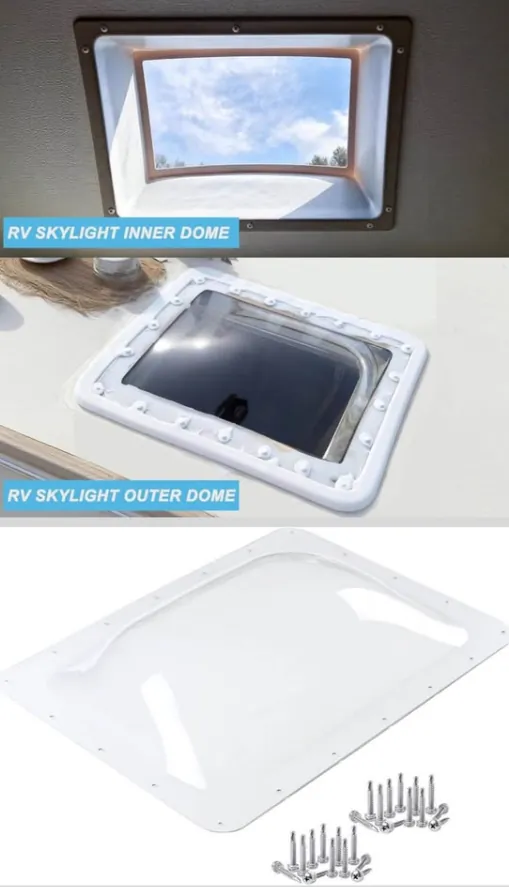
A skylight dome is one piece of acrylic or polycarbonate, heated and vacuum-formed over a tool, with a flat mounting flange formed into its perimeter. There is no frame, no gasket and no glass in it anywhere. The dome and the flange are the same piece of plastic, which is why a split that starts at a flange corner runs straight up into the clear area. Owners picture a window, and that picture drives the wrong repair. A window seals at a gasket, and its glass sits captive in a frame that absorbs the movement for it. A dome has no frame, so it absorbs every bit of that movement itself. The flange lands on the roof over a rough opening, on most travel trailers and fifth wheels directly above the shower. Fasteners pass through the flange into the deck. Butyl tape belongs under the flange and lap sealant belongs over the fastener heads. Nothing seals against the curved part of the dome.
Why the Sun Here Kills a Dome Before Anything Else Does
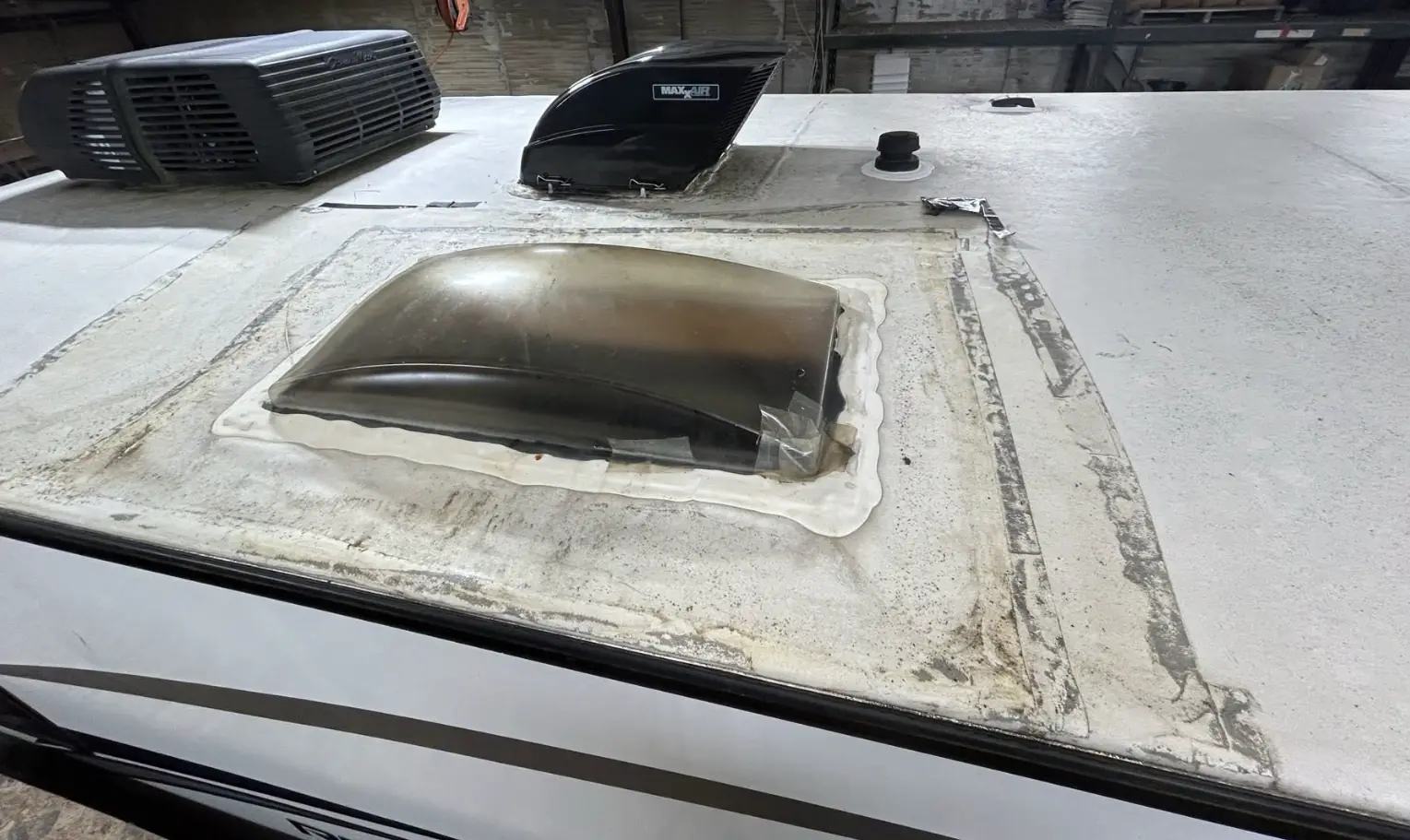
Acrylic and polycarbonate fail by photo-oxidation. Ultraviolet energy cuts polymer chains at the surface and burns through the stabilizer package built into the sheet, and once that stabilizer is spent the face goes chalky and then crazes, growing a web of fine cracks that follow the direction the sheet was stretched during forming. Crazing is not cosmetic. Every craze line is a stress riser, and a formed dome already carries stress from each heating cycle. Put a laser thermometer on a white dome at two in the afternoon and it reads far above 140, then falls to the high seventies by dawn, so the part has been worked several thousand times before it ever meets a hailstone. That is why domes break here from things a sound one would shrug off. A pine limb, a pea-sized hailstone, a knee set down in the wrong spot. The impact gets blamed, but the sun did the work.
The Symptom You Call About, and the Order We Check It In
The call is nearly always the same. Water on the shower floor or a stain spreading on the ceiling panel after an afternoon storm, and nothing at all wrong on a dry day. That pattern points at a roof penetration, and the skylight is one of six or seven candidates on that roof. Our technicians start inside, because the inside says which part failed. Water running down the inner garnish and pooling on the shower lip points at a split outer dome, with the inner dome catching and channeling it. Water showing up at the ceiling panel a foot off the opening points at the flange or a fastener instead. Then the roof, with weight kept over a rafter. We read the dome for crazing and corner splits, check whether sealant has lifted off the flange edge, and look for fastener heads standing proud. The vent fan opening and the air conditioner gasket get cleared at the same visit, since they share that run of roof.
Inner Dome and Outer Dome Are Two Different Parts
Over a shower most rigs carry two domes stacked. The outer dome is the weather skin, formed in clear, white or smoke tint. The inner dome, often called the garnish, is a separate molded part, and on ICON Technologies' SL1422 inner it is white ABS with a clear center insert. It exists to add an air gap and to keep condensation off the ceiling. That air gap earns its keep in this climate. A hot shower throws humid air at a panel chilled by the roof air conditioner, and without an inner dome that panel sweats and drips, which reads to an owner exactly like a leak. Depth is the spec people skip. ICON lists the SL1422 inner in a two inch depth suited to a minimum roof thickness of an inch and a quarter, and a five inch depth for a minimum roof thickness of four inches. Order the shallow one for a thick laminated roof and the flange never reaches the ceiling.
Measure the Flange, Not the Hole
Skylights are cataloged by the rough opening they cover, but you buy them by the flange, and those two numbers are never the same. On Specialty Recreation's own reference chart, an SL1422 covers a 14 by 22 inch opening with a flange of 17.5 by 25.5 inches and stands five inches tall. An SL2234 covers 22 by 34 on a flange of 25.5 by 38. So measure the outside of the flange you already have, edge to edge, with the dome still screwed down. Then measure rise, from the roof surface to the top of the dome, because two parts can share a flange and differ in height. The low-profile SL1422W-LP stands 4.5 inches where the extra-tall K1422WT stands eight. Do not take the measurement from inside the bathroom. That single shortcut is what sends the wrong part, and the reason is worth its own paragraph below.
The Bead of Caulk That Cracks the Next Dome
The well-meant mistake is ringing the dome with sealant where it curves up off the flange, the way you would seal a window. It looks like belt and braces. It is the thing that will split the replacement. Acrylic grows about 3.5 hundred-thousandths of an inch per inch for every degree Fahrenheit. Plaskolite's fabrication guide for its continuous cast acrylic, which names skylights and domes among its applications, calls for an eighth of an inch of expansion clearance on panes up to 36 inches, and says through-bolting and other inflexible fastenings are not recommended outdoors where temperatures swing hard. A dome 34 inches long moves close to that full eighth between dawn and mid-afternoon. Glue its skirt down and the movement has nowhere to go, so it becomes stress at the flange corners, which is precisely where domes tear. Seal it as designed: butyl under the flange so it squeezes out as fasteners draw down, then self-leveling lap sealant over the fastener heads and the outer flange edge only.
Temporary Patch or Replacement, and What It Costs
Two questions come up on this job more than any others: whether a temporary bead will hold, and whether resealing is an alternative to replacing. The honest answers are yes and no, in that order. A temporary fix is legitimate if you are mid-trip. Butyl tape pressed over the split, a rigid cover screwed to the flange, the rig parked nose-high so water sheds instead of standing. That buys days rather than months, because sealant will not bond to a crazed face and the split keeps running. Left alone it stops being a dome problem. Water tracks down the garnish into the shower surround and soaks the luan around the opening, and soft decking turns a part swap into structural work. Our service call covers the trip out and the first hour on site at the rate in the pricing table on this page; anything past that first hour is quoted and approved before we carry on.
Sources
Every figure on this page comes from a manufacturer document or a standards body, not from another repair site. Here is where each one comes from.
- Specialty Recreation - 2026 Replacement RV Skylight Quick Reference ChartManufacturer part numbers with hole size, flange size and height: SL1422 14x22 hole on a 17.5x25.5 flange at 5 inches, SL1422W-LP at 4.5, K1422WT at 8, SL2234 on a 25.5x38 flange, N1422 inner at 16x24, and SL1624 as a separate 16x24 hole size.
- ICON Technologies - RV Skylight DomesManufacturer statement that its RV skylights are made from impact-resistant polycarbonate, and that ordering a custom dome requires both the dome or hole opening size and the flange size.
- ICON Technologies - Skylight Inner Dome SL1422Inner dome purpose (a layer of insulation that reduces condensation on the outer skylight), white ABS with clear center insert, and the 2 inch depth for a minimum 1-1/4 inch roof thickness versus the 5 inch depth for a minimum 4 inch roof thickness.
- Plaskolite - OPTIX-L Continuous Cast Acrylic Sheet Fabrication GuideCoefficient of linear thermal expansion of 3.5 x 10⁻⁵ in/in/degF, skylights and domes listed as an application, an eighth-inch expansion clearance for panes up to 36 inches, the instruction that through-bolting and other inflexible mechanical fastenings are not recommended outdoors, and the use of non-hardening compound or butyl tape on small panes.
- Dicor - Self-Leveling Lap SealantThe manufacturer's own adhesion list (aluminum, mortar, wood, vinyl, galvanized metal, fiberglass, concrete; compatible with EPDM, TPO and PVC membranes), horizontal-surface use, and the cure schedule of 5 minutes to skin, 4 hours to waterproof.
Related repairs
Other systems we service
Where we work
Service category
What this usually costs
| Item | Price | What it covers |
|---|---|---|
| Service call | $299 | Includes the trip out to your RV and the first hour on site |
| Work past the first hour | Quoted after diagnosis | We tell you what it will take before we carry on |
| Parts | Quoted per job | Special-order parts may need a deposit before we order them |
| Written estimate | No charge | You approve the estimate before any work starts |
The service call covers the trip out to your RV and the first hour on site. Anything beyond that depends on what we find, and we quote it and get your approval before carrying on.
The price ranges on this page come from our own recent jobs across Florida, not from an industry average. What you pay depends on the rig, the parts it needs and what we find on site, so we give you a written estimate before any work begins and you approve it first.
Frequently asked questions
Would you reseal it or replace the whole skylight?
It depends entirely on whether the plastic is still sound. If the dome is intact and only the lap sealant around the flange has chalked and lifted, resealing is the right repair and the dome stays. If the dome is crazed, hazed or split, sealant laid over it will not bond and the crack keeps growing underneath, so resealing there only buys a few weeks and the dome still has to come off.
Is it possible to put a temporary patch around the skylight?
Yes, and it is worth doing if you are traveling. Butyl tape worked into the split, then a rigid cover screwed down to the flange, will keep a storm out for days. Park nose-high so water sheds. What will not work is a bead of sealant smeared across a crazed dome, because the surface it needs to grip is already fractured.
How soon can you install a new skylight on my RV?
Scheduling depends on the size. The common rectangles, a 14 by 22 or an 18 by 24, are stocked parts. Odd sizes, neo-angle shapes and extra-tall kits are ordered, which adds days. Because this is mobile work we come to the rig, so there is no shop queue in front of you, and the swap itself is a same-visit job once the correct dome is in hand.
How much does RV skylight dome replacement cost?
Quoting a fixed number for a job nobody has looked at is how owners get surprised, so treat these as typical ranges. The dome and its inner garnish are parts on top of that.
Can I use self-leveling lap sealant directly on the dome itself?
Seal the flange, not the dome. Dicor's own compatibility list for its self-leveling lap sealant names aluminum, wood, vinyl, galvanized metal, fiberglass and concrete plus EPDM, TPO and PVC membranes. Skylight plastic is not on that list, and even where it sticks it locks a part that has to move. Sealant goes over the fastener heads and the flange edge.
Does a cracked skylight mean I need a new roof?
Usually not. A dome is a bolt-on part and swapping it is unrelated to membrane work, so a rubber or TPO roof replacement is a separate conversation with its own trigger. What does connect the two is time. A split left through a wet season soaks the decking around the opening, and rotted decking is what turns a dome swap into structural repair.