EPDM Rubber Roof Replacement | Mobile RV Roof Service Florida
EPDM rubber roof delaminating, rippling or leaking at the flanges? Mobile full roof replacement anywhere in Florida. Call 888-759-1438 for an inspection.
An EPDM rubber roof is a bonded membrane, not a panel, so it is replaced rather than repaired once it releases from the decking underneath. A full replacement means stripping the old sheet, removing every roof-mounted component, replacing any rotted luan decking, adhering a new membrane, then re-mounting hardware on fresh butyl and sealing every flange.
The Ceiling Stain That Starts the Call
Almost nobody calls to say their membrane has failed. What we actually hear is "the whole roof needs to be resealed", or "I need somebody to look at the roof", or a description of a soft brown ring on the ceiling panel above the bed that was smaller last month. By the time a stain shows up inside, water has been moving for a while. It enters at a screw, a seam or a lifted flange, runs sideways along the top of the decking until it meets a rafter, then drops through at the lowest point it can find, which is often several feet from where it got in. That is why nobody can tell from inside the coach whether this is a seam reseal or a full re-membrane. Our technicians get on the roof and read the membrane itself, because the condition of the rubber and the decking under it decides the job, not the size of the stain.
Is It Actually EPDM? Telling Rubber From TPO and Fiberglass

EPDM is a rubber sheet, usually around 0.045 inch thick, glued across a thin luan plywood deck that sits on the roof framing. It is a bonded system, which means the membrane, the adhesive and the decking only work as one assembly. You can identify it by hand in about ten seconds. EPDM gives slightly under a thumb and feels like a rubber sheet over a firm board, it is white on top and black underneath, and wiping it leaves chalky gray residue on your palm. TPO is a thermoplastic, noticeably stiffer and slicker, it does not chalk, its seams are heat welded rather than glued, and a cut edge shows a woven scrim inside. Fiberglass reads differently again. It has no give at all, it knocks hard and hollow like a boat hull, and it carries a gelcoat sheen rather than a matte finish. The distinction matters because EPDM adhesives will not bond a TPO or fiberglass surface.
Chalking Is Normal on EPDM, Delamination Is Not
Chalking worries owners more than it should. EPDM weathers by sacrificing its own outer skin, so ultraviolet exposure oxidizes the top layer and it sheds as a fine white powder that streaks down the sidewalls after rain. A chalky hand after touching the roof is the membrane doing exactly what it was designed to do. It is not a leak, it is not a defect, and on its own it is not a reason to replace anything. Delamination is a different condition entirely, and it is the one that ends a roof. The membrane releases from the decking, and you see it as ripples, soft bubbles or areas that shift and whisper under palm pressure instead of feeling glued down. Once the sheet is floating, water that gets past any fastener travels freely underneath it across the whole roof, and no coating or patch applied on top can re-bond what has already let go.
Why an EPDM Roof Cannot Be Patched Forever
A patch is only as strong as the surface it is stuck to, and on an aging EPDM roof that surface is a chalked layer in the process of releasing. The patch may hold beautifully for a season and then lift with the oxidized skin it was bonded to. Every patch also introduces new edges. A roof that has been repaired repeatedly becomes a map of overlapping perimeters, and each one is a fresh candidate for lifting, catching wind and pooling water behind it. There is a genuinely cheaper preventative path, and it is worth taking early: annual inspection with the flanges and seams resealed while the membrane is still bonded. That is a maintenance visit, covered on our roof reseal and lap sealant page, and it is the right call on a sound roof. Once the sheet has delaminated or the decking has softened, sealing the top only traps the water that is already inside.
What Our Technicians Check, and In What Order
The inspection follows the same order every time, because the cheap findings need ruling out before anyone talks about a re-membrane. First is every roof-mounted component: the air conditioner gasket, the 14 inch by 14 inch vent flanges, the fan, the plumbing vents, the antenna base and any solar mounts. That order exists for a reason. When an owner asks where the rooftop air conditioner is leaking, the answer is very often not the roof at all but a compressed, hardened gasket between the unit and the roof opening, or mounting bolts that have relaxed. That is a component job, not a roof job, and it is a fraction of the cost. Next come the front and rear seams and the edge trim, then the open field of the membrane, and finally the decking itself. Our technicians press between the framing, which on most coaches runs at 16 inch centers, and note anywhere the deck gives underfoot.
How a Full EPDM Replacement Actually Goes
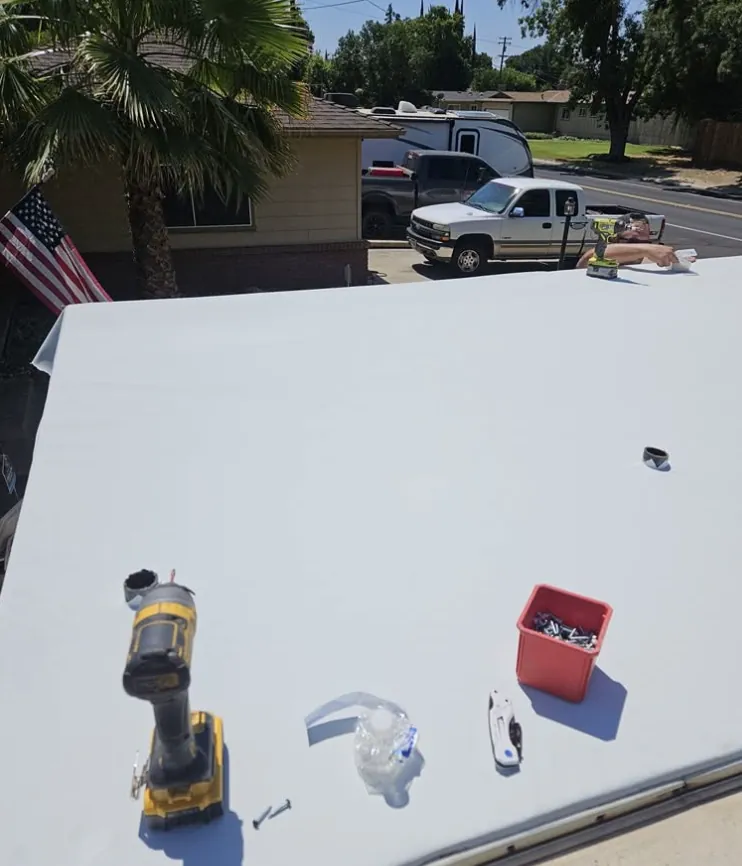
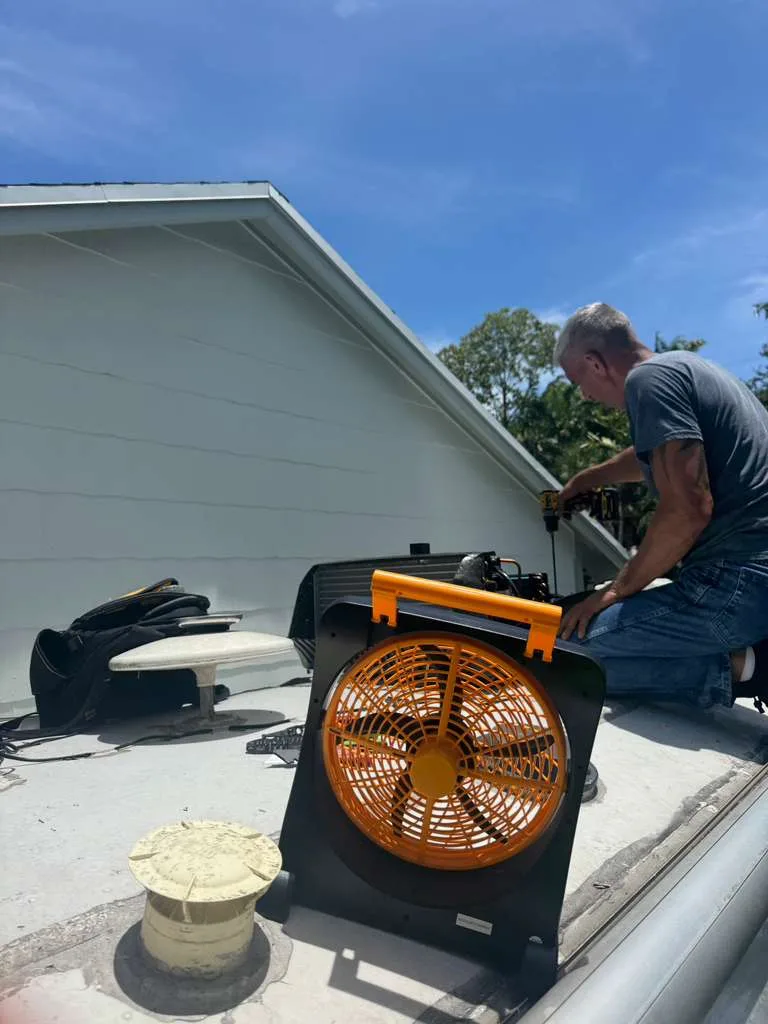
Everything on the roof comes off first. The air conditioner, vents, fan, antenna, solar panels, plumbing vents and the edge trim are all removed with a cordless impact driver and nut driver, with old sealant cut back using an oscillating multi tool and a stiff scraper. Then the old membrane is stripped and the adhesive residue is scraped down to clean decking. This is the point where the job either stays on plan or changes, because soft or blackened luan and any compromised framing has to be cut out and replaced before a new sheet touches it. The new membrane is rolled out and dry fitted so it can relax and be squared to the coach. It is then folded back half at a time while adhesive, water based or solvent based depending on ambient temperature and humidity, is rolled onto both surfaces before the sheet is laid in and worked flat. Components go back on fresh butyl tape, and every flange and seam is sealed last.
What It Costs, and What It Becomes If You Wait
A full EPDM replacement is quoted only after an inspection, and we will not put a fixed figure on a roof we have not walked. Honestly stated, the magnitude is this: a full length re-membrane is measured in days rather than hours, and once membrane, adhesive, butyl, sealant and any replacement decking are added to that labor, it lands in the thousands rather than the hundreds. Waiting is what makes it worse, and in Florida the deadline is fixed. Hurricane season runs June 1 to November 30, and a delaminated membrane with a lifted edge is exactly what wind uplift takes hold of, while post-storm branch strikes puncture a sheet that no longer has sound decking behind it to resist them.
The cheapest version of this job is the one bought while the membrane is still sound and only the terminations have failed. Once water is in the decking, the roof is the smaller half of the invoice.
Sources
Every figure on this page comes from a manufacturer document or a standards body, not from another repair site. Here is where each one comes from.
- Dicor Products - Dicor EPDM Rubber RoofingDicor describes its EPDM as part of a three part roofing system comprising the membrane, the bonding adhesive and the lap sealant. That is the manufacturer confirming the page's core point: an EPDM roof is a bonded assembly rather than a panel, so the membrane, the adhesive and the deck only work together.
- Dicor Products - Water Based Bonding Adhesive for EPDM and TPO membraneThe membrane manufacturer's own adhesive page gives the method the replacement section describes: the bonding agent is rolled onto the substrate at one gallon per 160 to 180 square feet and the sheet is rolled into it immediately, with no waiting time. The same page restricts it to moisture absorbent substrates and rules out metal and fiberglass, which is why the deck has to be identified before a sheet is bonded.
- Dicor Products - Self-Leveling Lap Sealant (501LS)The sealing step this page ends every job on, and the annual reseal it recommends on a sound roof. Dicor states that its self-leveling lap sealant is the secondary seal along the roof's edges, air vents, vent pipes and screw heads, that it is compatible with EPDM, TPO and PVC membranes and adheres to aluminum, wood, vinyl, galvanized metal and fiberglass, that it is UV stabilized, and that it skins over in 5 minutes, is waterproof in 4 hours and reaches 100 percent cure at 30 days.
Related repairs
Other systems we service
Where we work
Service category
What this usually costs
| Item | Price | What it covers |
|---|---|---|
| Service call | $299 | Includes the trip out to your RV and the first hour on site |
| Work past the first hour | Quoted after diagnosis | We tell you what it will take before we carry on |
| Parts | Quoted per job | Special-order parts may need a deposit before we order them |
| Written estimate | No charge | You approve the estimate before any work starts |
The service call covers the trip out to your RV and the first hour on site. Anything beyond that depends on what we find, and we quote it and get your approval before carrying on.
The price ranges on this page come from our own recent jobs across Florida, not from an industry average. What you pay depends on the rig, the parts it needs and what we find on site, so we give you a written estimate before any work begins and you approve it first.
Frequently asked questions
Can you inspect the roof and tell me what an actual repair would involve?
Yes, that is what the service call is for. Our technicians walk the roof, check every component flange, seam and edge trim, then press-test the decking between the framing. You get told which of three things you have: a component gasket problem, a membrane that is still bonded and only needs its seams resealed, or a roof that has delaminated and needs replacing. The first hour of that diagnostic time is usually included.
I was told the whole roof needs to be resealed. Is that the same as a replacement?
No, and the difference is large. Resealing renews the sealant at the flanges, seams and edge trim while the rubber membrane itself is still bonded to the decking, and it is a maintenance visit. A replacement means the membrane has released or the decking underneath has gone soft, so the old sheet comes off entirely. Resealing a delaminated roof buys nothing because the water is already traveling under the membrane.
Where is my rooftop air conditioner actually leaking from?
Usually from the gasket between the unit and the roof opening rather than from the membrane. That gasket compresses and hardens with age and heat, and the mounting bolts that hold the unit down against it relax over time. Our technicians check that first on every roof call, because if the membrane around it is sound, replacing the gasket and re-torquing the mounts solves the leak without touching the roof.
Do you repair or replace roof vents while the roof is being done?
Both, and a replacement is the natural time to decide. Every vent has to come off anyway to strip the membrane, so a cracked lid, a seized manual crank or a brittle 14 inch by 14 inch flange gets replaced then rather than being re-mounted and sealed in. Reusing a hardened flange on a brand new membrane is a false economy, since it becomes the first place the new roof leaks.
How long does a full EPDM replacement take, and can we sleep in the RV?
Plan on days rather than hours. The coach is open to the weather from the moment the old membrane comes off until the new sheet is adhered and the components are re-mounted, so the work is scheduled around a dry window and the interior needs to be clear beneath the working area. Our technicians will tell you at the inspection whether the coach is habitable overnight during the job.
How often should an RV roof be inspected?
At least twice a year in Florida, and ideally before hurricane season starts on June 1 and again after any storm that dropped branches on the coach. Inspection is cheap and it catches lifting sealant and early delamination while a reseal is still the answer. Roofs that go three or four years untouched are the ones where the decking has already softened by the time anyone looks.