TPO RV Roof Replacement: How It Differs From EPDM Rubber
TPO is not EPDM: different bonding adhesive, different seams, different repairs. Mobile TPO roof membrane replacement across Florida. Call 888-759-1438.
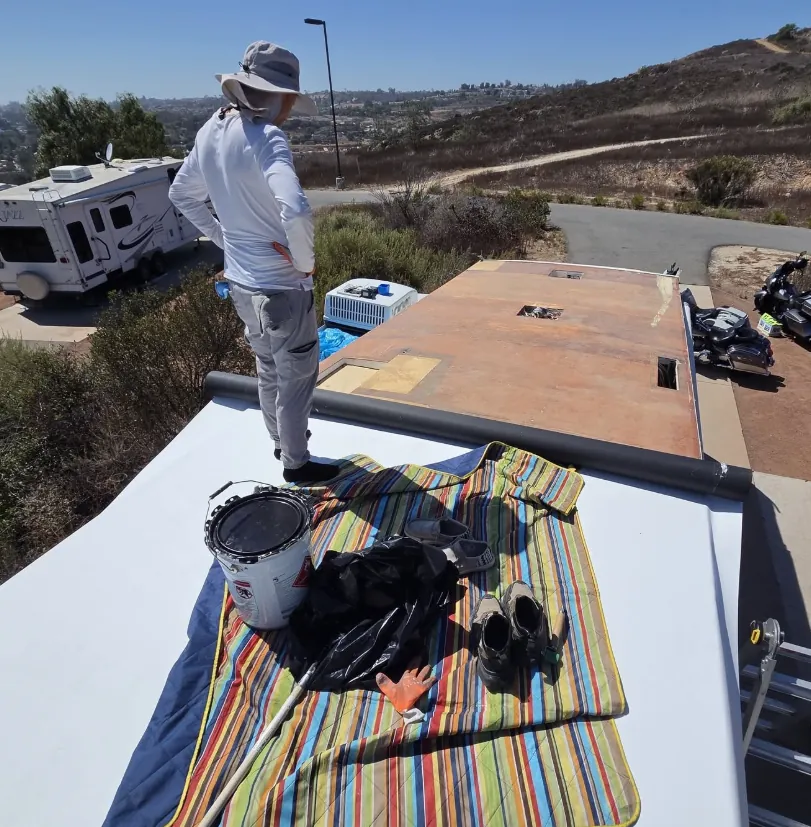
A TPO roof is a single sheet of thermoplastic polyolefin, reinforced internally with a woven scrim and bonded across the plywood decking of a coach. Because it is a thermoplastic it can be heat welded to itself, and it is supplied white. It is not interchangeable with EPDM rubber, so the membrane has to be identified before any adhesive, coating or replacement sheet is chosen for it.
What a TPO Roof Membrane Is Made Of
TPO stands for thermoplastic polyolefin, a single-ply membrane whose polymer is blended from ethylene and higher alpha-olefins. The industry specification for it, ASTM D6878/D6878M-21, requires two things that decide how the material behaves on a coach: the sheet must contain a reinforcing fabric or scrim, and it must be capable of being heat welded, fused or adhesively bonded to itself for watertight field splices. That scrim is the part an owner never sees. It sits inside the thickness of the sheet as a woven grid, and it is what stops the membrane stretching out of shape or tearing away from a fastener hole the way an unreinforced sheet would. On an RV the membrane is bonded over luan plywood decking laid across framing, commonly on 16 inch centers. Dicor supplies it as DiFlex II in a non-fleece-backed form and as BriteTek with a fleece backing, and that backing changes which bonding adhesive the job requires.
How to Tell Whether You Have TPO or EPDM Without Guessing
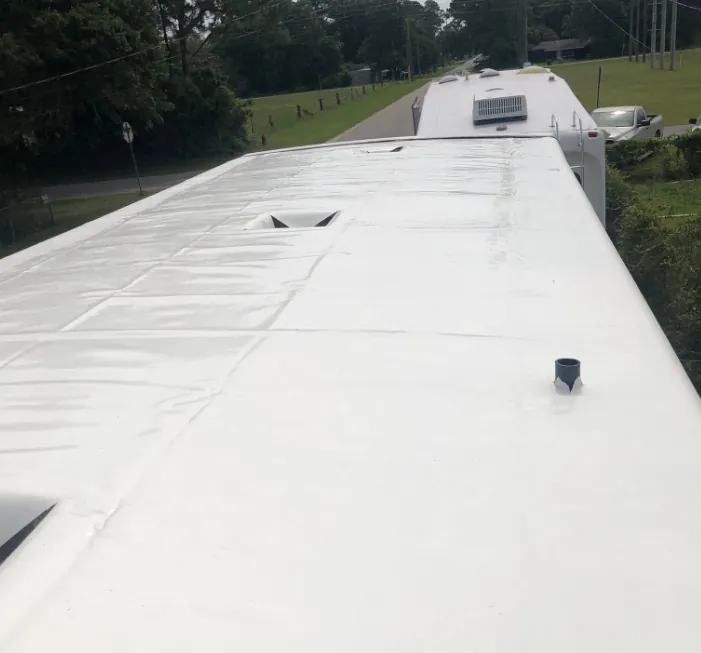
Four checks settle it, and none of them need a sample sent anywhere. Start with paperwork: the build sheet or the roof decal near the front cap normally names the membrane, and the coach manufacturer can pull it from the VIN when the decal has weathered off. Then read the surface. Aged EPDM sheds a chalky gray film onto a palm wiped across it, while TPO does not chalk at all and keeps a harder, slicker face that is white through the sheet rather than white over black. Third, find a cut edge, at a vent flange or under the drip rail, and look into the thickness for the woven scrim showing as a fine mesh. Fourth, study how a lap or a factory patch was joined. A fused, glossy, faintly rippled band is a heat weld, and only a thermoplastic can be joined that way. A glued lap hidden under a bead of sealant proves nothing by itself.
The Afternoon Storm Leak Call, and the Order We Work It
The call that starts most of these jobs is seasonal. Storms build over the peninsula most summer afternoons, the roof takes a heavy soaking at roughly the same hour every day, and a defect that seeped quietly through the dry months produces a stained ceiling panel or a soaked slide topper inside a week. Our technicians work it in a fixed order. The membrane is identified first, because every later decision depends on the answer. Then the laps and the perimeter termination are examined, including any heat-welded band, since a weld run too cold releases along a line rather than at a single point. After that comes the open field of the sheet, read for punctures, scrim showing through wear, and any coating somebody applied earlier. Last is the decking, pressed between the framing and, where the feel is ambiguous, probed with a pin-type moisture meter through an existing fastener hole rather than a fresh one.
Why EPDM Products Fail on TPO, and the 501 Versus 551 Myth
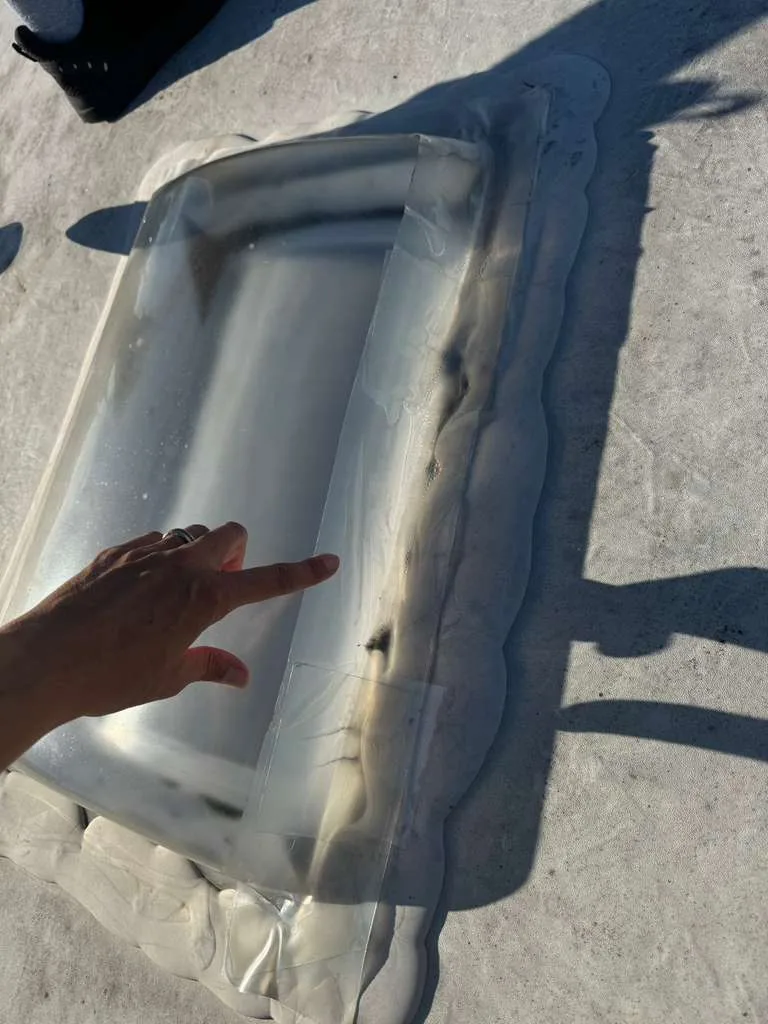
The incompatibility is real, but it is not where the forums put it. Dicor sells its water based bonding adhesive under a different part number for each membrane family: 901BA-1 for EPDM, 917BA-5 for BriteTek fleece-back TPO and DiFlex II, and 935BA-1 for Tufflex. The same instructions bar using it to seam rubber to rubber or to stick a membrane to metal, fiberglass or plastic, and set coverage at one gallon per 160 to 180 square feet. Lap sealant is the opposite case. Dicor lists 501LSW self-leveling and 551LSW non-leveling as compatible with EPDM, TPO and PVC alike, so the rule that 501 is the rubber sealant and 551 is the TPO one is wrong. That pair splits on geometry, self-leveling for horizontal surfaces against non-leveling for vertical ones. Coatings are where the real failure happens. A product formulated to key into oxidized EPDM has nothing to bite on a chalk-free thermoplastic, so it releases in sheets.
The Reflectivity Argument, Stated Honestly
The published numbers are genuine. Dicor rates Polar White DiFlex II at 86 percent reflectivity with a Solar Reflective Index of 108, holds flexibility down to minus 60 degrees Fahrenheit, and puts the sheet up to 36 percent lighter than competing membranes. What gets oversold is the comparison sitting behind those figures. Commercial roofing markets white TPO against black EPDM, where the gap is enormous. An RV rubber roof is already white on its exposed face, so trading a white rubber sheet for a white thermoplastic one will not deliver the cabin temperature drop those commercial numbers imply. The honest version is narrower and still worth having. A reflective sheet runs a cooler deck and a cooler footprint under the rooftop unit, which slows the thermal cycling that ages sealant around every penetration. Interior comfort is governed far more by the insulation beneath the decking than by the color of the membrane above it.
What It Costs, and Why a Quote Must Name the Membrane
Our service call covers the trip out and the first hour on site at the rate in the pricing table on this page; anything past that first hour is quoted and approved before we carry on. Findings scale from there. A released weld or a lifted termination on an otherwise sound sheet is an hours-long repair. A puncture with dry decking beneath it is a patch and a reseal, which is the same maintenance work covered on our roof reseal and lap sealant page. A sheet that has let go, or decking that gives underfoot, becomes a full membrane job measured in days. Treat any written quote that says only rubber roof replacement as unfinished. It should name the membrane, the bonding adhesive part number and how the laps and terminations will be finished, because those three lines are where a TPO job quietly goes wrong.
Sources
Every figure on this page comes from a manufacturer document or a standards body, not from another repair site. Here is where each one comes from.
- ASTM D6878/D6878M-21, Standard Specification for Thermoplastic Polyolefin-Based Sheet RoofingTPO sheet must contain reinforcing fabric or scrim and must be capable of being heat welded, fused or adhesively bonded to itself for watertight field splices.
- Dicor DiFlex II TPO RoofingDiFlex II is a non-fleece-backed TPO membrane, distinguishing it from the fleece-backed BriteTek TPO that takes a different bonding adhesive.
- Dicor Polar White DiFlex II TPO specifications86 percent reflectivity, Solar Reflective Index of 108, flexibility to minus 60 degrees Fahrenheit, and up to 36 percent lighter than competing membranes.
- Dicor Water Based Bonding AdhesiveMembrane-specific part numbers 901BA-1 for EPDM, 917BA-5 for BriteTek and DiFlex II, 935BA-1 for Tufflex; coverage of one gallon per 160 to 180 square feet; not intended for seaming rubber to rubber or bonding to metal, fiberglass or plastic.
- Dicor 501LSW Self-Leveling Lap Sealant501 self-leveling lap sealant is compatible with EPDM, TPO and PVC membranes and is specified for horizontal surfaces, disproving the claim that 501 is EPDM-only.
Related repairs
- our Fiberglass Roof Repair service
- Rv Roof Reseal Lap Sealant in Florida
- how we handle maxxair fan replacement
Other systems we service
Where we work
Service category
What this usually costs
| Item | Price | What it covers |
|---|---|---|
| Service call | $299 | Includes the trip out to your RV and the first hour on site |
| Work past the first hour | Quoted after diagnosis | We tell you what it will take before we carry on |
| Parts | Quoted per job | Special-order parts may need a deposit before we order them |
| Written estimate | No charge | You approve the estimate before any work starts |
The service call covers the trip out to your RV and the first hour on site. Anything beyond that depends on what we find, and we quote it and get your approval before carrying on.
The price ranges on this page come from our own recent jobs across Florida, not from an industry average. What you pay depends on the rig, the parts it needs and what we find on site, so we give you a written estimate before any work begins and you approve it first.
Frequently asked questions
Can you do a roof and seal assessment if I do not know what membrane I have?
Yes, and identifying the membrane is the first step of that visit rather than something you need to work out beforehand. Our technicians read the surface for chalk, check a cut edge at a vent flange for the woven scrim, and look at how the laps were joined. You are told which membrane you have, what condition it is in, and which outcome applies: reseal, patch, or a full sheet.
Is Dicor 551 the sealant for TPO and 501 the one for rubber roofs?
No. Dicor lists 501LSW self-leveling and 551LSW non-leveling lap sealant as compatible with EPDM, TPO and PVC membranes, so neither is membrane-specific. The difference between them is geometry: 501 is self-leveling and belongs on horizontal surfaces, while 551 is non-leveling and suits vertical ones such as termination rails and the edge of a front cap. The membrane-specific product is the bonding adhesive, not the sealant.
Will a white TPO roof make my RV cooler in the Florida heat?
A little, and less than the marketing suggests. Dicor rates Polar White DiFlex II at 86 percent reflectivity with a Solar Reflective Index of 108, which is genuinely high, but the comparison those figures are usually drawn against is black commercial EPDM. An RV rubber roof is already white on top. The real gain is a cooler deck and slower sealant aging, not a noticeably cooler cabin.
Someone already coated my roof. Does that change the job?
It usually adds to it. A coating meant to key into oxidized EPDM has nothing to bite on a chalk-free thermoplastic surface, so it tends to release in sheets, and while it is still up there it hides the membrane condition underneath. Before anything new is bonded down, that layer has to come off and the sheet has to be read clean, which is time added to the job.
My quote just says rubber roof replacement. Is that a problem?
It is a warning sign rather than proof of anything wrong. TPO and EPDM are different materials with different bonding adhesive part numbers and different ways of joining a lap, so a quote that never names which one is going onto your coach has not been priced against a specific system. Ask for the membrane name, the adhesive part number, and how the laps and terminations will be finished.
Does a TPO roof need heat welding, or can the seams be glued?
ASTM D6878 requires TPO to be capable of being heat welded, fused or adhesively bonded to itself, so both routes are permitted. On most coaches the replacement goes down as one continuous sheet, which means welding matters mainly at detail work, patches and terminations rather than across the roof. Where a weld is used it is run with a hot-air welder and pressed with a silicone seam roller while the material is still soft.