RV Water Heater Anode Rod and Element Repair in Florida
Lukewarm water, a rumbling tank or a leak in the underbelly? Mobile Suburban and Atwood water heater anode, element and tank service. Call 888-759-1438.
Owners call and say the hot water quit, or that it goes lukewarm fast. On an RV water heater that points to one of four things: a spent anode rod, a scaled or burned out heating element, a failed thermostat or ECO high limit switch, or a bypass valve left open.
The Symptoms Owners Actually Describe When They Call
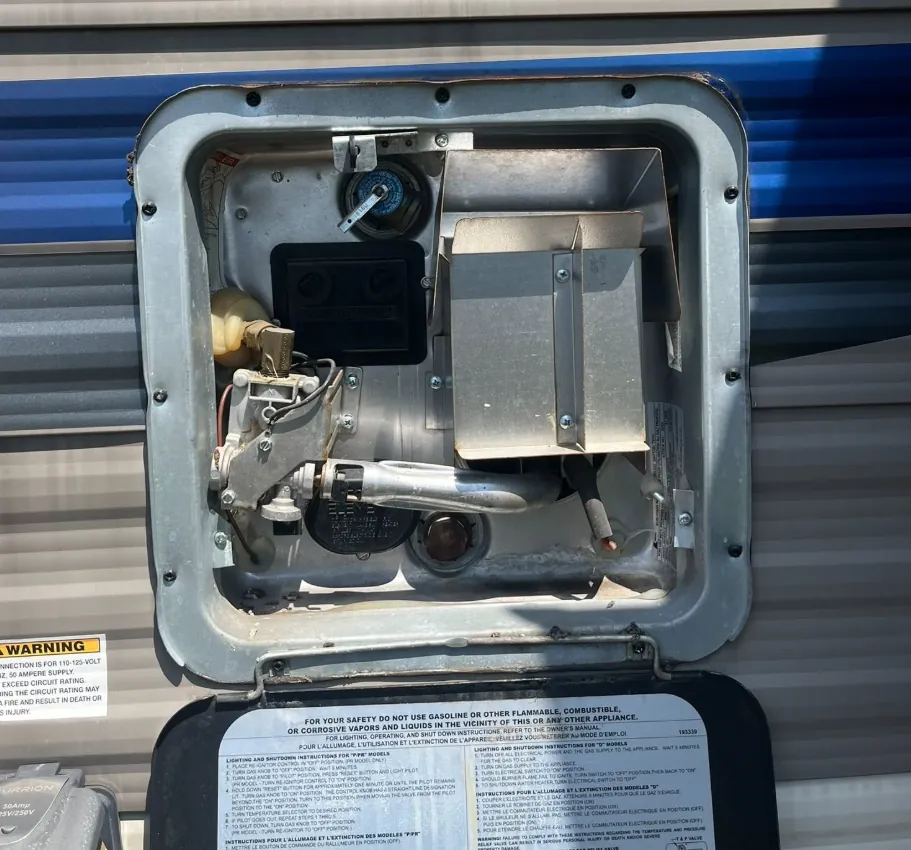
Almost nobody calls asking for an anode rod. The call is that the hot water quit, that it goes lukewarm halfway through a shower, or simply a request to come out and fix the hot water tank. Those descriptions map to a short list of real faults. Hot water that runs out in two minutes usually means the tank is half full of scale and sediment, or the bypass valves behind the heater are partly open and mixing cold water in. A deep rumble or popping while it heats is water flashing to steam under a crust of hardened calcium on the tank floor. No hot water on electric but fine on propane isolates the fault to the 120-volt side: element, thermostat, ECO switch or the breaker. The reverse, gas dead and electric fine, points at the DSI board, burner or gas supply instead. Rotten egg odor on the hot side is a magnesium anode reacting with sulfate, not a holding tank problem.
Suburban Needs an Anode Rod, Atwood and Dometic Must Never Have One
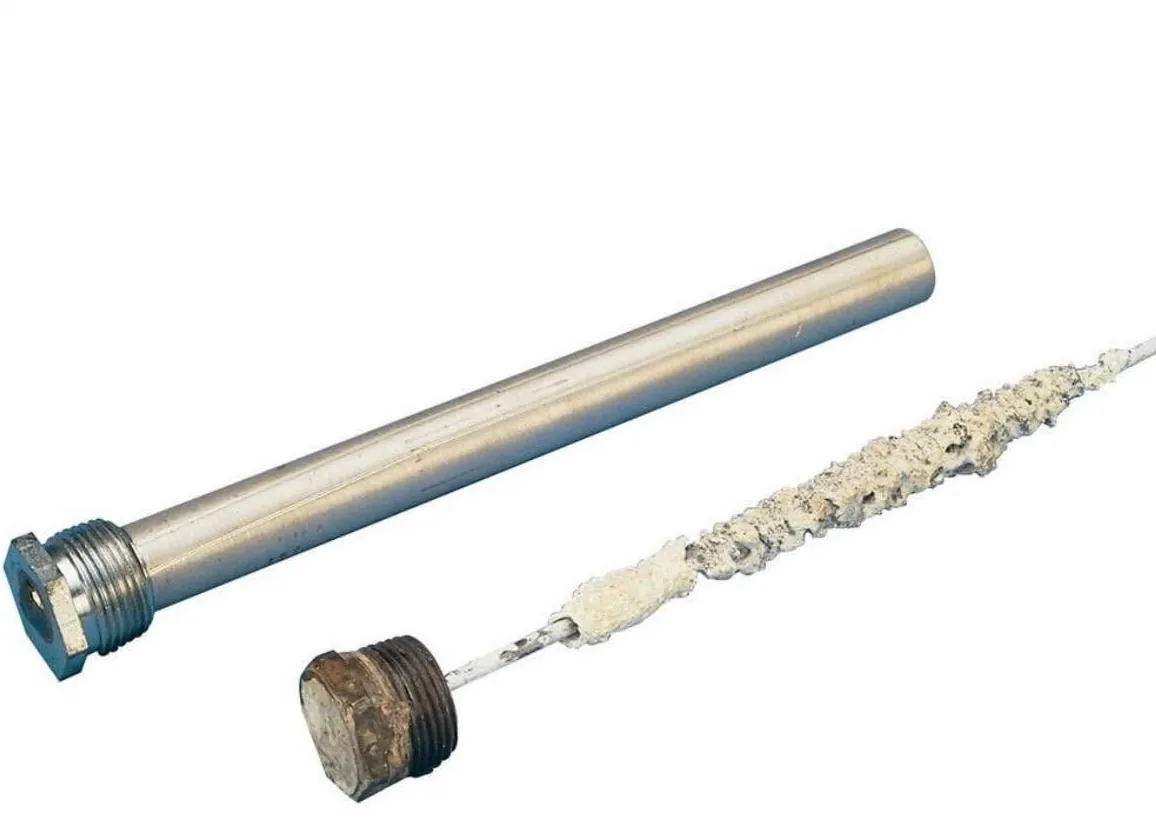
This is the single fact that decides everything else on the job, and getting it backwards destroys tanks. Suburban water heaters, the SW6DE, SW10DE and SW12DE families, use a porcelain lined steel tank. Steel corrodes, so Suburban fits a sacrificial magnesium or aluminum-zinc anode rod that doubles as the drain plug and gives itself up instead of the tank. Atwood heaters, now sold under the Dometic name, use an aluminum clad tank that protects itself chemically and takes a plain nylon drain plug. Fitting a magnesium anode into one sets up a galvanic couple between magnesium and aluminum that pits the tank wall from the inside. The threads are your tell. A Suburban anode port is 3/4 inch NPT, an Atwood drain plug is 1/2 inch NPT, so an anode cannot thread into an Atwood at all without an adapter bushing. If someone sold you that adapter, take it back out before it costs you the tank.
How Our Technicians Diagnose a Dead Water Heater, In Order
The sequence matters because half the calls are not the part the owner expects. Our technicians start at the bypass valves behind the heater, since a valve left in the winterize position after a summerize job mimics a failed element perfectly and costs nothing to correct. Next is the 120-volt side with a multimeter. A Suburban 1440-watt element such as the 520900 should read close to 10 ohms cold, because 120 volts squared divided by 1440 watts is 10. An open circuit or a reading to ground means the element is finished. We check the thermostat and the ECO high limit switch on the same pass, since an ECO that has tripped near 180 degrees Fahrenheit is a symptom of scale, not the cause. Then the tank comes down. We pull the anode with a 1-1/16 inch socket, flush the tank with a rinser wand, and measure what is left of the rod.
Water in the Underbelly After a Florida Afternoon Storm
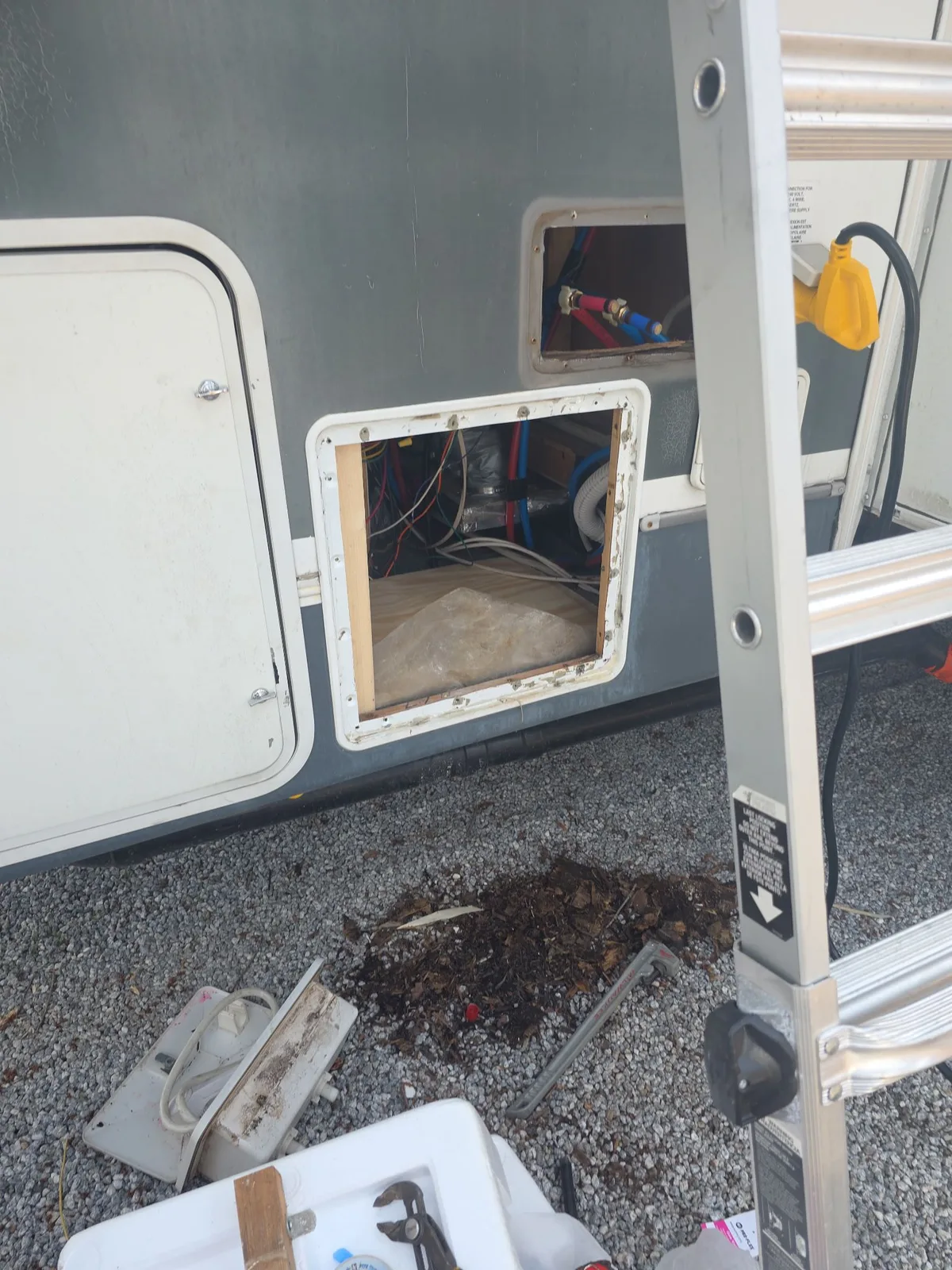
"Can you help with water leaking into the underbelly" is one of the most common calls we get, and it is the one worth being careful about. After an afternoon thunderstorm, rain driven sideways past a warped water heater access door lands in exactly the same place as a genuine tank leak, so the underbelly is wet either way. Our technicians separate the two by pressurizing the coach with the pump on and the shore water off, then watching the compartment dry. Water that returns only with the pump running is plumbing. A steady weep from the temperature and pressure relief valve, typically rated 150 psi and 210 degrees Fahrenheit, is usually park water pressure over 80 psi rather than a bad valve, and a regulator set near 45 psi cures it. Water still arriving with the system dead and the sky open is intrusion, and the fix is the access door seal and sealant, not the tank.
What It Costs, and What It Turns Into If You Leave It
We do not quote a fixed price on a tank we have not opened, because the anode is what tells us whether this is a service or a replacement. An anode swap and flush is normally under an hour of work plus a modest part. An element and gasket, or a thermostat and ECO pair, is usually about an hour once the panel is off. Left alone, the path is predictable. A consumed anode means the steel tank itself is corroding, a scaled tank cooks its own element repeatedly, and a pinholed tank is not repairable - it becomes a full tank replacement, a half day job and by far the most expensive outcome.
The anode is the cheapest part on this page and the one that decides whether the rest of it ever applies. Checking it during an annual flush costs minutes; discovering it was consumed two seasons ago costs a tank.
Sources
Every figure on this page comes from a manufacturer document or a standards body, not from another repair site. Here is where each one comes from.
- Suburban (Airxcel) - Advantage 6 Gallon Tank Water Heater, SW6DSuburban's own spec sheet for the SW6D lists a durable porcelain lined steel tank and a replaceable anode rod that protects against tank corrosion and doubles as a drain, plus Direct Spark Ignition. That is the manufacturer stating the exact reason a Suburban tank carries an anode rod at all.
- Dometic - WH-6GA 6 Gallon RV Water Heater feature listDometic lists the tank as aluminum and states in its own feature list that an anode rod is not required. This is the manufacturer side of the Suburban versus Atwood and Dometic distinction the page is built on, and the reason fitting a magnesium rod into one of these tanks is a mistake.
- Suburban - Replacement Anode Rod, magnesium 233514 and aluminum 233516Suburban catalogs the anode rod in both a magnesium and an aluminum version for all of its tank water heaters, which is what makes the rotten egg fix in the FAQ real: swapping the magnesium rod for the aluminum alternative is a factory option, not a workaround.
Related repairs
Other systems we service
Where we work
Service category
What this usually costs
| Item | Price | What it covers |
|---|---|---|
| Service call | $299 | Includes the trip out to your RV and the first hour on site |
| Work past the first hour | Quoted after diagnosis | We tell you what it will take before we carry on |
| Parts | Quoted per job | Special-order parts may need a deposit before we order them |
| Written estimate | No charge | You approve the estimate before any work starts |
The service call covers the trip out to your RV and the first hour on site. Anything beyond that depends on what we find, and we quote it and get your approval before carrying on.
The price ranges on this page come from our own recent jobs across Florida, not from an industry average. What you pay depends on the rig, the parts it needs and what we find on site, so we give you a written estimate before any work begins and you approve it first.
Frequently asked questions
Do you repair hot water heaters, or only replace them?
We repair them wherever the tank itself is sound. Anode rods, heating elements, thermostats, ECO high limit switches, temperature and pressure relief valves, drain plugs and bypass valves are all serviceable at your site. Replacement is only on the table when the tank wall or the anode port threads are gone, because a pressure vessel that has pinholed cannot be patched safely. Our technicians tell you which one you have before any parts are ordered.
Do you have a fitting for my hot water tank?
Usually, but tell us the brand first. Suburban anode ports are 3/4 inch NPT, while Atwood and Dometic drain plugs are 1/2 inch NPT nylon, and the two are not interchangeable. Our technicians carry both anode rods and nylon plugs, element gaskets, and PTFE tape. If you read us the model number off the label inside the access door, the right fitting comes out on the first trip instead of the second.
Can you repair a broken threaded fitting in the tank?
Sometimes. A cross threaded or lightly galled 3/4 inch NPT anode port on a Suburban can often be chased with a tap and resealed, and inlet and outlet nipples can be replaced. What cannot be saved is a port whose threads have torn out of the tank wall, since a thread insert will not hold against hot water pressure. That is a tank replacement, and we would rather tell you that than sell you a repair that leaks in a month.
How do I disconnect a stuck fresh water hose from the tank?
Kill the pump and open a hot tap first so nothing is under pressure. Then use two wrenches, one as a backing wrench on the fitting itself, so you are not twisting the nipple or the PEX line behind it. Most of the damage we get called out for is a seized brass fitting turned with one wrench, which snaps the connection off the tank. If it will not break loose under steady pressure, stop and call us.
How often does the anode rod need changing in Florida?
Check it annually and change it once roughly three quarters of the magnesium is gone or the steel core wire is showing through. Florida well and municipal water carries a heavy calcium and mineral load, so rods here are consumed faster than the same rig would burn one up north. Full timers hooked up year round should look at it every six months. Torque the new rod to about 20 to 25 foot-pounds over three wraps of PTFE tape.
Why does only my hot water smell like rotten eggs?
That smell is sulfate in the water reacting with a magnesium anode rod and with sulfate reducing bacteria living in the warm tank, which produces hydrogen sulfide gas. It is a water heater issue rather than a holding tank issue, which is why it shows up only on the hot side. The fix is a drain, flush and sanitize, plus an aluminum-zinc anode rod in place of the magnesium one on Suburban tanks.