RV Black Tank Sensors Reading Full and Tank Flush Repair
Black tank still reads full after dumping? Mobile probe testing, deep tank flush, Horst probe and SeeLevel sender swaps across Florida. Call 888-759-1438.
When a black tank reads full right after dumping, the first check is the tank, not the sensor: dump it, rinse it hard, then watch whether the reading falls. Next comes a meter across a level probe and the tank ground probe, then the harness at the monitor panel. Nearly every one of these ends at tissue and sludge bridging the probe faces rather than a failed sensor.
Why a Black Tank Reads Full Right After You Dump
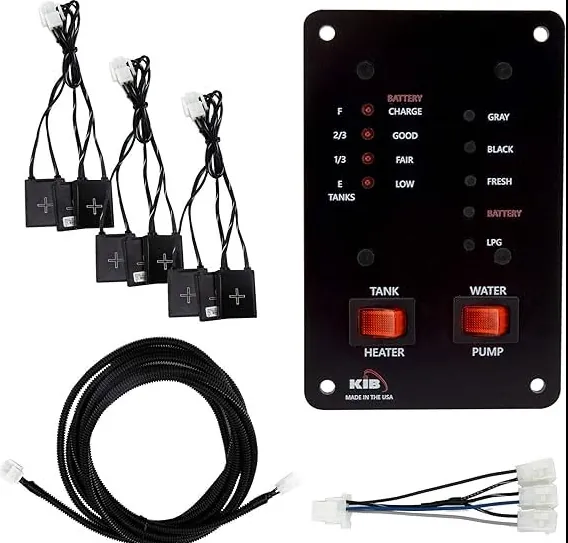
A standard RV holding tank monitor is a resistance circuit, not a float and not a pressure gauge. Three stainless probes pierce the tank wall at the one third, two thirds and full lines, and a fourth probe near the bottom acts as the ground. When waste rises far enough to touch a level probe it completes a circuit back to that ground probe, and the panel lights that segment. The failure is that waste does not actually have to be present for the circuit to close. Valterra describes the mechanism plainly: liquid residue and sludge clinging to the tank wall create a conductive path between a level probe and the bottom ground probe, so the panel reports liquid that is not there. One strand of toilet tissue draped across a probe face does the same job. That is why a reading sticks at two thirds or full while the tank underneath is genuinely empty.
The Order We Check Things When the Monitor Lies
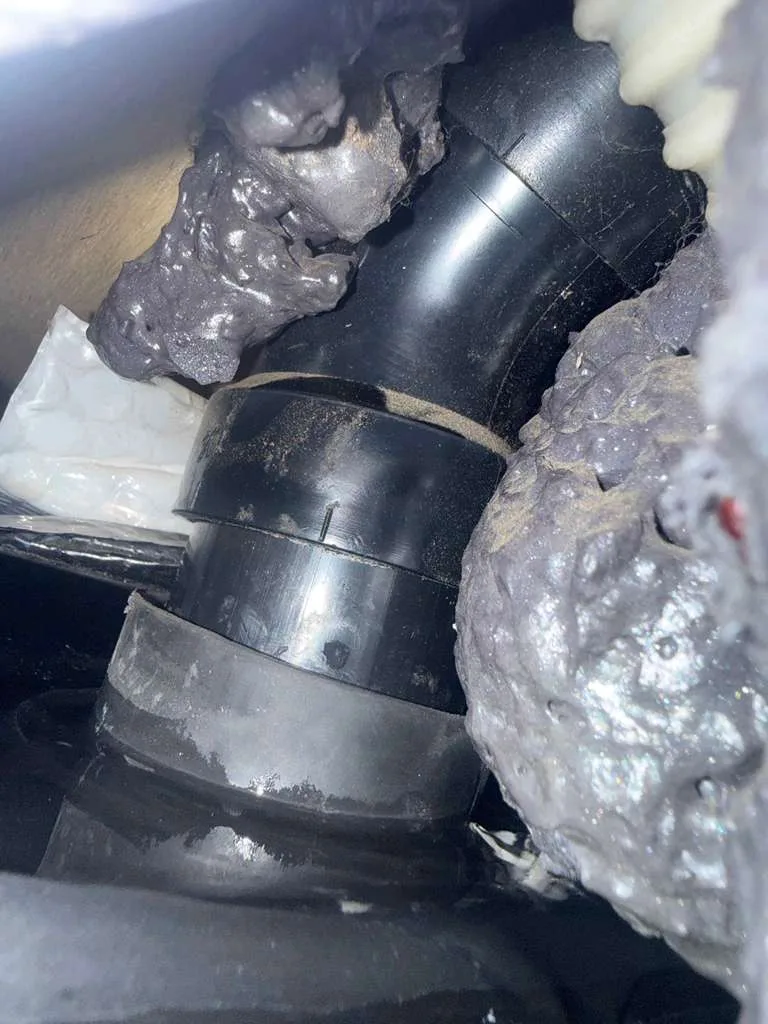
Diagnosis runs cheapest test first, because the cheapest test is also the most likely answer. Step one is a confirmed dump followed by a long rinse, either through the built-in flush or with a Valterra Master Blaster tank wand fed down through the toilet, then a second look at the panel. A reading that drops after a hard rinse has already told you the hardware is fine. Step two is electrical. With the tank empty, a digital multimeter across a level probe terminal and the tank ground probe should read open. Continuity there, with nothing in the tank, means the probe face is bridged or the wall is coated. Step three is the harness. A chafed sensor wire grounding on the frame, or a corroded ring terminal at the tank stud, produces the identical permanent full reading and gets blamed on the probe. Only when all three come back clean does the panel itself become the suspect.
Internal Probe Sensors Versus External Strip Senders
Two sensing technologies exist in RVs and they fail in completely different ways. Internal probes are the factory default: metal studs through the tank wall, sitting in direct contact with the waste and therefore in direct contact with everything that clings to them. External senders sidestep the problem by never touching the contents at all. The Garnet Instruments SeeLevel II 709 system bonds an adhesive sender strip to the outside of the tank wall and reads level through the plastic, so tissue and sludge inside have nothing to attach to. Horst Miracle Probes sit between the two approaches. They are still internal, but the sensing element is sleeved inside a Delrin body and a Teflon tube, which is what stops residue and sludge from creating a conductive path across the probe face, and Valterra lists them as considerably longer than a standard probe. They fit a standard 3/8 inch probe hole, so the tank wall does not have to be redrilled.
Does Your Coach Have a Built-In Tank Flush, and How to Tell
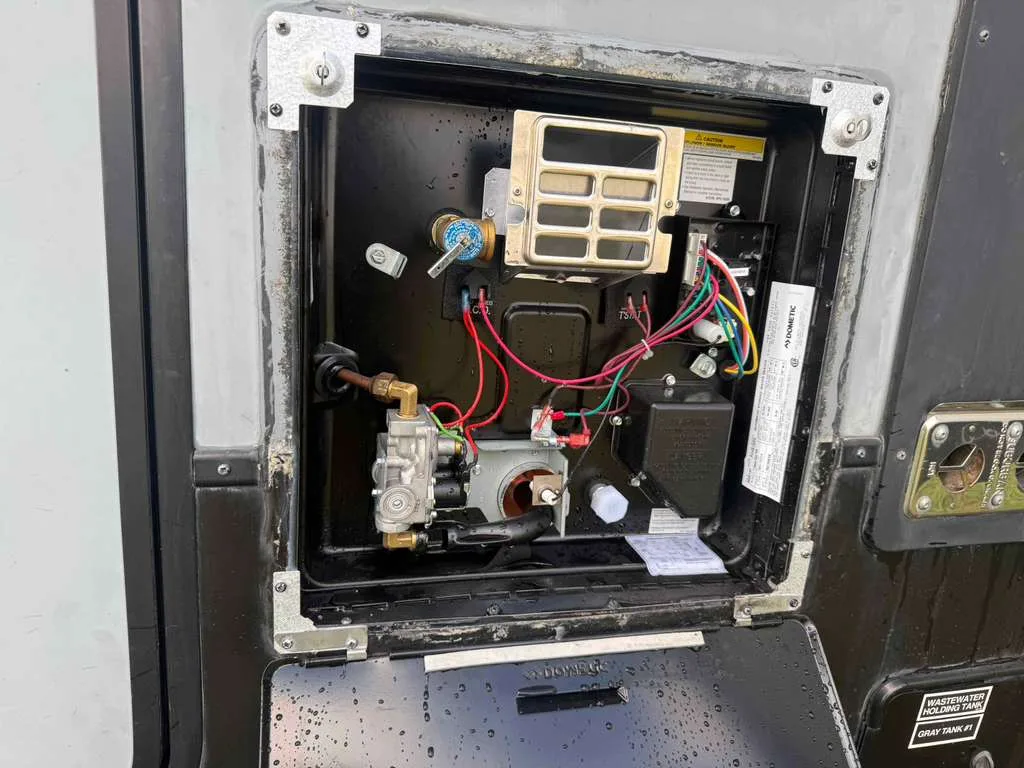
A built-in black tank flush is a permanently plumbed spray head in the top of the tank, fed by its own city water inlet on the service side of the coach. Look for a second, smaller hose connection near the dump valves, usually labeled black tank flush or sanitary flush, entirely separate from the fresh water gravity fill and the pressurized city water inlet. If there is no second inlet, the coach was built without one, and a Valterra No-Fuss Flush kit, part A71, adds a backflush fitting to a tank that never had one. Two cautions matter more than the rest. The flush line needs a working vacuum breaker so tank contents can never siphon back into a hose, and callers asking whether we service vacuum seal flush systems are usually describing exactly this fitting. Always run the flush with the dump valve open, never closed.
Ice Cubes, Enzymes and What Actually Cleans a Probe
The ice cube remedy asks you to pour a bag of cubes down the toilet and drive so they scour the sensors clean. The mechanics do not support it. Ice floats, the probes sit on a vertical tank wall well above the waterline, and cubes sliding around the tank floor never reach the surfaces that are actually fouled. Chemistry does the real work. Thetford builds a dedicated Level Gauge Cleaner aimed at sensors that fail from tissue and sludge build-up, and states outright that not every sensor problem can be corrected with it, which is an honest limit worth repeating rather than hiding. Enzyme treatments such as Thetford Aqua-Max solve a different problem entirely: enzymes accelerate the natural breakdown of waste and paper to control odor and prevent clogging on discharge. They keep a clean tank from fouling again. They will not strip a probe that is already coated.
What Each Finding Costs and What It Becomes If Left
Nobody should put a fixed number on a tank that has not been opened, because the finding decides the parts. A fouling-only result is the inexpensive outcome: a deep flush, a gauge cleaner soak and a re-read, frequently inside that first hour. Fitting four Horst Miracle Probes, part T21301VP for the black tank, adds parts plus the labor to physically reach the tank, and access drives that number far more than the probes do. Left alone, a monitor stuck on full stops being a nuisance. Owners start dumping on a calendar instead of a reading, solids pyramid under the toilet, and the job turns into clearing a blocked tank.
The order to fix it in is sensors and flush first, habits second. A working reading is what lets an owner dump on volume rather than on a calendar, and that single change prevents most of what turns into a blockage call later.
Year-Round Florida Use and How Often to Service the Tank
Coaches here never get a winter lay-up. A rig in Vero Beach, Boynton Beach or Clearwater is lived in, rented or camped in across the whole calendar, so the black tank works continuously and film builds on the probes all year instead of pausing for four cold months the way a northern coach does. That changes the interval, not the method. Thetford recommends a Tank Blaster cleanout quarterly, plus any time odors turn strong or solids begin to pyramid, and on a full-time Florida coach quarterly is the floor rather than the target. Tank work also tends to uncover neighbors. A weeping gray tank valve, a rocking toilet flange and a fresh water pump that will not hold pressure each have their own page on this site, and our technicians look over the whole plumbing bay while the coach is already open.
Sources
Every figure on this page comes from a manufacturer document or a standards body, not from another repair site. Here is where each one comes from.
- Valterra Products, RV Aftermarket Catalog (manufacturer catalog PDF, Sewer and Sanitation section)Verified by reading the PDF: the Horst Miracle Probes listing states the sensor is surrounded by a Delrin body and Teflon tube to prevent liquid residue or sludge from creating a conductive path, that the probes are considerably longer than standard probes, that they are specially designed to prevent false probe contact and the related reading, and that they fit a standard 3/8 inch diameter hole. Separate part numbers are listed for each tank, T21301 and T21301VP for black water tanks and T21302 and T21302VP for gray water tanks.
- Garnet Instruments - SeeLevel II 709-P3 ITRV tank monitor manualThe SeeLevel II external sender strip mounts to the outside of the tank wall and reads level through it, so nothing inside the tank contacts a sensing surface.
- Thetford - holding tank sensors always reading two thirds fullThetford Level Gauge Cleaner restores sensors that fail from tissue and sludge build-up, and states that not all sensor issues can be corrected by it.
- Thetford - what enzymes do in a black tankEnzymes accelerate the natural breakdown of waste and toilet paper to reduce odor and prevent clogging during discharge, which is prevention rather than probe cleaning.
Related repairs
Other systems we service
Where we work
Service category
What this usually costs
| Item | Price | What it covers |
|---|---|---|
| Service call | $299 | Includes the trip out to your RV and the first hour on site |
| Work past the first hour | Quoted after diagnosis | We tell you what it will take before we carry on |
| Parts | Quoted per job | Special-order parts may need a deposit before we order them |
| Written estimate | No charge | You approve the estimate before any work starts |
The service call covers the trip out to your RV and the first hour on site. Anything beyond that depends on what we find, and we quote it and get your approval before carrying on.
The price ranges on this page come from our own recent jobs across Florida, not from an industry average. What you pay depends on the rig, the parts it needs and what we find on site, so we give you a written estimate before any work begins and you approve it first.
Frequently asked questions
Do you do black tank cleanings?
Yes, and it is usually the first step rather than a separate service. A deep flush through the built-in inlet or a Master Blaster tank wand, followed by a gauge cleaner soak, resolves most stuck sensor readings on its own. If the panel still reads full after a verified empty tank and a full rinse, the visit moves straight into probe and harness testing instead of selling you a second cleaning.
Does a gray tank sensor fail the same way as a black tank one?
The electrical failure is identical, but the fouling is different. Gray tank probes get coated by soap scum, grease and hair rather than tissue, which is why Horst sells separate black and gray versions, listed by Valterra as T21301 for black tanks and T21302 for gray. Gray tanks also foul more slowly, so a gray reading that sticks is more likely to be a wiring or ground fault.
Will new sensors fix a tank that still reads full after cleaning?
Usually, provided testing pointed at the probes. A multimeter reading continuity between a level probe and the tank ground probe on a verified empty tank confirms the probe face is the problem, and replacement probes cure it. If the meter reads open at the tank but the panel still shows full, the fault is upstream in the harness, a ground connection or the monitor board, and new probes change nothing.
Can I add a tank flush if my RV did not come with one?
Yes. A backflush fitting such as the Valterra No-Fuss Flush kit can be added to a tank built without one, and it plumbs to its own dedicated inlet with a vacuum breaker so nothing can siphon back into a water hose. Retrofit difficulty comes down to tank access and where the fitting can be safely cut in, which is what the diagnostic visit determines.
Is there a sensor that will not foul at all?
External senders come closest. A Garnet SeeLevel II 709 sender strip bonds to the outside of the tank wall and reads through the plastic, so waste and tissue never contact a sensing surface and cannot bridge anything. It costs more than a probe set and needs the tank exterior accessible for the strip and its wiring, so it makes the most sense on a coach that has already been through two rounds of probes.