RV Water Pump Replacement and Short Cycling Repair in Florida
Pump clicking on and off with every tap closed? Mobile 12V RV fresh water pump diagnosis, strainer, check valve and replacement. Call 888-759-1438.
A 12 volt RV water pump is worth rebuilding when only the strainer, the check valve or the pressure switch has failed, and worth replacing outright once the diaphragm has hardened or the motor draws well over its rated amps. What decides it is a pressure test, not the noise.
Rebuild the Head or Fit a New Pump, and What Decides It
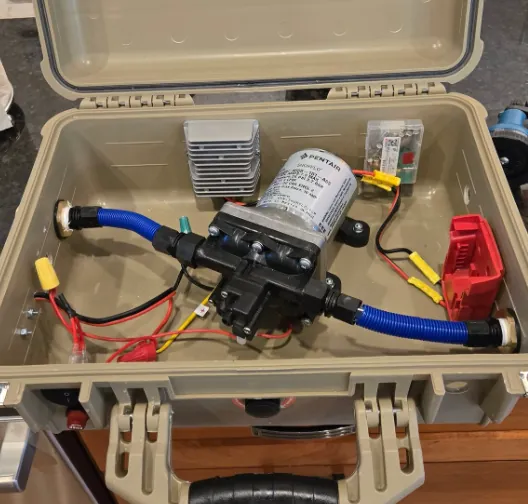
Almost every 12 volt fresh water pump is two halves: a small permanent magnet motor, and a serviceable upper head holding the diaphragm, the valve plate and the pressure switch. Head parts sell as kits, so a pump with a scored check valve or a switch that will not cut off is a parts job rather than a new unit. Once the motor pulls well over its rated amps, or the diaphragm has stiffened and split, a head kit costs enough that a fresh pump is the better spend. We will not quote a fixed figure on a pump nobody has looked at yet, because the finding decides the parts. Left alone, a pump that cycles all night flattens the house batteries, and a split diaphragm empties the fresh tank into the underbelly. Switch the pump off at the panel whenever the coach is left unattended.
Short Cycling Is Almost Never a Failed Pump
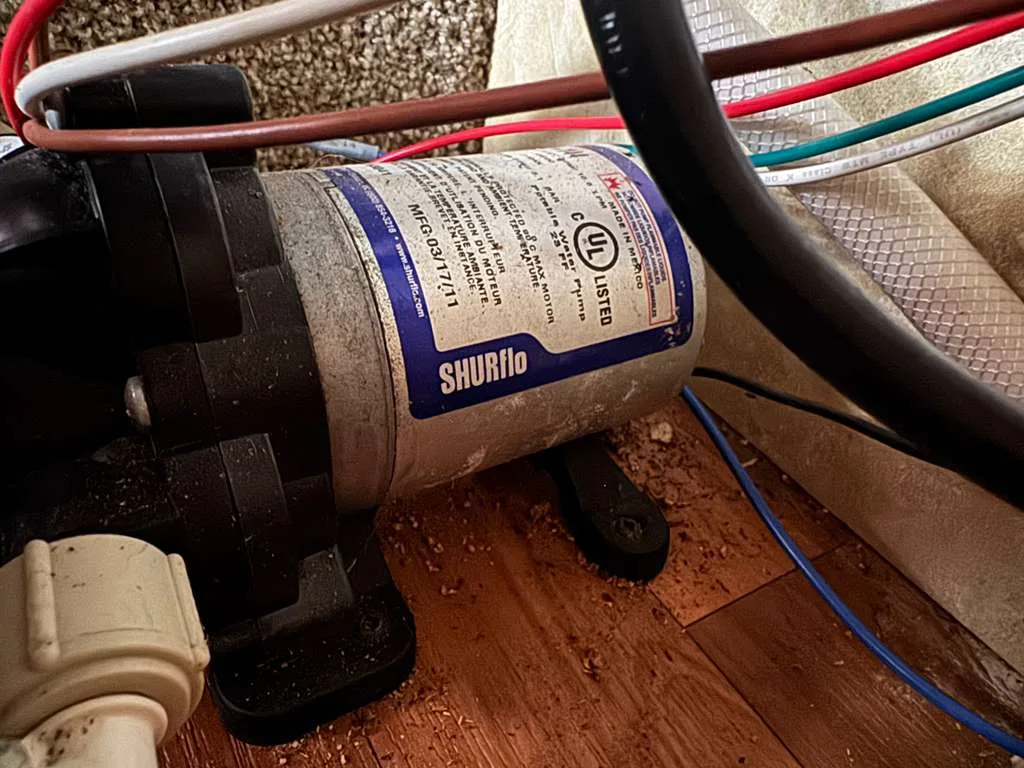
Short cycling is the pump kicking on for a fraction of a second, dropping out, then kicking on again, over and over with every faucet shut. The pressure switch is doing precisely what it was built to do: it cuts out near 55 psi on a Shurflo Revolution 4008 and cuts back in once pressure falls a few psi under that. If the plumbing cannot hold that pressure, the switch keeps tripping, and the pump takes the blame. Four things bleed pressure away. Trapped air compresses and gives the switch nothing solid to sit against; a worn one-way check valve in the head lets water push back toward the fresh tank; a waterlogged or missing accumulator removes the cushion; and a slow leak downstream, a toilet valve weeping or a loose fitting behind a wall, drops pressure faster than the switch can hold it. Sound pumps get thrown away over all four, which is why we test before we sell anybody a replacement.
Inside a Shurflo Revolution 4008 and What Each Part Does
The Revolution 4008 is the pump fitted to more coaches than any other: three chambers, roughly 3.0 GPM of open flow, a 55 psi cut-off and about 7.5 amps of draw at full load on 12 volts. It self primes through several feet of lift and survives running dry, so a coach can sit with an empty tank without cooking the motor. Inlet and outlet are half inch threaded ports, normally with a twist-on Shurflo 255-313 strainer on the suction side. Inside the head, a rubber diaphragm on a wobble plate draws water past the inlet flappers and pushes it out through the outlet flappers. Those flappers are the check valve, and the pressure switch above them senses the system through one small port, so trapped air or scale in that port fools the switch. Variable speed units, the Shurflo Aquajet RV and the Remco pumps some builders fit, ramp motor speed with demand instead of switching, so they never cycle this way.
The Test Order Our Technicians Follow Before Condemning a Pump
We start by proving what the pump is being asked to do. A 0 to 100 psi gauge threaded onto the outside shower port or the city water inlet shows whether the system holds pressure after cut-out, and how quickly it falls. Steady decay with everything shut means a leak or a check valve; pressure that never builds means the pump is moving air, or the water has a path back to where it came from. Next we open the water heater bypass and any winterizing siphon valve, then pull the strainer and read the screen. A DC clamp meter on the positive lead answers the rest: a healthy 4008 settles near its rated draw, a pump fighting a blocked strainer runs light, and a dragging motor or corroded terminals run heavy while voltage measured at the pump sags under battery voltage. Only after all of that, with the plumbing proven tight, do we condemn the unit itself.
Snowbird Coaches, Well Grit and a Strainer Nobody Has Opened
Seasonal use is harder on these pumps than daily use. A coach parked from May through November sits with water standing in the head, and the diaphragm and flapper valves take a set as they dry, so the first prime of the season leaks back past the check valve and the pump hunts. That is why so many cycling calls land in the first fortnight a snowbird is back in the coach. Water quality does the slower damage. Much of the state draws from a limestone aquifer, so campground and well supply carries dissolved calcium that scales the valve seats and the pressure switch port, and rural sites push fine sand down the line. With no strainer fitted, that grit scores the flapper seats until they will not seal at all. A strainer costs a fraction of what a pump does, and it is the cheapest part on the whole coach to neglect. We open one on every water call for that reason.
Sources
Every figure on this page comes from a manufacturer document or a standards body, not from another repair site. Here is where each one comes from.
- Pentair Shurflo Revolution 4008 series pump technical data sheetThe pump numbers quoted in the page: 3.0 GPM of open flow, a 55 PSI shut-off with a 40 PSI restart, a 12 volt DC permanent magnet motor, a one-way check valve that prevents reverse flow, half-inch NPSM male ports, and run-dry capability. The same sheet lists the upper assembly, pump head, check valve and pressure switch as separate service parts, which is the basis for rebuilding the head instead of replacing the pump.
- Pentair Shurflo Revolution 4008 series by-pass pump product pageThat the Revolution 4008 is a current by-pass style RV fresh water pump built around a one-piece diaphragm with an internal by-pass intended to reduce cycling, which is the design context for the short-cycling section.
- Pentair Shurflo RV water delivery pumps rangeThat Shurflo builds both pressure-switched demand pumps and variable speed RV pumps such as the Aquajet, supporting the point that variable speed units ramp with demand instead of switching and so never short cycle the way a pressure-switch pump does.
Related repairs
- Rv Black Tank Sensor Flush in Florida
- how we handle rv gray tank valve replacement
- Rv Pex Line Repair repairs
Other systems we service
Where we work
Service category
What this usually costs
| Item | Price | What it covers |
|---|---|---|
| Service call | $299 | Includes the trip out to your RV and the first hour on site |
| Work past the first hour | Quoted after diagnosis | We tell you what it will take before we carry on |
| Parts | Quoted per job | Special-order parts may need a deposit before we order them |
| Written estimate | No charge | You approve the estimate before any work starts |
The service call covers the trip out to your RV and the first hour on site. Anything beyond that depends on what we find, and we quote it and get your approval before carrying on.
The price ranges on this page come from our own recent jobs across Florida, not from an industry average. What you pay depends on the rig, the parts it needs and what we find on site, so we give you a written estimate before any work begins and you approve it first.
Frequently asked questions
How do I fix a broken water pipe in my RV?
Switch the pump off at its panel switch first, then close the city water valve, because either one will keep pushing water at the break. On most coaches the run is PEX with crimp rings, and the fix is a clean cut and a new coupling. The reason it belongs on this page is that a small unseen leak is the single most common cause of a pump that cycles all night with the taps shut, so we pressure test before assuming the pump has failed.
Is it the white water tank or black water tank?
The white or fresh water tank is the one the 12 volt pump draws from, and it is the only one of the three tanks with a pump on it at all. Gray holds sink and shower waste, black holds toilet waste, and both empty by gravity through their dump valves. So if the pump is the thing running, the fault sits on the fresh side and the black tank is not involved at all. Knowing which tank you mean saves a wasted trip and a wasted hour.
Can you help with water leaking into the underbelly?
Yes, and the pump is one of the first places we look. The head, the strainer and both threaded port fittings sit low in the coach, so a weeping fitting or a split diaphragm drips straight onto the coroplast belly wrap and pools there long before anything shows inside. A pressure test tells us whether the water is coming from the pump, a line or a tank fitting before anyone cuts the belly open, which keeps the repair small and the wrap intact.
Can you replace an RV generator fuel pump?
Yes, though that is a different pump from the one this page covers. The fresh water pump is a 12 volt diaphragm unit near the tank, while a generator fuel pump is a small electric lift pump feeding the carburetor or injection on an Onan set. Our technicians carry test gear for both, so tell the dispatcher which pump you mean and the right parts ride out on the truck the first time rather than the second.
Do I need an accumulator tank, and how do I know if mine is dead?
An accumulator such as a Shurflo 182-200 is a small bladder tank on the outlet side that stores a cup or so of water behind an air charge, so a brief draw comes out of the tank instead of restarting the motor. That cushion is what smooths flow and stops the rapid clicking. Test it with a tire gauge on its Schrader valve: if water sprays out, the bladder has burst and the tank is finished. A missing or waterlogged accumulator is one of the four classic causes of short cycling.