RV LP Gas Line Repair: Copper, Flare Fittings and Pigtails
Mobile RV LP gas line and fitting repair across Florida. Copper, black iron and pigtail failures, flare versus pipe thread, pressure tested. 888-759-1438
Whether an LP line gets repaired or replaced comes down to what the line is made of and where the damage sits. A corroded flare fitting or a cracked rubber pigtail is a part swap. A chafed run of copper behind a frame member usually means replacing that whole section, because a splice in the middle of a vibrating run only moves the next failure a few inches down the line.
Copper, Black Iron and Rubber Pigtails Fail in Three Different Ways
An RV propane system is not built from one material, and that is why there is no single answer to how it fails. Soft copper tubing, commonly 3/8 inch outside diameter, carries gas from the regulator back to the appliance branches, and it fails by work hardening and splitting where it has been bent, flexed or rubbed. Black iron pipe appears at rigid drops and manifolds near the furnace and range, and it fails at the threads, where rust works its way into the tapered portion that is doing the sealing. The rubber or thermoplastic pigtail between the bottle valve and the regulator is the shortest lived of the three, because it flexes every time a bottle is swapped and it lives outdoors in UV light. Cavagna Group states in its own propane catalog that a new pigtail should be installed with every new or replaced regulator. Line repair means the tube or pipe itself, not the regulator, tank valve or appliance it feeds.
Flare Fittings Versus Pipe Thread, and Why the Sealant Answer Changes
Two joint types do different jobs on the same coach, and they do not seal by the same mechanism. A 45 degree flare joint, the 1/4 inch inverted flare at a pigtail or regulator inlet, seals metal to metal: the flared cone formed on the end of the tube is clamped against the fitting seat by the flare nut, and nothing is supposed to sit in that gap. A tapered pipe thread, 1/4 inch or 3/8 inch NPT at a manifold or appliance stub, seals on the threads themselves as they deform against one another. That is why PTFE tape belongs on one and never on the other. Swagelok's own thread sealant instructions state that tape should be used only on male tapered pipe threads, and should not be used on flared, coned or tube fitting ends. Tape on a flare face does not seal anything. It holds the cone off its seat and manufactures the leak it was meant to prevent.
Chafe at the Frame Rail and Corrosion at the Fitting on Coastal Rigs
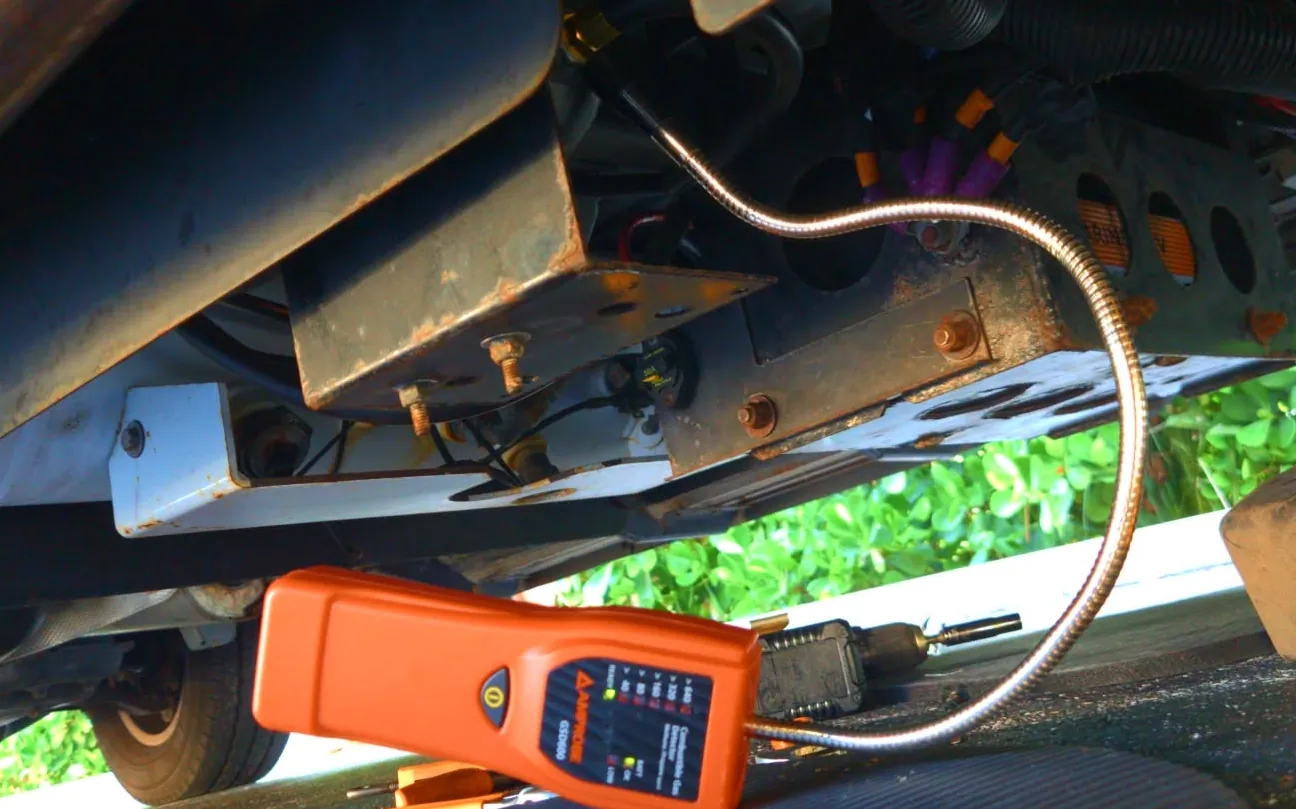
Two things kill an LP line in service, and both of them are slow. The first is motion: a copper run that crosses a frame member, a crossmember lip or a wiring loom will polish a flat spot into itself over thousands of road miles, and once the wall is thin enough the split shows up at that exact contact point rather than at a joint. The fix is not only new tube but a grommet, a rubber isolator or a properly spaced clamp so the replacement is not resting on bare steel. The second is corrosion, and on a rig kept near the coast it concentrates at the fittings. Salt aerosol settles on brass flare nuts and steel pipe threads, wicks under the nut where it stays damp, and works on the sealing face you cannot see. A green crust on a flare nut or orange bloom at a pipe joint is a finding, not cosmetic, and it is checked at every LP visit.
You Smell Propane or an Appliance Will Not Stay Lit: What Happens Next
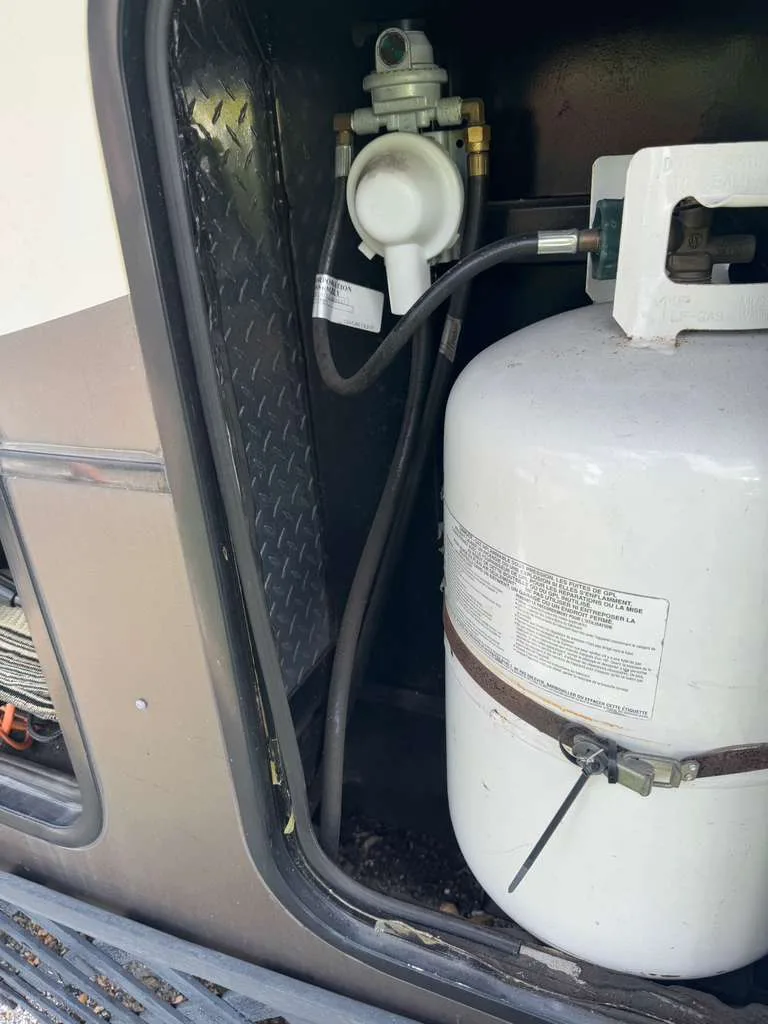
Owners rarely call about a line. They call because there is a propane smell at the bottle compartment, the furnace and water heater both went weak in the same week, or the detector went off once and never again. The check runs in a fixed order: bottles and pigtails first because they are outside and easiest to rule out, then the regulator and its connections, then a documented pressure test to prove whether the system holds at all, and only then a walk of the run itself for chafe points and corroded joints. Our technicians isolate branches rather than guess. Left alone, a weeping joint does not heal; it feeds an enclosed compartment.
Nothing about this is a wait-and-see repair. If you can smell gas, shut the tank valve at the bottle, leave the compartment open and do not run an appliance or a generator until the run has been pressure tested and cleared.
Is LP Line Repair a DIY Job? The Honest Answer
Plenty of RV work is reasonable to take on yourself, and we say so on other pages. This is not one of them. A propane line is the one system on a coach where a joint that looks and feels tight can still pass gas into an enclosed space overnight, and where the feedback you get from hand tools is not the feedback that matters. Forming a flare is the clearest example: a double flare made with a worn or misaligned tool looks correct, seats, and leaks under pressure. There is no torque figure that rescues a bad cone. That is also why a repair is followed by a pressure test as a matter of course rather than sold as an extra. Reconnecting a gas system without proving it holds is an unfinished job, not a discounted one. The full leak test and written certification is covered on its own page, along with regulator replacement, tank valve and OPD service, and detector replacement.
Sources
Every figure on this page comes from a manufacturer document or a standards body, not from another repair site. Here is where each one comes from.
- Swagelok, PTFE Thread Sealant Tape instructions (MS-14-01)Verified by reading the PDF: it states tape should be used only on male tapered pipe threads and Do not use on flared, coned, or tube fitting ends, plus the two to three wrap procedure and the rule that tape must never overhang the first thread.
- Cavagna Group, North America propane products catalogVerified by reading the PDF: the pigtails and manifolds section states Cavagna Group recommends to install a new pigtail with every new and replaced regulator, and lists 1/4 inch tubing pigtails in inverted flare and NPT to POL configurations with part numbers 30.A.190.0006, 30.A.190.0007 and 30.A.190.0001.
- NFPA 1192, Standard on Recreational Vehicles - Technical Committee public input responses carrying the draft standard textVerified by reading the PDF: section 5.3.2.5 lists the materials NFPA 1192 permits in an RV propane piping system, including steel or wrought iron pipe complying with ASTM A53/A53M, annealed Type K or L copper tubing conforming to ASTM B88 or complying with ASTM B280, fittings of wrought iron, malleable iron, steel or brass, and the requirement that brass flare nuts be stress relieved or of the forged type. Section 5.3.2.2 states that inferior or defective materials in propane piping or fittings shall be replaced and shall not be repaired, which is the written standard behind replacing a chafed run rather than splicing it.
- NFPA 1192 Technical Committee public input report, referenced publicationsVerified by reading the PDF: NFPA 1192's referenced publications list includes ASTM B88 and ASTM B280 seamless copper tube, ASTM A53 black steel pipe, ANSI/UL 569 Pigtails and Flexible Hose Connectors for LP-Gas, SAE J533 Flares for Tubing and SAE J476 Dryseal Pipe Threads. Supports the point that flare joints and tapered pipe threads are governed by two separate standards and are not interchangeable.
Related repairs
- Lp Detector Replacement in Florida
- how we handle lp tank valve opd service
- Lp Burner Orifice Service repairs
Other systems we service
Where we work
Service category
What this usually costs
| Item | Price | What it covers |
|---|---|---|
| Service call | $299 | Includes the trip out to your RV and the first hour on site |
| Work past the first hour | Quoted after diagnosis | We tell you what it will take before we carry on |
| Parts | Quoted per job | Special-order parts may need a deposit before we order them |
| Written estimate | No charge | You approve the estimate before any work starts |
The service call covers the trip out to your RV and the first hour on site. Anything beyond that depends on what we find, and we quote it and get your approval before carrying on.
The price ranges on this page come from our own recent jobs across Florida, not from an industry average. What you pay depends on the rig, the parts it needs and what we find on site, so we give you a written estimate before any work begins and you approve it first.
Frequently asked questions
Do you have a fitting for my hot water tank?
Usually yes, if you can tell us which side you mean. The gas side of a water heater ends in a threaded stub or a flare connection, and those are common sizes we carry. The water side is a different part entirely. A photo of the connection and the model number off the data plate lets us bring the right fitting on the first visit instead of sourcing it after we arrive.
Can you repair a broken threaded fitting, or does the whole line have to come out?
A broken or stripped threaded fitting is often a local repair. If the damage is in the fitting and the pipe or tube behind it is sound, the fitting comes off and a new one goes on with the correct sealant for that thread type. If the threads have corroded into the pipe itself, or the tube is thin at a chafe point, the section gets replaced instead. Splicing a damaged run rarely holds.
Which line is the fuel supply?
On the LP side, the supply run leaves the regulator outlet and heads under the coach toward the appliance branches, usually as 3/8 inch copper with brass flare fittings at each junction. The short flexible hoses from the bottles to the regulator are the pigtails, upstream of it. If you are looking at a motorhome and unsure whether a line is propane or engine fuel, do not disturb it. Send a photo instead.
How much does RV LP line and fitting repair cost in Florida?
Our service call covers the trip out and the first hour on site at the rate in the pricing table on this page; anything past that first hour is quoted and approved before we carry on. A pigtail or a single flare fitting frequently finishes inside that first hour. Replacing a chafed section of copper takes longer because the run has to be supported and re-secured. We do not quote a fixed price on a system we have not seen.
Can I use PTFE tape or pipe dope on my propane fittings?
Only on tapered pipe threads, and never on a flare. Swagelok's thread sealant guidance is explicit that tape is for male tapered pipe threads and is not to be used on flared, coned or tube fitting ends. On a flare, the seal is the metal cone against the seat, so anything in that gap holds the joint open. Sealant on pipe threads also has to be rated for LP gas, not a general purpose plumbing tape.
Do you pressure test the system after a line repair?
Yes, every time, and it is not a separate upsell. Opening any gas joint means the system has to be proven to hold before appliances go back in service, so a timed pressure test closes out the job. That is also the point at which a second, unrelated leak elsewhere in the coach gets caught. A repair that is not verified is not finished, which is why the test is part of the work rather than an option offered at the end.