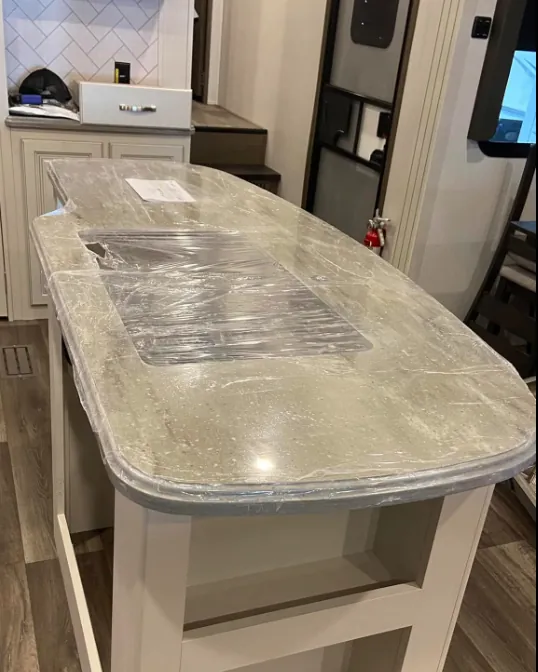
RV Countertop Replacement - Solid Surface, Sink Cutouts
Laminate lifting at the sink? We check the deck, then build a solid surface or laminate top with radiused cutouts. Mobile RV service in FL. 888-759-1438.
A failing RV countertop rarely stays cosmetic. Water works under the sink flange, the particleboard deck swells, and the top stops sitting flat on the cabinet run it is supposed to stiffen. RV countertop replacement means removing that deck, repairing the cabinet support under it, and fabricating a new top in solid surface, laminate or butcher block, with radiused sink and cooktop cutouts sized for a vehicle that flexes on every road.
What an RV Countertop Is, and What It Holds Together
An RV countertop is the horizontal deck that caps a galley cabinet run, and in most coaches it does more than hold a coffee pot. It is screwed or bonded to the cabinet cleats and stiles, and once fastened it ties the front rail to the back wall and helps keep that box square while the coach moves. Under the visible surface there is almost always a substrate. On a factory top that means a 3/4 inch particleboard or MDF deck with high pressure decorative laminate bonded to the face, a buildup strip glued under the front edge, and a postformed nose or an applied edge band. The sink and the cooktop then drop into openings cut through that deck. Those two openings remove more material than anything else on the top, and they are where failure begins. So a countertop is a semi-structural panel with two large holes in it, riding down the interstate at highway speed.
It Is Lifting by the Sink: What We Check, In Order
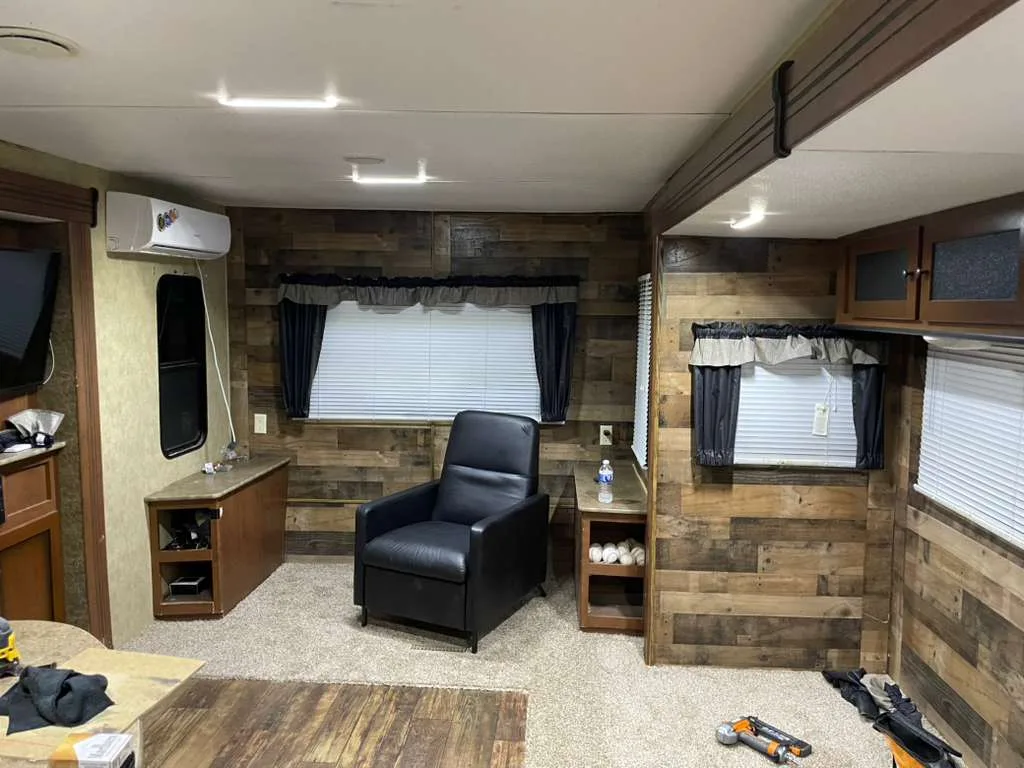
Owners describe this three ways. The laminate is bubbling or peeling along the sink edge, a dark line has opened at a seam, or the top feels soft when they lean on it. Our technicians start at the sink flange, because that is the path water takes into the deck. Check one is the bead. A drop-in sink set in silicone that has pulled loose leaves an open route to the raw cut edge of the particleboard, which was never sealed when the top was built. Check two is thickness. Digital calipers across a nominal 3/4 inch deck read measurably fatter within an inch or two of a wet cutout, and a pin-type moisture meter confirms the reading. That swelling is permanent, because the resin bond does not survive the fibers expanding. Check three is support. Cleats, fastener bite, the cabinet floor and the face frame all get probed for rot before any new top is priced.
What Each Finding Means, and What It Becomes If You Leave It
Those three checks sort the job into two outcomes, and the deck decides which one you are in. Thickness at the cutout is the measurement that separates them, not how bad the laminate looks from above. A failed sink bead caught early is a reseal and a couple of hours. A deck that has already swollen around the cutout ends the repair conversation, because swollen particleboard will not come back flat and fresh laminate bonded over a bulge telegraphs it straight through. Left alone the leak walks downhill. Water tracks the cut edge into the cabinet floor, the sink fasteners lose their bite and the bowl begins to drop, and the cabinet face and its hinges go after that. Florida coaches run year round with no winter lay up, so that progression is measured in months.
Granite and Quartz: The Upgrade That Cracks at the Cutout

Stone is the most requested upgrade and the wrong answer in most coaches. Weight is the obvious objection, since 3 cm granite runs roughly 17 to 18 pounds per square foot against about three for laminate over a particleboard deck, but weight is the second problem, not the first. The first is geometry. Corian Quartz's own fabrication fundamentals require a minimum of 2.5 inches of material all around a drop-in sink or cooktop cutout, 3.5 inches around an undermount bowl, 2.5 inches between adjacent cutouts, a minimum quarter inch inside radius with no square corners, and structurally sound full perimeter support beneath the slab. A galley top is commonly 22 to 25 inches deep and carries a 16 to 17 inch sink beside a cooktop in one run. Honor those margins and the layout stops fitting. Ignore them and a slab that cannot flex splits from a cutout corner.
Solid Surface, Laminate and Butcher Block: Where Each Belongs
Solid surface is the default answer for a coach. It is a filled acrylic or polyester sheet that can be seamed invisibly, thermoformed, and sanded back after damage, and a bowl can be bonded underneath so there is no exposed flange bead left to fail. Corian and HIMACS both behave this way. High pressure decorative laminate is the honest budget choice, and it is what most rigs left the factory wearing. Wilsonart's substrate bulletin states that laminate movement is humidity driven and that particleboard and MDF are recommended because they move at similar rates, which is also why a humid Florida summer swells the deck rather than the surface bonded to it. Butcher block suits a small coach and asks the most of the owner. It moves seasonally, wants oiling, and should never carry the sink cutout. Keep it for an island or a dinette side top away from standing water.
Cutouts, Edge Profiles and Templating Walls That Are Never Square
Every cutout corner is a stress riser, and in a vehicle it gets loaded thousands of times rather than never. DuPont specifies a minimum 3/16 inch (5 mm) inside corner radius for all cutouts in Corian solid surface, routed against a template guide with a 3/8 or 1/2 inch bit instead of sawn, and a larger radius carries stress better. A square jigsaw corner is the most common reason a new top splits inside a season. Edges absorb impact. A sharp arris chips on a knee or a hard cooler corner in transit, so an eased or radiused nose over a proper buildup strip survives where a crisp square one does not. Templating is the rest of the job. Coach walls bow, corners are rarely a true 90 degrees, and sidewalls lean, so the top gets scribed from a strip template built in place rather than measured with a tape.
Sources
Every figure on this page comes from a manufacturer document or a standards body, not from another repair site. Here is where each one comes from.
- Corian Solid Surface Fabrication Fundamentals: Cutting and Cutouts (DuPont / Corian Design)The minimum inside corner radius for all cutouts in Corian solid surface is 3/16 inch (5 mm), and cutouts are routed with a 3/8 inch (10 mm) or 1/2 inch (13 mm) bit against a 1 inch (25 mm) template guide rather than saw cut.
- Corian Quartz Design, Safety and Fabrication FundamentalsEngineered stone cutout rules: minimum 1/4 inch (6 mm) inside radii with no square inside corners or cross cuts, 2.5 inches (64 mm) of material around a drop-in sink or cooktop, 3.5 inches (89 mm) for an undermount bowl, 2.5 inches between adjacent cutouts, and structurally sound full perimeter support.
- Wilsonart Technical Bulletin: Substrate SelectionLaminate dimensional change is primarily humidity driven, particleboard and MDF are the recommended substrates because they move at similar rates, substrate thickness changes as its moisture content changes, and mismatched substrates produce warpage, stress cracking and open seams.
- RV Industry Association: adopted ANSI standards for RV constructionRV interior construction is governed by adopted ANSI consensus standards rather than residential kitchen practice, which is the basis for treating a coach top as a vehicle component.
Related repairs
Other systems we service
Where we work
Service category
What this usually costs
| Item | Price | What it covers |
|---|---|---|
| Service call | $299 | Includes the trip out to your RV and the first hour on site |
| Work past the first hour | Quoted after diagnosis | We tell you what it will take before we carry on |
| Parts | Quoted per job | Special-order parts may need a deposit before we order them |
| Written estimate | No charge | You approve the estimate before any work starts |
The service call covers the trip out to your RV and the first hour on site. Anything beyond that depends on what we find, and we quote it and get your approval before carrying on.
The price ranges on this page come from our own recent jobs across Florida, not from an industry average. What you pay depends on the rig, the parts it needs and what we find on site, so we give you a written estimate before any work begins and you approve it first.
Frequently asked questions
Can I put granite or quartz in my RV?
Rarely, and it is a bad trade in most coaches. Corian Quartz asks for 2.5 inches of material around a drop-in cutout, 3.5 inches around an undermount bowl, and structurally sound full perimeter support underneath. A 22 to 25 inch deep galley top with a sink next to a cooktop cannot honor those margins, so the slab cracks from a cutout corner.
Why is my RV countertop bubbling or lifting next to the sink?
Because the cut edge of the particleboard deck around the sink opening is raw, and a failed silicone bead lets water reach it. The core absorbs moisture, swells, and pushes the laminate up from underneath, which is what you feel as a bubble. Calipers across the deck near the cutout will read thicker than the same deck a foot away, and that swelling does not reverse when the coach dries out.
Can the countertop be replaced without pulling the sink and cooktop?
No. Both appliances sit in openings cut through the deck, so they come out before the old top does and go back after the new one is set and scribed. That is also the right moment to inspect the faucet supply connections, the drain trap, and the cooktop gas fitting, since all three are exposed once and would otherwise need a second visit to reach.
What does RV countertop replacement cost?
Our service call covers the trip out and the first hour on site at the rate in the pricing table on this page; anything past that first hour is quoted and approved before we carry on. Material and fabrication are quoted separately after the top is measured, because depth, cutout count, edge profile and material all move the number. We do not quote a fixed price on a top nobody has seen yet.
How long is my galley out of service?
A straight laminate top is commonly a single visit once the material is on hand. Solid surface usually runs longer, because a template is built in the coach, the top is fabricated off site, then set, seamed and scribed on a second visit. Any rot found in the cabinet cleats or the cabinet floor adds time, since that repair has to cure before a new deck is fastened to it.
Is butcher block a good countertop for an RV?
It works away from water and it is a poor choice at the sink. Wood moves with humidity, and a Florida coach that never gets a winter lay up keeps it moving all year, so it needs periodic oiling and it will open at glue joints if neglected. Use it for an island, a coffee bar or a dinette side surface, and put solid surface or laminate where the bowl and the cooktop live.