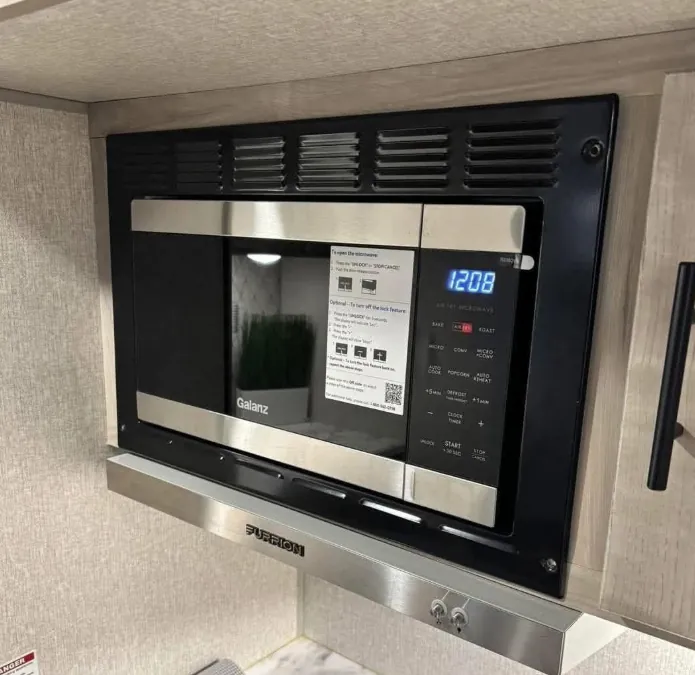
RV Convection Microwave Replacement and Cabinet Cutout Fit
Swapping a convection microwave is a cabinet and power job, not an appliance purchase. We measure the opening, circuit and vent path. Call 888-759-1438.
A dead microwave in a coach stops being a microwave problem the moment the old one comes out. The opening left behind decides the job, and a unit that clears the hole can still fail on depth, on trim flange coverage, or on the circuit feeding it. Replacement is a cabinet and power question first. Measure the cutout, the cabinet depth and the branch circuit before anyone buys an appliance.
What Owners Describe Before a Microwave Gets Replaced
Almost nobody calls and says the magnetron is done. The description is usually that the turntable spins and the plate stays cold, that the vent fan runs on its own after the door closes, that there is arcing inside when anything metal-trimmed goes in, or that the breaker drops the moment the roof air compressor kicks on while something is cooking. Those four symptoms live in three different systems, and only one of them is the appliance. A cold plate with a lit display is a high voltage or interlock fault inside the oven. Arcing is more often a burnt splash shield than a dead oven, and that mica sheet is a listed replaceable part on the Greystone 1.1 cubic foot convection unit. A fan that will not stop is a control board or a stuck thermostat. A tripping breaker is not a microwave fault at all, and swapping the appliance will not fix it.
The Order We Check, and What Each Finding Means

Power gets confirmed before anything comes off the wall. Our technicians read the outlet in the cabinet above the unit under load rather than at rest, because a tired shore cord or a loose neutral shows up as sag under 12 amps and looks fine on an unloaded meter. Next is the door: the interlock switches and latch are cheap, and a bent door or a loosened hinge is a safety condemn on any microwave oven. Then the split test, which decides the whole job. If the unit heats on microwave but not on convection, the convection element or its thermostat is at fault and the cabinet never has to be touched. If neither mode heats, the repair is high voltage work on a unit that is usually past warranty. That split is also what decides whether the cabinet gets opened at all, which is the difference between an hour at the wall and a two-person removal with the mounting plate coming off behind it.
The Cabinet Opening Decides This Job, Not the Appliance
Over-the-range units are hung, not dropped in, and the mounting geometry is unforgiving. Furrion's installation manual for its 1.5, 1.6 and 1.7 cubic foot OTR ovens calls for a 30 inch wide space between cabinets free of obstructions, 66 inches or more from the floor to the top of the oven, and 30 inches minimum above the cooking surface. The unit hangs on a steel mounting plate anchored with at least one wood screw into a stud plus two 3/16 by 3 inch toggle bolts, then pulls up tight to the cabinet bottom with three self-aligning machine screws. If cabinet depth including the doors exceeds 13 inches, the manual requires the oven to be spaced off the wall on material rated to carry 150 pounds so the top vent can still breathe. A stud finder and a level do more to scope this job than any parts catalog.
Trim Kits, Built-In Cutouts, and Where a Residential Unit Fails
Built-in convection ovens are a different animal from over-the-range units, and this is where the swap goes wrong. The Greystone 1.1 cubic foot convection oven, model D100N30ASPRIII-B5-FR01, measures 21 by 11 by 15 3/4 inches as a bare body and 24 1/4 by 18 1/4 by 15 3/4 inches once its trim is fitted, and the trim kit is not included. So the hole in the face frame is not the spec that matters. The trim flange is what hides the gap, and a residential unit whose body slides into the same opening will leave a bare edge because its kit is built for a 24, 27 or 30 inch residential cabinet. Depth kills more of these than width does. That body is nearly 16 inches deep and weighs about 41 pounds, and RV upper cabinets are frequently shallower than the residential boxes the appliance was drawn for.
Power Draw and Why a 30 Amp Coach Fights Back
The nameplate cooking wattage is not the number that matters. Furrion rates its OTR ovens at 120 VAC, 60 Hz, 15 amps maximum, 1550 watts, and requires a dedicated 15 or 20 amp branch circuit with the outlet box in the cabinet above. The FMCM15-BL spec sheet is blunter still: 900 watts rated output, 1500 watts rated input on microwave, 1450 watts on convection. The Greystone 1.1 cubic foot unit pulls 1500 watts on microwave, 1600 watts on convection and 1250 watts on grill. A 30 amp coach has 3,600 watts total. A Dometic Brisk II Evolution 15,000 BTU rooftop unit is rated at 13.3 compressor amps, so 13.3 amps of that service is gone before the kitchen wakes up. Add a 12.9 amp convection cycle and the coach sits near 28 of its 30 amps with the water heater element still waiting its turn.
Recirculating Versus Vented, and What Each One Costs a Coach
These ovens ship assembled for recirculating, which means the blower pushes cooking air through a charcoal filter and back into the room. Converting to true outside exhaust is not a switch, it is a teardown: the exhaust adapter moves to the top or the rear, the blower plate gets checked, and a hole gets cut. Furrion's adapter mates to standard 3 1/4 by 10 inch rectangular duct, or 5 or 6 inch round through a transition, and total equivalent duct length must not exceed 120 feet. That budget goes faster than it reads. A wall cap alone counts as 40 equivalent feet and each 90 degree elbow counts as 10, so a short real-world run is often already half spent. Furrion also cautions that an exhaust adapter positioned outside the recommended dimension will discharge grease-laden air into the structure, which in a coach means into the wall cavity.
Florida Heat, Generator Power, and What Leaving It Costs
A convection cycle is a 1,450 to 1,600 watt heater running inside a sealed box, and in August that fights the roof air directly. Dometic's own installation manual lists avoiding heat producing appliances alongside shading and closing windows as ways to cut heat gain when outdoor temperatures are extreme. The same manual sets a 3.5 kW minimum generator for a single 15,000 BTU unit, so a 3,600 watt portable already running the air has almost nothing left for a convection bake. Shore power at a 30 amp pedestal has the same ceiling. Left alone, a dead unit is still 40 pounds hanging on a plate, and road vibration works the mounting screws until the cabinet bottom sags. An exterior vent cap whose damper no longer swings free is also an open door for pests through humid storage. Apex does not do tires and does not do chassis work.
Sources
Every figure on this page comes from a manufacturer document or a standards body, not from another repair site. Here is where each one comes from.
- Furrion 1.5, 1.6 and 1.7 cu.ft. OTR Microwave Oven Installation Manual (CCD-0006072)30 inch mounting width, 66 inch floor to top of oven, 30 inch clearance above the cooking surface, 13 inch recirculating and 14 inch exhaust cabinet depth limits, 150 pound spacing requirement, mounting plate with stud screw and 3/16 by 3 inch toggle bolts, 120 VAC 60 Hz 15 amp max 1550 watt rating on a dedicated 15 or 20 amp branch circuit, ships assembled for recirculating, 3 1/4 by 10 inch exhaust adapter, 120 equivalent foot duct budget with a wall cap at 40 feet and a 90 degree elbow at 10 feet, and the grease-laden air caution
- Furrion FMCM15-BL 1.5 cu.ft. OTR Convection Microwave Oven Spec Sheet (MS-FMCM15-BL-V.1.4)900 watts rated output power, 1500 watts rated input power on microwave, 1450 watts rated output on convection, 120V/60Hz supply, two-speed 300 CFM venting and the 29 15/16 by 16 1/2 by 15 inch product size
- Greystone 1.1 cu.ft. Convection Microwave Oven Troubleshooting and Service Manual (CCD-0007856)D100N30ASPRIII-B5-FR01 power consumption of 1500 watts microwave, 1600 watts convection and 1250 watts grill, 15 or 20 amp dedicated circuit requirement, 24 3/16 by 18 1/8 by 15 9/16 inch outside dimensions, 41 pound net weight, and the replaceable part numbers for the splash shield mica sheet, roller assembly, glass turntable, upper exhaust guide and lower air duct
- Greystone by Furrion 1.1 cu.ft. Convection Microwave, model D100N30ASPRIII-B5-FR01Body dimensions of 21 by 11 by 15 3/4 inches without trim versus 24 1/4 by 18 1/4 by 15 3/4 inches with trim, 120V AC operation, 41 pound weight, and the statement that the trim kit is not included
- Dometic Brisk II Evolution 15,000 BTU Installation and Operating Instructions (Form 3315386.000)13.3 compressor rated load amps and 2.0 fan motor rated load amps at 120 Vac, the 3.5 kW minimum generator size for a single unit, and Dometic's heat gain guidance to avoid using heat producing appliances during extremely high outdoor temperatures
Related repairs
- Rv Washer Dryer Install repairs
- Norcold Cooling Unit Replacement
- our Dometic Fridge Board Repair service
Other systems we service
Where we work
Service category
What this usually costs
| Item | Price | What it covers |
|---|---|---|
| Service call | $299 | Includes the trip out to your RV and the first hour on site |
| Work past the first hour | Quoted after diagnosis | We tell you what it will take before we carry on |
| Parts | Quoted per job | Special-order parts may need a deposit before we order them |
| Written estimate | No charge | You approve the estimate before any work starts |
The service call covers the trip out to your RV and the first hour on site. Anything beyond that depends on what we find, and we quote it and get your approval before carrying on.
The price ranges on this page come from our own recent jobs across Florida, not from an industry average. What you pay depends on the rig, the parts it needs and what we find on site, so we give you a written estimate before any work begins and you approve it first.
Frequently asked questions
Can I put a residential over-the-range microwave in my RV?
Sometimes, because the 30 inch mounting width is shared with residential kitchens. The failures are depth, weight and vibration. Furrion caps cabinet depth at 13 inches for a recirculating install and requires spacing rated to 150 pounds beyond that, and RV uppers are often shallower than residential boxes. A residential unit also has no vibration rating, so hinges, turntable couplers and door latches take road load they were never drawn for.
Why does my breaker trip when the microwave and the air conditioner run together?
Because the arithmetic does not work. A 30 amp coach is 3,600 watts total. A Dometic Brisk II Evolution 15,000 BTU rooftop unit is rated at 13.3 compressor amps plus a 2.0 amp fan, and a Furrion OTR oven is rated 15 amps maximum at 1550 watts. That combination sits near 28 amps before the converter, the water heater element or a residential refrigerator conversion is counted. Swapping the microwave will not change it.
Do I need a trim kit, and is it included?
For a built-in cutout, yes, and usually no. The Greystone 1.1 cubic foot convection oven is 21 by 11 by 15 3/4 inches bare and 24 1/4 by 18 1/4 by 15 3/4 inches with its trim fitted, and the listing states the trim kit is not included. The trim is what covers the gap between the appliance body and the face frame, so a body that fits the hole can still leave a raw edge if the kit does not match.
Should the microwave vent outside or just recirculate?
Recirculating is how these units ship, and in most coaches it stays that way. True outside exhaust needs the adapter relocated, a hole cut, and a duct run inside a 120 equivalent foot budget in which a wall cap counts as 40 feet and each 90 degree elbow counts as 10. Vented is better for steam and grease. It also adds a roof or sidewall penetration to seal and inspect.
How long does a convection microwave swap take and what does it cost?
A like-for-like over-the-range swap into an existing 30 inch space is a same-visit job for two people, since the oven hangs on a mounting plate and pulls up to the cabinet. Cabinet modification, new trim or a vent conversion adds time and is quoted after we see the opening. The service call covers the trip out and the first hour on site, and anything past that first hour is quoted once the diagnosis is in and approved before we carry on.
Can I run a convection microwave on my generator?
On microwave, usually. On convection while the air conditioner runs, often not. Dometic sets a 3.5 kW minimum generator for one 15,000 BTU rooftop unit, and a convection element pulls 1,450 to 1,600 watts on top of that. A 3,600 watt portable will either brown out or drop the load. Running convection with the roof air cycled off is the practical workaround, which in a Florida August is its own problem.