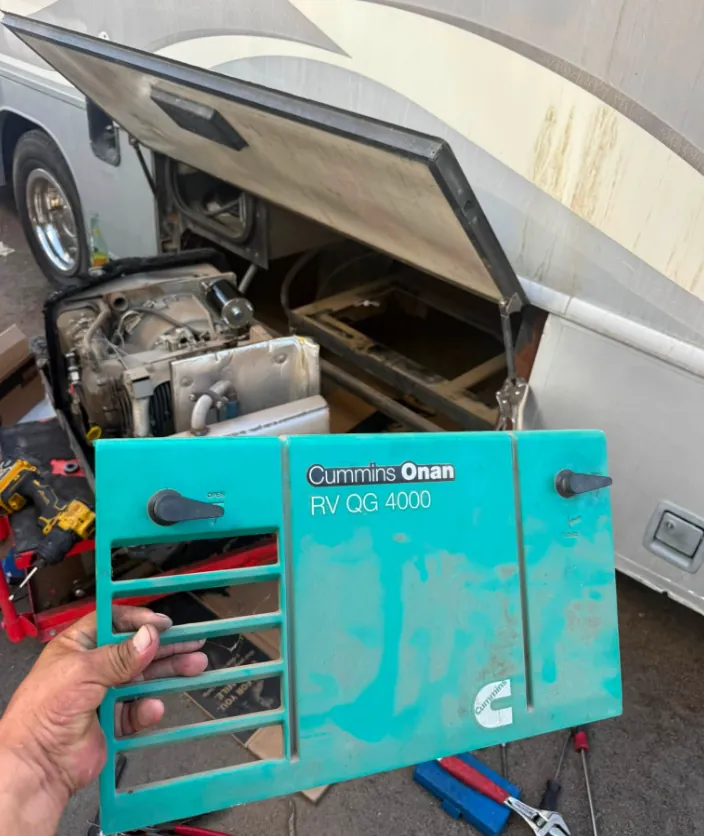
Onan Generator Service - QG and Marquis Repair in Florida
Onan QG and Marquis generator service anywhere in Florida. Mobile diagnosis, carburetor, brushes, oil and annual service. Call 888-759-1438.
Owners usually call us saying the generator cranks but will not stay running, or that it starts and then drops the air conditioning. On an Onan QG or Marquis set that is almost always a fuel, ignition or output fault rather than a dead generator. Our technicians diagnose it on site anywhere in Florida, working from fuel quality and the carburetor through the start/stop control to AC output at the brushes and slip rings.
Can you fix a generator that won't run?
That is the call we take most often, and on an Onan QG or Marquis set it rarely means the generator is finished. A no-run splits into three buckets - no crank, cranks but never fires, or fires and dies within a few seconds - and our technicians separate them in the first minutes because each one sends the job somewhere different. No crank points at the starting battery, the start solenoid or the start/stop control, and on most coaches the genset cranks off the chassis battery rather than the house bank, so a healthy inverter display tells you nothing. Cranks but never fires points at fuel delivery, the fuel pump or ignition. Fires and dies in about five seconds is the classic stale-fuel signature: the float bowl holds just enough to catch, then a varnished main jet cannot keep up. After any fault shutdown, holding the stop switch makes the panel lamp blink a fault code, which narrows it before a panel comes off.
Why Onan sets fail after a summer sitting still
Pump gasoline here is normally E10, and ethanol is hygroscopic - it pulls moisture out of humid tank air. Left past roughly three months it can phase separate, dropping a water and alcohol layer to the bottom of the tank and leaving the fuel above it short of the light fractions the engine needs to start. What stays behind in the carburetor is worse: gum and varnish that glaze the main jet, the idle circuit and the float needle seat, which is why a generator that ran fine in April cranks all day in September. The other half of our work is the opposite. Coaches that live here full time never get a winter lay-up, so hours accumulate all year with no natural service window, and oil, brushes and the spark arrestor quietly pass their intervals. Cummins Onan asks for the set to be exercised about two hours a month at half its rated load, and that habit alone prevents most of what we get called for.
"I have a little problem with it": our diagnostic order
We work the same sequence every time, cheapest and most likely first. Fuel level comes before anything, because the generator's pickup tube is deliberately set higher in the tank than the chassis engine's, so an Onan shuts down at around a quarter tank by design and the owner is not broken at all. Next is the blinked fault code, then engine oil level, since the low oil pressure switch will stop the set and hold it stopped. Then comes fuel delivery at the pump and the carburetor bowl, which we drain to look for water and varnish, followed by spark at the plug. Only then do we go electrical: no-load AC output on a Fluke 87V multimeter, where we expect roughly 120 to 126 volts and about 60 to 62 hertz. Frequency gets read before voltage, because it reports engine speed, and speed and output are two different repairs.
Can you change the oil on our generator?

Yes, and on these sets it is the service that buys the most life for the least money. These sets hold only 1.6 to 2 quarts depending on model, so a neglected one runs low quickly and trips its low oil pressure shutdown. In Florida heat our technicians normally fill with 15W-40. The same visit covers the air filter, the spark plug, which Cummins Onan gaps at 0.025 in, and the spark arrestor screen, which loads up with carbon and chokes the exhaust long before anyone notices. Onan's periodic maintenance schedule puts the oil change, the air filter element and the spark arrestor cleanout on a 150 hour cycle, and a coach that never lays up for winter reaches that mark on the hour meter long before the calendar suggests it should. The arrestor itself is not a teardown either. Two cleanout plugs come out of a cooled muffler, the set is run briefly to blow the carbon clear, and the plugs go back in.
Brushes, slip rings and no AC output
When the engine runs perfectly but nothing comes out of the outlets, the fault is usually in the generator end, not the engine. Two carbon brushes ride on the rotor's slip rings and carry the field current, and as they wear they shorten, lose spring pressure and shed conductive dust that bridges the rings. Our technicians pull the brush block, measure remaining brush length against the wear line, check that the springs still load them squarely, and read rotor resistance across the slip rings to prove the field winding is neither open nor shorted. Grooved or glazed rings get polished with crocus cloth, never emery, because aluminum oxide grit embeds in soft slip-ring metal and destroys the next set of brushes. On most Class A and C coaches the genset has to come out on its slide tray first - four mounting bolts, the fuel line and the harness - which is why this is a two to four hour job, not a thirty minute one.
Service, rebuild or replace: how we decide
We give the honest answer, because a rebuild sold on a worn-out block helps nobody. If the hour meter is low, compression is healthy and the set has simply been sitting, it is a service: clean or replace the carburetor, fresh fuel, oil, filters and plug. If the engine is sound but the fuel pump, carburetor and brushes have all reached the end together, a staged rebuild is usually worth it, since those parts typically run from around $40 to $90 for a brush kit, $60 to $400 for a carburetor depending on aftermarket or OEM, and $120 to $250 for a fuel pump. Replacement is the call when compression is down, the set burns oil, or the repair total starts approaching what a new 4 kW unit costs installed. Left alone, a varnished carburetor becomes a burnt exhaust valve, and worn brushes become scored slip rings and a rotor, which is a cheap part turning into an expensive one.
Sources
Every figure on this page comes from a manufacturer document or a standards body, not from another repair site. Here is where each one comes from.
- Cummins Onan operator manual, RV generator set KY series (Spec J-N), publication 981-0159The specifics of the 4 kW gasoline set: a 4,000 watt, 120 volt, 60 Hz rating; 1.6 quart oil capacity; a 0.025 inch spark plug gap; the 'Every 150 Hours' line of the periodic maintenance schedule; and the spark arrestor cleanout procedure. The same manual carries the note under the over-crank and engine-stopped fault codes that the genset fuel pickup tube is higher up in the fuel tank than the vehicle engine pickup, which is the basis for the quarter-tank shutdown described in the diagnostic order.
- Cummins Onan operator manual, RV generator set HGJAA and HGJAB (A035D009)The exercise and fault-reading claims: exercise the set at least two hours a month at approximately half rated power, stated as better than several shorter periods; 15W-40 listed among the recommended oils; the low oil pressure shutdown; the carburetor float bowl drain valve; and the two-digit fault code flashed on the status indicator, read by pressing STOP/PRIME after a fault shutdown.
- Cummins Onan operator manual, RV Quiet Diesel generator set HDZAA (Spec A-E), publication 983-0103The Quiet Diesel leak answer: the maintenance schedule includes fuel filter replacement and a fuel injector pressure check, and the manual instructs the owner to check for leaks at hose, tube and pipe fittings in the fuel supply system both while the set is running and while it is stopped, which is the method described on this page for finding the source rather than guessing from the puddle.
Related repairs
- Cummins Generator Board Repair
- our Generator Fuel System Rebuild service
- Generator Auto Start Install in Florida
Other systems we service
Where we work
Service category
What this usually costs
| Item | Price | What it covers |
|---|---|---|
| Service call | $299 | Includes the trip out to your RV and the first hour on site |
| Work past the first hour | Quoted after diagnosis | We tell you what it will take before we carry on |
| Parts | Quoted per job | Special-order parts may need a deposit before we order them |
| Written estimate | No charge | You approve the estimate before any work starts |
The service call covers the trip out to your RV and the first hour on site. Anything beyond that depends on what we find, and we quote it and get your approval before carrying on.
The price ranges on this page come from our own recent jobs across Florida, not from an industry average. What you pay depends on the rig, the parts it needs and what we find on site, so we give you a written estimate before any work begins and you approve it first.
Frequently asked questions
Do you work on RV generators and ACs?
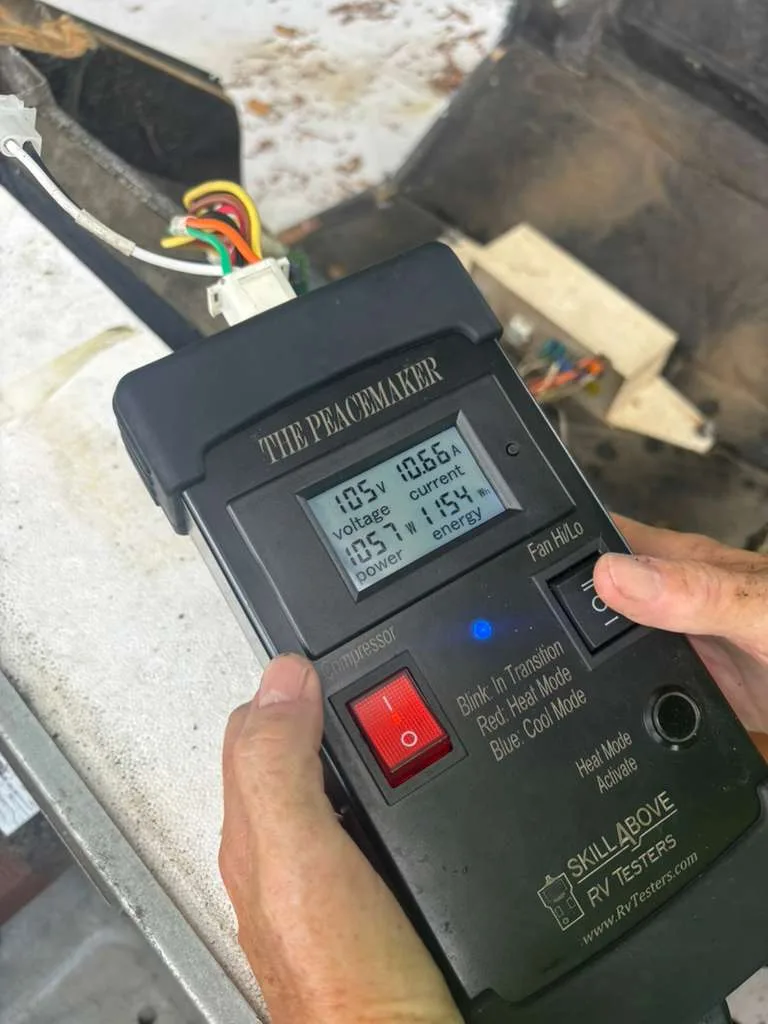
Yes, both, and often on the same visit. Our technicians service Onan QG and Marquis gas sets and Quiet Diesel units, and we also handle rooftop air conditioners, which matters because the two faults look identical from the driver's seat. A generator that will not carry the air conditioner can be a weak genset, a failing AC compressor or a soft-start problem, and testing both together is the only way to know which one you are actually paying to fix.
Can you replace an RV generator fuel pump?
Yes. On Onan QG sets the electric fuel pump is a common failure, and the symptom is usually cranks but never fires, or runs for a minute then quits as the bowl empties. We confirm it before replacing it by listening for pump click at the start command and testing delivery, because a varnished carburetor produces the same symptom.
Could I pay you to bench test a generator?
We do test loose and removed sets, and we will tell you up front when it is worth the money. A bench test shows whether the engine runs and whether it makes rated voltage and frequency, but it will not reproduce faults that only appear under real load in the coach. If the set is still in the RV, testing it in place with a load applied gives a far more useful answer for the same money.
Can you repair a diesel generator leak?
Usually yes. On Onan Quiet Diesel sets most leaks we find are fuel return lines, injector seals, the fuel filter head or the lift pump, and oil leaks tend to be the filter adapter or a valve cover gasket. We locate the source by cleaning the area, running the set and watching where it wets, rather than guessing from where the puddle lands. Leaks left alone soak the sound insulation, which becomes a fire concern as well as a repair.
How much does Onan generator service cost in Florida?
Our service call covers the trip out and the first hour on site at the rate in the pricing table on this page; anything past that first hour is quoted and approved before we carry on. We will not quote a fixed price for a generator we have not seen, because a set that needs a carburetor and a set that needs a rotor sound identical on the phone.
How often should an Onan QG be serviced if I use it year-round?
Plan on oil and filter every 150 run hours or annually, air filter and spark plug on the longer interval, and a look at the brushes and spark arrestor screen once a year. Florida coaches that never lay up for winter reach those hour marks faster than the calendar suggests, so we go by the hour meter, not the season. Exercising it about two hours a month at half load is the cheapest maintenance there is.