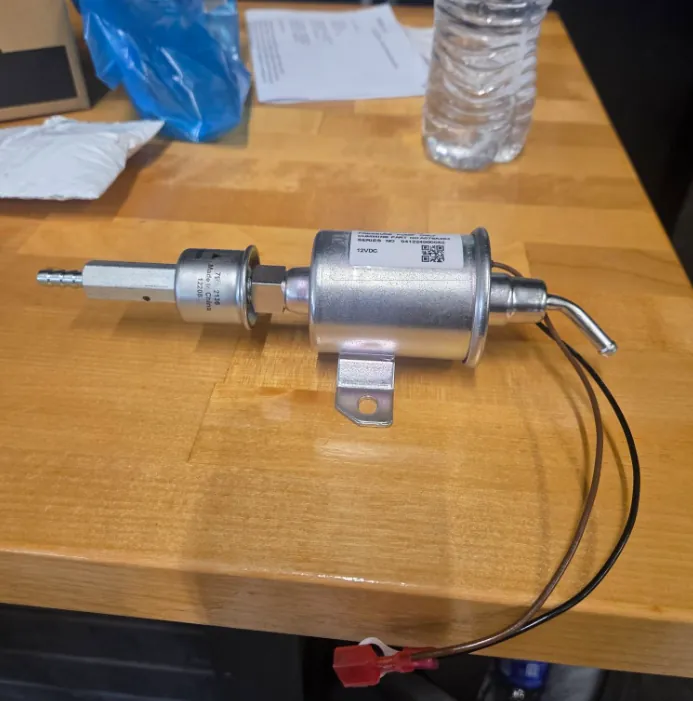
RV Generator Fuel System Rebuild - Pump, Carb and Filter
Ethanol-damaged RV generator fuel pump, carburetor and filter rebuilt on site anywhere in Florida. Honest rebuild-or-replace advice. Call 888-759-1438.
A generator fuel system rebuild is the cheap half of a fork every owner eventually reaches: rebuild the fuel side for a few hundred dollars, or replace the whole set for thousands. Compression and the hour meter decide which, not the no-start itself. When the engine is mechanically sound and the only damage is ethanol varnish in the carburetor, fuel pump and filter, rebuilding is almost always the right money.
Why a genset that ran last season will not start now
Pump gasoline here is E10, and ethanol pulls water vapor straight out of humid tank air. Once the fuel holds more water than the alcohol can carry in solution it phase separates: a heavy water and ethanol layer settles on the bottom of the tank, exactly where the generator pickup tube draws from, and the petrol floating above it has lost the light ends an engine needs to catch. That is the chemistry. The damage is what follows it. Whatever fuel is left in the carburetor bowl evaporates across a summer and leaves gum and varnish behind, glazing the main jet, the idle circuit and the float needle seat with a hard amber film that fresh fuel will not redissolve. The separated water layer meanwhile corrodes the aluminum bowl casting and the steel outlet fitting on the fuel pump. A coach closed up in May and opened in November has given all three failures about six months to happen together.
The order a fuel-side no-start gets worked

The set that cranks strongly and never fires is the classic ethanol case, and on Onan HGJAA and HGJAB controls it logs Code 4, Over Crank, which the manual defines as cranking that ran past 30 seconds without the engine starting. That code points at fuel, not electrics. First comes a bowl sample: the drain valve on the float bowl gives up less than half a cup into a glass jar, and if that sample shows two layers with a cloudy band between them, the tank is contaminated and no carburetor work will fix it until the tank is emptied. Next is delivery, holding STOP/PRIME for 30 seconds to run the pump and reading pressure on an inline gauge teed in ahead of the carburetor. A pump that clicks but will not build pressure has usually corroded internally. Last come the filter and the jets, because a starved carburetor and a blocked one produce an identical symptom from the driver seat.
What a fuel pump and carburetor rebuild involves
The filter goes first because it is cheapest and it protects everything downstream. On gasoline HGJAA and HGJAB sets that is Onan part 0149-2341-01, which unscrews directly from the fuel pump body rather than sitting inline, and the EFI sets take 0147-0860 instead. Cummins schedules it every 500 hours or once every three years, whichever lands first. After fitting one, the engine has to be primed for at least 30 seconds to fill the new filter before it will run cleanly. The carburetor then comes off the intake and gets stripped to the casting. Brass jets and the emulsion tube go into an ultrasonic cleaner, because varnish sits inside passages too fine to reach mechanically, and a torch tip cleaner clears the idle port without enlarging it. Drills are never used on a jet. The float needle, seat, bowl gasket and bowl O-ring are replaced as a set from the rebuild kit.
Draining is not the same as stabilizing
Cummins Onan asks for storage preparation when the set will sit unexercised for more than 120 days. A Florida snowbird absence from May to November runs about 180, so the coach clears that threshold by roughly two months and the requirement stops being optional advice. The step almost everyone misses is not the additive itself. After stabilizer goes into a full tank, the manual calls for running the set about 30 minutes plus two minutes for every foot of fuel line, at roughly half rated power, so that treated fuel actually displaces the untreated fuel already sitting in the line, the pump and the bowl. Pouring stabilizer in and shutting the door leaves raw E10 in every component that varnishes. Draining alone is no better by itself: an empty carburetor still leaves a residue film, and an empty steel tank invites condensation and rust across a humid summer.
Rebuild, replace, or fill it with ethanol-free
Ethanol-free 90 octane, sold around Florida marinas and boat ramps as rec-90, clears the 87 AKI minimum Cummins specifies and removes the water-absorption problem entirely. It costs more per gallon, and a generator burns few enough gallons that the premium is trivial next to a carburetor. For a set already damaged, the arithmetic is simple. A rebuild kit is usually well under $100, a replacement fuel pump typically $120 to $250, an OEM carburetor assembly typically $250 to $400. Replacing the whole set only wins when compression is down or the engine burns oil. Left alone, varnish leans the mixture until a burnt exhaust valve turns a fuel job into an engine job.
Which of the three applies is a compression and hours question, and it is answered before any quote rather than after. An owner should be told which of those three they are buying, and why, before a carburetor comes off.
Sources
Every figure on this page comes from a manufacturer document or a standards body, not from another repair site. Here is where each one comes from.
- Cummins Onan operator manual, RV generator set HGJAA (Spec J-K) and HGJAB (Spec J-L), publication A035D009Every Onan-specific number on this page: the 87 minimum Anti-Knock Index and the 'not more than 10% ethanol' fuel recommendation; gasoline fuel filter 0149-2341-01 and EFI fuel filter 0147-0860, and the instruction to unscrew the filter from the fuel pump; the 500-hour or three-year filter replacement interval; priming for at least 30 seconds after fitting a filter; Code 4 Over Crank, defined as cranking that exceeded 30 seconds without the engine starting; the 120-day storage preparation threshold; the instruction to run the set about 30 minutes plus 2 minutes per foot of fuel line at approximately half rated power after adding a preservative; the carburetor float bowl drain valve and its less than half a cup of drainage; and the notice that without a stabilizer the gasoline deteriorates into fuel system corrosion, gum formation and varnish-like deposits.
- US EPA, Ethanol Waivers (E15 and E10), Gasoline StandardsThat E10 is the default pump fuel a Florida owner will put in a generator. EPA states that a 1978 Clean Air Act waiver allowed the use of 10 volume percent ethanol in gasoline, and that today almost all gasoline sold is an E10 blend, which is why ethanol exposure is treated here as the normal case rather than the exception.
- Briggs & Stratton, fuel recommendations for small enginesThe small-engine side of the same problem, independent of Onan: that fuel can begin to deteriorate in as little as 30 days, that a fuel stabilizer is used specifically to prevent carburetor gumming and varnishing during storage, and that gasoline containing up to 10 percent ethanol is acceptable while E15 is not recommended or approved for small engines. This backs the FAQ answer that stabilizer is preventive rather than curative.
Related repairs
- Generator Auto Start Install in Florida
- how we handle onan generator service
- Cummins Generator Board Repair repairs
Other systems we service
Where we work
Service category
What this usually costs
| Item | Price | What it covers |
|---|---|---|
| Service call | $299 | Includes the trip out to your RV and the first hour on site |
| Work past the first hour | Quoted after diagnosis | We tell you what it will take before we carry on |
| Parts | Quoted per job | Special-order parts may need a deposit before we order them |
| Written estimate | No charge | You approve the estimate before any work starts |
The service call covers the trip out to your RV and the first hour on site. Anything beyond that depends on what we find, and we quote it and get your approval before carrying on.
The price ranges on this page come from our own recent jobs across Florida, not from an industry average. What you pay depends on the rig, the parts it needs and what we find on site, so we give you a written estimate before any work begins and you approve it first.
Frequently asked questions
Can you replace an RV generator fuel pump?
Yes, and it is one of the most common parts replaced on a fuel-side no-start. Our technicians confirm the pump is the fault first, by holding STOP/PRIME to run it and reading delivery pressure on a gauge, because a varnished carburetor produces the same cranks-but-never-fires symptom for a fraction of the cost. On gasoline Onan sets the fuel filter threads directly into the pump body, so the filter gets replaced at the same time as a matter of course.
Will fuel stabilizer fix a generator that already will not start?
No. Stabilizer is preventive chemistry: it slows the oxidation that creates gum and varnish, but it cannot dissolve deposits that have already hardened inside the jets and the float needle seat. It also does nothing about water that has already separated out in the tank. Once a set has sat through a Florida summer untreated and will not fire, the bowl has to come off and the passages have to be cleaned physically.
Is ethanol-free gas worth it for an RV generator?
For a generator, more so than for the chassis engine. A genset burns roughly half a gallon an hour, so a season of use is a handful of gallons and the price premium on rec-90 costs less than a single bowl gasket. Removing ethanol removes water absorption, phase separation and the varnish that follows, which is the failure behind most seasonal no-starts. Ethanol-free 90 octane also clears the 87 octane minimum Cummins requires.
How long does a fuel system rebuild take on site?
Plan on two to four hours for a full job on a slide-out mounted set. The carburetor strip and ultrasonic clean is the slow part, and pulling the genset out on its tray to reach the fuel pump adds time on many Class A and Class C coaches. A filter and pump swap on its own is usually inside two hours. A contaminated tank changes the picture entirely, because the tank has to be drained before anything downstream is worth doing.
Should I drain the generator before we head north for the summer?
Drain the carburetor float bowl, yes, using its drain valve. Do not drain the tank and leave it empty, because an empty steel tank breathes humid air all summer and rusts. Fill it instead, add stabilizer, then run the set about 30 minutes at half load so treated fuel reaches the lines, pump and bowl. Draining the bowl and stabilizing the tank are two different jobs and the set needs both.
How do I know it is the fuel system and not the control board?
The split is usually clean. Strong steady cranking with no fire, or a start that dies within seconds, is a fuel fault and belongs on this page. A dark panel, no crank at all, or a set that runs while the control reports nonsense is a control fault, covered on our Cummins generator board repair page. Brushes, slip rings, oil and annual service sit on our Onan generator service page.