Fifth Wheel Landing Gear Repair: Stripped Gears, Bent Legs
One landing leg down and one stuck, or a motor that spins with no movement? Mobile fifth wheel landing gear diagnosis across Florida. Call 888-759-1438.
Fifth wheel landing gear is the pair of electric screw jacks under the front overhang that carries the pin weight the moment the truck pulls away. It is not part of the leveling system. There is no level sensor and no control board behind it, only a drive motor, a reduction gearbox on the lead leg and a cross shaft that turns the follow leg. Lippert rates its universal electric unit at 6,000 pounds.
Landing Gear Is Not Part of Your Leveling System
Landing gear is the two front legs that hold a fifth wheel up once the hitch is released, and on most trailers it is a purely mechanical screw jack pair. A 12 volt drive motor bolts to a reduction gearbox on the lead leg, and a cross shaft carries that same rotation across to the follow leg. That is the entire system. There is no level sensor, no control board and no hydraulic pump anywhere in it. Auto leveling systems such as Lippert Level-Up, HWH and BAL sit behind their own controllers on a separate circuit, which is why a dark touchpad tells you nothing about landing gear that refuses to run. Lippert's install manual feeds the landing gear switch straight from the battery through a 30 amp fuse, and rates the universal electric unit at 6,000 pounds. Owners who assume the two systems share wiring usually chase the wrong box first.
The Cross Shaft Is What Keeps Both Legs in Step
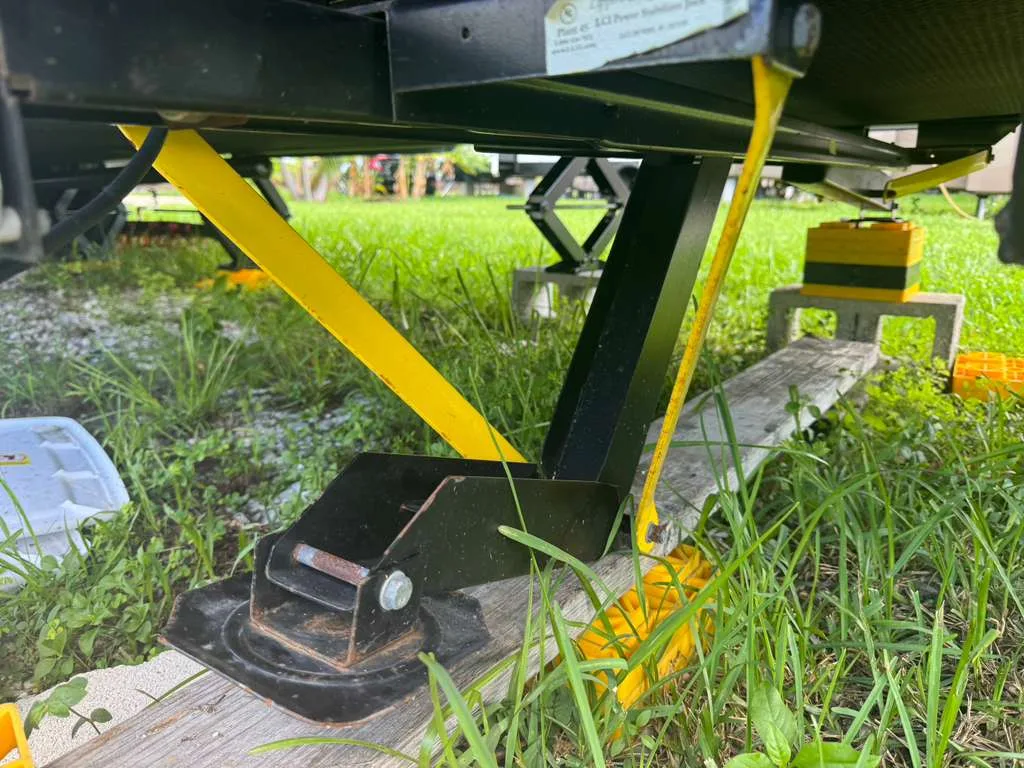
The cross shaft is a telescoping two piece rod, listed by Lippert as cross shaft kit 156842 with an inner and an outer half, and it is the only thing making the follow leg move when the gearbox turns. It is retained with quarter inch hardware: cross shaft nut 135829 and bolts 136375 and 157754, all 1/4-20. Lippert's install manual insists both legs be mounted at exactly the same height with their connecting rods directly across from each other, because any misalignment loads that shaft in bending every time the legs run. When a retaining bolt shears or the shaft ends round out, the lead leg keeps driving and the follow leg stops dead. The owner sees one side dropping and the other frozen, and the trailer starts racking diagonally. Stop at that point. Another thirty seconds of switch time puts the whole pin weight onto one leg.
The Gearbox Is Where This System Usually Fails
The reduction gearbox is a small bevel gearset that turns motor speed into the torque needed to lift several thousand pounds, and it is the most common failure point on electric landing gear. Water finds the housing, the grease thins and washes out, and the gear teeth round over under load. The symptom is unmistakable: the motor runs, the trailer does not move. Lippert now lists the aluminum gear box 276602, which supersedes both the older Venture standard gear box 143780 and the universal fit gear box 179015, so a replacement housing today is not the same part that came off. Splitting motor from gearbox takes about five minutes. Fit the manual crank handle 119226 onto the override shaft and turn it. If the leg walks, the gearset is sound and the fault is motor, switch or supply. If the shaft spins freely with no leg movement, the gears are gone.
Sandy Ground, Full Extension and a Bent Inner Leg

Sand, shell fill and soft marl sites are exactly where a bare footpad punches in on one side. The moment a leg leans, it is no longer taking load along its axis, and Lippert's own manual states the gear is designed for vertical operation and that excessive side loads may cause damage. Load distribution pads under footpad 119225 are the whole fix, and they cost less than one leg. Running the screw to full stroke every time makes it worse, because full extension leaves the least overlap between inner and outer tube, which is precisely when a side load has the most leverage on the bearing surfaces. Gaining height with the drop leg and snapper pin 225598 instead keeps that overlap. Lippert also sets the frame bracket nut at 10 to 18 ft-lbs and warns the bolt is not a stop, with bracket flanges no closer than 2 3/8 inches.
Salt Air on the Screw, the Gearbox and the Override Shaft
Inside each leg is an acme screw and a nut riding on it, and on a coastal Florida rig that screw spends its life in salt-laden air with a wet footpad under it. Corrosion on the thread raises the torque the gearbox has to deliver, which is how a marginal gearset finally strips. The same air attacks the motor case and the manual override shaft where it passes through the frame rail, and a rusted override shaft is the reason a crank handle will not seat on the night the motor dies. Find that shaft now, confirm the coupler fits and store the handle where it can be reached without crawling. Retract the legs completely before travel as Lippert instructs, since a retracted screw sits inside the tube rather than exposed to road spray and coastal humidity.
One Leg Down, One Leg Stuck: The Order We Check It In
Callers describe this as a stuck trailer, not a broken part, so the check runs from supply outward. First is battery voltage under load and the 30 amp fuse, because a landing gear motor is the heaviest single draw on a parked trailer. Second is the switch and harness, either the ignition proof unit 145236 or the Tuson harness 141892, read at the motor rather than at the switch. Third is the manual crank test that separates a dead motor from a stripped gearbox. Fourth is the cross shaft and its 1/4-20 hardware. Last is leg geometry and footpad condition. Left alone, a rounded override shaft turns a crank job into a cut and weld job.
Stop cranking the moment the override shaft feels like it is rounding. Everything before that point is a gearbox or a motor; everything after it involves cutting hardware off a leg that is still holding the front of the coach up.
Never Work Under a Fifth Wheel Held Up by Landing Gear Alone
Lippert's owner manual is blunt about this: the landing gear must not be used to support the trailer for service work, and the trailer has to be supported per the manufacturer's recommendation before anyone gets underneath it. The mechanism matters. A screw jack holds its load through thread friction and gearbox reduction, so the same worn gearset or sheared 1/4-20 bolt that stops a leg from moving can also stop it from holding, and it releases all at once rather than sagging first. Ram's towing guide puts king pin weight between 15 and 25 percent of gross trailer weight, so a 15,000 pound fifth wheel is resting roughly 2,250 to 3,750 pounds on two legs. Rated jack stands under the frame, every time. Lippert also warns never to lift the trailer far enough for the wheels to leave the ground.
Sources
Every figure on this page comes from a manufacturer document or a standards body, not from another repair site. Here is where each one comes from.
- Lippert Universal Electric Landing Gear 6K Owner's Manual (CCD-0010317)The 6,000 pound maximum capacity rating, the instruction that the landing gear must not be used to support the trailer for service work, the warning never to lift the trailer clear of the ground, the statement that the gear is designed for vertical operation and excessive side loads may cause damage, the load distribution pad guidance for soft surfaces, the drop leg and snap pin procedure, and the manual crank handle coupler on the reduction gearbox override shaft turning counterclockwise to extend and clockwise to retract.
- Lippert Universal Electric Landing Gear 6K OEM Installation Manual (CCD-0010316)The requirement that both landing legs be mounted at exactly the same height with the connecting rods directly across from each other for correct cross shaft installation, the 10 to 18 ft-lbs bracket nut torque with the note that the bolt is not used as a stop and bracket flange inside surfaces should not measure less than 2 3/8 inches, the 12 inch footpad ground clearance, the requirement that the manual override shaft be accessible from outside the frame, and the 30 amp inline fuse on the switch power lead from the battery.
- Lippert Electric Landing Gear Components listEvery part number used on the page: cross shaft kit 156842 with 1/4-20 nut 135829 and bolts 136375 and 157754, manual crank handle 119226, aluminum gear box 276602 superseding the Venture standard gear box 143780 and universal fit gear box 179015, ignition proof switch and harness 145236, Tuson switch and harness 141892, footpad and pin 119225, snapper pin 225598, mounting bracket 113511, 3/8-16 mounting nut 119072 and carriage bolt 125878, and the Venture lead and follow leg repair kits 146059 and 146060.
- Lippert Electric Landing Gear Assembly diagramThat the cross shaft is supplied as an inner and an outer half, and that the motor mounts to the gear box on one leg while the cross shaft drives the other, which is the arrangement the page describes as lead leg and follow leg.
- Ram Trucks Towing Basics, towing definitions and termsThat king pin weight should be more than 15 percent and less than 25 percent of maximum trailer weight, the figure used to show a 15,000 pound fifth wheel rests roughly 2,250 to 3,750 pounds on its two landing legs.
Related repairs
- Lippert Level Up Board
- our Hwh Hydraulic Leveling Service service
- Bal Electric Leveling Repair in Florida
Other systems we service
Where we work
Service category
What this usually costs
| Item | Price | What it covers |
|---|---|---|
| Service call | $299 | Includes the trip out to your RV and the first hour on site |
| Work past the first hour | Quoted after diagnosis | We tell you what it will take before we carry on |
| Parts | Quoted per job | Special-order parts may need a deposit before we order them |
| Written estimate | No charge | You approve the estimate before any work starts |
The service call covers the trip out to your RV and the first hour on site. Anything beyond that depends on what we find, and we quote it and get your approval before carrying on.
The price ranges on this page come from our own recent jobs across Florida, not from an industry average. What you pay depends on the rig, the parts it needs and what we find on site, so we give you a written estimate before any work begins and you approve it first.
Frequently asked questions
How much do you charge to anchor a fifth wheel?
Anchoring or tying a fifth wheel down is a separate job from landing gear service, and the two get confused because both hold the front of the trailer. Landing gear is a support, never an anchor, and it is not rated to resist uplift. Tell us what the trailer is sitting on and we can scope it properly.
Why does one landing gear leg go down while the other stays up?
That is a cross shaft failure until proven otherwise. Both legs are turned by one gearbox through cross shaft kit 156842, so when a 1/4-20 retaining bolt shears or the shaft ends round out, the lead leg keeps driving and the follow leg stops. Release the switch immediately. Running it further racks the trailer diagonally and puts the full pin weight on a single leg, which is how a straight leg becomes a bent one.
The motor runs but the landing gear does not move. What failed?
Almost always the reduction gearbox. Fit manual crank handle 119226 onto the override shaft and turn it by hand. If the leg moves, the gearset below the crank is intact and the problem is upstream in the motor, switch or wiring. If the shaft turns freely and nothing happens, the gears are stripped. Lippert's current replacement is the aluminum gear box 276602, which supersedes the older 143780 and 179015 housings.
Where is the manual crank override on fifth wheel landing gear?
It is a hex shaft on the reduction gearbox that passes out through the frame rail, usually on the back side of the lead leg, and Lippert's install manual requires it be reachable from outside the frame. Crank handle 119226 couples onto it. Turn counterclockwise to extend and clockwise to retract. Find yours and test the fit on a dry afternoon, because a corroded shaft that will not accept the handle is a bad discovery at a dark campground.
Is it safe to leave a fifth wheel parked on its landing gear for months?
Sitting still is fine; sitting on soft ground is not. Sand and shell settle unevenly, the footpad punches in on one side and the leg picks up a side load that Lippert specifically warns against. Put load distribution pads under footpad 119225, check the legs are plumb after the first heavy rain, and use the drop leg with snapper pin 225598 rather than running the screw to full stroke for storage height.
Can a bent landing gear leg be straightened or does it need replacing?
A bent inner tube is replaced, not straightened. The screw and nut inside run in a tube with tight clearance, so any bow binds the mechanism and puts the extra load straight back into the gearbox. Lippert lists lead and follow legs separately, including repair kits 146059 and 146060, so one damaged leg does not mean a full system. Diagnosis on site confirms whether the frame bracket 113511 took damage too.