RV Shore Power Inlet Repair and Pedestal Fault Diagnosis
Burnt 30A or 50A shore power inlet, hot skin, open ground or reverse polarity at the pedestal? Mobile diagnosis and repair across Florida. Call 888-759-1438.
A browned or melted shore power inlet does not settle down on its own. The loose contact that made the heat gets looser every cycle, and the end of that road is an arcing inlet, a melted cordset end, and in the worst case a coach skin sitting at line voltage.
What a burnt shore power inlet is and why it gets worse
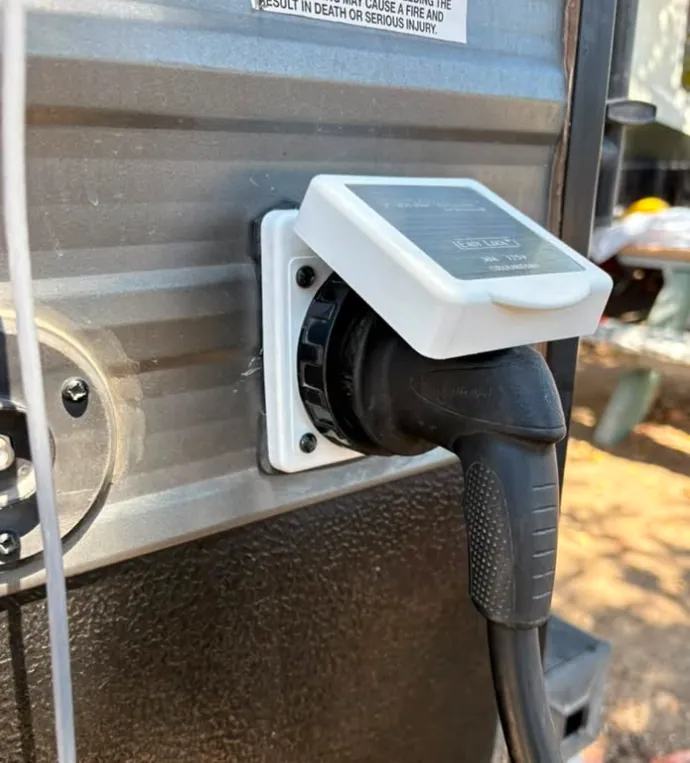
A shore power inlet is the recessed male receptacle in the sidewall that the park cord plugs into. It is either a 30-amp TT-30P rated 120 volts and 3,600 watts, or a 50-amp NEMA 14-50 rated 120/240 volts and 12,000 watts. Failure almost never begins inside the coach. It begins at the blade contact, where a spring clip that has lost tension grips the plug loosely enough to admit air. That gap turns a connection into a resistor, and a resistor carrying 30 amps makes heat. Heat oxidizes the copper alloy, the oxide raises resistance again, and the loop tightens every time the air conditioner cycles on. The damage is visible from outside long before anything trips. Browning appears at one blade first, then a scorched ring in the thermoplastic housing, then a blade sunk into softened plastic. Coastal rigs get there sooner, because salt aerosol corrodes the blades and hands the cycle a head start.
Hot skin condition: why an open ground is the fault that matters
Hot skin is what happens when the equipment grounding conductor between the coach and the pedestal is broken or was never landed, and some small leakage inside the rig has nowhere to drain. A chafed 120-volt conductor behind a wall, a failing water heater element or a wet junction in a bay can then push the chassis and the aluminum skin up toward line voltage. Nothing feels wrong while you are inside on rubber tires. The hazard appears at the doorway, where a person standing barefoot on wet grass reaches for a metal handle and becomes the ground path the pedestal no longer provides. That voltage can be a couple of volts or the full 120. A non-contact voltage tester run along the skin, the door frame and the entry step will chirp before anyone touches anything. A Fluke 117 between bare coach metal and a known earth reference gives the actual number. If it chirps, kill the pedestal breaker before touching the rig.
Test the pedestal before you plug in, not after
Callers ask a version of the same question every week: is your power box getting voltage. The pedestal is the cheapest thing on the site to check and the one thing nobody owns, so it is where testing starts. Open the pedestal breaker first, then look at the receptacle face for browning, a cracked cover or a socket that has lost its grip. With the breaker back on, a pedestal tester or a multimeter should read roughly 108 to 132 volts hot to neutral and the same hot to ground, with neutral to ground under about two volts. A 50-amp site gets both legs measured plus 240 across them. Near zero hot to ground means an open ground, and swapped hot and neutral readings mean reverse polarity, which is common at older parks. Then load it. If a 30-amp draw pulls the leg down more than about five percent, roughly six volts, the pedestal has a resistive connection that will cook your plug next.
How our technicians work the fault, in order, and what it costs
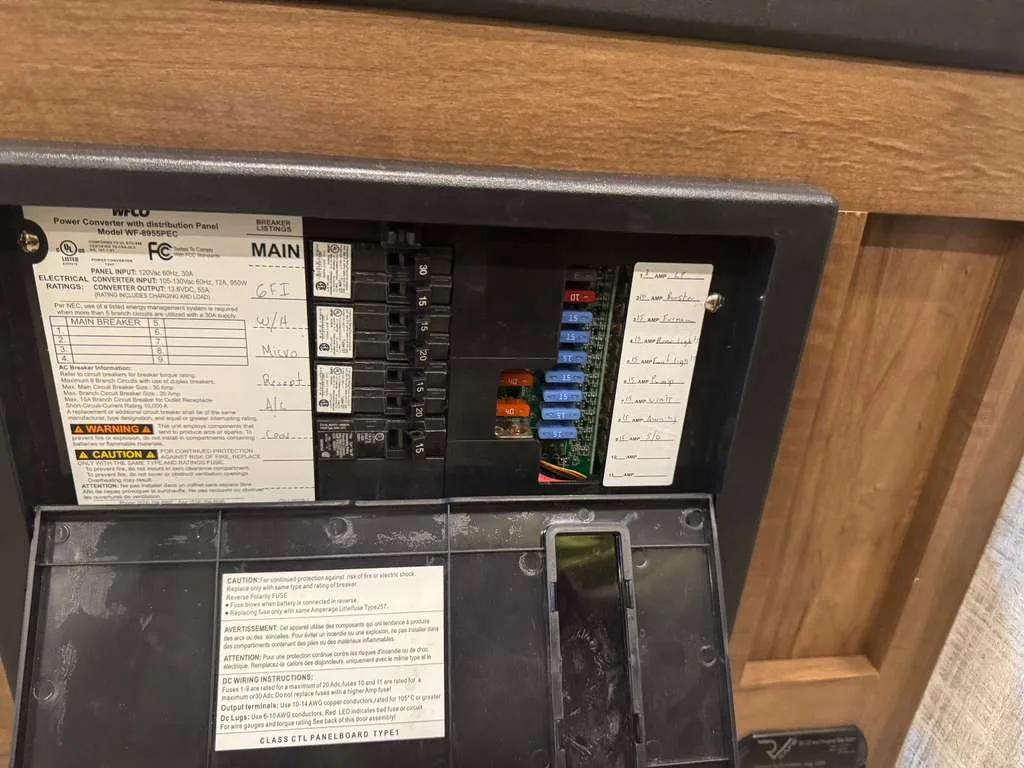
Owners rarely describe an inlet. They call and say there is a problem with the plugs after a power outage, or that the refrigerator stopped working after a power surge, or that half the outlets are dead while the lights still work. The order of work is the same either way. The pedestal is tested first, then the cordset ends and the inlet are inspected under load with an infrared thermometer, then voltage is compared at the inlet against the main breaker. Only after that does anything upstream of the panel come into question, because a transfer switch fault, a converter fault or a parasitic draw is a separate diagnosis with a separate fix. An inlet and cordset end replacement is generally a one to two hour job plus parts. Replace the cordset end at the same time if it shows any heat marking.
EMS or basic surge protector, and the blade pitting cycle
A basic surge protector is a block of metal oxide varistors. It clamps a lightning transient and does nothing at all about the two faults that actually destroy RV equipment, which are sustained low voltage and a miswired pedestal. An electrical management system watches the line continuously instead. The Southwire Surge Guard 34951 lists protection against open ground, open neutral, low voltage below 102 volts, high voltage above 132 volts and an overheating plug or receptacle. A Power Watchdog Gen II cuts power below 104 volts or above 132 volts and restores it only after the supply has been stable for 90 seconds. Neither one repairs a damaged inlet, but both stop the pedestal from finishing the job. The pitting cycle is the part owners can break themselves. Unplugging under load draws a small arc that pits the blade, the pit raises resistance, and the next connection runs hotter still. Kill the breaker before you pull the cord, every time.
Sources
Every figure on this page comes from a manufacturer document or a standards body, not from another repair site. Here is where each one comes from.
- NFPA 1192, Standard on Recreational Vehicles - Technical Committee draft text, which routes RV electrical work to Article 551 of NFPA 70, National Electrical CodeVerified by reading the PDF: section 4.3.1 requires that all electrical installations, systems and equipment in a recreational vehicle comply with Article 551, Parts I through V, of NFPA 70, and Chapter 2 identifies that referenced document as NFPA 70, National Electrical Code, 2020 edition. That is the route by which the grounding, bonding and polarity rules of the National Electrical Code govern a coach and its shore power connection, and the basis for treating an open ground as a code fault rather than an inconvenience. Section 5.3.1.6 separately forbids using propane piping as a grounding electrode.
- Southwire Surge Guard 34951, 50A portable EMSManufacturer listing of the faults an EMS protects against: open ground, open neutral, low voltage below 102 volts, high voltage above 132 volts, and an overheating plug or receptacle.
- Power Watchdog Gen II, 50 Amp surge protectorManufacturer statement of the 104 volt low and 132 volt high shutdown thresholds and the automatic restart once the supply has been stable.
Related repairs
Other systems we service
Where we work
Service category
What this usually costs
| Item | Price | What it covers |
|---|---|---|
| Service call | $299 | Includes the trip out to your RV and the first hour on site |
| Work past the first hour | Quoted after diagnosis | We tell you what it will take before we carry on |
| Parts | Quoted per job | Special-order parts may need a deposit before we order them |
| Written estimate | No charge | You approve the estimate before any work starts |
The service call covers the trip out to your RV and the first hour on site. Anything beyond that depends on what we find, and we quote it and get your approval before carrying on.
The price ranges on this page come from our own recent jobs across Florida, not from an industry average. What you pay depends on the rig, the parts it needs and what we find on site, so we give you a written estimate before any work begins and you approve it first.
Frequently asked questions
Is there a problem with the plugs after a power outage?
It is worth checking. An outage itself does not damage a plug, but the reconnect surge and the generator swaps that often follow will find a connection that was already marginal. Look at the inlet blades and the cord end for browning, a loose fit or a smell of hot plastic, and check whether the pedestal receptacle itself is scorched. If either half is discolored, stop using it and have the pair replaced rather than plugging back in to see what happens.
Can I run my camper air conditioner on house power?
Usually not on a standard 15-amp household outlet through a dogbone adapter. A single rooftop unit pulls roughly 12 to 16 running amps and several times that at startup, which trips the 15-amp breaker or, worse, quietly heats the adapter and the extension cord until one of them melts. A dedicated 20-amp circuit with nothing else on it will sometimes carry one unit if the cord is short and heavy gauge. A proper 30-amp or 50-amp feed into the coach inlet is the answer.
Why did my refrigerator stop working after a power surge?
Two very different causes look identical from the doorway. Either the 120-volt supply to that circuit is gone, which points at the inlet, the cordset, the pedestal or a tripped breaker, or the appliance control board itself took the hit and the supply is fine. Testing voltage at the outlet behind the fridge separates the two in about a minute, which is why it is always the first check rather than pulling the fridge. A surge that reaches a control board usually got in through an unprotected pedestal connection.
How much does shore power inlet repair cost?
Pricing is quoted as a typical range, because no two of these are the same job. Inlet and cordset parts are additional and depend on whether the rig takes a 30-amp TT-30P or a 50-amp NEMA 14-50, and on whether the sidewall behind the inlet needs repair.
Is it safe to keep using the RV if the inlet feels warm?
A warm inlet is a connection that is already failing, and the failure accelerates rather than leveling off. Drop the load immediately, run nothing heavy such as the air conditioner or the water heater on electric, and stop using the connection entirely if there is browning at a blade or any smell of hot plastic. A non-contact voltage tester run along the skin, the door frame and the entry step will also tell you whether a hot skin condition has developed while you decide.