Power Awning Repair: Solera by Lippert or Dometic Diagnosis
Powered RV awning diagnosis in Florida. Tell a Lippert Solera from a Dometic WeatherPro, then test switch, motor, board and wind sensor. Call 888-759-1438.
A powered RV awning is driven by a sealed 12-volt tubular motor inside the roll tube, turned by a drive head assembly at the right end and carried by an idler head at the left. Two brands cover most rigs, and they are two companies: Solera is a Lippert brand, while Dometic builds its own separate awning line.
Drive Head, Idler Head and Wind Sensor: The Four Subsystems
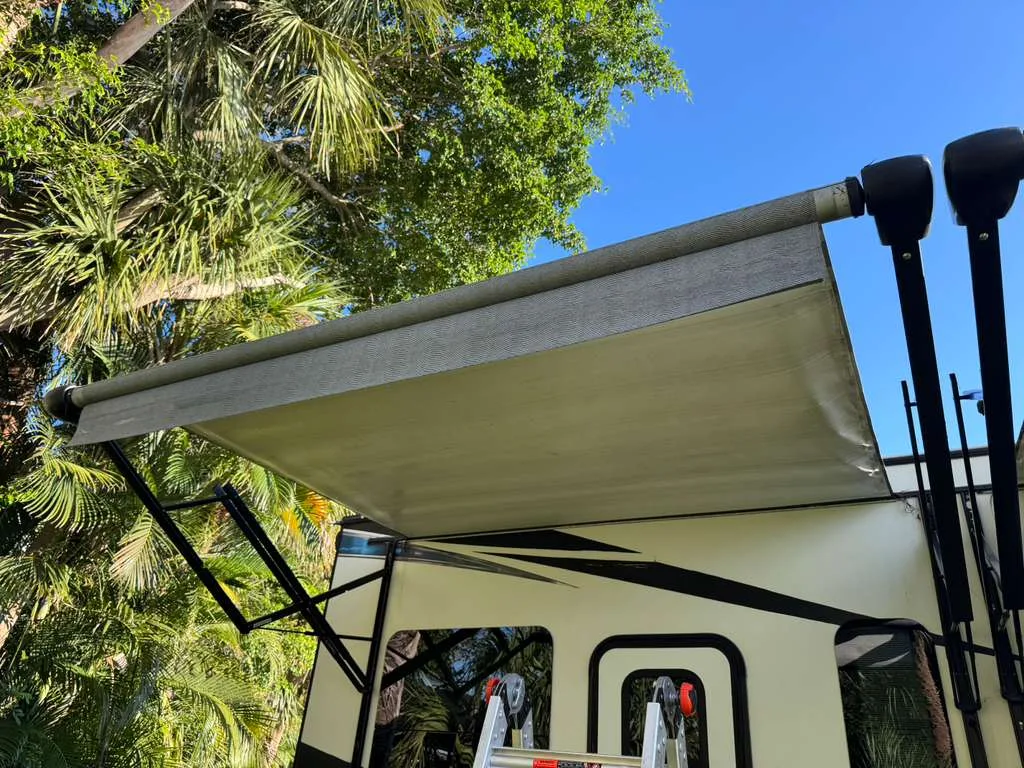
A power awning is four subsystems, and naming them correctly is what makes diagnosis possible. The roll tube carries the fabric and holds a sealed 12-volt tubular motor inside it. That motor turns through the drive head assembly, a cast head at the right end of the tube as you face the awning from outside, while the idler head at the left end simply carries the other end. The arms are a separate system. Each support arm assembly bolts to the sidewall through six fasteners, two at the top, two in the middle and two at the bottom. An articulating pitch arm with a gas strut drops one side for runoff, and above it all sits the awning rail holding the fabric's polycord. The electrical side is the fourth: a wall switch or key fob, a fuse, a control board, and on newer units a wind sensor living either in the drive side arm or up on the roof.
Solera Is Lippert and Dometic Is Dometic: How to Tell Them Apart
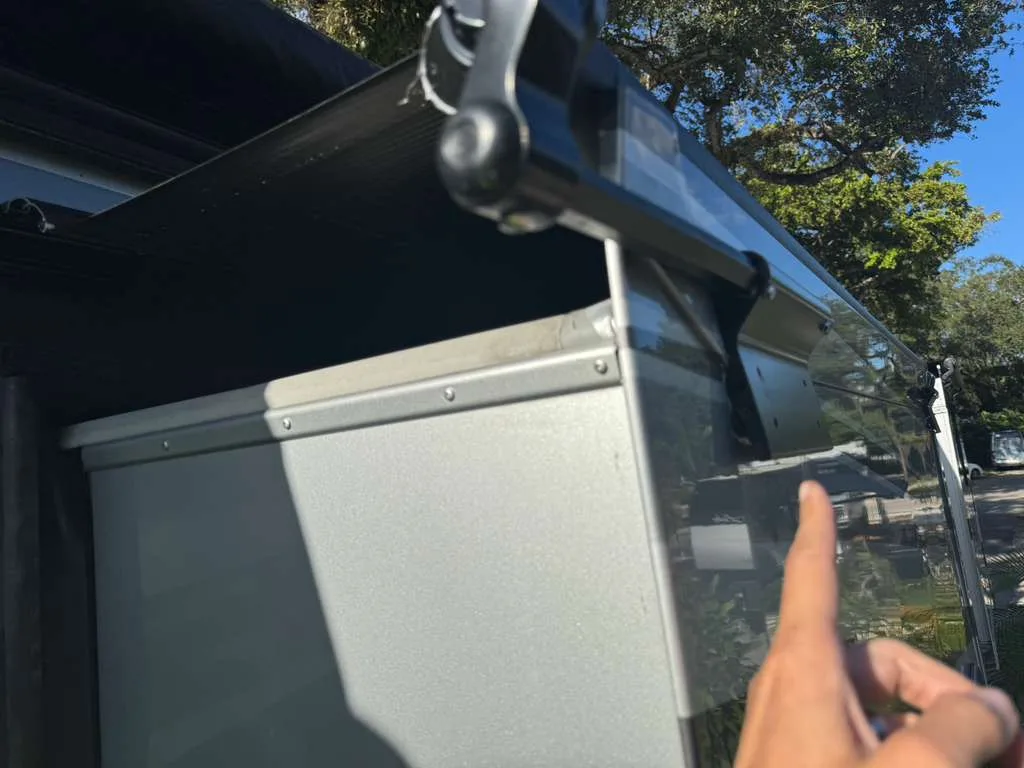
Solera is a Lippert brand. Lippert's own support documentation index lists every Solera awning series in one place: 1000 and 1000XL manual, 1500 Hybrid, 1800 Economy Edge, 2000 Standard Edge, 3000 Series 12V Power, 3000WS with wind sensor, 3500 Smart Arm, 4000 18V and the 5000 slide topper. No Dometic model appears on it. Dometic's support index is the mirror image. It lists 8500 and 9000 manual awnings, 9100 in manual and power, 9200 Power, the cassette-style 9500 Case in 120V and 12V, Sunchaser I and II, and the WeatherPro family, with no Solera anywhere. Two manufacturers, two parts systems, and nothing that crosses. Identify yours at the roll tube ends. A Solera 3000 Series head is a squared cast housing with a rubber grommet on the drive side covering a 7/16 inch manual override nut, and a 3000WS adds a QR and MAC address label on the front of the drive side arm.
The Failure Tree: Switch, Motor, Board, Then Sensor
Callers describe a system, not a part. The awning hums and will not move, it crawls out and stops, or it went in by itself and now nothing responds. The order of checks is fixed, and it starts nowhere near the motor. First the travel locks, because a locked latch imitates a seized motor exactly. Second the fuse, then 12 volts at the motor with the switch held, read on a digital multimeter. Third is voltage under load: Lippert's service manual calls for a minimum of 11 volts where the unit wire meets the awning wire during retract, and a slow awning usually fails that rather than failing mechanically. Fourth, isolate the motor by feeding its red and white leads off a cordless screw gun battery, bypassing switch, board and wiring in one move. Reverse the leads and it runs the other way. A motor that spins there but not on the switch is a wiring, switch or board fault, and all three are field serviceable.
When the Awning Retracts and Nobody Touched the Switch
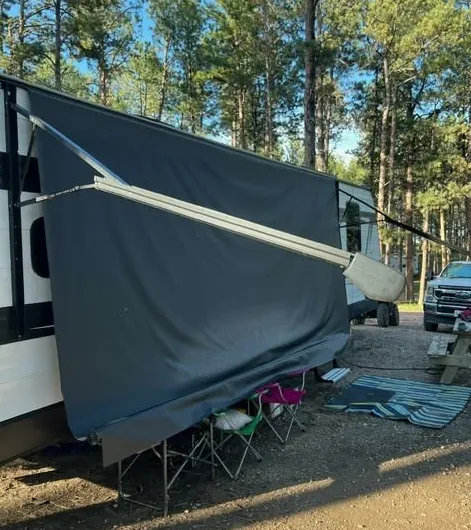
This is the call that spikes on a Florida afternoon, when a cell builds over an empty site and the sensor does exactly what it was sold to do. Each brand announces its sensor state differently, so the behavior itself identifies the awning. On a Dometic WeatherPro, a unit that runs out and stops three separate times during extension is not broken. Dometic's own troubleshooting states that three stops mean the wind sensor is disabled, and that wind speed LEDs dark with the power light on says the same. A selected wind speed blinking with power on means the sensor tripped, which is normal. Re-enabling is a toggle on the side of the control box on some generations and the key fob on others. A Lippert Solera 3000WS behaves in reverse. Its Bluetooth sensor sits inside the drive side arm and does nothing at all until paired to the OneControl app by QR code or 12 digit MAC address, where sensitivity is a slider.
Part or Full Assembly, and What Salt Air Decides
That spread matters because the cheap findings and the expensive one look identical from the ground. Switches, fuses, grounds, wiring and pitch arm tension are inexpensive parts fixed in place. The drive head is not a part, it is an assembly, and Lippert's manual treats it as one: the procedure calls for one to three people, the roll tube supported, the hairpin pulled and the head rotated clockwise to release tension before a two pin connector comes off. No brush replacement procedure for the tubular motor appears anywhere in it. Coastal parks push more of these toward assembly work. Salt aerosol drives galvanic corrosion between the steel retaining bolt and the aluminum head casting, and UV chalks the arm label that Lippert already expects to wear off.
On a coastal coach, ask for the hardware grade being fitted rather than assuming stainless means stainless. The wrong grade in a salt-air mounting corrodes faster than the part it replaced, which is a repair bought twice.
Sources
Every figure on this page comes from a manufacturer document or a standards body, not from another repair site. Here is where each one comes from.
- Lippert Customer Care Center - Awnings support documentation indexSolera is a Lippert brand: Lippert's own awning documentation index carries every Solera series (1000, 1000XL, 1500 Hybrid, 1800 Economy Edge, 2000 Standard Edge, 3000 Series 12V Power, 3000WS with wind sensor, 3500 Smart Arm, 4000 18V, 5000, Slide Topper, Universal and Window) and no Dometic model at all, which is the mirror image of Dometic's own support index.
- Lippert - Solera 3000 Series 12V Power Awning Troubleshooting and Service Manual (CCD-0001727)The diagnostic order and the readings: travel locks and fuse first, then power at the motor, a minimum of 11 volts where the unit wire meets the awning wire during retract, motor isolation using a cordless screw gun battery on the red and white leads, six support arm fasteners, pitch arm tightening with a 1/2 inch wrench against a 1/4 inch hex, and head assembly replacement with no brush service procedure anywhere in the manual.
- Lippert - Solera 3000WS Series Awning with Wind Sensor Owner's Manual (CCD-0007002)The Solera wind sensor sits in the drive side arm, pairs to the Lippert Unity board and must be activated in the OneControl app by QR code or 12 digit MAC address, sensitivity is a slider, a chime sounds before wind-triggered auto-retraction, and the manual override is a 7/16 inch nut under a grommet in the drive head on the right side viewed from outside.
- Dometic - Awnings (US) support product listDometic's own awning families, separate from Lippert: 8500, 9000, 9100 Manual and Power, 9200 Power, 9500 Case in 120V and 12V, Sunchaser I and II, and the WeatherPro line split into arm wind sensor and roof wind sensor versions.
- Dometic - Awning will go out and stop three timesDometic states that a WeatherPro stopping three separate times during extension is normal operation indicating the wind sensor is disabled, and that re-enabling it is a toggle switch on the side of the control box on some generations and the key fob remote on others.
- Dometic - Wind speed LEDs off, power light onDometic's diagnostic that wind speed LEDs dark with the power light on means the wind sensor is disabled.
Related repairs
- our Awning Fabric Replacement service
- Manual Electric Awning Conversion in Florida
- how we handle awning storm damage rebuild
Other systems we service
Where we work
Service category
What this usually costs
| Item | Price | What it covers |
|---|---|---|
| Service call | $299 | Includes the trip out to your RV and the first hour on site |
| Work past the first hour | Quoted after diagnosis | We tell you what it will take before we carry on |
| Parts | Quoted per job | Special-order parts may need a deposit before we order them |
| Written estimate | No charge | You approve the estimate before any work starts |
The service call covers the trip out to your RV and the first hour on site. Anything beyond that depends on what we find, and we quote it and get your approval before carrying on.
The price ranges on this page come from our own recent jobs across Florida, not from an industry average. What you pay depends on the rig, the parts it needs and what we find on site, so we give you a written estimate before any work begins and you approve it first.
Frequently asked questions
Is it an automated or manual awning, and does that change the repair?
It changes everything. A manual awning stores energy in a torsion spring and has no motor, switch or sensor to test, so the repair is mechanical. A powered unit has a 12-volt motor sealed inside the roll tube plus a switch, fuse and often a control board and wind sensor, which means most faults are electrical and get found with a meter before anything is taken apart. Converting one to the other is a separate job with its own kit.
Is it the awning brushes or motor?
Neither, usually, and brushes are not the answer owners expect. The tubular motor inside a Solera roll tube is a sealed unit, and Lippert's troubleshooting and service manual contains no brush replacement procedure at all, only head assembly replacement. So the real fork is whether the motor spins when fed straight from a battery. If it does, the fault sits upstream in the switch, ground or board, and those are the inexpensive repairs.
How do I manually retract my awning when the motor will not run?
On a Solera power awning, pull the rubber grommet out of the drive head assembly, which is always the right side viewed from outside the coach. That exposes a manual override nut. Put a 7/16 inch socket on a cordless drill and spin it counterclockwise to retract or clockwise to extend, then replace the grommet. Some Solera variants ship with no override nut at all, so confirm which one you own before a storm rather than during one.
Why did my awning close by itself when there was barely any wind?
Because the sensor is doing its job on a gust you did not feel at ground level. Wind loading on an extended panel builds faster than it feels standing under it, and both brands are tuned to retract early rather than late. On a Solera 3000WS the sensitivity is a slider in the OneControl app, and the awning sounds a chime before it moves. On a Dometic WeatherPro that trip shows up as the selected wind speed blinking.
Can you get and install an awning part, or does the whole head have to go?
Both happen, and the diagnosis decides which. Switches, fuses, wiring, gas struts and pitch arm fasteners are individual parts, and a pitch arm that will not hold position gets tightened with a half inch wrench on the nut against a quarter inch hex on the bolt, a quarter turn at a time. A failed motor is different, because it is sold inside the drive head assembly rather than on its own.
What does a powered awning diagnosis cost, and what if I leave it?
Our service call covers the trip out and the first hour on site at the rate in the pricing table on this page; anything past that first hour is quoted and approved before we carry on. Leaving it is the expensive path. A motor that stalls drags the head and arm out of alignment, and a half-retracted awning caught by a gust pulls on the rail, which sits at the roof-to-wall joint and turns a hardware repair into sidewall work.