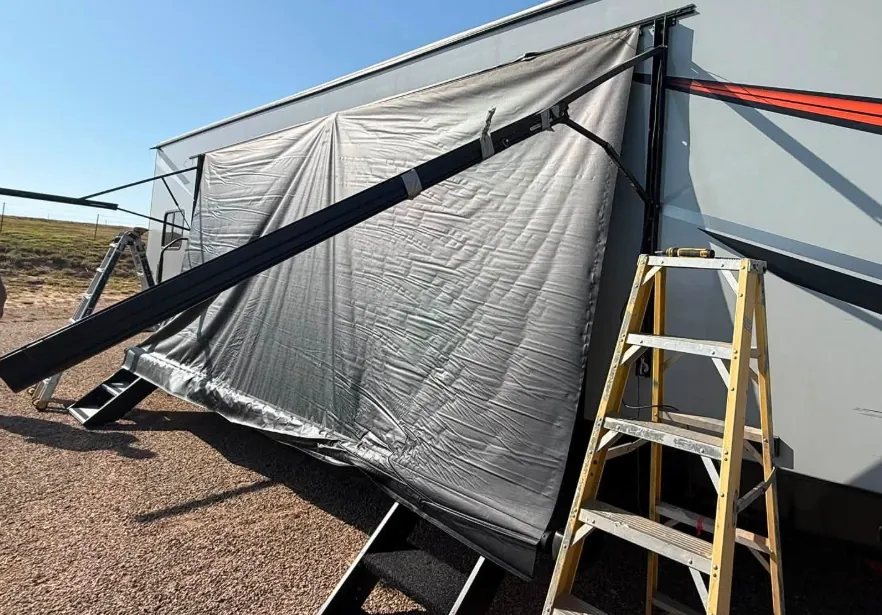
RV Awning Storm Damage Rebuild: Arms, Rail and Sidewall
Wind-damaged RV awning in Florida? We rebuild arms, mounting rails and the sidewall behind them. Mobile service statewide. Call 888-759-1438.
A wind-damaged awning left hanging on the side of an RV rarely stays an awning problem. The mounting rail sits at the roof-to-wall joint, so once wind pulls it loose the screw holes elongate, the sealant bead splits, and water starts moving into the sidewall. Wind breaks an awning in a predictable order: fabric first, then an arm casting, then the rail, then the wall behind it.
What Wind Actually Breaks First, and In What Order
An awning fails at its weakest link, and the order is predictable. Fabric goes first, tearing at a stitched seam or along the polycord channel where it enters the roller tube, because that is where a gust concentrates load instead of spreading it. Next is the support arm, where the aluminum casting bends or cracks at a rivet, usually on the drive side that carries the motor. Third, the mounting rail begins to walk out of the sidewall, elongating its screw holes and bringing luan with it. Fourth, and worst, the roof line opens where the rail let go, splitting the sealant bead along the roof-to-wall joint. Once the sequence reaches the third stage this stops being an awning job and becomes a structural one. Knowing where a rig sits in that order is the entire diagnosis, and it is why a photograph of the fabric alone tells a technician almost nothing.
It Came Off the Side of the Trailer: What Owners Describe
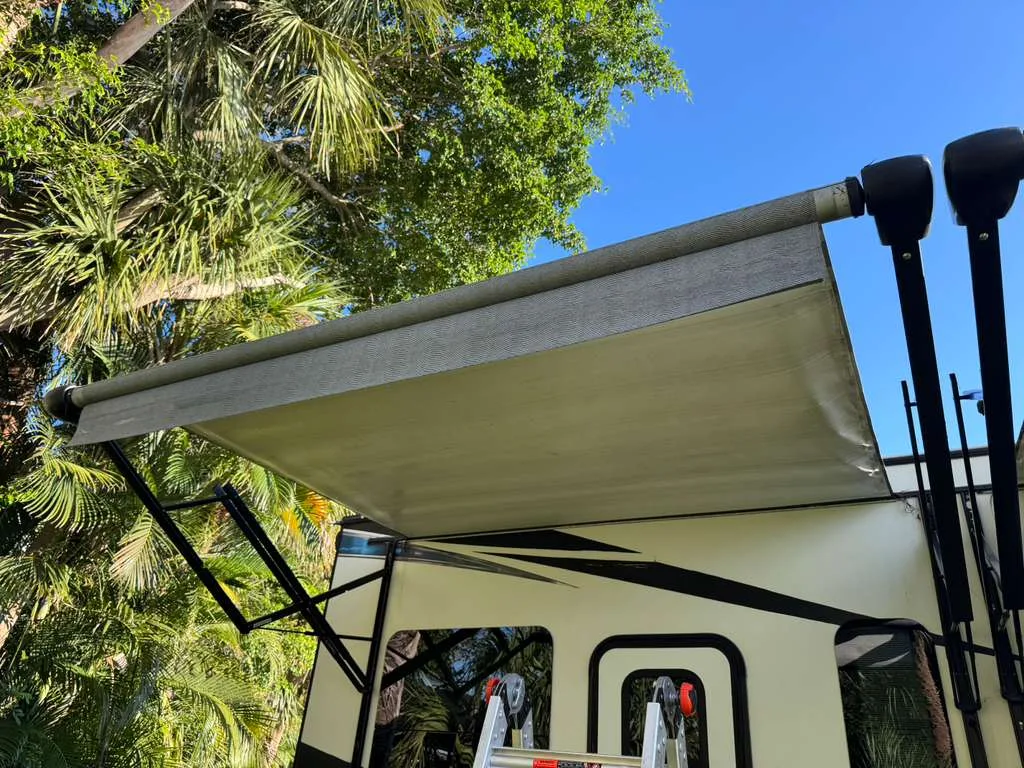
Callers rarely describe parts. What comes in after a squall line sounds like "can somebody come out for a detached awning" or "can you repair travel trailer damage," usually with a photo of fabric hanging into the road. Underneath those three descriptions sit three very different jobs. One rig has straight arms and a torn panel, which is a fabric job. A second has a straight rail but an arm casting cracked through its rivets, which is a hardware job. A third has a rail hanging off the wall with the screws still in it, which is a sidewall repair that happens to involve an awning. The only way to separate them is to read the rail line and the bracket faces, not the fabric. It is also why a firm number quoted over the phone from a fabric photo is a guess dressed up as an estimate.
Why the Sidewall Costs More to Fix Than the Awning
Lippert's OEM installation instructions for the Solera 3000 series require that every screw supporting the awning assembly land in a backer inside the wall structure. The rail is fastened with #10 by three quarter inch screws using all fastener holes, and each support arm bracket takes six #14 by one and a quarter inch screws: two at the top, two at the bottom, and two through the center of the arm. On laminated walls, four rivets may stand in for the middle and lower screws. That pattern spreads a wind load across the wall rather than concentrating it. When a gust wins anyway it does not shear the screws, it peels them, elongating every hole and delaminating fiberglass around them. New screws in old holes will not hold, so the repair is a new backer, re-bedded fasteners and a resealed roof-to-wall joint. The awning bolts on. The wall is structure, and structure costs more.
A Bent Arm That Still Retracts Is a Loaded Spring
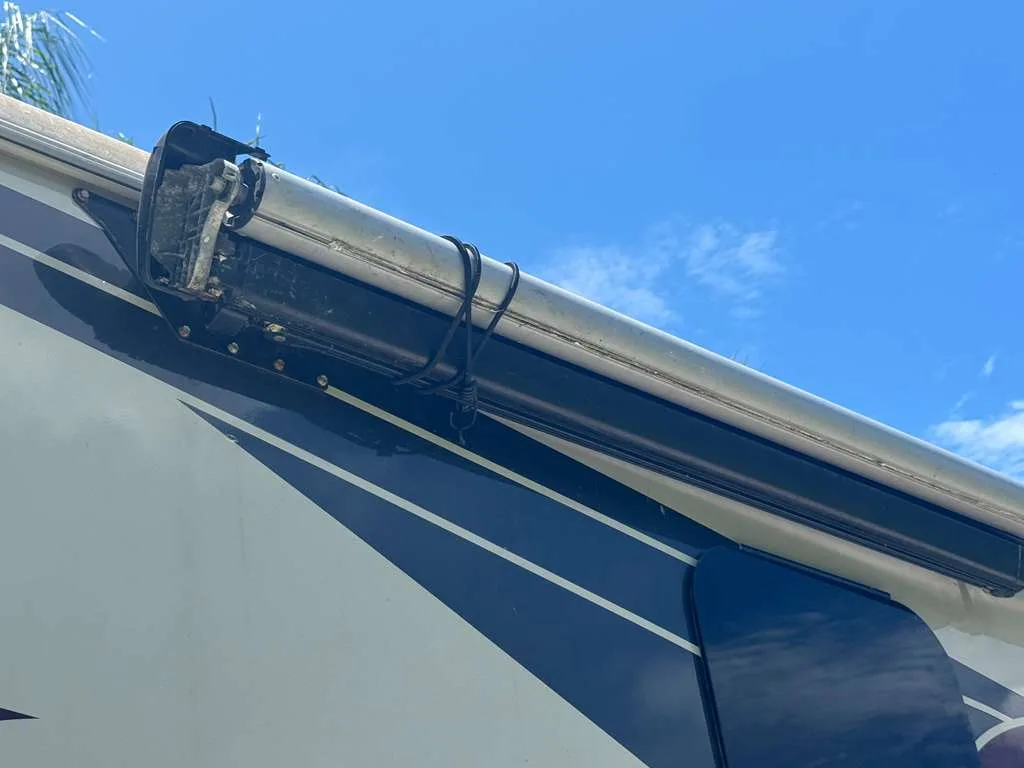
A bent arm that still runs is the thing owners most want to leave alone, and it is the one thing that should not be left. A support arm is not a simple strut. It carries preload from the roller assembly, and on adjustable pitch designs a spring inside the arm holds tension against the casting that retains it. Bend that casting and the load is now held off axis by a part that has already failed once. Two things follow. The arm no longer travels in its designed plane, so the drive head and the surviving bracket screws take side loads nobody sized them for, and every retraction cycle works the crack at the rivet a little wider. Anything that can release stored spring energy while a person is standing underneath is a safety question, not a cosmetic one. Straight, or replaced. There is no third answer worth quoting.
What Gets Checked After a Storm, and In What Order
Our technicians work a storm inspection from the wall outward rather than from the fabric in. First the roller tube is secured so nothing can unroll mid-inspection. Second, the rail line is read end to end for elongated holes, lifted sealant and any gap at the roof-to-wall joint, with a moisture meter run along the interior wall below it. Third, both bracket faces and arm castings are checked for cracks at the rivets and for arms that no longer sit square to the wall. Fourth is the electrical side, and it is read under load rather than at rest: the drive circuit should still hold 11.5 volts with the motor under load, and a tripped 15 amp breaker needs roughly thirty seconds before it will reset. The LED light rail runs on its own 3 amp fuse, so dead lights with a working motor point at that fuse rather than at the storm.
Rebuild or Replace: The Honest Fork, and What It Costs
The fork is simpler than most quotes make it look. If only the fabric is damaged and the rail, arms and roller tube are straight, the panel gets replaced and the assembly stays. Once two of the four subsystems are gone, fabric plus an arm, or an arm plus the rail, a complete replacement assembly is usually cheaper than rebuilding piece by piece, because every subassembly carries its own removal and alignment labor. Wall repair is a separate line either way and does not disappear by buying a new awning. Nobody should quote a storm rebuild as a fixed number before seeing the rail line, because the wall behind it is the variable.
Insurance is worth raising early rather than after the estimate. Storm damage to an awning is frequently covered where wear is not, and the documentation that supports a claim - photographs of the rail line and the wall behind it - is easiest to capture before anything is removed.
Retract It or Lose It: This Damage Is Almost Always Avoidable
Lippert's own owner's manual is blunt about it: the awning must be retracted completely during incidents of high wind, heavy rain, or any extended time away from the unit. That describes the Florida afternoon pattern exactly, because a cell can build and hit while the site sits empty. The National Weather Service calls a thunderstorm severe at gusts above 58 miles per hour, and awnings come apart well below that number. Wind sensor models such as the Solera 3000WS retract themselves and the sensitivity is adjustable through the One Control app, but a sensor is a backstop, not a plan. With the power out, the manual override under the grommet on the drive head will bring it in by hand. On insurance, coverage for wind damage varies by carrier and by policy, so verify your own terms with your carrier rather than assuming.
Sources
Every figure on this page comes from a manufacturer document or a standards body, not from another repair site. Here is where each one comes from.
- Lippert Solera OEM Installation Manual (CCD-0001655)Every screw supporting the awning assembly must land in a backer inside the wall structure; rail secured with #10 x 3/4 inch screws using all fastener holes; six #14 x 1-1/4 inch screws per support arm bracket; rivets permitted on laminated walls; center support bracket required over 22 feet.
- Lippert Solera 3000WS Awning with Wind Sensor Owner's ManualManufacturer instruction that the awning must be retracted completely during high wind, heavy rain or any extended time away from the unit, and that wind sensitivity for automatic retraction is adjustable in the app.
- NOAA National Weather Service - Thunderstorm SafetyA thunderstorm is classed as severe at wind gusts over 58 mph, the reference point for Florida afternoon storm-season gusts.
- Florida Department of Financial Services - Understanding Insurance CoverageNeutral state consumer resource for verifying policy terms; supports the instruction to confirm wind-damage coverage with your own carrier rather than assuming an outcome.
Related repairs
Other systems we service
Where we work
Service category
What this usually costs
| Item | Price | What it covers |
|---|---|---|
| Service call | $299 | Includes the trip out to your RV and the first hour on site |
| Work past the first hour | Quoted after diagnosis | We tell you what it will take before we carry on |
| Parts | Quoted per job | Special-order parts may need a deposit before we order them |
| Written estimate | No charge | You approve the estimate before any work starts |
The service call covers the trip out to your RV and the first hour on site. Anything beyond that depends on what we find, and we quote it and get your approval before carrying on.
The price ranges on this page come from our own recent jobs across Florida, not from an industry average. What you pay depends on the rig, the parts it needs and what we find on site, so we give you a written estimate before any work begins and you approve it first.
Frequently asked questions
Can somebody come out for a detached awning?
Yes, a detached or partly detached awning is a mobile call. The first task on site is making the assembly safe: securing the roller tube so it cannot unroll, and taking the load off any bracket still hanging on the wall. Only then does the inspection start at the rail line.
How do I manually retract my awning after a storm?
On a Solera power awning a rubber grommet on the drive head assembly covers the manual override. Remove the grommet, insert the override tool and wind the awning in by hand. This is the same method used when the battery is dead or shore power is out. If an arm is bent or the fabric is binding, stop there. Forcing a deformed arm through its travel is how a loaded assembly lets go with somebody standing under it.
Can you get and install an awning part, or only complete awnings?
Both. Individual parts such as a support arm assembly, a drive head, a motor or a section of mounting rail can be sourced and fitted, and complete replacement assemblies are installed as well. Which route is cheaper depends on how many subsystems the wind took. Once the fabric and an arm are both gone, a full assembly usually wins, because each separate part carries its own removal and alignment labor.
Do you replace awnings on RVs, or only repair them?
Both, and it is a cost question rather than a preference. Awnings longer than 22 feet also require a center support bracket, which changes what a replacement involves. If the wall behind the rail is damaged, that repair comes first. Mounting a new awning into elongated screw holes in soft luan puts the next storm's load straight back into a wall that has already failed once.
Will insurance cover a wind-damaged RV awning?
That depends entirely on the carrier and the policy, and it is worth confirming before any work starts. Some policies treat the awning as part of the RV, some exclude it, and some ask whether it was extended and unattended when the wind hit. Photograph everything in place before anything is removed. The Florida Department of Financial Services consumer division can help you read the terms if the answer is unclear.