Manual to Electric RV Awning Conversion: Cost and Limits
Converting a manual RV awning to electric in Florida: what actually gets replaced, the 12V feed, and the manual override trade-off. Call 888-759-1438.
Converting a manual RV awning to electric starts with one check: which assembly is actually on the wall. Lippert Solera pull-strap awnings have a documented conversion, TI-164, that swaps the drive and idler head assemblies and keeps the arms you already own. Carefree, Dometic and A&E spring-arm awnings share no compatible hardware, so converting one of those is a complete assembly replacement.
What Gets Checked Before Anyone Quotes a Conversion
A conversion quote begins with identifying the assembly, not measuring the opening. Our technicians look first for the variant code sticker on the roll tube near the motor head, because Lippert ties replacement part compatibility to that code rather than to awning length. Second comes arm geometry. A Solera manual pull-strap awning uses articulating arms with a gas strut, and stores its spring tension inside the drive head assembly and idler head assembly. A Carefree Fiesta or a Dometic A&E patio awning uses rafter arms and a sprung roller tube, which is a different machine wearing similar fabric. Third is the wall: whether the awning rail fasteners still bite, whether the sealant bead above the rail is intact, and whether a 12-volt feed can physically reach the drive side. Any one of those failing moves the job from a conversion to a rail repair first.
Why This Is Usually a New Awning, Not a Motor on Old Arms
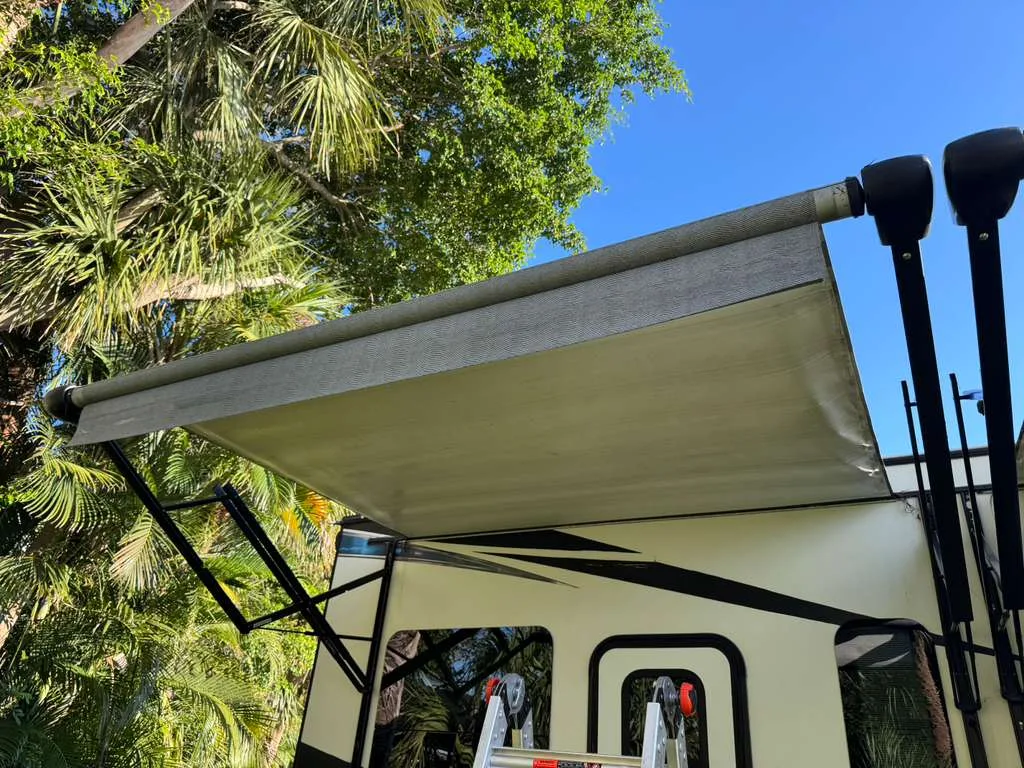
The thing owners are most surprised by is that motorizing the arms you own is rarely an option. Lippert publishes one documented retrofit, TI-164, and it converts a Solera manual pull-strap awning by replacing the drive head assembly, part 266146 in white or 273478 in black, the idler head assembly, 266147 or 273479, and both end caps. The torsion spring lives inside those heads, so removing them is what turns a spring-tension awning into a spring-free powered one. Nothing in that kit crosses brands. A Carefree or Dometic manual awning shares no head casting, shaft or end cap dimension with Solera hardware, so converting one means a complete assembly change: arms, roll tube, fabric and mounting hardware together.
Owners are often quoted a motor alone by someone who has not checked the roll tube dimension. Ask which assembly is being supplied before agreeing to anything, because a motor that will not mate to your tube is a returned part and a wasted visit.
Where the 12 Volts Comes From, and What It Has to Hold
A powered awning needs a dedicated 12-volt feed, a switch and protection, and TI-164 is specific about all three. At the motor, the black wire from the power cord lands on black and the white wire lands on the motor's red. Lippert calls for all wire at 14 AWG or larger, sized to deliver a minimum of 12 volts at the connection to the supplied power cable, ships a 6-amp auto-reset breaker with the awning, and recommends the awning sit on a 15-amp circuit; the motor itself carries internal thermal protection. The wire runs from the motor about halfway down the outer arm, up the inner arm and into the wall mount extrusion under plastic wire covers, routed outside the pin joining the steel tension arm to the wall mount so it cannot be pinched. Every wall penetration then gets sealed.
Can the Existing Rail and Sidewall Carry a Powered Assembly
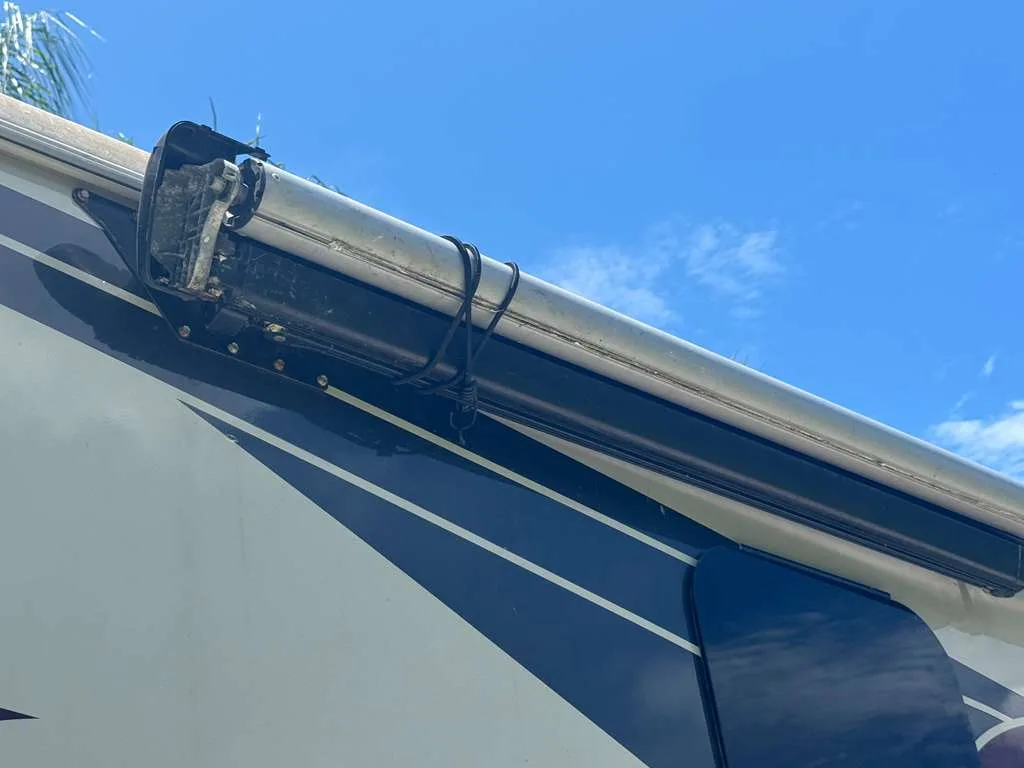
A powered head assembly is heavier than a pull-strap head, and a spring-free awning transfers its load differently: the arms and gas struts hold the roll tube rather than a wound spring doing part of the work. So the rail gets tested before anything is ordered. If fasteners spin in their holes, if the bead above the rail is weeping, or if a moisture meter reads elevated at the roof-to-wall joint, the rail and its backing come first and the conversion waits behind that work. The conversion also creates a new hole in the sidewall for the power feed, directly above living space. That penetration is the part most likely to be under-sealed on a rushed install, and a slow leak at a wire pass-through does not announce itself; it soaks the luan behind the rail, delaminates the panel, and turns a convenience upgrade into sidewall repair a season or two later.
The Trade-off Nobody Mentions: Getting It In With No Power
On a standard Solera power awning there is a manual override. You pull the rubber grommet from the drive head assembly, always on the right side as viewed from outside the unit, put a 7/16 inch socket on a cordless drill, and spin the override nut clockwise to extend or counterclockwise to retract. Lippert notes the same procedure covers dry camping with no battery. Powered, retraction takes roughly 35 seconds and extension roughly 27 seconds on a fully charged battery, so by hand plan on a ladder and several minutes. Here is the part that matters in storm season. Lippert also publishes a Solera 3000 Series 12V Power Awning with no manual override at all, and its factory manual retract procedure calls for two or three people, a drill, zip ties, ladders and a razor knife. Ask which variant you are being sold.
Who Should Not Do This, and the Cheaper Thing to Do Instead
If your manual awning still extends and retracts cleanly and the rig sits parked for months at a time, this upgrade is a poor buy. You are adding a motor, a breaker, a switch, a wire run and a new sidewall penetration to solve a task you perform a handful of times a year, and every one of those parts is a future failure point in year-round Florida use where nothing gets a winter lay-up. There is a middle option almost nobody is offered. Lippert's TI-194 converts the same pull-strap awning to a manual gearbox awning, kit 333410 in white or 333411 in black, using gearbox drive head 300029 or 300031 and crank handle 300030. It removes the spring exactly as the power kit does, needs no wiring and no battery, and the crank still works with a flat house battery.
Sources
Every figure on this page comes from a manufacturer document or a standards body, not from another repair site. Here is where each one comes from.
- Lippert TI-164: Conversion From Manual Pull Strap To Power AwningThe conversion replaces the drive head assembly and idler head assembly (266146/273478 and 266147/273479) rather than motorizing existing arms; wiring is black to black and white to red at the motor; all wire 14 AWG or larger to hold 12 volts at the supplied cable; a 6A auto-reset breaker is supplied and a 15A circuit is recommended; the motor has internal thermal protection; all wall penetrations must be sealed.
- Lippert TI-194: Conversion From Manual Pull Strap To Manual Gear Box AwningThe manual gearbox alternative to a power conversion: kit 333410 white or 333411 black, gearbox drive head 300029/300031 and manual crank handle 300030, removing the same spring tension with no 12-volt feed required.
- Lippert Solera 3000 Series 12V Power Awning With No Manual Override, Owner's ManualLippert ships a power awning variant with no manual override nut, and its published manual retract procedure requires two or three people, a drill, zip ties, ladders and a razor knife, with a third procedure that cuts the fabric off the roll tube.
- Lippert Solera 3000 Series 12V Power Awning Troubleshooting and Service ManualMinimum 11 volts where the unit wire meets the awning wire during retract, ground connection ahead of the switch as a slow-running cause, retract approximately 35 seconds versus extend approximately 27 seconds on a fully charged battery, and the manual override procedure using a 7/16 inch socket on the drive head.
Related repairs
Other systems we service
Where we work
Service category
What this usually costs
| Item | Price | What it covers |
|---|---|---|
| Service call | $299 | Includes the trip out to your RV and the first hour on site |
| Work past the first hour | Quoted after diagnosis | We tell you what it will take before we carry on |
| Parts | Quoted per job | Special-order parts may need a deposit before we order them |
| Written estimate | No charge | You approve the estimate before any work starts |
The service call covers the trip out to your RV and the first hour on site. Anything beyond that depends on what we find, and we quote it and get your approval before carrying on.
The price ranges on this page come from our own recent jobs across Florida, not from an industry average. What you pay depends on the rig, the parts it needs and what we find on site, so we give you a written estimate before any work begins and you approve it first.
Frequently asked questions
Can you install a motorized awning extension arm on my existing awning?
Not as a standalone arm on most awnings. Solera power arms are sold as part of a head assembly conversion, and Lippert's TI-164 replaces the drive head and idler head together rather than motorizing a single arm. On a Carefree or Dometic manual awning there is no compatible powered arm at all, so the honest answer is a complete assembly replacement. We identify the assembly by its roll tube variant code before quoting anything.
How do I manually retract my awning if the motor or battery dies?
On a standard Solera power awning, remove the rubber grommet from the drive head assembly on the right side as viewed from outside, fit a 7/16 inch socket to a cordless drill, and turn the override nut counterclockwise to retract. Keep a ladder handy. If your awning is the variant with no manual override, there is no nut to turn and the factory procedure needs two or three people and hand tools, which is worth knowing before a storm.
Do you replace awnings on RVs, or only convert the ones we have?
Both, and on this job they are frequently the same thing. A Solera pull-strap awning can genuinely be converted by swapping head assemblies and adding a 12-volt feed. Anything else, including Carefree and Dometic manual patio awnings, is a full assembly replacement because no cross-brand head, shaft or end cap fits. We tell you which category your rig falls into before ordering parts.
Can you get and install the parts, or do I have to source them?
Our technicians order the conversion hardware and fit it. Lippert publishes part numbers by color, such as drive head assembly 266146 in white or 273478 in black, and ties compatibility to the variant code on your roll tube, so ordering blind by awning length is how the wrong head arrives.
My awning runs slow or stops partway. Could it be electrical?
Usually, yes. Lippert's service manual calls for a minimum of 11 volts where the coach wire meets the awning wire during retraction, and lists a poor ground connection ahead of the switch as a common cause. Retract is slower than extend by design, about 35 seconds against 27. A slow awning is far more often a voltage drop, a corroded ground or a tripped auto-reset breaker than a failed motor.