
Why Is My RV Water Heater Not Working?
Establish which side has failed and the problem halves. How to reset one properly, why it lights and then quits, and when a repair stops being worth the money.
Find out which side has failed before anything else. A unit that heats on gas but not on electricity has a heating element or a supply fault. One that heats on electricity but not on gas has a gas, igniter or airflow fault. One that does neither points at the control board, the thermostat or the thermal cutoff shared by both.
Apex RV Repair is mobile across Florida - we come to your RV. Call 888-759-1438.
Most RV water heaters can run two ways, on propane or on 120 volt electricity, and each side has its own components. That is genuinely useful news when one stops working, because it means half the unit is still proving itself.
This page walks the checks in the order that narrows it fastest, starting with the question that eliminates most of the possibilities in about a minute.
Why is my RV water heater not working?
Start by testing each source separately rather than leaving the unit on automatic. Run it on gas alone and see what happens, then on electricity alone. Automatic mode switches between them and hides which side has actually failed.
If gas works and electricity does not, the fault is on the electric side: usually the heating element, its thermal cutoff, or the 120 volt supply reaching it. If electricity works and gas does not, the fault is in the gas train, the igniter or the flue, and the tank itself is fine.
If neither works, look at what both sides share. That is the control board, the thermostat and the thermal cutoff, and one of those three is nearly always the answer when both modes are dead at once.
Two minutes of testing this way saves a technician a diagnostic hour, and it costs nothing.
How do you reset an RV water heater?
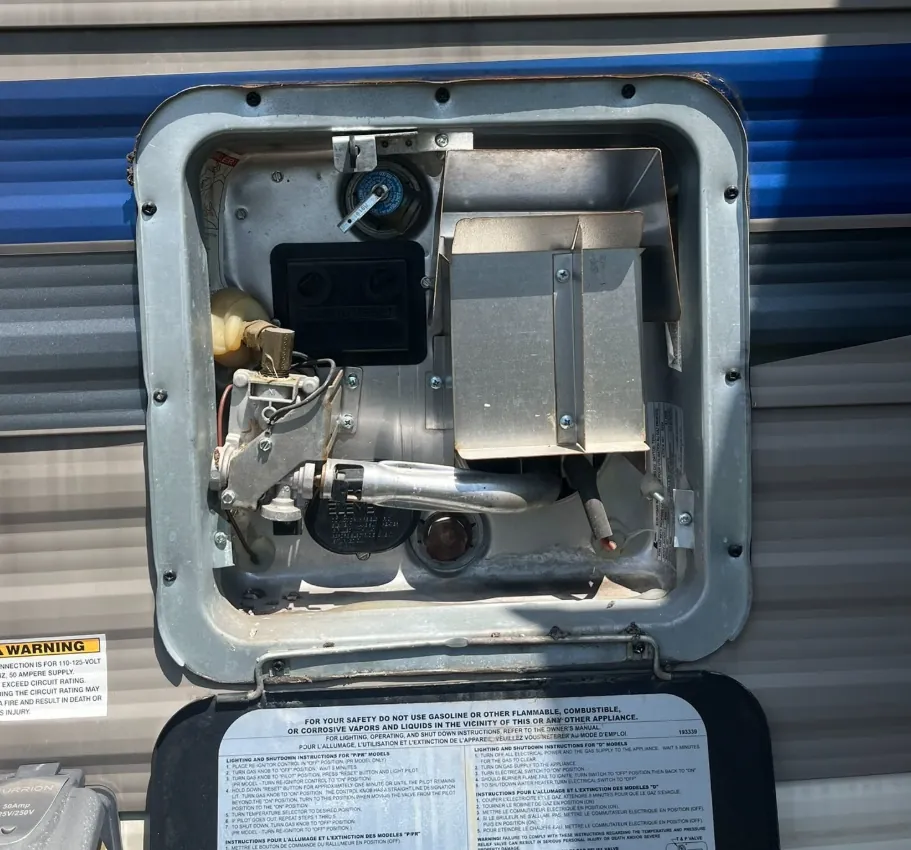
There are usually two resets and they are different things, which is where the confusion starts.
The first is the thermal cutoff, a small button on the unit itself, generally reached through the exterior access door. It trips when the tank overheats and it will not allow the heater to run until it is pressed back in. If pressing it restores operation, note that: a cutoff does not trip for no reason, and something caused the overheat.
The second is a control board reset, done by removing power to the unit entirely, both the 120 volt breaker and the 12 volt supply, for several minutes. Boards latch faults after repeated failed ignition attempts and will not retry until they lose power.
If a reset brings it back and it fails again within days, the reset is treating a symptom.
Why does my water heater work on gas but not on electric?
Because the electric side is a simple heating element circuit and those fail in a small number of ways.
The element itself is the most common. It is a resistive element sitting in water, and it eventually opens or fails. The second is its own thermal cutoff, fitted specifically to protect it. The third is the supply: a tripped breaker, a failed switch or a coach running on weak shore power.
There is one cause worth naming because it is preventable and permanent. Running the electric element with the tank empty destroys it almost immediately, because the element depends on water to carry heat away. This is the single most common way an element is killed, and it usually happens right after de-winterizing when the switch goes on before the tank has filled.
Fill first, then switch on. That order is the whole trick.
Why does the water heater light and then go out?
That specific pattern almost always means the unit is lighting successfully and then failing to confirm it, which is a sensing problem rather than a gas supply problem.
Direct spark ignition systems light the burner and then check for flame using a sensing electrode. If the electrode is dirty, corroded or out of position, the board never sees the flame it just created and shuts the gas off as a safety response. It looks like the heater cannot stay lit; in fact it is refusing to believe it is lit.
The other common cause is airflow. A flue obstructed by a wasp nest, a mud dauber or debris disturbs the flame enough that it will not hold, and in Florida that is a genuinely frequent finding on a coach that has stood for a season.
Both are cleaning and adjustment work rather than parts, which puts this at the cheaper end.
What does it mean when it runs but the water is not hot?
It means the unit is heating something, just not what you are drawing. Three causes account for nearly all of it.
- A bypass valve left in the winterizing position, so water routes around the tank entirely and never touches it.
- A thermostat set low or failing, so the tank is heating to a temperature well below what you expect.
- Heavy sediment or a spent anode taking up tank volume, so the amount of genuinely hot water is far less than the tank's rating.
The bypass valve is worth checking first because it is free and it catches people every spring. A tank bypassed for winterizing and never returned to the normal position produces a heater that runs perfectly and delivers cold water indefinitely.
Our RV plumbing troubleshooting guide covers the anode and sediment side in detail.
Why is my RV water heater not staying running?
A unit that runs for a while and then stops is behaving differently from one that never starts, and the difference points at protection rather than failure.
The usual explanation is a thermal cutoff opening as the tank gets hot, then closing again as it cools, producing a cycle. What causes that overheat is more interesting than the cutoff itself: heavy sediment on the bottom of the tank insulates the heat from the water, so the tank metal gets hot while the water does not.
Sediment builds faster on hard water, and much of Florida has hard water. A tank flush and an anode check is routine maintenance that directly prevents this failure mode, and it is the cheapest service on the whole appliance.
On the gas side, the same intermittent pattern can come from marginal propane pressure, which shows up on several appliances at once rather than only this one.
How long should an RV water heater last?
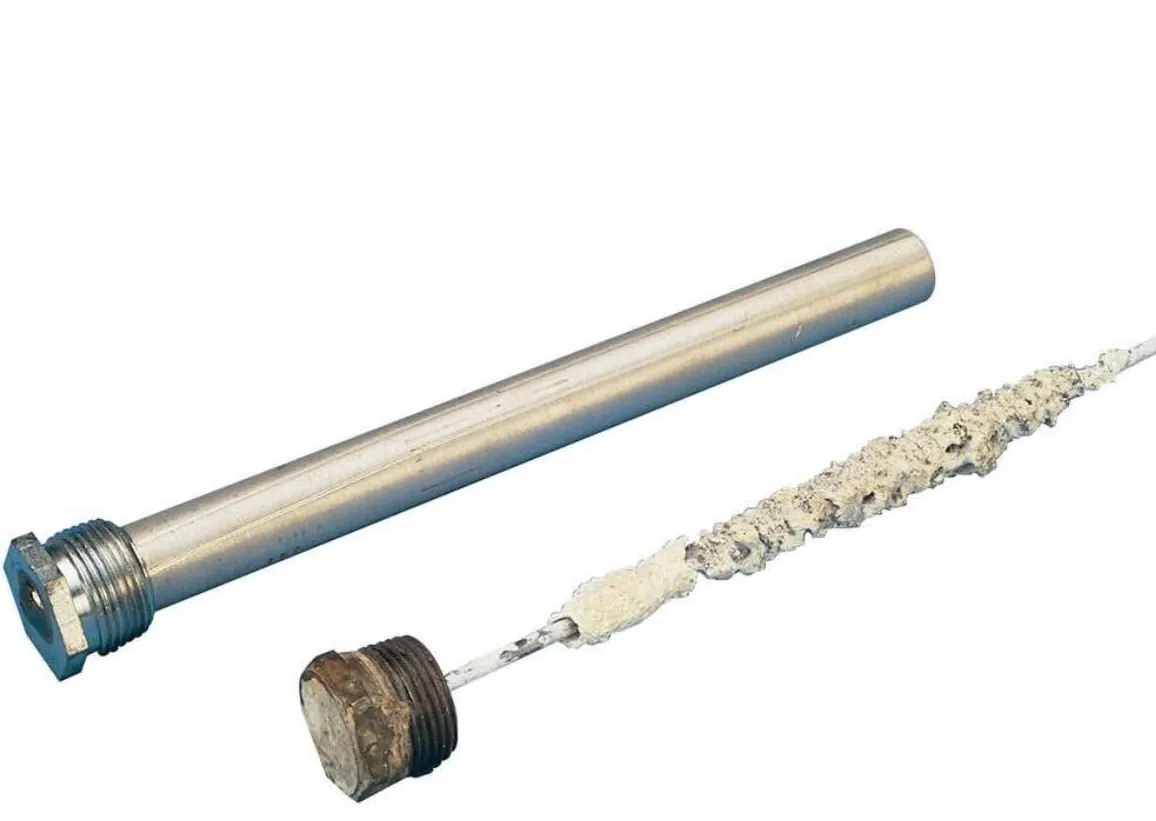
Longer than most of them do, and the difference is almost entirely maintenance. The tank is the part that ultimately decides the life of the unit, and the tank's life is decided by whether the anode rod was ever changed.
An anode rod is a sacrificial component. It is designed to corrode so the tank does not, and once it is consumed the corrosion moves to the tank itself. A rod checked annually and replaced when spent is a small routine cost. A rod left until it is gone means the tank quietly starts rusting from the inside.
Not every RV water heater has one, and fitting a rod to a tank not designed for it causes its own problems, which is why the model matters before anyone buys a part.
Florida's hard water and year-round use both accelerate this, so an annual check here is more meaningful than the general guidance suggests.
When is it a repair and when is it a replacement?
The dividing line is the tank. Everything bolted to the outside of the unit is a repair, and a tank that has failed is a replacement.
Elements, thermostats, thermal cutoffs, control boards, igniters, gas valves and anode rods are all serviceable parts, and none of them individually approaches the cost of a new water heater. A unit with a sound tank is almost always worth repairing regardless of its age.
A leaking tank is the end. Tanks are not repaired, welding a corroded tank is not a safe or lasting fix, and a tank that has rusted through has usually been thinning for years. Water appearing at the bottom of the compartment is the sign, and it is worth acting on quickly because the water is going somewhere in the coach.
At replacement time it is worth asking about a tankless conversion, since that is the moment the plumbing and the opening are already open.
What a visit costs
A service call is $299 and covers the trip out to your RV and the first hour on site. Work past that first hour is quoted to you once our technician has found the fault, before we carry on. In Orlando, Lakeland, Kissimmee, Apopka and nearby the service call is $399 and time past the first hour runs $200 per hour. Written estimates are free and you approve one before any work starts. Call 888-759-1438.
Sources and further reading
Every figure above that came from a manufacturer or a standards body is linked here so you can check it yourself.
- Suburban water heaters operation guide (PDF) - Manufacturer operating and troubleshooting documentation, including the thermal cutoff and its reset procedure.
- Suburban - tank water heaters - Model identification, which decides whether your tank takes an anode rod at all.
- Suburban - replacement anode rod - The sacrificial part whose replacement decides how long the tank itself lasts.
- OSHA - electrical hazards - Why live element connections in a wet compartment are treated as qualified-person work.
Related pages on this site
- RV water heater and anode service - the flush and rod change that prevents most of this
- RV plumbing troubleshooting - anodes, sediment and the rest of the water system
- Truma AquaGo service - for coaches with a tankless unit fitted
- RV winterization in Florida - why the bypass valve catches people every spring
- RV repair in Gainesville - mobile plumbing service in north central Florida
RV water heater questions Florida owners ask
How long should an RV water heater take to heat up?
On gas, typically twenty to thirty minutes for a six gallon tank from cold. On the electric element it is considerably slower, often an hour or more, because the element delivers far less power than the burner. A slow recovery on electric alone is normal rather than a fault.
Can I run the electric element with an empty tank?
No, and this is the single most common way an element is destroyed. The element relies on surrounding water to carry heat away, so running it dry burns it out almost immediately. Always confirm the tank is full before switching the electric side on, particularly after de-winterizing.
What is the bypass valve and why does it matter?
It routes water around the tank instead of through it, so the tank can be left empty during winterizing without filling with antifreeze. Left in the bypass position afterwards, the heater will run perfectly and you will never get hot water, because the water you draw never enters the tank.
Why does my water heater smell like rotten eggs?
That is usually a reaction between the anode rod and bacteria in the water rather than a fault in the heater. Flushing the tank and changing the rod normally resolves it, and switching to a different rod material helps where it keeps returning.
Is a tankless RV water heater worth it?
It gives continuous hot water and removes tank corrosion and anode maintenance entirely, which is a real advantage in hard water. The trade is that tankless units are more sensitive to water flow and to propane pressure, and they cost more up front. The natural moment to consider one is when an existing tank has failed.
Can I fix an RV water heater myself?
The bypass valve, the thermal cutoff button and a tank flush are reasonable owner tasks. Anything involving the gas train, the burner or live 120 volt element connections is not, because those combine propane and mains electricity in a confined compartment.