What Does RV Awning Replacement Cost in Florida?
Why one quote is a few hundred and the next is four figures, what pushes a job past the base price, and the point where storm damage stops being a repair and becomes a claim.
The gap between quotes is almost always fabric versus assembly. Replacing fabric on sound hardware is the cheap end. Replacing arms, a roller tube or a motor after a storm is a different job entirely. What decides which one you need is the hardware, not the state of the fabric.
Apex RV Repair is mobile across Florida - we come to your RV. Call 888-759-1438.
Awning quotes surprise people more than almost any other RV job, because two numbers for what sounds like the same work can sit a long way apart.
The reason is that an awning is two things: a piece of fabric, and the mechanism that moves and holds it. Damage to one is inexpensive. Damage to both is not, and a Florida storm rarely damages only one. Our awning care guide covers the maintenance side; this page is about the money.
Why is fabric-only so much cheaper than a full assembly?
Because they are different products and different amounts of work. Fabric is a consumable. It is measured, ordered and fitted to hardware that stays on the coach, and the job is finished in a visit.
An assembly is arms, a roller tube, mounting brackets, springs and on a powered unit a motor and its control. Replacing that means removing the old hardware from the side of the coach, dealing with whatever the mounting holes look like underneath, and fitting and aligning the new unit so it rolls straight and seals against the wall.
The second job also carries a risk the first does not. Awning brackets are through-fastened into the sidewall, and a bracket that has been working loose has often been letting water in for a while. Finding that turns an awning job into a sealing job.
Fabric on sound hardware is the outcome everyone wants and it is worth establishing early which one you are dealing with.
What makes an awning replacement cost more than the base price?
Five findings move the number, and all of them are found on the coach rather than predicted on the phone.
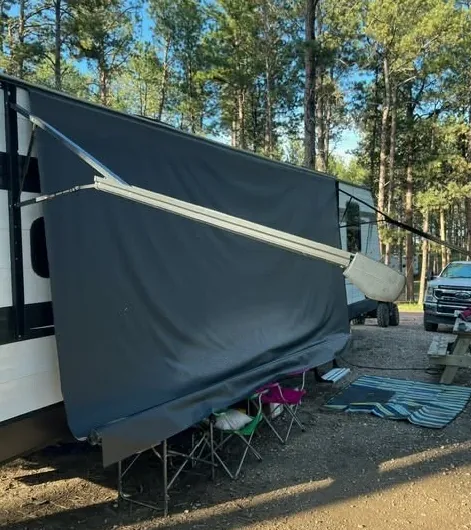
- Bent or twisted arms, which are common after wind and cannot be straightened reliably.
- A bowed roller tube, which shows as fabric that will not roll evenly and cannot be corrected with tension.
- A failed motor or control on a powered awning, which is a separate part from the mechanics.
- Damage to the sidewall behind the mounting brackets, which has to be repaired and sealed before anything new is fitted.
- A discontinued model, where the original assembly is no longer available and an adaptation is needed.
The sidewall is the one that changes the character of the job. An awning fitted over compromised structure will loosen again, so that has to be dealt with first regardless of what it does to the estimate.
Will insurance cover storm damage to an RV awning?
Often, and awnings are one of the more straightforward RV claims, because storm damage is visibly sudden in a way sealant failure is not.
What complicates it is the awning left out. Manufacturers are explicit that an awning should be retracted in wind, and an assembly destroyed while extended during a storm invites the argument that the loss was avoidable rather than accidental. Outcomes vary between insurers and between policies on exactly that point.
Damage that happens while the awning is stowed is a much cleaner claim. So is damage from falling debris, a branch, or hail, where the cause is external and obvious.
As with any claim, photograph everything before touching it, including the position the awning was in. Our guide to roof leak claims covers how the sudden-versus-avoidable argument tends to run.
Does the awning brand change what it costs?
It changes availability more than price, and availability is what actually decides your timeline.
The major manufacturers fitted to coaches sold here have well-supported parts channels, so fabric and components are generally obtainable. Where cost climbs is on older models, discontinued lines and coaches carrying a manufacturer's own branded assembly that was only ever made for a few model years.
Powered awnings add their own dimension, because the motor and control have to match the mechanics and sometimes the coach's own control panel. A powered replacement is rarely a simple swap between brands.
This is why identifying what you actually have matters before anyone quotes it. The model and serial are usually printed on a label at the end of the roller tube or on the arm casting. Finding those numbers before you call turns a guess into a quote, and it is the difference between a part that arrives and a part that has to go back.
Is a manual awning cheaper to own than a powered one?
Over the life of the coach, generally yes, and the difference is not in the purchase price.
A manual awning has fewer things that fail. There is no motor, no control board and no wiring running through the arm, so what goes wrong is mechanical and visible. When it does fail, it usually still works badly rather than not at all, which means you can retract it and travel.
A powered awning is more convenient and more likely to be used properly, which genuinely extends fabric life, because an awning that is easy to retract actually gets retracted. The trade is that a failed motor can leave the awning extended, and an awning that will not stow is a coach that cannot travel.
Most powered units have a manual override for exactly that reason, and knowing where yours is before you need it is free.
What does a cheap awning replacement leave out?
Usually the inspection of everything the fabric attaches to. New fabric on a bent arm or a bowed tube looks fine on the day and starts wearing at the point where the geometry is wrong, so it fails early and unevenly.
The second omission is the mounting. Brackets should be checked and resealed while the assembly is off, because that is the only convenient moment to do it. Refitting over old sealant is fast, invisible and stores up a water problem.
Third is tension and alignment. An awning that does not roll straight wears its own fabric, collects water in one corner and puts uneven load into the arms. Getting it right takes time at the end of the job, which is exactly where a cheap quote saves it.
None of this shows for a season, which is why the cheapest quote often wins the work and loses the coach money.
How much does ignoring an awning problem cost?
More than the awning, because the failure modes reach the coach. That is the part owners tend not to see coming.
A loose bracket is the clearest example. It is a small fix while it is only loose, and while it is loose it is also flexing the sidewall and working the sealant around the fasteners. Left long enough it becomes a water intrusion path into the wall, and wall repairs are in a completely different price category from awning repairs.
A torn awning is the other one. Fabric that has started to tear catches wind rather than shedding it, which loads the arms far harder than intact fabric would, and that is how a fabric job becomes an assembly job during the next storm.
Florida compresses both timelines. Ultraviolet exposure weakens fabric faster here, and the afternoon storm pattern from June onward gives any weakness a regular test.
What can you do to make an awning last?
Three habits do most of the work, and none of them cost anything.
- Retract it whenever you leave and whenever wind is forecast, without exception. Wind is what destroys assemblies, and an extended awning in a Florida afternoon storm is the single most expensive mistake available.
- Never roll it up wet. Trapped moisture in Florida humidity produces mildew within days, and mildew staining is permanent in the fabric.
- Check the mounting brackets twice a year and have anything loose dealt with before it becomes a sealing job.
The first one matters more than the other two combined. Almost every destroyed assembly we are called to was extended when it should not have been, and almost every one of those was a coach nobody was standing next to at the time.
What a visit costs
A service call is $299 and covers the trip out to your RV and the first hour on site. Work past that first hour is quoted to you once our technician has found the fault, before we carry on. In Orlando, Lakeland, Kissimmee, Apopka and nearby the service call is $399 and time past the first hour runs $200 per hour. Written estimates are free and you approve one before any work starts. Call 888-759-1438.
Sources and further reading
Every figure above that came from a manufacturer or a standards body is linked here so you can check it yourself.
- Lippert - awnings support - Manufacturer documentation for the awning systems fitted to a large share of coaches sold here, including manual override procedures.
- Lippert - master owner's manuals index - Identify exactly which awning assembly is on your coach before anyone quotes parts for it.
- National Weather Service - Tallahassee - Florida's afternoon storm pattern, which is the wind event that destroys extended awnings.
- Florida Office of Insurance Regulation - The state regulator, including consumer information on how storm damage claims are handled.
Related pages on this site
- RV awning fabric replacement - the job when the hardware is still sound
- Awning storm damage rebuild - when arms or the roller tube have gone too
- RV awning care in Florida - wind limits, mildew and the maintenance that prevents this
- Will insurance cover an RV roof leak - how the sudden-versus-avoidable argument works
- RV repair in Naples - mobile awning service in southwest Florida
RV awning cost questions Florida owners ask
Can I replace RV awning fabric myself?
It is possible with two people and care, and the risk is the roller tube. It holds a strong spring under tension, and releasing that uncontrolled causes real injuries. Anyone attempting it should understand how their specific tube is de-tensioned before starting rather than after.
How long does an RV awning last in Florida?
Less than the general guidance suggests, because ultraviolet exposure here is harder on fabric than in most of the country. What decides it is habit rather than years: an awning that is retracted when unattended and stored dry lasts far longer than one left out.
Is vinyl or acrylic better for a Florida awning?
They fail differently rather than one being simply better. Vinyl resists water and shows mildew staining; acrylic breathes and dries faster but is less waterproof in heavy rain. Our awning care guide compares them properly for this climate.
What happens if my powered awning will not retract?
Most powered awnings have a manual override so the assembly can be stowed enough to travel, and finding out where yours is before you need it is worth doing now. A coach that cannot retract its awning cannot safely move, which turns an inconvenience into an emergency.
Does a torn awning need replacing immediately?
Sooner than most owners think, because a tear changes how the awning behaves in wind. Intact fabric sheds air; torn fabric catches it and transfers that load into the arms. Replacing fabric is far cheaper than replacing an assembly the fabric destroyed.
Can an awning be repaired instead of replaced?
Small tears away from the edges and the roller can sometimes be repaired, and it is a reasonable stopgap. What cannot be repaired reliably is a bent arm or a bowed roller tube, because the geometry is what holds the fabric flat and a straightened component will not hold alignment.