RV Awnings in Florida: Wind, Mildew and Measuring for New Fabric
Why an awning fails in an afternoon storm, what the black streaking really is, and the measurement almost everyone gets wrong.
If you take one thing away, make it the measurement. Awning fabric is sized center-to-center between the arm assemblies, and the finished panel is shorter than the nominal awning length by roughly the width of the hardware at each end. Measure the old fabric and you will order a size short. Measure the rail, or go by the awning's stated size and let the fabric supplier apply the standard reduction.
Apex RV Repair is mobile across Florida - we come to your RV. Call 888-759-1438.
An awning is the most exposed thing on an RV and the least often maintained. It spends its life in direct sun, gets rolled up wet, and is asked to survive Florida afternoon storms that arrive in ten minutes with no warning.
Most awning damage is not really awning failure. It is an awning that was left out when it should not have been, or fabric that had already been weakened by heat and mildew and simply gave up on a normal day.
How much wind can an RV awning actually take?
Less than people assume, and the number is not really the point - what matters is that the failure is sudden rather than gradual.
An extended awning is a large flat surface held out on two arms. Wind does not simply push it sideways; it gets underneath, lifts, and turns the awning into a wing. Once that starts, the load on the arms and on the mounting rail rises very quickly, and the failure is usually the hardware or the rail rather than the fabric tearing.
That is why awning damage in Florida so often comes with sidewall damage. A rail pulled away from the wall takes fasteners, sealant and sometimes a section of the wall skin with it, and the resulting repair is far larger than an awning job.
- Never leave an awning out unattended, and that includes overnight and while you are away from the site. Florida afternoon storms build fast and the awning is out for hours before anyone gets back to it.
- Roll it up if you are unsure. There is no penalty for retracting an awning that turned out not to need it, and there is a large one for the reverse.
- Set a slight slope so water runs off one end. Standing water on an awning is heavy and is what pulls arms out of alignment even without wind.
- Tie-downs are not a wind solution. They reduce flap and movement on a calm day. They do not make an awning safe in a storm, and they can transfer the load into the rail rather than letting the awning fold.
The overnight rule
If you do nothing else differently, stop leaving the awning out overnight. A large share of the awning damage in Florida happens between midnight and dawn, to people who were asleep and had no idea the weather had changed.
What are the black streaks on my awning and can I get rid of them?
There are two different marks that get called the same thing, and they need different treatment.
Mildew shows as spotting or blotches, often in a pattern that follows where the fabric was folded when rolled up. It is biological growth, it happens because the awning was rolled away damp, and Florida humidity means the fabric may never dry fully inside the roll. This is by far the most common cause of a stained awning here.
Runoff streaking is different: vertical dark lines running down the fabric, usually worse near the roof edge. That is oxidized residue washing off the roof membrane above and being deposited on the awning. The awning is not dirty so much as it is catching what the roof sheds - which is also why the same streaks appear on the sidewalls.
How do you actually remove awning mildew and runoff staining?
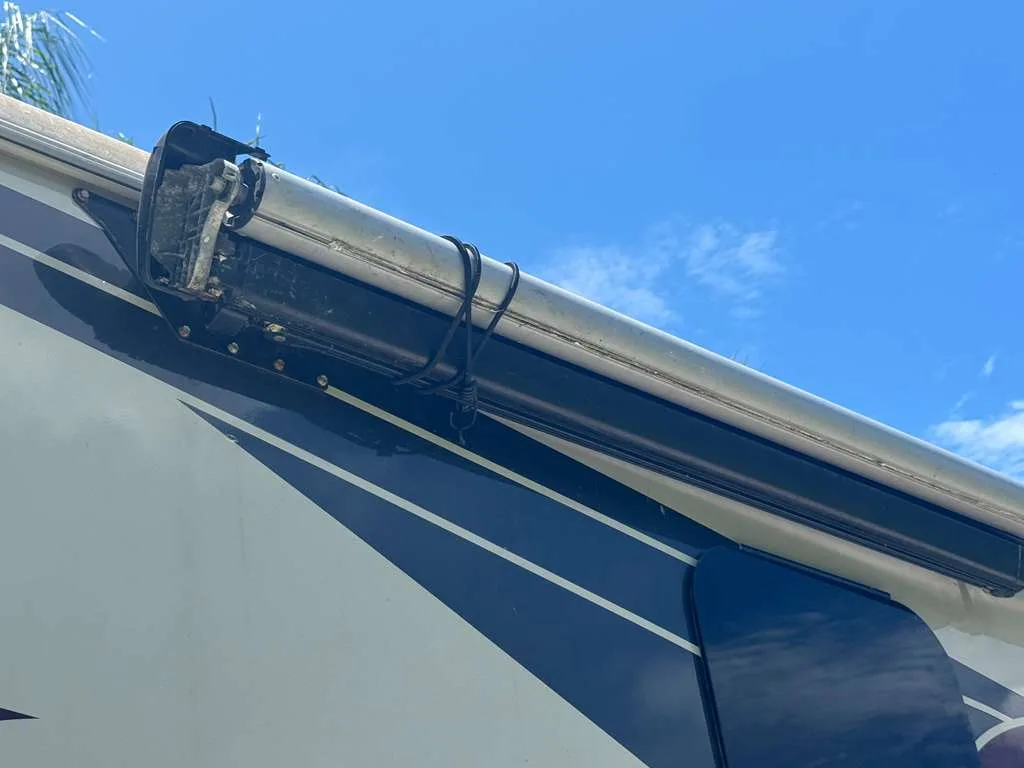
Mildew responds to cleaning with an appropriate fabric cleaner, and more importantly to prevention: let the awning dry before rolling it away, and if you have to roll it wet, extend it again at the next opportunity rather than leaving it rolled for weeks. Runoff streaking is addressed at the roof, by washing the membrane, not by scrubbing the awning harder.
What matters for both: aggressive cleaners and pressure washing damage the fabric coating. A vinyl awning has a surface treatment that is what makes it water resistant, and stripping that produces a clean awning that now absorbs water and grows mildew faster than before.
Neither mark is a reason to replace fabric on its own. Both are cosmetic until the coating is gone, and it is the cleaning method that usually decides which side of that line the awning ends up on.
How do I measure for replacement awning fabric?
This is where the money gets wasted, because the obvious method gives the wrong answer.
Awnings are described by a nominal size - the overall length of the assembly. The fabric, however, spans between the two arm assemblies, and the hardware at each end occupies space. The finished fabric panel is therefore meaningfully shorter than the nominal awning length.
So the correct method is to measure center to center between the arm assemblies, or to establish the awning's nominal size and let the fabric supplier apply their standard reduction.
The nominal size printed on the assembly is not the fabric size, and ordering by it is the single most common way owners end up with a panel that will not fit. Measure the hardware you actually have rather than trusting the label on it, because the label describes the assembly and the supplier needs the span.
Should you replace awning fabric alone or the whole assembly?
- Do not measure the old fabric. It has stretched, shrunk or torn, and any of those puts your number off.
- Do not measure the rail end to end and order that, for the same hardware reason.
- Do check the roller tube and the hardware while the fabric is off. A bent tube or a worn arm pivot will destroy new fabric quickly, and that access is already open.
Also decide before ordering whether you are replacing fabric only or the whole assembly. If the arms are bent, the rail is pulled, or the spring tension is gone, new fabric on old hardware is a short-term repair.
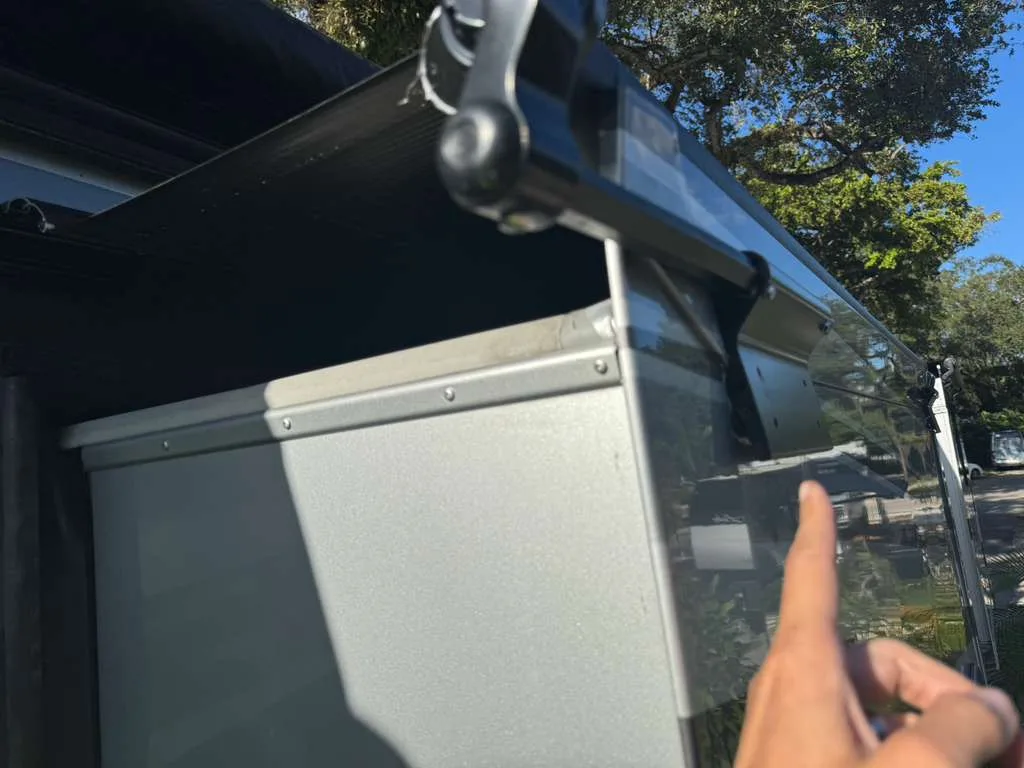
Answer that before ordering anything. New fabric fitted to a bent arm or a pulled rail fails early and takes the cost of the fabric with it.
Vinyl or acrylic - which lasts better in Florida?
They fail in different ways, and Florida is hard on both for different reasons.
| Vinyl | Acrylic | |
|---|---|---|
| Water | Waterproof while the surface coating is intact. | Water resistant and breathable rather than waterproof - it sheds light rain and lets moisture through in a downpour. |
| Mildew | The main failure mode here. Rolled up damp, it holds moisture against itself and grows mildew readily. | Breathes, so it dries faster and resists mildew better - the significant advantage in a humid climate. |
| Sun | Coating degrades over time; the fabric stiffens and eventually cracks along fold lines. | Solution-dyed acrylic holds color well, but the fabric still ages in sustained UV. |
| Shade and heat | Blocks light and traps heat underneath. | Breathes, so the space under it tends to be cooler. |
| Cleaning | Wipes clean easily while the coating is good; aggressive cleaning strips that coating. | More tolerant of cleaning but can hold dirt in the weave. |
For a coach that lives in Florida and gets rolled up wet often, the breathability argument favors acrylic. For a coach that wants a waterproof surface and gets dried before rolling, vinyl is fine. What changes the outcome more than either choice is whether the awning goes away wet.
Why won't my powered awning extend or retract properly?
Work through it in this order, because the cheap causes are also the most common.
- Battery voltage under load. Powered awnings are 12 volt motors and behave exactly like slide-outs when the bank is weak - slow, stalling, or dead. Check it under load before anything else.
- Obstruction. A branch, a tie-down still attached, or debris in the roller. Look before running the motor again.
- Spring tension. On many designs the springs assist retraction. Lost tension shows as an awning that goes out fine and struggles to come back.
- The motor or gearbox itself, which is the least likely and the one people jump to first.
- The control switch or wiring, particularly on a coach that has been in Florida sun for years - connectors corrode in the sidewall.
Know where the manual override is before you need it. Every powered awning has a way to be brought in by hand, and the time to look it up is not while a storm is coming in. Lippert publishes awning documentation by product line.
What maintenance actually extends awning life here?
- Dry it before rolling it away. This one habit prevents most mildew and costs nothing.
- If you rolled it up wet, extend it again when you can rather than leaving it rolled for weeks.
- Wash the roof. Less runoff means fewer streaks on the awning and the sidewalls.
- Clean the fabric gently and on a schedule, with a product intended for it. No pressure washing.
- Check the arms, pivots and rail fasteners twice a year. A rail fastener working loose is a leak path into the sidewall before it is an awning problem.
- Set a slope every time you extend it, so water runs off rather than pooling.
- Retract it whenever you leave the site or go to bed.
The rail is the item most worth watching, because it is both an awning component and a sealed penetration into the wall. Our water damage article explains why sidewall penetrations matter more than they look.
When is this a job for a technician?
Cleaning, inspecting, adjusting slope and checking battery voltage are all owner tasks.
Where it stops is spring tension. Awning roller tubes store real energy in their springs, and releasing that uncontrolled while a large fabric panel and two arms are under load causes genuine injuries. Fabric replacement on a spring-loaded awning is not a first DIY project.
The other one is any awning where the rail has moved. That is no longer an awning repair - it is a sidewall repair with an awning attached, and the sealing behind the rail decides whether the coach leaks afterwards. See our awning service page for what a mobile visit covers.
The dividing line is whether a mistake ends at the part or reaches the wall. Fabric and a stuck motor stay where they are; anything that involves removing the rail or drilling near it does not.
What a visit costs
A service call is $299 and covers the trip out to your RV and the first hour on site. Work past that first hour is quoted to you once our technician has found the fault, before we carry on. In Orlando, Lakeland, Kissimmee, Apopka and nearby the service call is $399 and time past the first hour runs $200 per hour. Written estimates are free and you approve one before any work starts. Call 888-759-1438.
Sources and further reading
Every figure above that came from a manufacturer or a standards body is linked here so you can check it yourself.
- Lippert - awnings support - Manufacturer documentation for awning product lines, including manual override procedures and hardware service.
- Lippert - master owner's manuals index - Where to find the specific manual for your awning rather than a similar one.
- Dometic documents database - For Dometic-branded awnings, look up the manual by model number for measurements and service procedures.
- National Weather Service - Tallahassee - One of the NWS offices covering Florida. Local forecast and storm information is the practical tool for deciding whether the awning stays out.
Related pages on this site
- RV awning repair - fabric, arms, rails and powered awning faults
- RV roof repair - the membrane above the awning, and the source of runoff streaking
- Spotting RV water damage - why a loose awning rail is a leak path
- Book a service call - mobile across Florida
RV awning questions Florida owners ask
Can I replace just the awning fabric or do I need the whole assembly?
Fabric only is fine if the arms, roller tube, rail and springs are all sound. Fit new fabric to bent arms, a distorted tube or a rail that has started to pull, and the new fabric wears unevenly and fails early. The hardware inspection is what decides, and it is far easier to do while the old fabric is off.
How do I get mildew off an RV awning?
A cleaner made for awning fabric, a soft brush and patience. Avoid bleach-heavy household products and never pressure wash - both strip the surface treatment that makes vinyl water resistant, which leaves you with a clean awning that grows mildew faster than it did before. Then fix the cause by letting it dry before it is rolled away.
Is a wind sensor worth having on a powered awning?
It is a useful backstop and not a substitute for retracting the awning. Sensors respond to movement or wind speed and can react after a gust front has already loaded the awning, which in a fast-building Florida storm may be too late. Treat it as a second line of defense behind the habit of bringing the awning in.
Why does my awning sag in the middle?
Usually stretched fabric, lost spring tension, or arms that are no longer holding the correct geometry. Sag matters beyond appearance because it creates a pocket that collects water, and a pool of water is heavy enough to bend arms or pull at the rail. A sagging awning should be looked at before the next storm rather than after.
Does an awning cause water to get into the RV?
Not the fabric, but the rail can. The awning rail is fastened through the sidewall and sealed, and those fasteners work under load every time the awning is used. A loose rail fastener or failed sealant along the rail is a genuine entry point, which is why the rail is on the twice-yearly inspection list.
Can you replace awning fabric at a campground?
Yes, awning fabric and hardware work is mobile and done where the RV is parked, anywhere in Florida. What we do need is enough space beside the coach to extend the awning fully and work along it. Call 888-759-1438 with the awning's nominal size and whether it is manual or powered.
My awning came in crooked and now it will not roll up flat. What happened?
Usually one arm is out of adjustment or slightly bent, so the roller is no longer square to the rail and the fabric tracks to one side as it winds. Continuing to operate it that way creases the fabric along the same line every time and eventually splits it. It is worth correcting the geometry rather than fighting it.
Should I remove the awning for hurricane season?
Most owners do not, but the coach should be prepared: awning fully retracted and secured, arms latched, and anything that could catch wind removed. If the coach is stored somewhere exposed for the season and you will not be checking on it, removing the fabric is a reasonable precaution and considerably cheaper than a torn awning that has taken the rail with it.