Furrion Chill AC Repair: Mobile Rooftop Service in Florida
Furrion Chill and Chill Cube rooftop AC diagnosis, control box and shroud replacement anywhere in Florida. Call 888-759-1438.
A Furrion Chill rooftop air conditioner is worth repairing when the fault sits in the ceiling control box, the ADB shroud, a fan motor, a sensor or the roof gasket, because Furrion publishes replacement part numbers for all of them. It is worth replacing when the sealed circuit has lost refrigerant, since a Chill rooftop unit has no field service ports.
Repair or Replace a Furrion Chill: What Actually Decides It
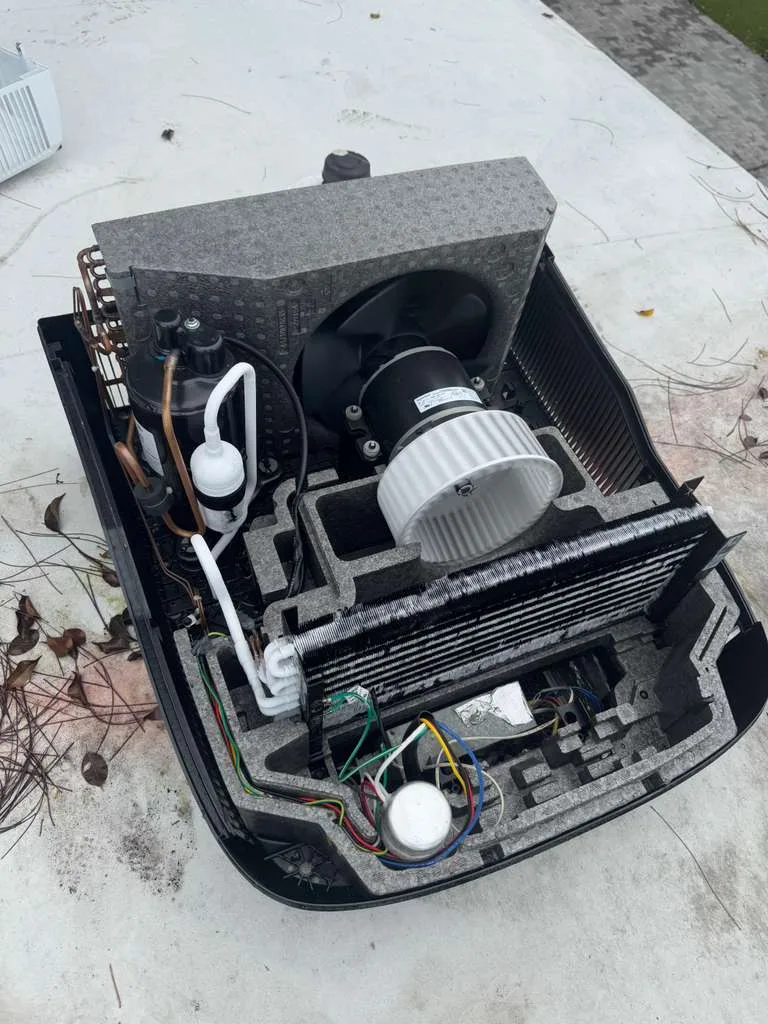
The decision on a Furrion Chill turns on one question: does the fault sit inside the sealed refrigeration circuit or outside it? Outside it, nearly everything is a parts job. Furrion's own service manual CCD-0010485 lists the ADB shroud, the EVA roof gasket, the leveling shim kit, the return air filter, the evaporator fan blades, the indoor evaporator motor, the outdoor condenser motor and the start capacitors as replaceable items, each with a Lippert part number. The white low profile top cover shroud, for instance, is part 2022452411, supplied with its nine screws. Inside the circuit there is nothing to do. The FACR15SA leaves the factory with a 23.1 ounce R410A charge and no field service ports, so a unit that has lost that charge is a replacement rather than a recharge. Which side of the line a fault falls on is settled by the diagnosis, not by the age of the unit, and it is the whole of the repair or replace decision.
Chill, Chill Cube and Chill Low Profile Are Three Different Boxes
Furrion sells three rooftop shapes under the Chill name, and the names mislead. The original Chill (FACR13SA, FACR14SA, FACR15SA) uses R410A and measures 34-7/8 by 27-5/8 by 13-5/8 inches. The Chill Cube (FACR18VSSA, FACR18HEPA) uses R32, is rated 18,000 BTU, and measures 29 by 29-1/2 by 14-1/2 inches. The Chill Low Profile (FACR13LPSA2, FACR15LPSA2) also uses R32, stands only 11 inches tall, but stretches 41-1/2 inches front to back. So the Cube is not the low one. It is 7/8 of an inch taller than a standard Chill, and what it actually buys is a nearly square footprint that gives back roughly five inches of roof length for a solar panel or a vent. All three drop into the same 14-1/4 by 14-1/4 inch opening, so the hole is almost never what blocks a swap. Roof thickness and the hardware already around it are what block it.
Runs All Day But Never Gets Cold: The Order to Check
Owners describe this two ways: the Chill runs constantly and the coach never cools, or it cools for a while, shuts off on its own and restarts later. Check in order. First the return air filter and decoration plate, since Furrion specifies cleaning the filter every four weeks in use and replacing it yearly, and a loaded filter starves the evaporator. Second the freeze sensor clipped into the evaporator fins, which shuts the unit down by design and reads to an owner as a random fault. Third the ceiling control box and its harnesses. Fourth the roof itself: blocked intake grilles, a cracked shroud, and the gasket. Those four mounting bolts torque to 40 to 50 inch pounds and compress the gasket to about 9/16 inch, so an inch-pound torque wrench earns its place here. Left alone the pattern moves on to a frozen coil, then water through the ceiling grille, and a soaked air distribution box is a ceiling repair, not an AC repair.
The Control Box, the DIP Switches and Third-Party Thermostats
A Chill's brain does not live on the roof. The control box mounts into the ceiling frame inside the coach, behind the ADB shroud, and carries a six-position DIP switch that sets the zone number, tells the unit whether a furnace and a heat strip are fitted, and selects between the digital wall thermostat harness and the analog one. That last switch is where non-Furrion thermostats fail. The analog harness exists for Lippert OneControl only, and the R32 Low Profile manual states flatly that otherwise the cable is not to be used, so a Chill wired to a generic RV thermostat has no supported path at all. Supported controls are Furrion's own FACW12SA-BL basic, FACW12PA-BL premium and FACW12ZA-BL multi-zone wall thermostats, or the FACC13VSD thermostat adapter kit on a Cube. Multi-zone coaches also need every control box set to a unique zone value, or the zones argue over one shared thermostat.
What 15,500 BTU Actually Holds in a Florida August
Furrion rates the FACR15SA at 15,500 BTU with 3.2 pints per hour of dehumidification, and puts its applicable vehicle length at 31 feet. The 13,500 BTU FACR13SA is rated to 23 feet, and the 18,000 BTU Chill Cube is also rated to 23 feet because it is a single non-ducted zone. Those figures assume shade, sealed ducts and intact insulation. Park broadside to an August afternoon and the roof, the slide toppers and the glass all add heat faster than one rooftop unit removes it. The wall thermostat set range bottoms out at 60 degrees, but a set point is a request, not a capability: the unit removes a fixed quantity of heat per hour and the coach settles wherever gain and removal balance. Furrion also warns against running MAX COOL overnight and says to leave at least two ceiling vents open, because a Chill can ice up below 78 degrees ambient.
Sources
Every figure on this page comes from a manufacturer document or a standards body, not from another repair site. Here is where each one comes from.
- Furrion 15.5K Rooftop Unit Spec Sheet, FACR15SA-BL-AM and FACR15SA-PS-AM15,500 BTU capacity, R410A refrigerant, 1,720 watts and 15.4 amps in cooling, and the 60F to 86F set temperature range
- Furrion Chill Rooftop Air Conditioner Instruction Manual, FACR13SA / FACR14SA / FACR15SAthe 14-1/4 by 14-1/4 inch roof opening, 3 to 6 inch roof thickness, 40 to 50 inch pound bolt torque and 9/16 inch gasket compression, DIP switch functions, wall thermostat model numbers, and the 13,500 / 14,500 / 15,500 BTU specification table
- Furrion Chill Cube 18K Non-Ducted Rooftop Air Conditioner Aftermarket ManualChill Cube model numbers, 18,000 BTU rating, R32 refrigerant, 29 by 29-1/2 by 14-1/2 inch unit dimensions and the 3-1/2 inch minimum roof thickness
- Furrion Chill Low Profile Rooftop Air Conditioner (R32) Installation and Owner's ManualChill Low Profile dimensions and capacities, the DIP switch analog and digital selection, and the statement that the analog harness is only for Lippert OneControl
- Chill 13.5K / 15K / Low Profile Air Conditioner (R32) Troubleshooting and Service Manualthe replaceable parts list with Lippert part numbers including shroud 2022452411 and the EVA gasket, filter service intervals, and the MAX COOL and 78F freeze-up warnings
- Furrion Warranty policythat product registration is not required for Furrion warranty coverage and that the original receipt or order number serves as proof of purchase date
Related repairs
- Rv Ac Soft Start Install in Florida
- how we handle suburban furnace repair
- Truma Aventa Service repairs
Other systems we service
Where we work
Service category
What this usually costs
| Item | Price | What it covers |
|---|---|---|
| Service call | $299 | Includes the trip out to your RV and the first hour on site |
| Work past the first hour | Quoted after diagnosis | We tell you what it will take before we carry on |
| Parts | Quoted per job | Special-order parts may need a deposit before we order them |
| Written estimate | No charge | You approve the estimate before any work starts |
The service call covers the trip out to your RV and the first hour on site. Anything beyond that depends on what we find, and we quote it and get your approval before carrying on.
The price ranges on this page come from our own recent jobs across Florida, not from an industry average. What you pay depends on the rig, the parts it needs and what we find on site, so we give you a written estimate before any work begins and you approve it first.
Frequently asked questions
How much does it cost to replace the control knobs on a Furrion Chill?
On a manual-control air distribution box the two knobs push through holes in the decoration plate and lock into place, so a broken knob is a snap-in part with no tools involved. The catch is that a knob which turns freely and changes nothing is not a knob fault at all, it is the control behind it.
Will a Chill Cube fit where my old Furrion Chill was mounted?
The opening usually will. All three Chill families use the same 14-1/4 by 14-1/4 inch roof opening. Roof thickness is the trap: the original Chill is approved from 3 inches, while the Chill Cube and the Chill Low Profile both require a minimum of 3-1/2 inches. A coach with a 3 inch roof cavity that legitimately carried a Chill sits outside the published range for a Cube.
Do I need to register a Furrion Chill for the warranty to apply?
No. Furrion's warranty page states that product registration is not required for warranty coverage, and that your original receipt or order number acts as proof of purchase date. The warranty terms themselves sit in the user manual for the specific model, and faults from accident, neglect, misuse, misinstallation or normal wear are excluded. Keep the receipt and the model number off the rooftop nameplate.
Can I run a Nest or a generic RV thermostat on a Furrion Chill?
There is no supported way to do it. The control box speaks a four-wire digital protocol to Furrion's own wall thermostats, and its analog harness is reserved for Lippert OneControl. A generic thermostat wired in tends to produce intermittent cooling, a fan that will not stop, or a system that ignores the set point entirely, which is why control wiring gets checked before anyone condemns a compressor.
Why does my Furrion Chill ice up overnight in Florida?
Two published causes, and both bite hardest in a humid climate. Furrion warns against leaving the temperature knob at MAX COOL at night, and requires at least two ceiling vents open in COOL mode. Once ambient temperature falls toward 78 degrees the coil can freeze, the freeze sensor shuts the unit down, and the melt turns up as water at the ceiling grille the next morning.