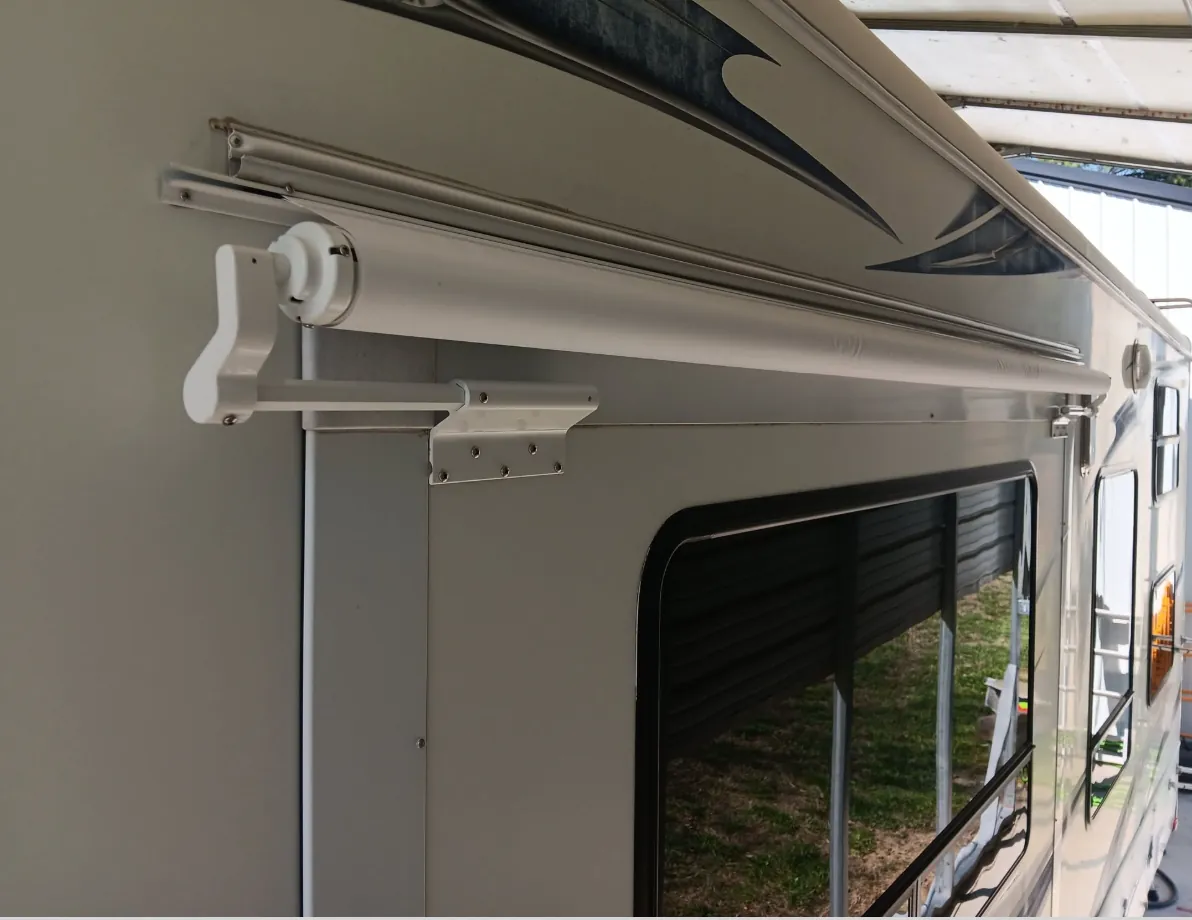
RV Slide Topper Replacement: Pooling and Spring Tension
Slide topper pooling, sagging vinyl or a torn canopy over your slide-out? Mobile spring tension and fabric replacement across Florida. Call 888-759-1438.
"There is a pond sitting on the awning over my bedroom slide" is how most slide topper calls start. A topper holds water when its spring has lost winds or the vinyl has stretched, and the weight of that pool is what tears fabric and bows the roll tube. The fix is often a tension adjustment back to a specified wind count rather than new fabric.
Why Water Pools on a Slide Topper Instead of Running Off
A slide topper is a spring-loaded vinyl canopy fixed to the sidewall above the slide-out room. It has no support arms and no pitch adjustment, so tension in the roll tube is the only thing holding the fabric at a slope steep enough to shed rain off the outboard edge. When the spring loses winds or the vinyl stretches, that slope flattens and a flat panel becomes a basin. Water weighs roughly eight pounds per gallon, so a shallow pool a few feet across loads the middle of the canopy with fifty pounds or more, carried by one seam and a thin aluminum tube. Carefree of Colorado addresses this in its own Slideout Cover service manual: retract the room in eight to twelve inch steps to dump standing water, and during rain close the room in six to eight inch increments, specifically to stop the fabric stretching or distorting. Stretch accumulates, and it never comes back out.
A Topper Is a Debris Shield, Not a Small Patio Awning
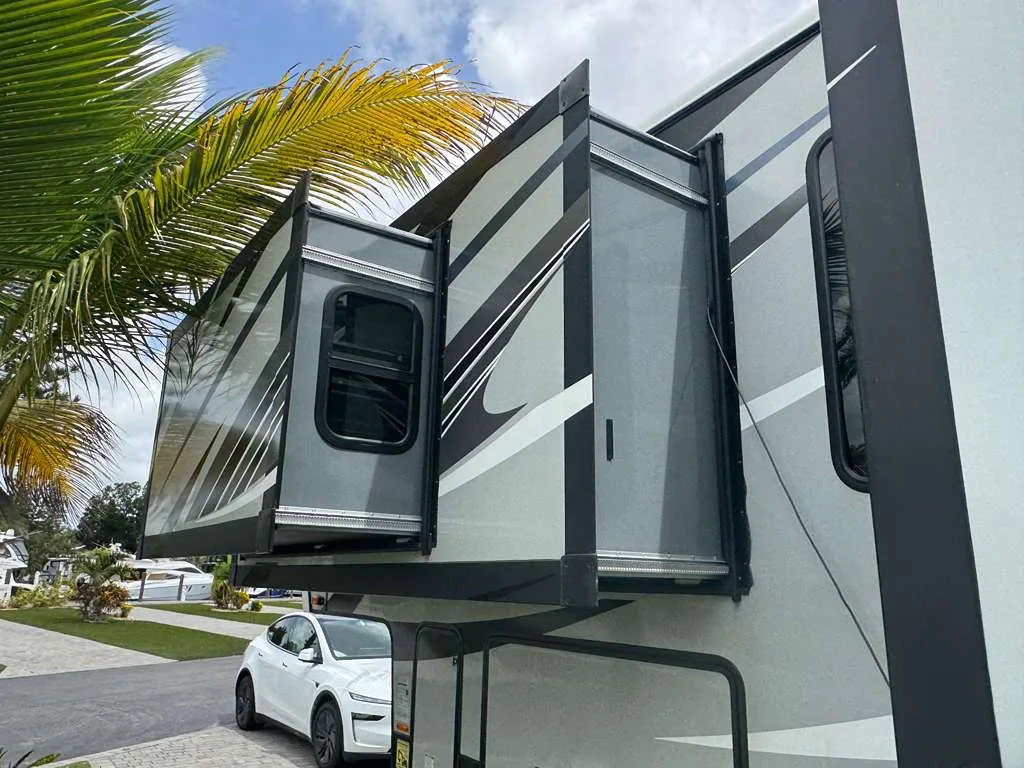
The two products look alike and fail for completely different reasons. A patio awning is deployed when you want shade and rolled away when you do not, while a slide topper is permanently attached to the slide-out and extends and retracts with the room, which Lippert states in the Solera 1000 Series owner's manual. Its stated job is keeping the slide roof clear of dirt, leaves and debris so none of it rides back into the wall opening when the room comes in. There are no arms, no pitch control and no wind sensor. One pre-wound spring in a single end of the roll tube does all the work, and on the Carefree Slideout Cover that spring sits in the right hand end, paired with an automatic anti-billow lock and striker plate that hold the vinyl flat during travel. Nothing in that assembly forgives slack.
What Gets Checked on a Sagging Topper, and In What Order
Diagnosis starts at the fabric and works inward, because the cheapest finding sits at the end of the list. First the canopy itself: a stretched, chalky or seam-split panel is past adjusting. Next the spring, checked by pinning each end with a cotter pin and counting the winds the assembly actually holds against the count the manufacturer specifies. Then the hardware Lippert's own troubleshooting table names for a loose canopy, which is the end caps and their 10-32 screws, followed by the bracket screws into the room flange. On toppers sixteen feet and longer the roller support cradle claw and its SLIC pins get pulled and inspected, since a dropped cradle mimics lost tension exactly. Last comes the awning rail track, where rub marks mean trapped debris, and the wiper and bulb seals underneath, which is where a neglected topper leaves its real damage.
Spring Tension Adjustment Versus Replacing the Fabric
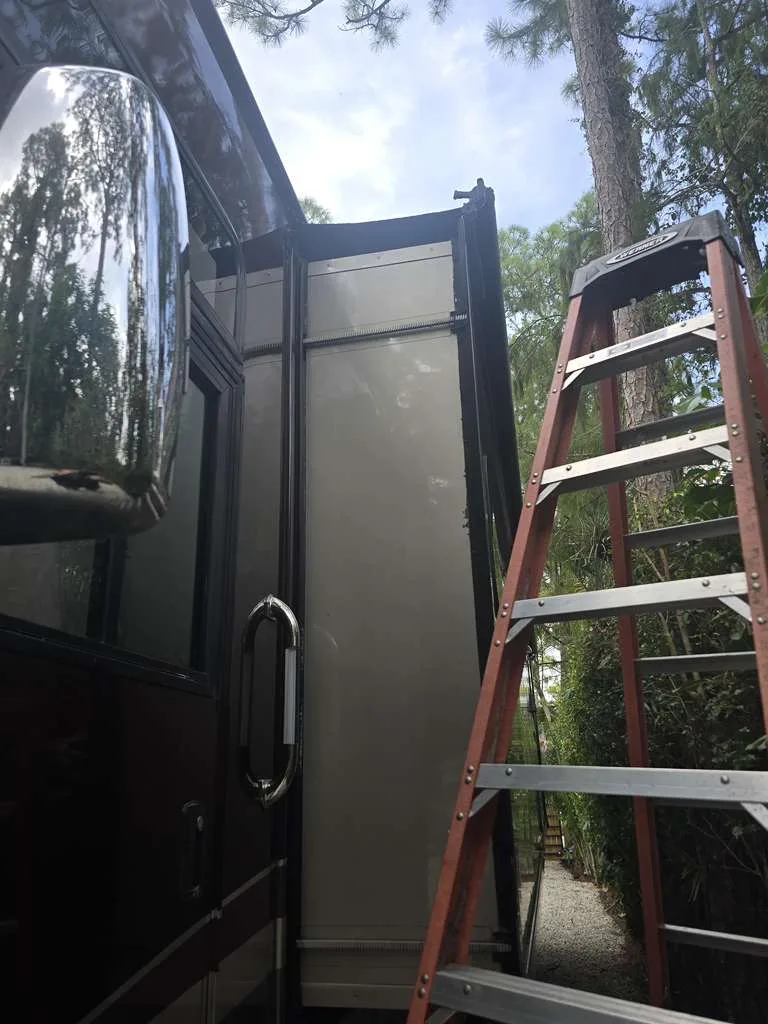
Tension is a number, not a feel, and that is what separates a two hour visit from a canopy order. Lippert technical sheet TI-471 resets a Solera 1000 Series topper with the room open no more than six to eight inches, cotter pins in both ends, the mushroom end cap and its #3 Phillips screws removed, and the hex bar drawn out of the wall plate so the spring can be released and rewound to fourteen winds. Carefree calculates the target from box length instead: eleven winds at forty-seven inches or less, feet plus seven between four feet and thirteen feet eleven, and twenty-one winds from fourteen feet up, added one turn at a time with a 13/16 box wrench. Fabric only gets ordered when it is torn, permanently stretched or chalked through, and it seats with a polycord and a #10 by 2 screw torqued to sixteen inch-pounds.
What the Topper Protects, and Why Skipping It Costs More
A topper is cheap insurance on two expensive parts: the slide seal and the slide floor. A canopy that sags lets pine needles, oak litter and small branches settle in the low spot, and when the room retracts that debris rides in along the roof of the room and drags across the wiper seal. One stick under a wiper is all it takes to score or hole the seal, and a holed seal puts afternoon rain onto the slide floor, where saturated luan and rot follow. Ultraviolet exposure makes this a faster clock here than up north, because a topper is never rolled away and takes full sun every day of its life.
That is the argument for replacing a tired topper before it fails rather than after. The fabric is the cheap part of this system, and everything it protects - the seal, the room floor and the luan under it - is not.
Sources
Every figure on this page comes from a manufacturer document or a standards body, not from another repair site. Here is where each one comes from.
- Lippert TI-471, Solera 1000 and 5000 Series Slide Topper Tension Adjustment (CCD-0007724)The 1000 Series retension procedure: room open six to eight inches, cotter pins in both ends, mushroom end cap and #3 Phillips screws removed, hex bar out of the wall plate, spring rewound to fourteen winds.
- Lippert Solera 1000 Series Slide Topper Owner's Manual (CCD-0003956)That a topper is permanently attached and moves with the room, that its purpose is keeping slide-outs free of dirt, leaves and debris, the sagging fabric troubleshooting entry pointing to spring tension and end caps, and the roller support cradle claw with SLIC pins on toppers sixteen feet and larger.
- Carefree of Colorado Slideout Cover Service Manual 052559-301The pooling procedure of retracting in eight to twelve inch steps and closing in six to eight inch increments during rain to prevent stretching, the spring winds formula by box length, the 13/16 box wrench method, the sixteen inch-pound polycord screw torque, and the roller tube, spring and plunger kit part breakdown.
- Carefree of Colorado Slideout Cover Installation Manual 052559-001One spring mounted in the right hand end of the roll tube, the automatic anti-billow lock and striker plate holding the fabric during travel, and available box lengths from forty-two to two hundred two inches.
Related repairs
- our Schwintek In Wall Repair service
- Lippert Hydraulic Slide Repair in Florida
- how we handle lippert cable slide repair
Other systems we service
Where we work
Service category
What this usually costs
| Item | Price | What it covers |
|---|---|---|
| Service call | $299 | Includes the trip out to your RV and the first hour on site |
| Work past the first hour | Quoted after diagnosis | We tell you what it will take before we carry on |
| Parts | Quoted per job | Special-order parts may need a deposit before we order them |
| Written estimate | No charge | You approve the estimate before any work starts |
The service call covers the trip out to your RV and the first hour on site. Anything beyond that depends on what we find, and we quote it and get your approval before carrying on.
The price ranges on this page come from our own recent jobs across Florida, not from an industry average. What you pay depends on the rig, the parts it needs and what we find on site, so we give you a written estimate before any work begins and you approve it first.
Frequently asked questions
Do you guys do repair awnings, or does a pooling slide topper have to be replaced?
Both, and the check is quick. If the vinyl is intact and the sag comes from lost spring winds, a tension adjustment to the manufacturer's specified count restores the slope and the topper keeps working. If the panel is torn, split at a seam or permanently stretched from carrying water, tension will not bring it back and the canopy gets replaced. Our technicians make that call on site before anything is ordered.
Do you guys replace awnings on RVs, including the topper over a slide-out?
Yes, slide toppers are replaced on site at your campground, storage lot or driveway anywhere we cover in Florida. A topper swap is measured by box length, not by the old fabric, and the roll tube comes down with the room closed and both ends pinned so the pre-wound spring stays captive. Patio awnings and slide toppers are separate assemblies, so tell us which one is damaged when you call.
Can you get and install an awning part, or do I have to source the fabric myself?
We source and install. Slide topper parts are ordered by assembly rather than off a shelf, and Carefree lists them that way: a roller tube assembly arrives complete with spindle and pre-wound spring, while the right hand spring assembly, the spring sleeve and the plunger kit are separate line items. Bringing the correct part on the first visit is the difference between one trip and three.
Why does water sit on my slide topper when it never used to?
The spring has lost tension, the fabric has stretched, or both. Either way the canopy no longer holds a slope, and the first pool it carries makes the next pool bigger, because stretched vinyl does not shrink back. Standing water on a topper is not cosmetic. It is the load that bows the roll tube and pulls seams apart, so it is worth addressing before the panel itself fails.
What does slide topper work usually cost?
Our service call covers the trip out and the first hour on site at the rate in the pricing table on this page; anything past that first hour is quoted and approved before we carry on. A tension adjustment normally lands inside that first block of labor. A full canopy or roll tube assembly replacement adds parts plus install time. We do not quote a fixed price on a topper nobody has looked at yet.
Can I just leave the slide topper off and save the money?
You can, and plenty of owners do, but you are trading the cheap part for the expensive one. Without a topper every leaf, needle and twig that lands on the slide roof gets pulled into the wall opening across the wiper seal each time the room comes in. That is the wear path that ends in a scored seal, water on the slide floor and eventually rotted subfloor under the room.