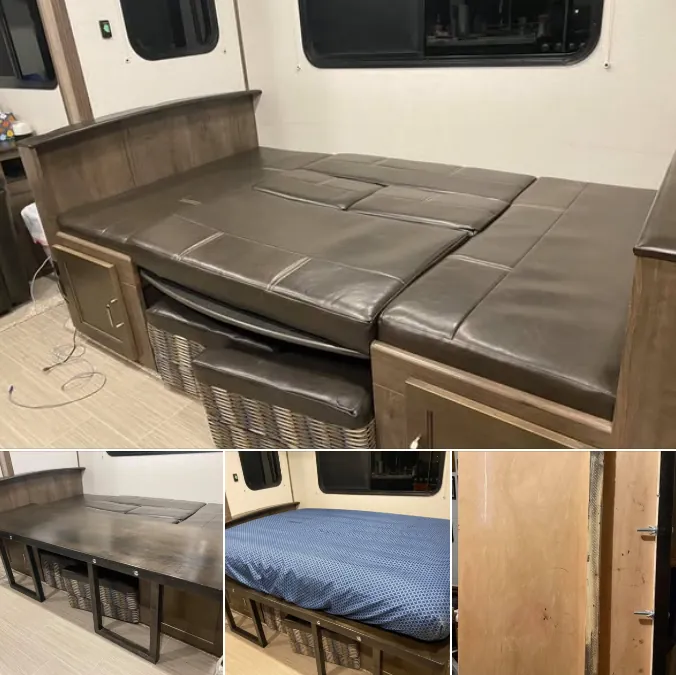
RV Dinette to Bed Conversion, Booth Repair and Replacement
Dinette to bed conversion, booth dinette repair and belted seating checks for Florida coaches. Mobile RV service statewide. Call 888-759-1438.
A dinette is three things at once: a bed mechanism, a storage box, and in many coaches a belted seating position. The first question on any conversion or swap is whether the bench carries factory seat belt anchors, because that makes the job a safety-relevant modification rather than decorating.
Before Anything Else: Does Your Dinette Carry Seat Belts?
A dinette bench with factory belts is not furniture. It is a designated seating position, and the vehicle was certified with it in place. Federal Motor Vehicle Safety Standard No. 210 requires a Type 1 lap belt anchorage to withstand 22,241 N, which is 5,000 pounds of force, and a Type 2 lap and shoulder anchorage to take 13,345 N at the lap portion and 13,345 N at the shoulder portion simultaneously. FMVSS No. 207 covers the seat itself, requiring the structure to hold 20 times the seat mass in kilograms multiplied by 9.8, applied forward and rearward, plus a 373 newton meter moment about the seating reference point. Nothing sold as replacement RV furniture is tested to those numbers. Florida Statute 316.614 exempts the living quarters of a recreational vehicle from the belt usage requirement, so no traffic stop will ever tell you the belts are gone. Look under the bench for anchor plates bolted through the floor before you plan anything.
Pedestal, Latch, Leg and Support Rail: What Actually Converts
Four mechanisms turn a table into a bed, and each one fails its own way. A drop-down unit such as the Lippert Bed/Table Pedestal V2 uses a spring loaded latch on the side of the column: release the latch, guide the top down, and the tabletop becomes the bed base. A variable height pedestal works differently, running two telescoping cylinders on sealed gas struts that adjust from 13 inches to 28 inches, with the top cylinder giving 8 1/2 inches of travel and the bottom cylinder 9 inches. A folding or removable leg carries the outboard corner and depends on a floor socket that road vibration works loose. A support rail, often a wooden ledger screwed to the bench face, catches the table edge once it drops. Sliding designs like the Versa Flex Dinette add a wall guide track and clevis pins at the table guide tracks, and those pins are the first hardware to walk out.
The Table Creeps, Sags or Will Not Latch: What We Check, In Order
Owners describe this three ways: the table will not stay up, it will not drop level, or the bed sags in the middle with two people on it. Check one is the locking collar. On a gas strut pedestal, a table that creeps up or down almost always means the collar handle is not fully closed or the collar has loosened, and the fix is the hand-turned thumbscrew on that collar, not a new pedestal. Check two is the latch and its strike. A spring loaded latch that will not catch usually points to a bent strike or a column that has racked because the base moved under it. Check three is fastener bite. Every screw at the pedestal base, the leg socket, the support rail and the bench cleats gets backed out with a #2 square drive bit and the hole inspected. Check four is the deck. A pinless moisture meter and an awl go into the floor around the base before anything is remounted.
What Each Finding Costs, and What It Becomes If You Leave It

Every figure here is a typical range, not a quote, and no dinette is priced before it has been seen. Our service call covers the trip out and the first hour on site at the rate in the pricing table on this page; anything past that first hour is quoted and approved before we carry on. A loose locking collar or a re-shimmed latch strike often finishes inside that first hour. Rebuilding stripped mounting holes with dowels, epoxy or threaded inserts adds hardware and cure time to the visit. A base that has to come out to reach a wet deck stops being furniture work and gets priced with the floor repair. Left alone, a creeping pedestal cracks the tabletop at its mounting plate, a loose base elongates its screw holes until nothing holds, and a damp deck under that base turns into subfloor replacement.
The Base Is What Fails When the Coach Flexes
The cushion gets blamed and the base is what actually goes. A booth dinette base is usually a plywood or particleboard box screwed to the floor and the sidewall, and it spends every mile fighting the coach twisting underneath it. Correct practice is to land those fasteners in a ceiling-to-floor backer or a framed stud rather than in a thin wall panel. Where a builder skipped that step, #10 screws are biting into lauan, the joint elongates, the box racks, and the seat back begins to lean. This is also the honest limit on swapping a factory dinette for free-standing furniture. A pub table and two chairs remove a belted seating position along with the structure it was anchored to, and nothing bought as loose furniture restores that. Confirm with your coach manufacturer before deleting a seating position the vehicle was built and certified with.
Damp Foam, Mildew and a Dinette Base Over a Slide Floor
Vinyl dinette seating traps whatever gets spilled on it. Foam under a sealed vinyl cover has no path to dry inside a closed coach, and a cushion that never gets lifted holds moisture against a plywood bench top for months at a time. That is where the musty smell in a stored coach usually begins, and it stays a cleaning and cushion problem until the wood beneath it darkens. The version that is a leak is a dinette base sitting on a slide room floor. A slide floor is thinner than the main deck, and water entering over the wiper seal runs to the low edge and sits under the heaviest object in the room. A soft spot felt at the base corner is often the first visible sign of a slide seal that has been passing water all season, which puts the job with slide floor rot and wall stud rot rather than furniture repair.
Sources
Every figure on this page comes from a manufacturer document or a standards body, not from another repair site. Here is where each one comes from.
- Lippert Bed/Table Pedestal V2 Owner's Manual (CCD-0007719)The spring loaded latch that lowers the tabletop into a bed base, and Lippert's statement that the tabletop must be supported underneath and that the weight rating depends on the support structures used by the OEM.
- Lippert Variable Height Table Pedestal Owner's Manual (CCD-0002731)Two telescoping gas strut cylinders adjustable from 13 to 28 inches, and the locking collar thumbscrew adjustment for a pedestal that creeps up or down.
- Lippert Versa Flex Dinette Owner's Manual (CCD-0008902)The sliding dinette wall guide track, table guide tracks and clevis pins, and the maintenance instruction to inspect and tighten fasteners to keep the furniture stable and secure.
- FMVSS No. 207, Seating systems (49 CFR 571.207)The occupant seat strength requirement of 20 times the seat mass in kilograms multiplied by 9.8 applied forward and rearward, the simultaneous seat belt load, and the 373 newton meter moment about the seating reference point.
- FMVSS No. 210, Seat belt assembly anchorages (49 CFR 571.210)Anchorage strength requirements of 22,241 N for a Type 1 lap belt and 13,345 N applied to the lap and shoulder portions simultaneously for a Type 2 assembly.
- Florida Statutes 316.614, Safety Belt UsageFlorida safety belt requirements do not apply to the living quarters of a recreational vehicle, so no usage law protects a deleted belted seating position.
Related repairs
- Theater Seat Recliner Repair in Florida
- how we handle rv countertop replacement
- Day Night Shade Repair repairs
Other systems we service
Where we work
Service category
What this usually costs
| Item | Price | What it covers |
|---|---|---|
| Service call | $299 | Includes the trip out to your RV and the first hour on site |
| Work past the first hour | Quoted after diagnosis | We tell you what it will take before we carry on |
| Parts | Quoted per job | Special-order parts may need a deposit before we order them |
| Written estimate | No charge | You approve the estimate before any work starts |
The service call covers the trip out to your RV and the first hour on site. Anything beyond that depends on what we find, and we quote it and get your approval before carrying on.
The price ranges on this page come from our own recent jobs across Florida, not from an industry average. What you pay depends on the rig, the parts it needs and what we find on site, so we give you a written estimate before any work begins and you approve it first.
Frequently asked questions
How do I tell whether my dinette is belted seating?
Lift the cushions and look under the bench for anchor plates or bolts passing through the floor, and check the bench face and sidewall for retracted belt stalks tucked into the seam. A belted bench was certified as a designated seating position under FMVSS 207 and 210, so it is structure rather than furniture. If you cannot find the anchors and the floor plan suggests belts, ask your coach manufacturer before you modify it.
Can I replace my booth dinette with a free-standing table and chairs?
Physically, yes, and plenty of full-timers do it. The honest catch is that if the booth carried belts, removing it deletes a belted seating position and the anchored structure behind it, and loose furniture cannot replace either. That changes how many people the coach can safely carry in transit, so confirm the swap with your coach manufacturer rather than assuming the seats were decorative.
Why does my table pedestal creep down while we are eating?
On a variable height gas strut pedestal the cylinder is held by a locking collar, and creep means that collar is not gripping. Check that the handle is fully closed first. If it is, hand-tighten the thumbscrew on the collar to pull its edges closer together, leaving a small gap, then confirm the handle still closes easily. Excess weight on the table produces the same symptom.
How much weight will a converted dinette bed hold?
There is no published rating from the mechanism maker. Lippert's Bed/Table Pedestal V2 owner's manual states that the tabletop must be supported underneath before a mattress goes on it, and that the weight rating depends on the support structures used by the OEM. The real limit is set by the coach builder's filler boards and bench ledgers, which is why these beds sag at the center seam first.
The dinette cushions smell musty after summer storage. Is that a leak?
Usually not. Sealed vinyl seating over closed bench tops holds condensation and spills against the foam, and a cushion left flat all summer never dries out. Lift every cushion, check the bench top for dark staining, and probe the deck at the base corners. Staining or a soft corner moves it from a cushion problem to a moisture problem worth surveying properly.