RV Residential Refrigerator Conversion: Power, Framing, Cost
Converting an RV absorption fridge to a residential or 12V compressor unit takes inverter, battery and cabinet work. Honest repair-or-convert advice: 888-759-1438
Swapping an RV absorption refrigerator for a residential or 12V compressor unit is an electrical project, not an appliance swap. The fork is simple. If the sealed cooling unit is intact and only a board or thermistor failed, repair is far cheaper and keeps propane operation. If the sealed unit has leaked, converting buys reliable cooling in heat, but it demands inverter capacity, a lithium bank, and a reframed cabinet opening.
Repair the absorption unit or convert? What actually decides it
Owners describe the same symptom before they ever call it a conversion question. The freezer still holds, the fresh food side climbs toward 50F by mid afternoon, and the box recovers by morning. That pattern points at the sealed cooling unit or at blocked airflow, not at the electronics. The fork is cost against capability. A Dometic power board, an eyebrow board or a thermistor is a parts and labor repair, and it leaves propane operation intact. A vented Norcold or Dometic cooling unit is finished as an absorption appliance, because the ammonia and sodium chromate charge cannot be recovered in the field. Converting is the honest call when the sealed system is dead, the coach can carry a lithium bank, and the owner camps mostly on shore power or solar. Repairing is the honest call when the rig has two flooded batteries, no inverter, and a boondocking habit.
What a residential refrigerator actually draws in amp-hours
Daily energy, not peak watts, is what sinks these projects. A residential refrigerator sized for a coach uses roughly 1.0 to 1.5 kilowatt-hours a day. Pulled from a 12 volt bank through an inverter at about 88 percent efficiency, that lands near 100 to 140 amp-hours every 24 hours, before lights, the water pump or a CPAP. A purpose-built 12 volt compressor unit is kinder because it skips the inverter entirely. It pulls 8 to 9 amps on pulldown and 2.5 to 3 amps holding, which averages near 70 amp-hours a day in mild conditions. Sustained 90F ambient inside a closed coach pushes duty cycle up, and 90 to 110 amp-hours a day is the number to plan around in a Florida summer rather than the brochure figure.
Inverter sizing, compressor surge, and the idle draw nobody budgets
A 120 volt residential fridge runs on 100 to 150 watts, so owners assume a small inverter will do. Locked rotor surge at compressor start is several times running load, and that is the number that sizes the unit. Victron rates the Phoenix 12/1200 VE.Direct at 1000 watts continuous at 25C with 2200 watts peak, while the 12/800 gives 650 watts continuous and 1500 watts peak. That continuous figure falls to 850 watts at 40C and derates a further 1.25 percent per degree above that, so a bay install in Florida gets sized on the hot rating. The idle draw is the line nobody budgets, because the same inverter burns 10 watts switched on and doing nothing, close to 19 amp-hours a day off a 12 volt bank before the fridge cycles once. Pure sine output is required, not modified sine, because inverter-driven compressors and their control boards misread a chopped waveform. ECO mode is unusable here as well, since the fridge electronics drop below the standby threshold whenever the compressor cycles off.
Why lead-acid usually cannot carry it and LiFePO4 can

Two flooded group 27 batteries give roughly 180 amp-hours nominal and only about half of that usable before sulfation damage begins. A 110 amp-hour daily fridge load eats the entire usable reserve inside one night, and Peukert losses at real discharge rates shave the number further. Voltage sag is the second problem. A tired flooded bank sinks toward the 9.3 volt DC low shutdown of the Victron Phoenix VE.Direct family, and the fridge shuts off before the bank is truly empty. LiFePO4 stays far flatter, still near 13.2 volts under load, and accepts high recharge current, so one generator hour or a good solar day genuinely refills it. The converter, charge controller and alternator path all have to be made lithium-aware first, because a lead-acid profile will neither fill the cells nor use the charge current they will take.
The cabinet opening almost never matches the new refrigerator
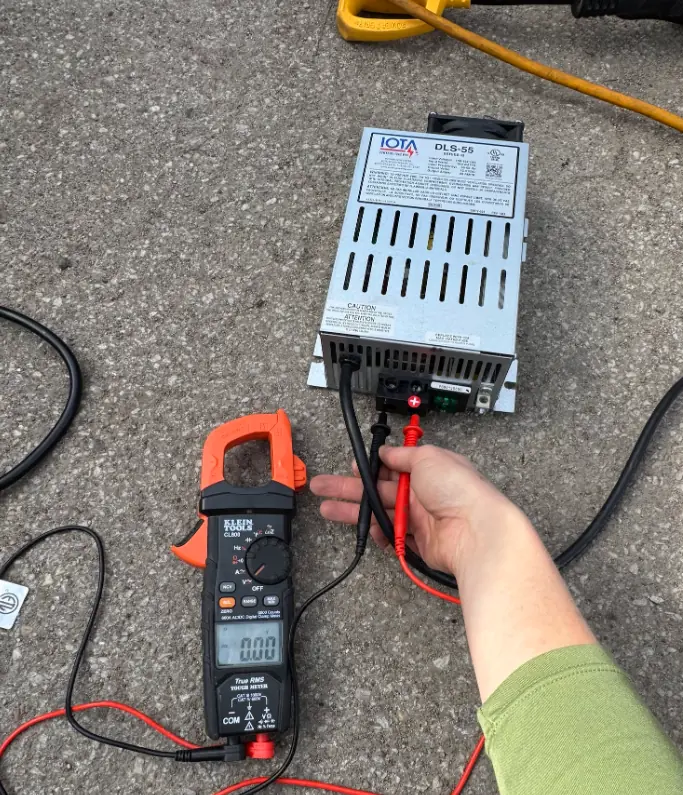
Absorption cutouts were framed around a chimney, not a compressor. The bay one leaves behind is nothing like the 23.5 by 59.75 by 25.75 inch envelope of a 10.7 cubic foot 12 volt Everchill, which also weighs 119 pounds empty. So the face frame gets rebuilt in 3/4 inch plywood or poplar, cleats get added on both sides, and the floor under the unit gets reinforced rather than trusting a single layer of lauan over foam. The old upper roof vent and lower sidewall vent become open holes. Both must be closed properly, the roof cutout patched and resealed with self-leveling lap sealant, or a conversion turns into a water damage claim. An oscillating multi-tool, a track saw, a digital angle finder and a Klein CL800 clamp meter cover most of the fitting and verification work.
Bracing it for travel and giving up propane for good
Household refrigerators are engineered to sit still on a level kitchen floor. In a coach the unit needs a plywood surround, screwed L-brackets or a strap across the front, positive door latches rather than magnetic seals alone, and shelf and drawer restraints so nothing shifts on a Florida interstate expansion joint. Compressor feet belong on a solid platform, because a flexing subfloor transmits vibration into the mounting and eventually into the refrigerant lines. The larger loss is propane. An absorption fridge held setpoint on a 20 pound tank for days with essentially no battery draw at all, and that capability disappears completely at conversion. After the swap a flat battery bank means a warm refrigerator within hours. For anyone who dry camps without solar, that single tradeoff outweighs every advantage a compressor unit has.
What gets checked before we quote, in order, and what it becomes
First our technicians confirm the absorption unit is genuinely dead rather than merely struggling. Thermistor resistance should read roughly 7,000 to 10,000 ohms at 77F, the 120 volt heating element near 44 ohms, and an infrared thermometer on the boiler tells whether heat is being made at all. Yellow residue or an ammonia smell at the boiler confirms a vented sealed system. Next comes the cabinet opening, the vent cutouts, the existing inverter and battery bank measured under load, the converter model and the floor structure. Left alone, a leaking unit never recovers, and a box drifting to 50F is a food safety problem well before it is a repair decision.
The two questions worth answering before any of that is how long the coach sits between trips and whether it spends that time on shore power. A residential box is an easy win on a coach that is always plugged in and a recurring problem on one that is not.
Sources
Every figure on this page comes from a manufacturer document or a standards body, not from another repair site. Here is where each one comes from.
- Victron Energy - Phoenix Inverter VE.Direct 250VA to 1600VA datasheetContinuous power 1000W at 25C and 850W at 40C for the 12/1200, 2200W peak, 10W zero-load draw, 1.25 percent per degree derate above 40C, and the 9.3V DC low shutdown.
- Furrion - Everchill 10.7 cu. ft. 12V RV refrigerator product specificationsPublished cabinet dimensions of 23.5 inches wide by 59.75 inches high by 25.75 inches deep and 119 pound weight, used to show why an absorption cutout rarely matches.
- Lippert Components - Everchill refrigerator manuals and service documentationManufacturer install guides, spec sheets and troubleshooting documents for the 12 volt Everchill models referenced on this page.
Related repairs
- Rv Icemaker Water Line in Florida
- how we handle rv convection microwave swap
- Rv Washer Dryer Install repairs
Other systems we service
Where we work
Service category
What this usually costs
| Item | Price | What it covers |
|---|---|---|
| Service call | $299 | Includes the trip out to your RV and the first hour on site |
| Work past the first hour | Quoted after diagnosis | We tell you what it will take before we carry on |
| Parts | Quoted per job | Special-order parts may need a deposit before we order them |
| Written estimate | No charge | You approve the estimate before any work starts |
The service call covers the trip out to your RV and the first hour on site. Anything beyond that depends on what we find, and we quote it and get your approval before carrying on.
The price ranges on this page come from our own recent jobs across Florida, not from an industry average. What you pay depends on the rig, the parts it needs and what we find on site, so we give you a written estimate before any work begins and you approve it first.
Frequently asked questions
RV fridge or residential?
It depends on how you camp. If you stay on shore power or run solar with a lithium bank, a 12 volt compressor or residential unit cools better and faster in Florida heat and never needs leveling. If you dry camp without solar, keep absorption, because it holds setpoint on propane for days with almost no battery draw. Cost matters too, since repairing a board or thermistor is far cheaper than a conversion.
Can I run a residential refrigerator on my existing two batteries?
Almost never. Two flooded group 27 batteries offer about 90 usable amp-hours, and a residential fridge through an inverter needs 100 to 140 amp-hours a day on its own. You would flatten the bank before morning and damage it doing so. A realistic conversion pairs at least 200 amp-hours of LiFePO4 with a pure sine inverter, and usually solar or a generator to put the energy back.
Do I lose propane operation completely?
Yes, entirely. A compressor refrigerator has no burner, no flue and no LP valve, so the propane leg of the appliance is gone for good. That is the real cost of conversion and it is permanent. Some owners keep a small absorption or 12 volt portable cooler for boondocking trips instead. If propane cooling is the reason you bought the coach, repair the absorption unit rather than converting it.
Can you repair an RV absorption fridge that won't cool?
Often yes. A no-cool complaint is frequently a thermistor, a power board, an eyebrow board, a failed 120 volt element or a gas supply fault rather than a dead cooling unit, and all of those are repairable on site. The sealed cooling unit itself is the one part that cannot be fixed in the field. Diagnosis separates them, and the first hour is usually included in the service call.
How long does a residential fridge conversion take?
Plan on two visits, not one afternoon. The electrical side, meaning battery bank, inverter, dedicated circuit and fusing, is its own job. The carpentry side, meaning removing the old unit, sealing the roof and sidewall vents, reframing the opening and building travel bracing, is another. Coaches that already have a lithium bank and an adequate inverter go much faster, because only the cabinet work remains.