
RV Pre-Trip Safety Inspection: Weight, Hitch and Load Check
Mobile pre-trip RV safety inspection in Florida. Weight ratings, hitch and restraint checks, systems verified in travel mode. Call 888-759-1438 to book.
A pre-trip RV safety inspection settles one fork: what has to be repaired before you pull out of the driveway, and what can safely wait until you are back. The deciding question is how a fault behaves at 65 mph. A loose awning arm or an undersized safety chain becomes a highway event, while a slow drip stays a slow drip. The inspection sorts one list from the other and prices both.
Repair Before Departure or Wait: What Decides It
A pre-trip safety inspection is a departure audit of a rig that is about to be loaded, hitched and driven. It is not an evaluation of whether the coach is worth buying, which is the job of a pre-purchase inspection and a different scope entirely. A buyer's inspection asks what the RV is worth. A pre-trip inspection asks what the next 400 miles will do to it. The sorting rule is failure behavior at speed. Anything that can detach, swing open, drag or unlatch gets fixed before departure, because the repair is trivial next to the consequence. Anything that seeps, runs inefficiently or simply looks tired gets documented and scheduled for later. A typical inspection ends with a short must-fix list and a longer watch list, and the owner leaves knowing which item sits on which.
The Weight Numbers Most Owners Have Never Measured

Weight is the part of a pre-trip inspection owners skip, and the part that most often turns out to be wrong. Four ratings govern a towable. GVWR is the maximum the trailer may weigh loaded, GAWR is the ceiling for each individual axle, GCWR caps tow vehicle and trailer together, and payload is what remains after curb weight comes off the GVWR. Ram's towing reference puts trailer tongue weight between 10 and 15 percent of the loaded trailer weight, and fifth-wheel king pin weight at roughly 25 percent of gross trailer weight. Those percentages are why a rig that passes on total weight can still be dangerously light on the hitch, which is what starts a sway event. The only way to know real numbers is a loaded pass over a CAT Scale, axle by axle, with fresh water, propane and gear aboard. Most owners have weighed their RV empty, or at the dealer, or never at all.
The Departure Walk-Around, in the Order a Failure Costs You
The walk-around runs highest consequence first, which means anything that can leave the vehicle at highway speed. Start at the roof line. A Winegard Sensar IV antenna, model RVW-395, has to be cranked to its 4-inch stowed travel height, and Winegard specifies 16 inches of clearance from the boom to the nearest object. Next come the awning arms and travel locks on a Lippert Solera or comparable unit, then the entry step, then every cargo door, the battery bay and the shore power hatch. The hitch is last in sequence and first in importance. Florida Statute 316.530 requires safety chains or cables strong enough to hold the trailer to the tow vehicle under all conditions, crossed beneath the coupler by convention so a dropped tongue lands in the chains instead of on pavement. Florida Statute 316.520 makes it the driver's duty to prevent any part of a load from shifting or escaping.
Systems Checked in Travel Configuration, Not Parked
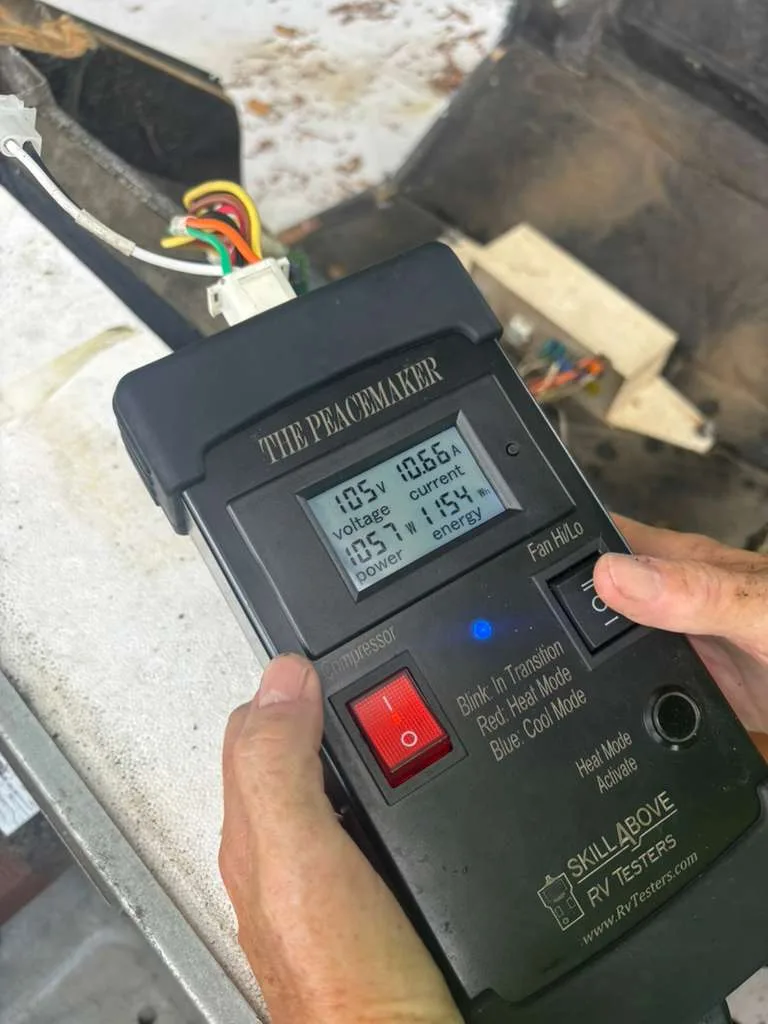
Most RV inspections happen with the coach set up: slides out, jacks down, shore power connected. A pre-trip inspection has to run the other way, because the faults that strand people only show themselves in travel configuration. Slides go fully in and the wiper seals get checked for a rolled or folded lip, which is what lets water track down an interior wall during four hours of rain on I-95. Leveling jacks retract to the stowed position and the sensors are confirmed, because a jack that reports up while sitting an inch proud will find the first steep driveway apron. The house battery is read in the same pass, since a fully charged 12 volt bank should sit near 12.6 volts at rest on a multimeter. LP is shut at the tank, the regulator vent checked, and the refrigerator moved to 12-volt or off before the first fuel stop.
What the Inspection Reports and What Apex Does Not Repair
An inspection is only honest if it says plainly where it stops. Apex does not replace, balance or rotate tires, and Apex does not perform chassis, axle or brake repair. Those conditions are still examined and written into the report: DOT date codes and age, sidewall cracking, uneven wear that points at an axle or alignment problem, and a dated recommendation to visit a truck or tire shop before departure. Reporting a condition and repairing it are two different services, and blurring them is how an owner ends up surprised on the shoulder of I-75. What our technicians fix on the spot is the coach itself: awning arms and travel locks, slide seals and slide operation, leveling jacks and sensors, LP regulators and detectors, 12-volt wiring, the converter, and roof penetrations that will admit water in the first afternoon storm.
Sources
Every figure on this page comes from a manufacturer document or a standards body, not from another repair site. Here is where each one comes from.
- Ram Trucks - Towing Basics (Body Builder Guide)Definitions of GVWR, GAWR and GCWR, plus trailer tongue weight of 10 to 15 percent of trailer load and fifth-wheel king pin weight at about 25 percent of gross trailer weight.
- Florida Statutes 316.530 - Towing requirementsFlorida requires safety chains or cables of sufficient strength between trailer and tow vehicle, and exempts hitches known as a fifth wheel from that subsection.
- Florida Statutes 316.520 - Loads on vehiclesFlorida places the duty on owner and driver to prevent any part of a load from dropping, shifting or escaping from a vehicle on a public highway.
- Winegard Sensar IV RV antenna (RVW-395)The Sensar IV lowers to 4 inches above the roof for travel and requires 16 inches of clearance from the boom to the nearest object.
- National Weather Service - Wind safetySustained winds of 40 to 50 mph are enough for isolated wind damage, the crosswind threshold that matters to a high-sidewall RV.
Related repairs
- Rv Insurance Damage Appraisal in Florida
- how we handle rv warranty claim documentation
- Post Hurricane Rv Assessment repairs
Other systems we service
Where we work
Service category
What this usually costs
| Item | Price | What it covers |
|---|---|---|
| Service call | $299 | Includes the trip out to your RV and the first hour on site |
| Work past the first hour | Quoted after diagnosis | We tell you what it will take before we carry on |
| Parts | Quoted per job | Special-order parts may need a deposit before we order them |
| Written estimate | No charge | You approve the estimate before any work starts |
The service call covers the trip out to your RV and the first hour on site. Anything beyond that depends on what we find, and we quote it and get your approval before carrying on.
The price ranges on this page come from our own recent jobs across Florida, not from an industry average. What you pay depends on the rig, the parts it needs and what we find on site, so we give you a written estimate before any work begins and you approve it first.
Frequently asked questions
How much does a pre-trip RV safety inspection cost, and how long does it take?
Our service call covers the trip out and the first hour on site at the rate in the pricing table on this page; anything past that first hour is quoted and approved before we carry on. No fixed repair price gets quoted on a rig nobody has seen yet. Inspections happen at your storage lot, driveway or campground.
Is a pre-trip inspection the same thing as a certified RV inspection?
No. Callers asking for a certified RV inspection usually want the formal pre-purchase product, which follows a published standards-of-practice checklist and produces a long report for a buyer or a lender. A pre-trip safety inspection is a departure check on a coach you already own, scoped to what can fail between here and your destination. Different question, different report, much shorter turnaround.
Do you check tires and brakes during a pre-trip inspection?
They get inspected and reported, not serviced. Apex does not replace, balance or rotate tires, and Apex does not repair brakes or chassis components. What you receive is a written finding: DOT date code and age, sidewall and tread condition, wear pattern, and whether it should be handled before you leave. You take that report to a tire or truck shop, which is an honest division of labor rather than a silent gap in the report.
My rig has been parked since April. What changes after a long sit?
A seasonal rig fails differently than a hard-used one. Six months of Florida heat hardens slide wiper seals and awning fabric, dries the LP regulator diaphragm, and lets wasps build in furnace and refrigerator intakes. Batteries sulfate, the water heater anode dissolves, and roof lap sealant cracks where it was already thin. A pre-trip inspection on a rig that has idled since spring spends most of its time on seals, LP and 12-volt, not on mechanical wear.
What do I check if I have to evacuate for a hurricane with no time?
Prioritize restraint over comfort. Hitch coupler latched and pinned, safety chains connected, breakaway cable attached, antenna cranked down, awning arms locked, every cargo door and the battery bay latched, jacks up and slides in. Skip filling the fresh tank to save weight and margin. The National Weather Service notes sustained winds of 40 to 50 mph are already enough for isolated wind damage, and a tall sidewall feels that first on a causeway.
Can a pre-trip inspection be used to support an RV warranty claim?
It can start one, but it is not built for it. A pre-trip report documents condition and date, which is useful evidence, though a warranty claim needs failure-specific photos, part numbers and language matched to the manufacturer's coverage terms. That is a separate warranty claim documentation service. If a pre-trip inspection turns up something that looks like a covered defect, say so and it can be re-documented properly before you file.